• In Mixed Company: Multiracial academics, advocates and artists gather for Hapa Japan Conference

    Nichi Bei: A mixed plate of Japanese American News & Culture
    2011-05-26

    Alec Yoshio MacDonald, Nichi Bei Weekly Contributor

    As a graduate student in UCLA’s psychology department during the late 1970s, Christine Iijima Hall absorbed scathing criticism about her dissertation. Fellow academics dismissed her project as “a ridiculous piece of research,” she said, and newspapers declined to publicize her need for study participants based on the belief that she was covering a “stupid topic.” Few people, apparently, saw any worth in exploring the identity formation of individuals from mixed black and Japanese backgrounds.
     
    Coming from such a background herself, Hall remained undeterred in pursuing the subject. In part, she was motivated to counteract existing literature that painted a disturbing portrait of those like her—in essence, that “we were insane, that there was something wrong with us, we never knew what we wanted, and we killed ourselves.” The studies that yielded these alarming conclusions were flawed, she explained, because they tended to focus on institutionalized patients instead of average folks. By delving into the everyday mixed race experience, she knew she could reveal a more compelling story deserving of attention.
     
    In her effort to reframe an issue so widely ignored and narrowly interpreted, Hall ended up producing one of the pioneering works of an emerging discipline. At that time “‘multiracial’ was not a word yet,” she recalled, but thanks in no small measure to her perseverance, the field of multiracial studies exists today.

    Scholars in the field recently had the chance to reflect on the past, present and future of their discipline when they came together April 8 and 9 for the Hapa Japan Conference. Held primarily on the campus of UC Berkeley and hosted by the university’s Center for Japanese Studies, it showcased a range of both foundational and current projects concerning multiraciality. As Hall pointed out while revisiting her dissertation for a session called “A Changing Japanese-American Community,” the conference also served as “a reunion for many of us who have done mixed race research.”…

    Read the entire article here.

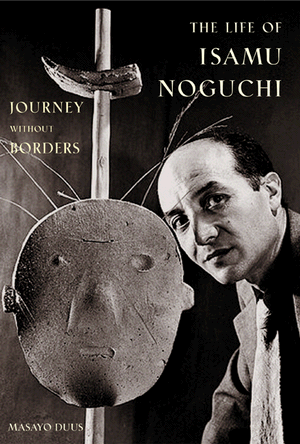
  • The Life of Isamu Noguchi: Journey without Borders

    Princeton University Press
    2004
    440 pages
    6 x 9
    36 halftones
    Paper ISBN: 9780691127828

    Masayo Duus
    Translated by Peter Duus

    • 2005 Non-fiction Finalist for the Kiriyama Prize, Pacific Rim Voices
    • One of Choice’s Outstanding Academic Titles for 2005

    Isamu Noguchi, born in Los Angeles as the illegitimate son of an American mother and a Japanese poet father, was one of the most prolific yet enigmatic figures in the history of twentieth-century American art. Throughout his life, Noguchi (1904-1988) grappled with the ambiguity of his identity as an artist caught up in two cultures.

    His personal struggles—as well as his many personal triumphs—are vividly chronicled in The Life of Isamu Noguchi, the first full-length biography of this remarkable artist. Published in connection with the centennial of the artist’s birth, the book draws on Noguchi’s letters, his reminiscences, and interviews with his friends and colleagues to cast new light on his youth, his creativity, and his relationships.

    During his sixty-year career, there was hardly a genre that Noguchi failed to explore. He produced more than 2,500 works of sculpture, designed furniture, lamps, and stage sets, created dramatic public gardens all over the world, and pioneered the development of environmental art. After studying in Paris, where he befriended Alexander Calder and worked as an assistant to Constantin Brancusi, he became an ardent advocate for abstract sculpture.

    Noguchi’s private life was no less passionate than his artistic career. The book describes his romances with many women, among them the dancer Ruth Page, the painter Frida Kahlo, and the writer Anaïs Nin.

    Despite his fame, Noguchi always felt himself an outsider. “With my double nationality and my double upbringing, where was my home?” he once wrote. “Where were my affections? Where my identity?” Never entirely comfortable in the New York art world, he inevitably returned to his father’s homeland, where he had spent a troubled childhood. This prize-winning biography, first published in Japanese, traces Isamu Noguchi’s lifelong journey across these artistic and cultural borders in search of his personal identity.

    Table of Contents

    • Prologue
    • Chapter One: Yone and Leonie
    • Chapter Two: His Mother’s Child
    • Chapter Three: All-American Boy
    • Chapter Four: Journey of Self-Discovery
    • Chapter Five: Becoming a Nisei
    • Chapter Six: The Song of a Small
    • Chapter Seven: Honeymoon with Japan
    • Chapter Eight: The World of Dreams
    • Chapter Nine: The Universe in a Garden
    • Chapter Ten: Encounter with a Stonecutter
    • Chapter Eleven: Farewell to s Dreamer
    • Epilogue
    • Notes
    • Bibliography
    • Acknowledgments
    • Index
    • Photgraphy Credits
  • Honors 301: Mixed Race Art and Identity

    DePaul University, Chicago, Illinois
    Autumn Quarter 2011-2012

    Laura Kina, Associate Professor Art, Media, & Design

    Mixed Race Art & Identity will focus on contemporary art and popular culture to critically examine images of miscegenation and mixed race and post-ethnoracial identity constructs. Students will learn about the history and emergence of the multiracial movement in the United States from the 1967 Loving v. Virginia Supreme Court Case, which overturned our nation’s last anti-miscegenation law; to the emergence of the multiracial movement in the 1990s leading up to the 2000 U.S. Census, which for the first time allowed multiracial individuals to self-identify as more than one race; to the ways in which discussions of race have unfolded following the 2008 election of President Obama and the results of the 2010 Census.  Through the vehicle of art and cultural studies, students will reflect upon our present moment and the increasingly ethnically ambiguous generation that is coming of age. This seminar course is designed to be interactive and will include: class discussions, leading or co-leading a reading, online reflection posts on readings, viewing films, art lectures, a visiting artist talk, a mid-term paper, and a final creative group curatorial project.

    Course Books/Readings and Research Resources

    Required Text Books (Available through the University Bookstore and on reserve at the LPC library. We will read select chapters from these two books.)

    Required E-reserve and/or Online Readings (Available through library.depaul.edu or through the course blackboard site, Mixedheritagecenter.org (MHC), or online.)

    Research and selections from original artist interviews with contemporary artists from the forthcoming book “War Baby/ Love Child: Mixed Race Asian American Art” edited by Laura Kina and Wei Ming Dariotis (University of Washington Press, 2013) and related exhibition co-curated by Kina and Dariotis (DePaul University Art Museum April 26 – June 30, 2013, Chicago, IL and Wing Luke Museum of the Asian Pacific American Experience August 9, 2013 – January 19, 2014, Seattle, WA. ) The artists covered include: Mequita Ahuja, Albert Chong, Serene Ford, Kip Fulbeck, Stuart Gaffney, Louie Gong, Jane Jin Kaisen, Lori Kay, Li-lan, Richard Lou, Laurel Nakadate, Samia Mirza, Chris Naka, Gina Osterloh, Adrienne Pao, Cristina Lei Rodriguez, Amanda Ross-Ho, Debra Yepa-Pappan, and Jenifer Wofford.

    Film, Video, TV, and Radio

    Supplemental E-reserve and Reserve Readings are also available through the LPC Library

  • ‘Non-racialism’ in the struggle against apartheid

    South African Review of Sociology (originally Society in Transition)
    Volume 34, Issue 1 (2003)
    pages 13-37
    DOI: 10.1080/21528586.2003.10419082

    Gerhard Maré, Professor of Sociology
    University of KwaZulu-Natal, Durban

    This article examines the movement of South African society from a racialised past to a racialised present. It argues that an important opportunity, arising out of the transitional conjuncture, seriously to come to grips with the racist and racialised categories of apartheid, is rapidly being lost. Racism and a racially-ordered system is founded on the soft bed(rock) of race-thinking, and continues to draw on the banal perpetuation of notions of race in everyday life, as well as in political practice in a democratic South Africa. The author proposes that the undoubted commitment of the African National Congress to ‘non-racialism’ has remained unrealisable because there was no serious theoretical investigation of the status of race categories, either how they operated within apartheid South Africa or within the struggle for democracy itself. For this reason, it seems clear that the ANC’s ‘non-racialism’ more appropriately should be read as ‘non-racism’, as the notion of the existence of ‘races’ as socially meaningful categories have remained pivotal political categories and continue to operate as everyday common sense.

    …In this paper I focus on the commitment to ‘non-racialism’ by the ANC, a commitment called the ‘unbreakable thread’ of decades of struggle against white domination (Frederikse 1990), and note some other positions and organisations. I will, in effect, take issue with the application of the term ‘non-racialism’ to describe the position of the ANC, which is much more accurately termed multi-racialism, despite Tambo’s rejection of such an interpretation. In conclusion I will suggest some of the implications of such misuse, most importantly that it cannot be the basis for ‘the primary goal [of] a completely restructured society’ (Frederikse, 1990:3-4).

    Race thinking is embedded in our everyday thinking. It is located in racialised social identities, lived through what has been variously referred to as ‘stories of everyday life’(Wright, 1985:15; Heller, 1982), the ‘minutiae of everyday existence’ (Comaroff, 1996:166), the ‘banality’ of living within the ‘assumptions and common-sense habits’ (Billig, 1995:37) of a society permeated with race thinking. Such racialism will have to be disembedded from there, through deliberate social practice, institutional and legal change, and finding ways of subverting, rather than corroborating, daily experience and racialised ways of making sense. We continue to operate with race as a collective identity, and as the articulating and organising principle for other identities and/or moments when we draw on an array of alternate identities. Non-racialism remains without content if it continues to be a largely unexamined rhetorical commitment to an ideal.

    At the same time, however, it is necessary immediately to note that my argument does not deny, in any way, the extreme dehumanisation and domination suffered under the system of apartheid, or under any racist system. Nor does it deny, as should be clear, that race thinking is located in real social conditions, and effectively makes sense of the way in which people have experienced, and continue to experience, that social reality, within a changing pattern of domination. It does not explore, here, the various ways in which race thinking serves, at times justificatory, exploitative, and other purposes. On the contrary, my argument depends on recognising the strength of pervasive racialisms, and demands and forms the basis for investigating racism. I will return to this point…

    Read the entire article here.

  • Missed Opportunities and the Problem of Mohawk Chief John Norton’s Cherokee Ancestry

    Ethnohistory
    Volume 59, Number 2 (Spring 2012)
    pages 261-291
    DOI: 10.1215/00141801-1536885

    Carl Benn, Professor of History
    Ryerson University

    John Norton (1770–1831?) was one of the most important Iroquois leaders in the late eighteenth and early nineteenth centuries and the author of a thousand-page manuscript on First Nations history, a journey he made to the Cherokee country, and his adventures in the War of 1812. However, that text and his other writings have received comparatively little attention from scholars despite the rich opportunities these documents hold for exploring the indigenous world of his day. Much of the neglect stems from a reluctance to accept him as a “real” native person because he was born in Scotland and was an adopted Mohawk and because people have doubted his claim that his father was a Cherokee. This article clarifies Norton’s claim to a Cherokee connection and concludes that the evidence overwhelmingly supports the probability that his father was a Cherokee; thus it invites scholars to look at Norton’s work anew in their quest to understand the First Nations world of the latter 1700s and early 1800s.

    Read or purchase the article here.

  • The Politics of Loving Blackness in the UK

    University of Birmingham
    March 2010
    336 pages

    Lisa Amanda Palmer

    A thesis submitted to The University of Birmingham For the degree of DOCTOR OF PHILOSOPHY (Department of American and Canadian Studies)

    Can ‘loving blackness’ become a new discourse for anti-racism in the UK and the broader black diaspora? This thesis will critically assess the concept of ‘loving blackness as political resistance’ as outlined by the African American feminist bell hooks (1992). The thesis will show the ways in which blackness has been both negated and denigrated in western cultures and thus constructed in opposition to notions of love and humanness. Conversely, love and blackness are also rehabilitated in different ways by Black diasporic populations in Britain through the transnational space. The transnational space can provide opportunities for constructing, networks of care, love and anti racist strategies that affirm the value of blackness and Black life. However, the transnational space can also be fraught with risks, dangers and exclusions providing Black and migrant populations with uneven forms of citizenship and belonging to western neo-liberal states. Loving blackness within a transnational context can help to create a dynamic space to affirm blackness against racial exclusions and dominations whilst providing a lens to suggest alternative ways of being human.

    Table of Contents

    • Introduction: The Politics of Loving Blackness in the UK
      • Background
      • Black feminist methodologies and personal narratives
      • The transnational space and personal narrative as a methodological reflection
      • Love and Black feminism
      • Love as a means for social change
      • Thesis outline
    • Chapter one: Racism and the denigration of blackness
      • Introduction
      • Loving dialogue and the affirmation of Black humanity
      • The politics of love and blackness
      • Is loving blackness possible in a white supremacist context?
      • Blackness as a discursive location
      • ‘Race,’ racism and pseudo science
      • Whiteness lost – the ‘origins’ of blackness in sixteenth century England
      • Plantocracy racism and slavery
      • Early black presence in England
      • Pathological configurations of blackness in the Western environment
      • Internalised narratives of racism
      • Blackness falling out of love with Britishness
      • Conclusion
    • Chapter two: A love that binds the nation: race memory and the politics of Forgetting
      • Introduction
      • Navigating race and blackness in Obama’s ‘post-racial’ America
      • Forgetting racial horrors and imperial terror
      • ‘The white, white West’ – white hegemony and social amnesia
      • ‘The forgetting machine’
      • De-colonial fantasies within liberal democracies
      • Conclusion
    • Chapter three: ‘We don’t want the hate mongers’: Multicultural love and anti-colonial politics in the making of Black Britain
      • Introduction
      • Are we all British now? Love and the multicultural nation
      • ‘Tea drinking, hokey cokey’ and other projections of monocultural Britain
      • Multicultural blackness in Britain
      • Post-colonial paradigm of blackness in Britain
      • The dialogic paradigm of blackness in Britain
      • Symbols and memory in the making of ‘Black Britain’
      • Windrush
      • Why Manchester 1945?
      • Before ‘Black Britain’
      • Conclusion
    • Chapter four: Diminishing Blackness: Transnational Blackness Beyond the ‘Black British’ paradigm
      • Introduction
      • Mixed futures/mixed histories
      • ‘Absorbing’ blackness
      • Invasion and the Black presence in Britain
      • The ‘mongrel nation’
      • Keeping racism in the mix
      • Disappearing blackness
      • Blanqueamianto – ‘The gradual whitening of blackness’
      • Troubling terms of race
      • Reframing Black Liverpool and that moment of optimism
      • Transnational blackness and Liverpool
      • Conclusion
    • Chapter five: Slipping and Shifting: The changing parameters of Blackness in Britain
      • Introduction
      • ‘It’s Grimey’ – Black Popular Culture in Britain
      • Black Boys and Eski Beats
      • New migration and new racisms
      • No more saris, no more steel bands, no more samosas
      • ‘The deportation machine’
      • ‘Ethnic’ hierarchies and the new blackness in Britain
      • Racial excesses of white privilege
      • Constant Contestation
      • Conclusion – Loving blackness within a transnational context
    • Chapter six: The Cultural Politics of Loving Blackness
      • Introduction
      • ‘Loving Justice’ – Malcolm and Martin
      • Cornel West and the nihilistic threat to Black America
      • Neoliberal nihilism, Katrina and the (in)visible Black American underclass
      • Nihilism and the Katrina catastrophe
      • hooks and ‘loving blackness’
      • Loving Native Indianess
      • Love and philosophy
      • Spirituality and politics
      • Caribbean transnational bonds of kinship and loving blackness
      • Conclusion
    • Chapter seven: ‘Ladies a you’re time now’ Erotic Politics, Lovers’ rock And Resistance in Britain
      • Introduction
      • Black sexuality and erotic corruptions
      • Historical legacies
      • Lovers’ rock and its transnational emergence in Britain
      • A femminised sanctuary
      • Blocking Jah vibes
      • Conscious lovers’
      • Love as a discourse for liberation
      • Conclusion
    • Conclusion
      • Conclusion
      • Future research – ‘Black Europe’
    • Bibliography

    …Chapter 4: DIMINISHING BLACKNESS: Transnational Blackness beyond the ‘Black British’ paradigm

    Introduction

    There are a number of reasons why the nomenclature ‘Black British’ has remained a tenuous and contested political location for Black populations in Britain. In this chapter I will explore why our contemporary transnational situation destabilises this notion further. I am suggesting that the continuing disavowal of blackness and racism specifically in media discourses and amongst wider political and social fields in Britain continues to undermine what I will call the ‘optimistic moment of Black Britishness.’ That moment occurred between the mid 1980s and early 1990s where a ‘veritable renaissance’ of ‘Black British’ cultural representation had created a new form of Black visibility in Britain and beyond (Mercer 1994). This new visibility came into existence through the representation and cultural production of Black British film, visual arts, poetry, literature, music and television as well as through the academic writing of Black British scholars during this period such as Kobena Mercer (1994), Paul Gilroy (1987;1993) and Stuart Hall (Dent 1992; Owusu 2000). At the height of this moment, Stuart Hall (1992) suggested that ‘blacks in the British diaspora must, at this historical moment, refuse the binary of Black or British’ (Hall 1992, p.29). For Hall the ‘or’ represented a site of ‘constant contestation.’ In his view the aim of the struggle was for ‘a new kind of cultural positionality, a different logic of difference’ which he argues was encapsulated by the cultural historian Paul Gilroy. According to Hall, Black people in Britain should replace the ‘or’ with ‘and’, thus refusing the essentialising binary of Black or British. Instead the preferred ‘and’ could help us to realise the potentiality or possibility of this hybrid location (Hall 1992). For Hall the logic of coupling rather than binary opposition meant that,

    You can be Black and British, not only because that is a necessary position to take in 1992, but because even those two terms, joined now by the coupler ‘and’ instead of opposed to one another, do not exhaust all of our identities. Only some of our identities are sometimes caught in that particular struggle (Hall 1992, p.29).

    However, after nearly two decades since Hall’s discourse on being both Black and British, has the optimism of this moment gone? Has the expectant ‘and’ deployed by Hall to heal this ‘constant contestation’ delivered the desired end to the entangled struggle of being Black British? I will attempt to answer these questions more specifically in this chapter in relation to the predicted ‘mixed race’ future and ‘mixed race’ histories of Britain and the changing transnational formation of blackness in contemporary British life. I will approach this analysis through the lens of a less than remarkable documentary text, The Great British Black Invasion which charts the changing face of Black Britain in the 21st centaury. I will explain that this documentary works as a micro representational text to the larger continuing omission of specific forms of regional blackness found in Britain in cities such as Liverpool, a city with one of the longest settled Black populations in the UK (Brown 2006). I will further discuss the political implication of Invasion’s discourse on racialised absorption blackness and ‘diminishing blackness’ as well the configuration of blackness as a transnational cultural and political framework. ‘Mixing’ and ‘absorption’ are terms that describe the faux embrace of racial intermixture. And at the same time these terms actually, and somewhat paradoxically, also work to reinforce deeply racist ideas about British racial ‘purity.’ I will conclude by suggesting that the transnational space for Black communities in Britain defined as ‘mixed race’ or otherwise remains a critical yet complex location to build alternative concepts of blackness. Through the dynamic utilisation of diasporic resources, transnational notions of blackness can act as revolutionary interventions ‘that undermine the practice of domination’ (hooks 1992, p.20) helping marginalised human beings to recover their human worth.

    Mixed futures/mixed histories

    Within the UK, the ‘racial’ forecast for African Caribbean populations suggests that this particular ethnic group will eventually decline as a distinct ethnic category from Britain’s multicultural map (Platt 2008). According to the report, Ethnicity and Family- Relationships within and between ethnic groups: An analysis using the Labour Force Survey (Platt 2008), Britain is facing a ‘mixed race’ future:

    At the other end of the spectrum, Black Caribbean men and women were the most likely of any group to be in an inter-ethnic partnership (48 per cent of men and 34 percent of women in couples were in an inter-ethnic partnership); and this increased between first and second (or subsequent) generations and between older and younger men and women. Rates were also higher among couples with children. For 55 per cent of Caribbean men living with a partner and children under 16, and 40 per cent of Caribbean women, that partner was from a different ethnic group. It therefore appears a trend that is set to continue and that will result in an increasing number of people with diverse identities of which Caribbean heritage forms a part. It also means that those who define themselves as singularly Caribbean are likely to decline over time, as increasingly complex heritages emerge among those with some element of Caribbean descent (Platt 2008, p.7).

    For many yeas now, it has been suggested that the fastest growing population in the UK will be of ‘mixed origins.’ For example, in the early 1990s, it was reported that around 53 per cent of African Caribbean men age 16-24 and 36 percent of Caribbean women of the same age were married or cohabiting with white partners (Modood et al., 1997). In our increasingly globalised societies, where diverse mobile populations move around the globe for temporary or permanent settlement, patterns of sexual interaction across racialised, national, religious and linguistic borders are set to continue (Bhattacharyya, et al. 2002). However, it is worth pointing out that the practice of ‘race mixture’ is not new to British soil. The long historical presence of Black populations in Britain, in particular African, Caribbean and Asian populations has been documented in the social histories that trace the Black presence in Britain back to the Roman era (Fryer 1984, Walvin 1994, Christian 1998, Ramdin 1987). Since the rise of the British Empire, the continuity of this presence has been directly linked to transatlantic slavery and the expansion of British imperial and colonial endeavours (Fryer 1984, Ramdin 1987). Metropolitan cities such as London, Cardiff, Liverpool and Bristol were some of the major British seaports involved in the transatlantic slave trade. It was at these ports that many Africans enslaved and in servitude first glimpsed British soil and began to make an impact upon local white populations (Christian 1998). During the nineteenth century, amongst the Black settler communities and visitors that emerged within the major British slaving ports, the practice of interracial marriage became widespread between Black males and white females (Fryer 1984, Christian 1998). The most common explanation for intermarriage suggests that on the whole the Black population during this period (numbering approximately 10,000 in total) had largely consisted of young African males who heavily out numbered the presence of African women (Fryer 1984, p.235). The practice of interracial marriages and the integration of African men into to larger white populations became a common practice amongst earlier noted individual Black settlers to Britain such as Olaudah Equiano, Ukawsaw Gronniosaw and others who came before them (Fryer 1984). Early Black radical figures to emerge onto the British scene were of ‘mixed origins.’ Personalities such as William Davidson one of the infamous Cato Street conspirators who attempted to blow up the entire Cabinet of the British Government in 1820 alongside Robert Wedderburn a working class hero who advocated press freedom in Britain whilst proclaiming that slaves had the right to kill their masters, both had fathers from Scotland and Black mothers from Jamaica (Fryer 1984). The Jamaican nurse and healer Mary Seacole the celebrated heroine of the Crimean War (1853-1856) who risked her life to nurse wounded and dying soldiers in the British Army also shared a ‘mixed’ Jamaican and Scottish ancestry (Fryer 1984). In the early twentieth century, in port cities such as Liverpool, Black male settlers to the city whether as students, seamen or factory workers inevitably formed intimate interracial relationships and families with local white women (Christian 1998). What I am referencing here is that the idea of a ‘mixed race’ future in Britain is neither novel nor without historical continuity. Indeed we cannot consider the possibility and implications of mixed futures without considering the living contextual legacy of mixed heritage communities in Britain. Thus as Peter Fryer (1984) had noted in response to the question as to what actually happened to Britain’s earlier nineteenth century Black populations, it would appear that the decedents of ‘interracial’ couplings no longer thought of themselves as constituting a distinct Black community and over time became part of the British poor (Fryer 1984, p.235). As such it would be reasonable to suggest that a significant number of ‘white’ families in Britain share a hidden history of Black ancestry. As Fryer explains,

    The records of their lives are obscure and scattered, and they have for the most part been forgotten by their descendents. But there must be many thousands of British families who, if they traced their roots back to the eighteenth or early nineteenth century, would find among their ancestors an African or person of African descent (Fryer 1984, p.235).

    Increased awareness of the historical continuity of early Black settlers would enable twenty first century Black populations in Britain to form more complex discursive engagements with the notion of blackness and its emergence within the British Isles. Furthermore, a more complex rendering of the pre-twentieth century Black experience in Britain would further contribute to debunking the implausible myth of a racially sealed pure white Anglo Saxon race as synonymous with being British…
    Read the entire dissertation here.

  • Biologically, there is only one human race. Race applied to human beings is a social grouping; it is a system originally devised in the 1700s to support slavery and colonialism that classifies people into a social hierarchy based on invented biological, cultural, and legal demarcations.

    Dorothy E. Roberts, “Breaking the Bonds of Race and Genomics,” GeneWatch, Volume 25, Issue 1 (January-February, 2012): http://www.councilforresponsiblegenetics.org/GeneWatch/GeneWatchPage.aspx?pageId=405.

  • Taking racism into account does not mean refusing to collect and classify data in medical research according to race and ethnicity. On the contrary, those classifications provide important epidemiological information, as Risch et al. maintain, about the impact of social and environmental factors—including socio-economic inequities and cultural biases—on the health of individuals and groups. As Troy Duster argues, the way to ‘recognize, engage, and clarify the complexity of the interaction between any taxonomies of race and biological, neurophysiological, society, and health outcomes’ is to consider ‘how science studies deploy the concept of race’. The story of how biotechnology is revolutionizing medicine has put genomic research very much into public consciousness and has made genetic explanations of health disparities among individuals and especially groups the ‘default position’. Distinguishing between genomic and social and environmental factors in disease susceptibility and drug response is notoriously difficult, especially since, as Keita et al. note, ‘some environmental influences can be so subtle and occur so early in life as to be missed . . . ’. Yet, that distinction determines how researchers and practitioners understand and address the problem of health disparities. ‘Race’ and ‘ethnicity’ are very different as surrogates for genomics and for social and environmental factors in the assessment of health outcomes, which is why the larger stories in which the research is embedded are scientifically and medically as well as socially relevant.

    Priscilla Wald, “Blood and stories: how genomics is rewriting race, medicine and human history,” Patterns of Prejudice, Volume 40, Numbers 4/5 (2006): 316.

  • Given the historical fact that White supremacy has been constructed by Whites for the benefit of Whites, White supremacy is routinely interpreted as a code word for White people. However, White supremacy is more than a collection of White people. As a system, many people participate in it, and as an ideology, many people think, feel, behave, and operate according to it, and in many ways defend and uphold it—White and “non-White” alike. The institution of colorism exemplifies how “non-Whites” serve to uphold White supremacy. For example, while most individuals who bleach their skin vehemently reject accusations that they desire to be White, and in fact are aware that no amount of chemical intervention will actually render them White nor will Whites, the gatekeepers to Whiteness, ever grant them access to the racial or social category, as they seek to gain access to the privilege that has historically been afforded to lighter skin as an approximation of Whiteness, they endorse the constructed superiority of Whiteness and thus White supremacy. As such, any true understanding of White supremacy must transcend focus on White people and physical White power alone. It must address White supremacy as an ideology and confront the psychological power of Whiteness.

    Yaba Amgborale Blay, “Skin Bleaching and Global White Supremacy: By Way of Introduction,” The Journal of Pan African Studies, (Volume 4, Number 4, June 2011): 7-8.

  • In the past, the belief that human races had substantial and clearly delimited biological differences contributed to justify discrimination and was used to oppress and foment injustices, even within the medical context. The concept of race is still loaded with ideology and carries within it relationships of power and domination. It is similar to a banana peel: empty, slippery and dangerous.

    S. D. J. Pena, “The fallacy of racial pharmacogenomics,” Brazilian Journal of Medical and Biological Research, Volume 44, Number 4 (April 2011): 272.