• Neither Enemies nor Friends: Latinos, Blacks, Afro-Latinos

    Palgrave Macmillan
    April 2005
    352 pages
    6 1/8 x 9 1/4 inches
    Hardcover ISBN: 978-1-4039-6567-7, ISBN10: 1-4039-6567-6
    Paperback ISBN: 978-1-4039-6568-4, ISBN10: 1-4039-6568-4

    Anani Dzidzienyo, Associate Professor of Africana Studies and Portuguese & Brazilian Studies
    Brown University

    Suzanne Oboler, Professor of Latin American and Latina/o Studies
    John Jay College of Criminal Justice, City University of New York

    In this collection, leading scholars focus on the contemporary meanings and diverse experiences of blackness in specific countries of the hemisphere, including the United States. The anthology introduces new perspectives on comparative forms of racialization in the Americas and presents its implications both for Latin American societies, and for Latinos’ relations with African Americans in the U.S. Contributors address issues such as: Who are the Afro-Latin Americans? What historical contributions do they bring to their respective national polities? What happens to their national and socio-racial identities as a result of migration to the United States? What is the impact of the growing presence of Afro-Latin Americans within U.S. Latino populations, particularly with respect to the continuing dynamics of racialization in the United States today? And, more generally, what are the prospects and obstacles for rethinking alliances and coalition-building between and among racial(ized) minorities and other groups in contemporary U.S. society?

    Table of Contents

    • Part I: Comparative Racialization in the Americas
      • Flows and Counterflows: Latinas/os, Blackness, and Racialization in Hemispheric Perspective—Suzanne Oboler and Anani Dzidzienyo
    • Part II: The Politics of Racialization in Latin America
      • A Region in Denial: Racial Discrimination and Racism in Latin America—Ariel E. Dulitzky
      • Afro-Ecuadorian Responses to Racism: Between Citizenship and Corporatism—Carlos de la Torre
      • The Foreignness of Racism: Pride and Prejudice Among Peru’s Limeños in the 1990s—Suzanne Oboler
      • Bad Boys and Peaceful Garifuna: Transnational Encounters Between Racial Stereotypes of Honduras and the United States (and Their Implications for the Study of Race in the Americas)—Mark Anderson
      • Afro-Mexico: Blacks, Indígenas, Politics, and the Greater Diaspora—Bobby Vaughn
      • The Changing World of Brazilian Race Relations?—Anani Dzidzienyo
    • Part III: The Politics of Racialization in the United States
      • Framing the Discussion of African American–Latino Relations: A Review and Analysis—John J. Betancur
      • Neither White nor Black: The Representation of Racial Identity Among Puerto Ricans on the Island and in the U.S. Mainland—Jorge Duany
      • Scripting Race, Finding Place: African Americans, Afro-Cubans, and the Diasporic Imaginary in the United States—Nancy Raquel Mirabal
      • Identity, Power, and Socioracial Hierarchies Among Haitian Immigrants in Florida—Louis Herns Marcelin
      • Interminority Relations in Legislative Settings: The Case of African Americans and Latinos—José E. Cruz
      • African American and Latina/o Cooperation in Challenging Racial Profiling—Kevin R. Johnson
      • Racial Politics in Multiethnic America: Black and Latina/o Identities and Coalitions—Mark Sawyer
      • Racism in the Americas and the Latino Scholar—Silvio Torres-Saillant
      • Witnessing History: An Octogenarian Reflects on Fifty Years of African American–Latino Relations—Nelson Peery

  • Triangular Mirrors and Moving Colonialisms

    Etnográfica
    Volume 6, Number 1 (2002)
    pages 127-140

    Anani Dzidzienyo, Associate Professor of Africana Studies and Portuguese & Brazilian Studies
    Brown University

    Though there does not exist an undifferentiated colonialism category because of specificities relating to historical time conjunctions, the interfacing of such conjunctions with metropolitan projects, and the modalities of contesting colonial hegemonies and transformations in the structural/institutional relations between (ex)colonial and (ex)colonised, there is, however, the exigency for an ongoing contemplation and analysis of the reflections and refractions in the mirrors of empire and colonialism. By focussing on contradictions that characterize present-day relations between African countries and Brazil, there is the possibility for unraveling inter/intra colonial/ racial contradictions and how they impact on structures of power. Brazil, because of the widely recognized and increasingly proclaimed “africaness” becomes a mirror that simultaneously reflects and refracts multiple images of colonialism, race and empire.

    Why is Brazil in this discussion, especially in view of the fact that my concerns pertain to colonialism and decolonization in Africa in the post-World War II period? Is there an implicit suggestion that there is a colonial tinge about Brazil’s African relations? Could it actually be the case that specific Brazilian articulations have veered in the direction of “colonialist” practices/perceptions? What, after all, constitutes colonialism?

    For the purposes of this discussion I do not propose to offer (an)other definition for colonialism, nor do I propose to use “postcolonialism” as an analytical or descriptive concept save to note, following McClintock, that the term postcolonial suggests or imposes a certain linearity, a centering of colonialism (Euro) as the actual starting point of the life and development of societies and political economies of those areas that became entangled with or ensnared into European expansion overseas, and the creation of “colonial” models of life and governance in these sites. Postcoloniality suggests a terminal point in a process whereas, in fact, the consequences of colonialism spawned in conjunction with or opposition to specific local patterns of behavior do not simply melt away. Postcolonial sounds less confrontational than neo-colonial and appears to privilege cultural and literary constructions, highlighting formalistic processes of decolonization (flag, national anthem, heads of station). Further, it does not interrogate the continuity of the political culture and political economy constructed and left as a legacy by colonialism (see McClintock 1995).

    Focussing on Brazilian-African relations offers the distinct advantage of (re)visiting Brazil’s own efforts at carving out a niche for the country, drawing upon specific historical, cultural, economic and political assests presented as a demonstration of the possibilities of South-South relations rendered even more manifest because of Brazil’s bona fides as an ex-colony – one inextricably linked to “Africa” and African polities seeking new modalities of change and development in the “post-independence” or decolonized new age…

    …It is at this point that local, national and international images and perspectives jostle one another for attention in our (re)considerations of empire and end of empire. These discussions then cannot be demarcated by any specific ending of the empire because of the co-existence of past mirrors. Not that all of Africa is directly engaged with Brazil to the same extent or with equal intensity. In the following pages, an effort is made to analyze the multiple dimensions of Brazil-Africa relations without necessarily privileging the Portuguese connection but without loosing sight of its fundamentality for both Brazil and Africa. The role of race, specifically how race manifests itself in international relations – with specific reference to the representations of African-American concerns – provides a mirror for Brazil-Africa relations. Hence the attention paid to USA/Afro USA in this essay…

    Read the entire article here.

  • Passing for what? Aspects of Identity in Nella Larsen’s Novels

    Black American Literature Forum
    Volume 20, Number 1/2 (Spring-Summer, 1986)
    pages 97-111

    Cheryl A. Wall, Board of Governors Zora Neale Hurston Professor of English
    Rutgers University

    True, she was attractive, unusual, in an exotic, almost savage way, but she wasn’t one of them.
    Quicksand (124)

    “… I was determined … to be a person and not a charity or a problem, or even a daughter of the indiscreet Ham. Then, too, I wanted things. I knew I wasn’t bad-looking and that I could ‘pass.’”
    Passing (56)

    At the height of the Harlem Renaissance, Nella Larsen published two novels, Quicksand (1928) and Passing (1929). They were widely and favorably reviewed. Applauded by the critics, Larsen was heralded as a rising star in the black artistic firmament. In 1930 she became the first Afro-American woman to receive a Guggenheim Fellowship for Creative Writing. Her star then faded as quickly as it had risen, and by 1934 Nella Larsen had disappeared from Harlem and from literature. The novels she left behind prove that at least some of her promise was realized. Among the best written of the time, her books comment incisively on issues of marginality and cultural dualism that engaged Larsen’s contemporaries, such as Jean Toomer and Claude McKay, but the bourgeois ethos of her novels has unfortunately obscured the similarities. However, Larsen’s most striking insights are into psychic dilemmas confronting certain black women. To dramatize these, Larsen draws characters who are, by virtue of their appearance, education, and social class, atypical in the extreme. Swiftly viewed, they resemble the tragic mulattoes of literary convention. On closer examination, they become the means through which the author demonstrates the psychological costs of racism and sexism.

    For Larsen, the tragic mulatto was the only formulation historically available to portray educated middle-class black women in fiction. But her protagonists subvert the convention consistently. They…

  • Obama election stokes debate over what is biracial

    Pittsburgh Post-Gazette
    2009-02-03

    L. A. Johnson


    Steve Mellon/Post-Gazette

    Heather Curry believes President Barack Obama is denying his white heritage by identifying himself as African-American.

    “It’s great that he’s biracial,” says Ms. Curry, 19, a Point Park University advertising major who identifies herself as biracial. “I wish he would accept it a little bit more.”

    The election of Mr. Obama—the son of a white woman from Kansas and a man from Kenya—has jump-started a national dialogue on race and racial identity as America’s view of multiracial people changes.

    Mr. Obama always has acknowledged his biracial background but identifies himself as African-American. With Mr. Obama, people see who and what they want to see, says Joy M. Zarembka, the Washington, D.C.-based author of “The Pigment of Your Imagination: Mixed Race in a Global Society.” “And most everyone can relate to him — whether [they’re] white, black, rich, poor, foreign, American, etc.”…

    …Ms. Curry thinks the media have helped define him as only black and fears that history will forget that America’s “first black president” actually is a biracial man.

    “I feel like there are not enough [biracial] role models out there,” says Ms. Curry, whose father was white and mother is black. “We need to say we’re proud of our heritage.”

    Her roommate, Erica Stewart, has a different view. Ms. Stewart has a white mother and a black father. Because her mother raised her, she identifies more with white culture than black culture, but she embraces aspects of both and often is mistaken for Hispanic.

    “If [Obama] feels more African-American, I don’t have issues with that,” said Ms. Stewart, 19, an art major at the Community College of Allegheny County. “If I had grown up with [my father] instead of my mom, I would have identified more as an African American.”

    Friends since middle school in Erie, the two young women recall how they struggled to figure out their own racial identity, routinely seeming too black to some whites and too white to some blacks…

    …Ms. Curry thinks Mr. Obama identifying as African-American could be confusing to mixed-race children, making them feel they have to choose or making them think, “If Obama says he’s black, does this mean I’m black?” She thinks biracial people shouldn’t choose one race over the other because they are both.

    “I’m biracial,” she says. “I will fight somebody who calls me black.”

    Mr. Obama has a special resonance with African-American people, people of African descent, people of color in general and multiracial people.

    “Because he identifies as African-American rather than multiracial … there’s a certain tension there,” says G. Reginald Daniel, a University of California, Santa Barbara, sociology professor and author of “More Than Black?: Multiracial Identity and the New Racial Order.”

    Elliott Lewis, a mixed-race man, journalist and author of “Fade: My Journeys in Multiracial America,” finds the ongoing debate about whether Mr. Obama is black or biracial frustrating…

    Read the entire article here.

  • Skin Bleaching and Global White Supremacy: By Way of Introduction

    Journal of Pan African Studies
    Volume 4, Number 4 (2011)
    pages 4-46
    23 illustrations

    Yaba Amgborale Blay, Assistant Teaching Professor of Africana Studies
    Drexel University, Philadelphia, Pennsylvania

    The cosmetic use of chemical agents to lighten the complexion of one’s skin, also referred to as skin whitening, skin lightening, and/or skin bleaching, is currently a widespread global phenomenon. While the history of skin bleaching can be traced to the Elizabethan age of powder and paint, in its current manifestations, skin bleaching is practiced disproportionately within communities “of color” and exceedingly among people of African descent. While it is true that skin bleaching represents a multifaceted phenomenon, with a complexity of historical, cultural, sociopolitical, and psychological forces motivating the practice, the large majority of scholars who examine skin bleaching at the very least acknowledge the institutions of colonialism and enslavement historically, and global White supremacy contemporarily, as dominant and culpable instigators of the penchant for skin bleaching. As an introduction to this Special Issue of The Journal of Pan African Studies focusing on skin bleaching and global White supremacy, the purpose of this paper is to critically examine the symbolic significance of whiteness, particularly for and among African people, by outlining the history of global White supremacy, both politically and ideologically, discussing its subsequent promulgation, and further investigating its relationship to the historical and contemporary skin bleaching phenomenon.

    Read the entire article here.

  • Black No More: Skin Bleaching and the Emergence of New Negro Womanhood Beauty Culture

    The Journal of Pan African Studies
    Voume 4, Number 4 (June 2011)
    pages 97-116

    Treva B. Lindsey, Assistant Professor of Women’s and Gender Studies
    University of Missouri, Columbia

    This article examines the usage of skin bleaching products and processes among some African American women in the urban upper south in the United States during the early twentieth century. Numerous African American women invested in these products and processes as means to shed vestiges of enslavement and to configure “urbane” and “modern” identities. More specifically, as African American women exercised their ability to function as consumer citizens, manufacturers and advertisers built upon prevailing beauty aesthetics among whites and on a black intra-racial beauty standard that posited dark skin as inferior. By exploring the history of skin lightening in this particular community, I uncover a politics of appearance that intersected with white cultural hegemony as well as gendered discourses about urban black modernity and social mobility. Although pre-Emancipation enslaved and freedwomen struggled against the devaluation of their darker hues, the privileging of white skin imparted lasting effects on African American beauty culture and intra-racial class and color politics. Some African Americans internalized beauty aesthetics that privileged whiteness. Among African American women in the urban upper south, skin bleaching rose in popularity during the early twentieth century. I discuss what factors led to this rise in popularity such as the desires of some African American women to perform urban modernity and to participate in the public sphere as consumer citizens through the purchasing and usage of products associated with fashioning a “New Negro” self. Beauty culture, and in particular, discourse surrounding skin bleaching, served as sites for competing ideals and perspectives regarding the aesthetics of New Negro womanhood.

    Introduction

    Understand, we do not advertise this bleach to make one white.
    God alone can accomplish this, and it would be miraculous.
    1

    During the late nineteenth and early twentieth centuries, skin bleaching products and procedures became increasingly popular in African American communities across the United States. Many African American newspapers and periodicals carried numerous advertisements for these products and procedures in their consumer sections. Although skin bleaching/lightening had a long history in African American communities in the U.S., the formalization of a raciallyspecific consumer marketplace during the Progressive and New Negro eras created opportunities for manufacturers and sellers to target new, potential customers. The rhetoric extant in these advertisements trumpeted whiteness and or lightness as preferential and aesthetically desirable. Advertisers marketed their skin bleaching products and processes to African American communities throughout the United States. African American women in urban centers became central to advertising discourses. African American men participated in various arenas of beauty culture, however, beauty culture existed as a feminized space. Through purchasing a skin bleach cream or a bar of complexion soap, New Negro women in the U.S. embraced their fledgling status as consumer citizens and contributed to broader discussions about the interplay of race, class, color, gender, aesthetics, urbanity and modernity.

    At the core of the New Negro Movement was a desire for a re-creation of self, both individually and collectively. New Negroes acted upon this desire for re-creation through reconfiguring aesthetic and cultural traditions. African Americans engaged in new practices and aesthetic discourses with an unprecedented sense of possibility for self-determination and autonomy. Through the altering, adorning, and maintenance of physical appearance, African Americans could literally reconstruct and refashion themselves and create new models of black aesthetic identity. Aesthetic practices were integral to African Americans in shedding the vestiges of enslavement and for asserting their place within the modern world…

    …Prior to Emancipation, many African Americans associated light skin with greater freedom and opportunity as well as with membership in an elite class of African Americans. Some free African American women were of both European (white) and African (black) descent, and subsequently certain phenotypical features, including lighter skin, represented freedom to enslaved and impoverished African Americans. While not accepted fully by whites, free African American women often attained comparatively more social and economic freedoms than enslaved women. Many of the African American elite in Washington, arguably because of their mixed-race heritage had lighter skin. For many of them, their skin color in its unaltered state was the ideal to which thousands of African Americans strove to achieve. The physical appearance of the “Negro Elite” became integral to an African American politics of appearance that intersected with ideas about African American possibility and the fashioning of a New Negro identity. According to black beauty scholars Ayana Byrd and Lori Tharps, “by the time slavery was officially abolished in 1865, ‘good’ hair and light skin had become the official keys to membership in the Negro elite,” although exceptions were made based upon educational attainment and occupation. Free African American women were the foremothers of the “Negro Elite” class that continued to grow after Emancipation.

    The ideal of light and white skin were foundational to how white manufacturers who dominated the African American beauty industry throughout the nineteenth century created and marketed racially-specific beauty products and how some African Americans consumed beauty products. From the midnineteenth century onward, white-owned companies manufactured and sold skin care products that claimed to lighten and whiten black skin. These advertisements appeared in African American periodicals and reified lighter skin as both “American” and modern beauty ideals. Freedwomen were the prime consumers of these products. A small market for skin care products for the African American elite in D.C. emerged in the 1840s and 1850s. Among black Washington women of all classes, skin-lightening continued to flourish after emancipation and well into the twentieth century. These beauty practices often reflected the aspirations of some Washington women to adhere to prevailing beauty norms and to escape the vestiges of “physical blackness,” which located them at the bottom of the U.S. beauty hierarchy and connected them to their past as slaves or poor workers. Attempting to escape their cultural past and their labor identities, some African American women migrating to Washington in the late nineteenth century mimicked styling choices and practices of D.C.’s African black and white women. Dark skin was not viewed as attractive or modern within certain elite circles in Washington and within the U.S. more broadly. Consequently, the racially-specific enterprise of African American skincare that emerged post-Emancipation honed in on a racial-social-class-color-gender hierarchy that devalued dark skin and that further solidified the primacy of physical whiteness…

    …The advertisement for Black Skin Remover champions the product’s ability to make black skin several shades whiter and mulatto skin “perfectly white.” The “before” and “after” images used in the advertisement display a stark transformation of dark skin to white skin. While boasting other “positive” effects such as the removal of wrinkles and pimples, the most significant selling point of the face bleach was its ability to achieve whiteness for its purchaser. Toward the end of the advertisement, the manufacturer notes that the product will be sent to the consumer in a way in which, the contents of the package would be known only to the consumer. Despite the popularity of skin-lightening processes among some African Americans, this small section of the advertisement suggests a potential backlash from African Americans who viewed skin lightening/whitening as an anti-black cultural practice. It also suggests that consumers of skin lightening products desired a transformation that appeared “natural” and not achieved through usage of products.

    On the same page of the advertisement for Black Skin Remover is an advertisement for another skin bleaching product, Hartona Face Bleach. Similar to the advertisement for Black Skin Remover, the Hartona Remedy Company claims that its face bleach “will gradually turn the skin of a black or dark person five or six shades lighter, and will turn the skin of a mulatto person almost white.” The advertisement also promises that the face bleach will be “sent securely sealed from observation.” Both advertisements capture the effects of white cultural hegemony on African American beauty culture as well as the existence of African Americans opposing the consumption and usage of skin bleaching products and processes. Through the advertising culture that emerged in Washington’s African American press, physical whiteness was constructed as the ideal to which African American women should strive. Notably, the advertisements focus on African American and “mulatta” women as consumers. African American men also consumed these products, however, throughout the New Negro era, advertisers primarily targeted African American women and identified African American beauty culture as a feminized space. At the expense of the devaluation of their skin colors, African American women became the central figures of a racially-specific aesthetic-based enterprise that responded to perceived and real desires for social mobility and aesthetic valuation within a cultural hierarchy premised upon white cultural hegemony…

    Read the entire article here.

  • Race Matters: Race, Telenovela Representation, and Discourse in Contemporary Brazil

    University of Iowa
    May 2010
    193 pages

    Samantha Nogueira Joyce

    A thesis submitted in partial fulfillment of the requirements for the Doctor of Philosophy degree in Communication Studies in the Graduate College of The University of Iowa

    In Race Matters: Race, Telenovela Representation, and Discourse in Contemporary Brazil, I investigate the primetime telenovela Duas Caras (2008), examining how different factors such as narrative, audience reaction, as well as media criticism and commentary played a dynamic role in creating a meta-discourse about race in contemporary Brazil. In a larger sense, I examine how the social discourse about contemporary race relations and racism in that country were circulated, constructed and reconstructed during the time the program aired. Additionally, I explore the role of the media, particularly the telenovela, in debunking the idea that Brazil is a racial democracy. Secondly, the research incorporates the Brazilian notion that telenovelas are “open texts”, meaning they are co-authored by a variety of industrial, creative, cultural and social actors, into a methodological approach that expands the traditional idea of textual analysis. In addition to reading the telenovela text itself, this study investigates the production process, audience responses and broader media coverage. Thus, the public discourse about the telenovelas is a key part of the text itself.

    TABLE OF CONTENTS

    • I. RACE MATTERS: RACE, TELENOVELA REPRESENTATION, AND DISCOURSE IN CONTEMPORARY BRAZIL
      • Introduction
      • Method
      • “Data” (Textual) Analysis
      • Cultural Value
      • Literature Review
      • Brazilian Television History
      • Soap Operas Vs Telenovelas: ‘Distant Relatives’
      • The Centrality of Telenovelas
      • Audience, Democratic Participation and Publis Spheres
      • Entertainment-Education
      • Ethical Dilemas
      • Conclusions: Current Reality, Future Possibilities
      • Outline of Chapters
    • II. BLACK FLOWS: DUAS CARAS, THE LEGACY OF WHITENING AND RACIAL DEMOCRACY IDEOLOGY IN BRAZIL
      • Race and Raça. The United States and Brazil: Similar History, Disparate Outcomes
      • The Culteral Role of Narratives of Cross-Racial Love
      • The Black Movement in Brazil
      • Affirmative Action Policies, Quotas and Racial Identity In Brazil
      • Conclusions
    • III. “MY LITTLE WHITEY”. “MY BIG, DELICIOUS NEGRO”. TELENOVELAS, DUAS CARAS, AND THE REPRESENTATION OF RACE
      • Brazilian Blacks and TV
      • Historical Uses of Racial Stereotypes. American and Brazilian TV
      • Representing Contradicions: Evilásio’s Case
      • From a Traditionally “White Priviledged” Space to “Multicolored Duas Caras”
      • Duas Caras, Ratings, Racism and Public Pressure
      • My Little Whitey and My Big Delicious Negro
    • IV. DEU NO BLOGÃO! (“IT WAS IN THE BIG BLOG!”). WRITING A TELENOVELA, A BLOG, AND A METADISCOURSE
      • Mãe Setembrina
      • The Barretos
      • The Role of Ratings: IBOPE
      • Conclusions
    • V. DUAS CARAS AS A NEW APPROACH TO SOCIAL MERCHANDIZING
      • The Social Merchandising Approach
      • E-E and SM: Similarities and Disparities
      • Emotional Involvement and Personal Agendas
      • Duas Caras as the “Future of E-E”
      • Racial Matters as a “Social Good”
      • E-E, SM and the Importance of Celebrity
      • Conclusions
    • VI. CONCLUSIONS
    • BIBLIOGRAPHY

    Read the entire dissertation here.

  • How the Movies Made a President

    The New York Times
    2009-01-16

    Manohla Dargis

    A. O. Scott

    Barack Obama’s victory in November demonstrated, to the surprise of many Americans and much of the world, that we were ready to see a black man as president. Of course, we had seen several black presidents already, not in the real White House but in the virtual America of movies and television. The presidencies of James Earl Jones in “The Man,” Morgan Freeman in “Deep Impact,” Chris Rock in “Head of State” and Dennis Haysbert in “24” helped us imagine Mr. Obama’s transformative breakthrough before it occurred. In a modest way, they also hastened its arrival.

    Make no mistake: Hollywood’s historic refusal to embrace black artists and its insistence on racist caricatures and stereotypes linger to this day. Yet in the past 50 years—or, to be precise, in the 47 years since Mr. Obama was born—black men in the movies have traveled from the ghetto to the boardroom, from supporting roles in kitchens, liveries and social-problem movies to the rarefied summit of the Hollywood A-list. In those years the movies have helped images of black popular life emerge from behind what W. E. B. Du Bois called “a vast veil,” creating public spaces in which we could glimpse who we are and what we might become…

    Read the entire article here.

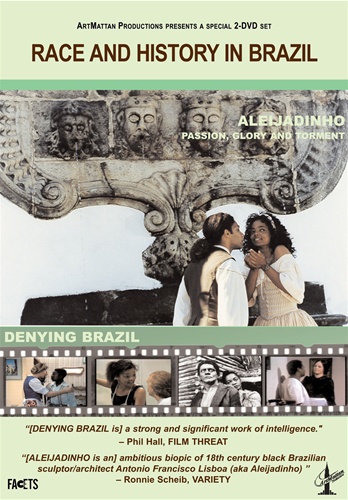
  • Race and History in Brazil (Denying Brazil / Aleijadinho: Passion, Glory and Torment)

    Facets Multi-Media
    2000 (Release date 2011-02-22)
    192 minutes
    Brazil
    Product Code: DV100942 (2-DVD set)

    Joel Zito Araújo
    Geraldo Santos Pereira
     

    Race and its impact on the art and history of Brazil are highlighted in this two-disc set. Joel Zito Araújo’s documentary Denying Brazil (A Negacao do Brasil, 92 mins.) analyzes contemporary Brazilian soap operas, calling attention to the ways archetypes and stereotypes influence identity in the Afro-Brazilian community. Well-known soap actors Milton Gonzalvez, Zeze Mota, and Maria Ceica offer provocative comments about their experiences. This is joined by Geraldo Santos Pereira’s Aleijadinho: Passion, Glory and Torment (Aleijadinho: Paixao, Gloria e Suplicio, 100 mins.) a fictionalized drama about the life of 18th century sculptor Antonio Francisco Lisboa, also known as Aleijadinho. Born the son of a slave, Lisboa struggles with prejudice, mental illness, and disease, but never stops expressing himself through his art. The story unfolds in flashback as a professor investigates the tragic life of the artist. In Portuguese with English subtitles.

  • Professor Mary Beltrán to be Featured Guest on Mixed Chicks Chat

    Mixed Chicks Chat (Founders of the Mixed Roots Film & Literary Festival)
    Hosted by Fanshen Cox, Heidi W. Durrow and Jennifer Frappier
    Website: TalkShoe™ (Keywords: Mixed Chicks)
    Episode: #255 Professor Mary Beltrán
    When: Wednesday, 2012-05-09, 21:00Z (17:00 EDT, 14:00 PDT)

    Mary C. Beltrán, Associate Professor of Media Studies
    University of Texas, Austin

    Mary Beltrán an Assistant Professor of Radio-Television-Film at the University of Texas at Austin, is of Mexican and German, English, and Scotch Irish heritage. Her research is focused on the production and narration of race, ethnicity, gender and class in U.S. television, film, and celebrity culture, with an emphasis on Latina/o and mixed race representation. She is the co-editor (with Camilla Fojas) of Mixed Race Hollywood (NYU Press 2008), an anthology of scholarship on mixed-race representation in film, television, and new media. She also is the author of Latina/o Stars in U.S. Eyes: The Making and Meanings of Film and TV Stardom (University of Illinois Press, 2009), which explores the construction and marketing of Latina and Latino stars in the U.S. in relation to the evolving status of Mexican Americans and other Latinos since the 1920s. Mary is a former journalist and social worker; her experiences working in San Francisco with Latina and African American teens and interest in the complexities of popular culture and its impact on young people of color spurred her to pursue a career that would allow her to combine her various interests and conduct research at the intersections of race, class, and gender and entertainment media studies. Since becoming a faculty member of the University of Wisconsin-Madison and now the University of Texas, Beltrán has taught a variety of classes on race and entertainment meida, including first-ever courses at both universities on Mixed Race and U.S. Media Culture. Aside from her books, she has published on such topics as mixed-race actors and characters in U.S. media culture, racial representation in millennial television, ethnic media activism targeting the television networks, and the racial politics of beauty and body ideals as reinforced in Hollywood media productions. She has been conducting research for a new book, Post-Race Pop: Interrogating Racelessness in Millennial Media Culture. Post-Race Pop explores the emphasis on racial ambiguity and utopic presentations of racial and ethnic diversity in contemporary television and other millennial media culture, particularly in light of the imperatives of the media industries to appeal to an increasingly diverse audience and popular political rhetoric that has utilized notions of post-racial America to widely divergent ends.

    Selected Bibliography: