• My Transnational, Hapa Identity in Question

    Stephen Murphy-Shigematsu
    2012-02-19

    Stephen Murphy-Shigematsu
    Stanford University

    I like to say that I have a transnational, multicultural, multiethnic identity. I am hapa, haafu, I am both/and, Japanese AND American. But I know that many others still see the world in dichotomies, as either/or, Japanese OR American.
     
    I know what I look like. I’ve seen my face in the mirror before. But I forget that others might see me differently than I see myself. And I know who I am. But I am aware that others usually do not know me.
     
    I was reminded of this while riding in a taxi with my 108 year-old grandmother in Matsuyama, a city on the island of Shikoku. Incredibly, she still likes shopping and chatted excitedly as we drove downtown to Mitsukoshi, her favorite department store. The taxi driver eyed me for a while in the rear view mirror before asking the inevitable question, “Where are you from?” I tried to dampen his curiosity. “Tokyo,” I answered curtly. But he was not easily discouraged, “I mean which country?” “Country?” I repeated, as if it was a dumb question. “I think Tokyo is in Japan, isn’t it?”
     
    He looked at me strangely before laughing nervously. He was puzzled. He expected me to say America. Of course I could say America. My father was American and I lived there half my life. But I could also say Japan. I was born here, my mother, wife and children are Japanese and I have lived the other half of my life here. Then again, I could also say that I am multicultural, multilingual, multinational, transnational, international or a global citizen, not just a citizen of any one country…

    Read the entire article here.

  • Claudia Unterweger – Austria’s first black News presenter

    Afro-Europe: International Blog
    2012-02-18


    ©ORF (Ali Schafler)

    Claudia Unterweger (39) is the first black TV News presenter in Austria. She was born to an African-American father and an Austrian mother. Since February 2011 she is one of the News presenters of “Zib-flash”, a program of the Austrian Broadcasting Corporation ORF.

    Unterweger caused a stir in 2011 because of the simple fact that she had a different skin color than the general population. “I define myself as black, or as an African-Austrian woman,” says the Vienna-born Unterweger.

    She sees herself as a part of the media history. “Arabella Kiesbauer (an Afro-Austrian) was over 30 years on the screen and was already a pioneer in the entertainment field. We are now taking a step forward and I hope that many more steps will follow.”

    Unterweger continues. “I personally call and see myself as an Afro-Austrian, a black Austrian, but also as part of a whole generation of black people who grew up here in Austria, but who are still perceived as an anomaly.”…

    Read the entire article here.

  • While the British government was somewhat pressured by white seamen’s organisations to protect jobs for whites, the primary cause of the anxieties underlying the Coloured Alien Seamen Order moved far beyond employment issues in the shipping industry. As has been well-documented by several scholars, the effort to limit immigration of African seamen to Britain was fundamentally linked to growing unease with the social and sexual liaisons between white women and black seamen. According to Carina Ray (2009), the anxiety over interracial sexual relations was at the root of a massive repatriation campaign for black seamen in the interwar era. Jacqueline Nassy Brown’s work depicts the political backlash against black seamen within England at this time, having been identified as the root of the ‘colour problem’ and the degeneration of white women’s morality. To demonstrate the tone of the British public’s views on the subject of racial mixing, Brown cites the writings of Muriel Fletcher, a social scientist who conducted research on black seamen in Liverpool in 1928–30. As Fletcher wrote in the report of her findings:

    In their own country they are not allowed to mix freely with white people or have relations with white women. Once having formed unions with white women in this country, they are perhaps loathe to leave England … In this country [the black seaman] is cut adrift from [tribal restrictions] before he has developed the restraint and control of Western Civilization. In Liverpool there is evidence to show that the negro tends to be promiscuous in his relations with white women. [Their] sexual demands impose a continual strain on white women.

    Fletcher’s deepest fears, and indeed those of the British public at large, were linked to the ‘half-caste’ children born out of these unions and raised in an environment characterised by immorality. Far from being a marginal view, Fletcher’s findings have been identified as both constructive and representative of ‘systematic social and political disempowerment of Black people’ in Liverpool until the present (Christian 2008:238). According to Brown (2005:28), ‘It would be hard to state emphatically enough how thoroughly racial politics in Liverpool/Britain reflect the legacy of the Fletcher Report’. Indeed, studies from the 1980s and beyond confirmed the ongoing marginalisation and stigmatisation of the black and mixed-race community in Liverpool (Christian 2008:238).

    Lynn Schler, “Becoming Nigerian: African Seamen, Decolonisation, and the Nationalisation of Consciousness,” Studies in Ethnicity and Nationalism, Volume 11, Issue 1, (April 2011): 46. http://dx.doi.org/10.1111/j.1754-9469.2011.01100.x.

  • Instead of advocating for an endless slide of identities, Cablinasian works effectively as a marker of a racialized identity if its users momentarily stop its movement and claim identities, while retaining their original reflexivity. In two parallel arguments, cultural critics Stuart Hall (1996) and Candice Chuh (2003) advocate for an understanding of race as fiction, while simultaneously accepting the strategic “closure” of identity for political projects. This approach differs from conventional identity politics in its temporality. Rather than claim an essential, stable, and unitary community identity, these identities are contingent, flexible, and porous. Certainly, this transforms traditional notions of racial politics based on an unwavering allegiance to a particular racial identification, but it also makes for a more inclusive and descriptive rather than prescriptive politics.

    LeiLani Nishime, “The Case for Cablinasian: Multiracial Naming From Plessy to Tiger Woods,” Communication Theory, Volume 22, Issue 1 (February 2012): 105.

  • TIME to Think in Full Color About Race & Ethnicity

    Marcia Alesan Dawkins, Ph.D.
    2012-02-25

    Marcia Alesan Dawkins, Visiting Scholar
    Brown University

    TIME Magazine’s latest cover story (Feb. 2/24) is called “Yo Decido. Why Latinos will pick the next President.” It reports that about 9% of all voters in 2012 will be Latino, up 26% from four years ago. While the Latin@ vote is definitely an important and interesting and game-changing political development, the most interesting thing about this story isn’t the headline or the article’s statistics. It’s the cover (left).

    The cover claims to feature 20 portraits of Latin@s with captions. Some are individual or occupational descriptions like dancer, DREAMer, nutrition undergrad, car aficionado and immigration activist. Other descriptions are nation-oriented, like Mexicans, Hondurans and Guatemalans.

    Here’s the problem: In reality, the cover features only 19 portraits of Latin@s and one man who passes as Latino but actually identifies himself as multiracial—half Chinese and half White. According to Michelle Woo at the OC Weekly, “That man is Michael Schennum, is the short-haired gentleman in the top row, center, behind the letter ‘M.’ He is half Chinese and half White. Not Latino. Not even a little bit.”…

    Sociologists have identified two patterns emerging in US multiracial communities. Asian / Whites and Latin@ / Whites tend to acknowledge and celebrate all aspects of their backgrounds but live life as Whites, especially if their fathers are White. Black / Whites and Black / Asian, Black / Latin@s tend to celebrate all aspects of their backgrounds but live their lives as Black

    Read the entire article here.

  • Election of the first black mayor

    Daily Mail
    1913-11-10

    Source: mytimemachine.co.uk

    Coloured Mayor—Majority of One at Battersea—Dramatic Speech

    For the first time in the history of this country a man of colour has been elected mayor of a borough. The honour has fallen to Mr. John Richard Archer, a photographer, of Battersea Park-Road, who by thirty votes to twenty-nine was last night elected Mayor of Battersea by the Progressive Party. His opponent was Mr W G Moore, a West End tailor.

    Mr Archer has hitherto kept secret the place of his birth. Last night, on donning his chain of office, he revealed the secret in a dramatic speech. He said:

    “I am a man of colour. Many things have been said about me which are absolutely untrue. I think you ought to show the same respect for me as you would a white man. I am the son of a man who was born in the West Indies. I was born in a little, obscure village in England that you may never have heard of–Liverpool. I am a Lancastrian born and bred.”

    “MY MOTHER WAS IRISH”

    “My mother [here Mr Archer spoke with great emotion] was just my mother. She was not born in Burma , as some newspapers stated. She was not born at Rangoon . My mother was Irish.”…

    Read the entire article here.

  • Pain of ‘Trail of Tears’ shared by Blacks as well as Native Americans

    Cable News Network (CNN)
    In America: You define America. What defines you?
    2012-02-25

    Tiya Miles, Professor of American Culture, Afroamerican and African Studies, and Native American Studies
    University of Michigan

    Editor’s Note: Tiya Miles is chairwoman of the Department of Afro-American and African Studies, and professor of history and Native American studies at the University of Michigan. She is the author of “Ties That Bind: The Story of an Afro-Cherokee Family in Slavery and Freedom” and “The House on Diamond Hill: A Cherokee Plantation Story.”  She is also the winner of  a 2011 “genius grant” from the MacArthur Foundation.

    (CNN) – African American history, as it is often told, includes two monumental migration stories: the forced exodus of Africans to the Americas during the brutal Middle Passage of the Trans-Atlantic slave trade, and the voluntary migration of Black residents who moved from southern farms and towns to northern cities in the early 1900s in search of “the warmth of other suns.” A third African-American migration story–just as epic, just as grave–hovers outside the familiar frame of our historical consciousness. The iconic tragedy of Indian Removal: the Cherokee Trail of Tears that relocated thousands of Cherokees to Indian Territory (now Oklahoma), was also a Black migration. Slaves of Cherokees walked this trail along with their Indian owners.
     
    In 1838, the U.S. military and Georgia militia expelled Cherokees from their homeland with little regard for Cherokee dignity or life. Families were rousted out of their cabins and directed at gunpoint by soldiers. Forced to leave most of their possessions behind, they witnessed white Georgians taking ownership of their cabins, looting and burning once cherished objects. Cherokees were loaded into “stockades” until the appointed time of their departure, when they were divided into thirteen groups of nearly 1,000 people, each with two appointed leaders. The travelers set out on multiple routes to cross Tennessee, Kentucky, Illinois, Missouri and Arkansas at 10 miles a day with meager supplies.
     
    At points along the way, the straggling bands were charged fees by white farmers to cross privately owned land. The few wagons available were used to carry the sick, infant, and elderly. Most walked through the fall and into the harsh winter months, suffering the continual deaths of loved ones to cold, disease, and accident. Among these sojourners were African Americans and Cherokees of African descent. They, like thousands of other Cherokees, arrived in Indian Country in 1839 broken, depleted, and destitute…

    Read the entire article here.

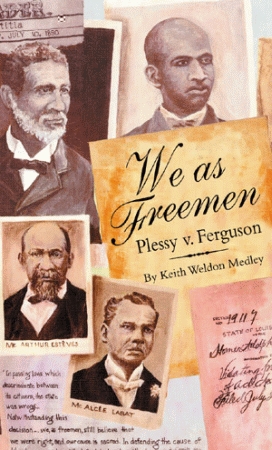
  • We as Freemen: Plessy v. Ferguson

    Pelican Publishing Company
    2003
    176 pages
    5½ x 8½
    20 photos – Notes – Index
    ISBN: 1-58980-120-2
    EAN: 978-1-58980-120-2 hc

    Keith Weldon Medley

    In June 1892, a thirty-year-old shoemaker named Homer Plessy bought a first-class railway ticket from his native New Orleans to Covington, north of Lake Pontchartrain. The two-hour trip had hardly begun when Plessy was arrested and removed from the train. Though Homer Plessy was born a free man of color and enjoyed relative equality while growing up in Reconstruction-era New Orleans, by 1890 he could no longer ride in the same carriage with white passengers. Plessy’s act of civil disobedience was designed to test the constitutionality of the Separate Car Act, one of the many Jim Crow laws that threatened the freedoms gained by blacks after the Civil War. This largely forgotten case mandated separate-but-equal treatment and established segregation as the law of the land. It would be fifty-eight years before this ruling was reversed by Brown v. Board of Education.

    Keith Weldon Medley brings to life the players in this landmark trial, from the crusading black columnist Rodolphe Desdunes and the other members of the Comité des Citoyens to Albion W. Tourgee, the outspoken writer who represented Plessy, to John Ferguson, a reformist carpetbagger who nonetheless felt that he had to judge Plessy guilty.

  • Guidance document 10: Dual Heritage pupils

    Ethnic Minority Services
    Nottingham City Council Children Services
    November 2005
    20 pages

    Jane Daffé, Senior EMA Consultant
    Nottingham City, LA

    Contents

    1. Introduction
    2. Terminology
    3. Statistics
    4. Identity
    5. Dual Heritage Voice
    6. Educational research
    7. Curriculum, resources, role models
    8. Conclusion
    9. Appendix
      1. Recommended Resources Reflecting the Lives of Dual Heritage Children and Families
      2. Poem: Blended
      3. Dual Heritage Quiz

    Introduction

    The primary focus of this document are children of Dual Heritage who have one White parent and the other of African Caribbean background. Although pupils of Dual Heritage in our schools have a much wider range of ethnic backgrounds (White/Asian etc), the specified target group is our most significant Dual Heritage group in Nottingham, both in terms of numbers and concerns related to underachievement and exclusion. Some factors and experiences will be of relevance to other pupils of differing Dual Heritage, some of relevance to other Black pupil groups.

    I hope to have produced a guidance document that will be of practical use to teachers in schools; within each sub-section are highlighted actions and recommendations which will enable schools to audit their current situation, develop their practice and create an increasingly inclusive whole-school ethos that is supportive and relevant for Dual Heritage pupils and families.

    Terminology

    The term Dual Heritage will be employed throughout this document; although labels are rarely unanimously agreed upon, it is currently considered by many to be a more acceptable and positive description than the still frequently used ‘mixed race’ (our pupils in schools often use the latter, and sometimes still the term ‘half-caste’).

    Why not ‘mixed race’?
    It is scientifically agreed that different ‘races’ do not exist, only one Human Race, therefore a shift from using the term ‘race’ seems to be the common order. Further, the word ‘mixed’ can have negative connotations in relation to identity e.g. ‘mixed up’, implying confusion and also that the original elements from both heritages are inevitably lost or changed.

    Why not half-caste?
    ‘Caste’ is derived from the Portuguese word ‘casta’, meaning lineage or breed. In human culture, it refers to rigid social divisions, as in the Hindu caste system. Societies with a low degree of social mobility such as South Africa under apartheid and the practice of slavery in the Southern United States could be described as caste-based societies – the connotations of oppression are clear. Moreover, ‘half’ clearly implies lacking and incomplete, indicating inferiority…

    Read the entire report here.

  • The Absurdity of America: George S. Schuyler’s Black No More

    EnterText: an interdisciplinary humanities e-journal
    Volume 1, Number 1 (Winter 2000) Americas, Americans
    pages 127-148

    Joseph Mills, Susan Burress Wall Distinguished Professor of the Humanities
    North Carolina School of the Arts, Winston-Salem

    It is a peculiar sensation, this double-consciousness, this sense of always looking at one’s self through the eyes of others…. One ever feels his two-ness—an American, a Negro—two souls, two thoughts, two unreconciled striving; two warring ideals in one dark body, whose dogged strength alone keeps it from being torn asunder.
    W. E. B. DuBois, The Souls of Black Folk (1903)

    What do we want?… We want to be Americans, full-fledged Americans, with all the rights of other American citizens. But is that all?… We who are dark can see America in a way that white Americans can not. And seeing our country thus, are we satisfied with its present goals and ideals?
    – W. E. B. DuBois, “Criteria of Negro Art” (1921)

    In 1931 George S. Schuyler published Black No More, a satire about Americans’ obsession with race. The book was controversial, in part, because Schuyler mocked African-American leaders. The novel contains parodies of Marcus Garvey, N.A.A.C.P. figures, and Tuskegee leaders. For example, Shakespeare Agamemnon Beard, a caricature of W.E. B. DuBois, writes ornate overblown editorials for The Dilemma, claims an “exotic” heritage, and “like most Negro leaders, he deified the black woman but abstained from employing aught save octoroons.” DuBois, himself, however, praised the book. He recognized that it would be “abundantly misunderstood,” because, “the writer of satire . . . is always misunderstood by the simple.” Although Black No More contained “scathing criticism of Negro leaders,” DuBois noted with admiration that the satire then “passes over and slaps the white people just as hard and unflinchingly straight in the face.” In many ways, Black No More demonstrates satire’s democratic potential. Mockery becomes the great leveller, and by ridiculing all, the novel calls into question racial and class hierarchies. In a letter to H. L. Mencken, Schuyler stated his intentions: “What I have tried to do in this novel is to laugh the color question out of school by showing up its ridiculousness and absurdity…I have tried… to portray the spectacle as a combination madhouse, burlesque show and Coney Island.”

    Unfortunately, as DuBois anticipated, the novel has been misunderstood. In a 1971 introduction to the book, Charles Larson states, “It would be easy—and some people would perhaps say better—to ignore Schuyler’s first novel,” and Margaret Perry’s comment that “we cannot dismiss [Black No More] entirely” reveals a desire to do just that. In fact, for decades Schuyler’s work overall has been denigrated or overlooked. To give only one example, in Cary Wintz’s Black Culture and the Harlem Renaissance, a table of “Year-by-Year Publication of Major Works of the Harlem Renaissance, 1922-1935” has almost fifty titles but does not include Schuyler’s books. In the 1990s, however, Robert A. Hill and R. Kent Rasmussen recovered a significant amount of Schuyler’s pulp fiction, and, in doing so, they demonstrated the need to re-evaluate Schuyler’s work. In particular, Black No More, Schuyler’s major literary achievement, needs to be reassessed. Considered by Arthur Davis to be “the best work of prose satire to come from the New Negro Movement,” and one of the few works of the time to use satire, the novel makes an important contribution to the discourse of race and national identity…

    …The book’s most damning indictment of this “urge towards whiteness” is a shocking lynching scene. Southern aristocrat Arthur Snobbcraft, the head of an elitist Anglo-Saxon association, joins forces with the Knights of Nordica to run a presidential campaign. Snobbcraft organizes a massive genealogy project to determine how much of the population has Negro blood. He intends to use the results to whip up national hysteria over the dangers of miscegenation; however, the plan backfires when his chief researcher, Dr. Buggerie, discovers that at least fifty million people who are considered “white” have a mixed heritage, including Buggerie, Knights of Nordica leader Givens, and Snobbcraft himself. After his opponents steal the information and give it to the newspapers, Snobbcraft tries to flee the country, but his plane runs out of gas and has to land in Mississippi. Snobbcraft and Buggerie decide to disguise themselves with shoe-polish blackface, but they run into members of the True Love Christ Lover’s Church, a group which has been praying for one last Negro to lynch. When they wipe off their blackface, they are accepted as Caucasians until one of the few church members who can read sees a newspaper article detailing their mixed ancestry. Snobbcraft and Buggerie are then mutilated, tortured and killed in an orgiastic frenzy…

    …There occur two dynamics in Black No More: a whitening at the level of skin and a blackening at the level of blood. Although the process of Black No More, Inc. “whitens,” the genealogical research of Buggerie “blackens” at least half of the population by revealing their mixed ancestry. When he learns of the research, Givens acknowledges, “I guess we’re all niggers now;” his comment echoes one made earlier by one of the owners of Black No More who noted that “Everything that looks white ain’t white in this man’s country.” In fact, almost nothing is white in the country. Schuyler dedicates Black No More to “all Caucasians in the great republic who can trace their ancestry back ten generations and confidently assert that there are no Black leaves, twigs, limbs of branches on their family trees.” The tone conveys his doubt that anyone can do this. Schuyler believed that America refused to admit that it consisted of a mulatto culture. In this sense, when he states in “The Negro-Art Hokum” that “the American Negro is just plain American,” he is insisting not only on the “Americanness” of the Negro, but also on the “Negroness” of America…

    Read the entire article here.