• The Black Musketeer: Reevaluating Alexandre Dumas within the Francophone World

    Cambridge Scholars Press
    August 2011
    260 pages
    8.1 x 6 x 1.1 inches
    ISBN 13: 978-1-4438-2997-7
    ISBN: 1-4438-2997-8

    Edited by:

    Eric Martone, Assistant Professor of History and Social Studies Education
    Mercy College, Dobbs Ferry, New York
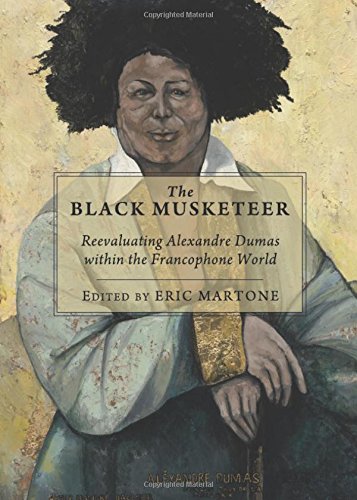
    Alexandre Dumas, author of The Three Musketeers, The Count of Monte Cristo, and The Man in the Iron Mask, is the most famous French writer of the nineteenth century. In 2002, his remains were transferred to the Panthéon, a mausoleum reserved for the greatest French citizens, amidst much national hype during his bicentennial. Contemporary France, struggling with the legacies of colonialism and growing diversity, has transformed Dumas, grandson of a slave from St. Domingue (now Haiti), into a symbol of the colonies and the larger francophone world in an attempt to integrate its immigrants and migrants from its former Caribbean, African, and Asian colonies to improve race relations and to promote French globality. Such a reconception of Dumas has made him a major figure in debates on French identity and colonial history.

    Ten tears after Dumas’s interment in the Panthéon, the time is ripe to re-evaluate Dumas within this context of being a representative of la Francophonie. The French re-evaluation of Dumas, therefore, invites a reassessment of his life, works, legacy, and previous scholarship. This interdisciplinary collection is the first major work to take up this task. It is unique for being the first scholarly work to bring Dumas into the center of debates about French identity and France’s relations with its former colonies. For the purposes of this collection, to analyze Dumas in a “francophone” context means to explore Dumas as a symbol of a “French” culture shaped by, and inclusive of, its (former) colonies and current overseas departments. The seven entries in this collection, which focus on providing new ways of interpreting The Three Musketeers, The Man in the Iron Mask, The Count of Monte Cristo, and Georges, are categorized into two broad groups. The first group focuses on Dumas’s relationship with the francophone colonial world during his lifetime, which was characterized by the slave trade, and provides a postcolonial re-examination of his work, which was impacted profoundly by his status as an individual of black colonial descent in metropolitan France. The second part of this collection, which is centered broadly around Dumas’s francophone legacy, examines the way he has been remembered in the larger French-speaking (postcolonial) world, which includes metropolitan France, in the past century to explore questions about French identity in an emerging global age.

    Table of Contents

    • Acknowledgements
    • Introduction: Alexandre Dumas as a Francophone WriterEric Martone
    • Part One: Life and Works
    • Part Two: Legacy
      • From the Literary Myth to the Lieu de Mémoire: Alexandre Dumas–and French National Identity(ies)—Roxane Petit-Rasselle
      • Dent pour dent”: Injustice, Revenge, and Storytelling in The Count of Monte Cristo and Balzac and the Little Chinese SeamstressBarbara T. Cooper
      • “A French Precursor of Obama”: The Commemoration of General Alexandre Dumas and French Reconciliation with the Past—Eric Martone
    • Contributors
  • Filipinos in Nueva España: Filipino-Mexican Relations, Mestizaje, and Identity in Colonial and Contemporary Mexico

    Journal of Asian American Studies
    Volume 14, Number 3 (October 2011)
    pages 389-416

    Rudy P. Guevarra, Jr., Assistant Professor, Asian Pacific American Studies, School of Social Transformation, College of Liberal Arts and Sciences
    Arizona State University

    This essay examines how the Manila-Acapulco galleon era (1565-1815) under Spanish colonialism forged the early mestizaje between Filipino Indio men and Mexican Indian and mixed race women, which produced children who became the first multiethnic Mexican-Filipinos in Nueva España (Mexico). This story is juxtaposed with current migrations of Filipinos to Mexico via the vacation cruise liners, which share a story of contemporary mixing between Filipinos and Mexicans. By acknowledging both their identities and looking to the past, these modern day multiethnic Mexipinos and Filipinos connect to a long historical web of interconnectedness which underpins the mestizaje that began in the sixteenth century.

    Read or purchase the article here.

  • Racial Alterity in the Mestizo Nation

    Journal of Asian American Studies
    Volume 14, Number 3 (October 2011)
    pages 331-359

    Jason Oliver Chang, Assistant Professor of History and Asian American Studies
    University of Connecticut

    The eviction of Chinese cotton farmers from Mexicali, Baja California serves as a focal point to explore the racial boundaries of dominant discourses of Mexican national identity. By examining the politics of agrarian reform, the article illustrates how the racial alterity of Chinese immigrants to national ideals served to consolidate diverse Mexican peoples as liberal mestizo racial subjects. Racial alterity is further explored by tracing the lives of Mexican women who married Chinese men and their multi-ethnic children. Anti-Chinese politics and conscription of mestizo subjects were central themes in the Mexicanization of Baja California.

    Read or purchase the article here.

  • Negotiating Mixed Race: Projection, Nostalgia, and the Rejection of Japanese-Brazilian Biracial Children

    Journal of Asian American Studies
    Volume 14, Number 3 (October 2011)
    pages 361-388

    Zelideth María Rivas, Professor of Chinese and Japanese
    Grinnell College, Grinnell, Iowa

    Since their arrival in Brazil in 1908, the presence of Japanese immigrants has shaken Brazilian conceptions of race. Narratives of interracial marriages and biracial children in 1930s medical documents and short stories demonstrate the incorporation of the Japanese into Brazil and their subsequent marginalization within the Japanese community. This article compares and contrasts the shifting depictions of biracial Japanese-Brazilian children in Brazil by Brazilians and first generation Japanese immigrants in order to understand how their presence challenges and “negotiates” national identity. The process of othering and marginalizing biracial children upsets the hegemonic understandings of racial categorization in Brazil.

    Read or purchase the article here.

  • Showing Her Colors: An Afro-German Writes the Blues in Black and White

    Callaloo
    Volume 26, Number 2, Spring 2003
    pages 306-319
    DOI: 10.1353/cal.2003.0045

    Karein Kirsten Goertz, Lecturer of Germanic Language and Literature
    University of Michigan

    This essay undertakes a detailed analysis of May Ayim’s Blues in Schwarz Weiss and examines her development of what she terms Ayim’s “hybrid language”—an expressive poetic style in which African and German elements are not mutually exclusive but rather two interwoven strands that Ayim brings together to articulate the texture of her identity as a Black German. Goertz contends that Ayim’s use of complex forms of irony and displacement constitutes a sophisticated practice of “defamiliarization” that represents an important new signifying practice in German literary expression.

    I am who I am, doing what I came to do, acting upon you like a drug or a chisel to remind you of your me-ness as I discover you in myself.
    Audre Lorde

    That bird is wise, look. Its beak, back turned, picks for the present what is best from ancient eyes, then steps forward, on ahead to meet the future, undeterred.
    —Kayper-Mensah

    Through her poetry, essays and political activism. May Ayim sought to dissolve the socially and politically constructed borders that continued to exist after the fall of the Berlin Wall in 1989. To her, the post-unification “new German solidarity” with its nationalistic rhetoric of Heimat (homeland), Volk (the people) and Vaterland (fatherland) signaled a redrawing of the line between those who were considered part of the German collective and those who were not; the previous ideological and geopolitical faultline between Fast and West was being replaced by a division along ethnic lines. Afro-Germans and other ethnic minorities living in Germany recognized that “the new ‘We’ in ‘this our country’ did and does not make room for everyone.” Rather than feeling summoned by this newly constructed collective identity, they understood it to be a place of confinement or delimitation and exclusion: “ein eingrenzender und ausgrenzender Ort” (Ayim, “Das Jahr” 214). Ayim’s spatial description of the pronoun signals that the repercussions of its limited parameters are real and practical, as well as psychological. Unable to identify with the new definition of the first-person possessive pronoun, she invariably finds herself cast into its second-person negative.

    The title poem of Ayim’s first poetry volume, Blues in Schwarz Weiß (Blues in Black and White), published in 1995, traces the process of marginalization along color lines, with German unification as one of its more recent manifestations. To explain the age-old dynamic between black and white, she references the African-American tradition of the blues: during the celebration of German unity, some rejoiced in white, while others mourned on its fringes in black—together they danced to the rhythm of the blues. The blues were born out of the experience of oppression, but, as Angela Davis points out, blues also offers the key to transcending the racial and gender imbalance…

    Read or purchase the article here.

  • Racial Ambiguity and Whiteness in Brian Castro’s Drift

    Journal of the European Association of Studies on Australia
    Volume 2, Number 2, 2009
    pages 113-126
    ISSN 2013-6897

    Marilyne Brun, Lecturer in Postcolonia Studies
    Université Nancy 2

    This article focuses on Drift, the fifth novel of contemporary Australian writer, Brian Castro, and concentrates on the ambiguous racial inscriptions of some of its characters. While white experimental British writer B.S. Johnson progressively becomes darker in the novel, his desire to escape his whiteness is complicated by another extreme, the albinism of Tasmanian Aboriginal Thomas McGann. This article discusses one essential aspect of these surprising fictional representations: the critique of whiteness that they articulate. The racial ambiguity of the two main characters offers a subtle reflection on Tasmania’s colonial legacy. Yet beyond Castro’s exploration of the contingencies of the Tasmanian context, the characters‟ racial ambivalence destabilises conventional representations of whiteness. The novel both exposes the metonymic nature of whiteness and critiques the specific modes of reading the body that are involved in preoccupations with whiteness.

    Read the entire article here.

  • Cultural encounters and hyphenated people

    The Journal of the European Association of Studies on Australia
    Volume 1, 2009
    pages 97-107
    ISSN 1988-5946

    Anne Holden Rønning, Professor Emerita
    University of Bergen, Norway

    Cultural encounters are a dominant feature of contemporary society. Identities are ever-changing ‘routes’ as Hall and others have stated, so we become insiders and outsiders to our own lives. The manifaceted expression of cultural belonging and its formation is illustrated by examples from Australasian writers who express not only the conflict of belonging to more than one culture, but also its inherent value. Such writers provide the reader with alternative ways of reading culture and illustrate the increasing trend to see ourselves as hyphenated people belonging nowhere specific in a globalised world.

    In the move from a colonial to a post-colonial, multicultural, and transnational society critics have spoken of identity, identities, pluralism and hyphenated peoples. Globalization and extensive migration in the late twentieth and early twenty-first centuries have increased encounters between cultures and raised further questions of integration and assimilation. Matthews has defined culture as “the information and identities available from the global supermarket” (27). He sees culture as hyphenating in our materialistic society since the cultural supermarket, dominated by the mass media, leaves the ability to appropriate culture in an adequate manner socially to the individual rather than the group.

    If we consider the manifaceted expression of cultural belonging and its formation, two of the most common encounters are linguistic and cultural, expressed in texts of different kinds in art, music, literature, or drama. The themes of many recent EASA conferences have underlined this aspect of Australian studies, from pluralism at the first conference, to maintaining the national, re-visioning, remembering, re-invention of itself, and translating cultures, to mention just some. In art, for example, this has been demonstrated by papers on the use of palimpsest in Japanese-Australian pottery, a fascinating picture of sculptures and vases with half Chinese and half Australian motifs. On another occasion it was shown how older colonial Australian landscape paintings were painted over, or had new features imposed on them by indigenous painters—for example, barbed wire, different indigenous signs—thus subverting and reclaiming the land. And, of course, literature has provided a plethora of examples of cultural encounters at all conferences. Brydon and Tiffin think of this kind of “cross-cultural interaction” in terms of flora, comparing it to a rhizome which spreads its roots out and shoots up in other places, yet retains its contact with the centre (1993, 12), symptomatic of the diversification of cultures and identities…

    …Hyphenated people

    Though the word ‘hyphenated’ has often been thought of in negative terms, in today’s society it is increasingly thought of as positive, indicating multiculturality—since the days of homogeneity of race are long gone. However, recently when speaking of this I have been met with a sense of derision—another attempt to make oneself different, another labelling. But are we not all hyphenated in some way, the two parts intertwined? An understanding of this could lead to a world less full of conflicts. Bhahba has discussed what happens when cultures meet, historically from the point of view of colonization, and today with immigration as the site for such exchange. He describes “[h]ybridity [as] a fraught, anxious and ambivalent condition. It is about how you survive, how you try to produce a sense of agency or identity in situations in which you are continually having to deal with the symbols of power or authority” (THES 1999). But he also acknowledges the mix of cultures he himself represents in this ironic description of himself as Mr. Hybrid: “The very process of colonization shifts certainties and sureties. It exposes the fictionality of certain ideas that are seen to be universal. (…) Hybridity is like the way I’m dressed – Indian jacket, silk scarf, corduroys and a collarless shirt from Italy. There you are, Mr. Hybrid” (THES 1999)

    The hyphenated person retains parallel cultures, both influencing the other but yet remaining separate. This is most clearly seen in migrant and settler communities, but is equally relevant for all who no longer live in their so-called ‘country of origin’. Trinh-Minh-Ha, the American Vietnamese film critic, has written much on these issues as she sees film as a particular example of cross-cultural encounters both in viewer and maker as well as in text and performance. She envisages such encounters as often resulting in a bricolage, a pastiche, quoting Scott Momaday: “We are what we imagine. Our very existence consists in our imagination of ourselves (…) The greater tragedy that can befall us is to go unimagined” (‘Out There’ cited in Minh-Ha 8). For those migrating or of mixed racial and ethnic parentage literature has always had a vital role to play in disseminating and problematizing issues of hyphenation, from the time of Shakespeare’s Caliban onwards. In When the Moon Waxes Red Trinh Minh-Ha uses the moon as a symbol of the constant and yet the changing, and therefore I would suggest symbolic of how cultural encounters function. The title of the book refers to a belief in Chinese mythology that a red moon is a portent of coming calamity—the eclipse as dangerous. Just as the moon waxes and wanes, yet retains its form, so do our identities vary according to time and place, and the cultural encounters we meet…

    Read the entire article here.

  • A critical ethnography of biracial elementary teachers: Biracial identity development and its effect on teaching practices and racism prevention

    Alliant International University, San Diego
    2010
    480 pages
    Publication Number: AAT 3428767
    ISBN: 9781124269009

    Jon E. Kingsbury

    A Dissertation Presented to the Graduate Faculty of the Hufstedler School of Education Alliant International University In Partial Fulfillment of the Requirements for the Degree of Doctor of Education

    The purpose of this qualitative inquiry was to develop a critical ethnographic methodology to examine the experiences that led a select group of elementary teachers to self-identify as biracial. Additionally, through the use of critical systems analysis, this inquiry explored the perspectives of the informants with regard to racism at the classroom and the greater school or district levels. In order to collect data, in-depth phenomenological interviews were conducted with two self-identified biracial elementary teachers from the southern California area. These interviews were tape recorded and transcribed verbatim. This inquiry sought to create an interview structure that would ensure a critical ethnographic approach to data generation that resulted in the development of the Figure Eight Interview Model, wherein the research process is dominated by two distinct research settings. The first is where the researcher and the informant are working collaboratively during the actual interviews. The second setting is where the researcher and the informant are working independently, using grounded theory to critically analyze the data transcribed from the previous interview. The analyses were then discussed at the next interview, where thematic categories were developed. These two settings were repeated three times, with each interview building on the previous and becoming more focused. Using system and social integration levels of critical systems analysis, themes were uncovered in order to develop theory for addressing, reducing, and ultimately preventing racism in classrooms and schools. These themes, along with the Figure Eight Interview Model, can be refined and expanded through further research done by professional development planners, multicultural educators, and qualitative researchers.

    Table of Contents

    • LIST OF FIGURES
    • 1 . INTRODUCTION
      • Purpose of the Study
      • Significance of the Study
      • Assumptions of the Study
      • Delimitations of the Study
      • My View of Humanity and Racism
    • 2. REVIEW OF THE LITERATURE
      • Racial Identity Development
        • Introduction
        • Monoracial Identity Models
        • Biracial Identity Models
        • Racial Identity Development and Teachers
        • Comments on Review of Racial Identity Models
      • Teachers’ Biographies
        • Perspectives on Teachers’ Biographies
        • Development of Teachers’ Biographies
        • Purpose and Value of Teachers’ Biographies
      • Multicultural Education
        • History and Development of Multicultural Education
        • Definitions and Goals
        • Teachers’ Role in Multicultural Education
      • Conclusions From the Review of the Literature
      • Research Questions in Light of the Literature Review
    • 3. RESEARCH METHODOLOGY
      • Research Paradigms
      • Critical Ethnography
        • Sociohistorical Development
        • Conceptual and Philosophical Framework
        • Feminist Methodology
        • Critical Theory
      • Research Design of the Study
        • In-Depth Phenomenological Interviewing
        • Sampling Strategy
        • Selection of Informants
        • Content and Conduct of the Interviews
        • Data Analysis
        • Carspecken’s Stages for Critical Research
        • Data Generation and Data Management
        • My Role as Researcher
        • Trustworthiness
    • 4. ASSESSING THE RESEARCH METHODOLOGY
      • Procedural Aspects of the Study
        • Number of Informants
        • Commitment of Time
        • Use of Instruments
        • Components of the Data Analysis
        • Summary of Procedural Aspects
      • Theoretical Concerns Within Critical Ethnography
        • Empowerment
        • Contextualization of Data
        • Romanticism
        • Validity/Trustworthiness
        • Summary of Theoretical Concerns
      • Criteria Within the Figure Eight Interview Model
        • The First Interview
        • The Second Interview
        • The Third Interview
        • Summary
    • 5. MY ANALYSIS AND RESPONSES TO THE STUDY
      • The Research Questions
        • Research Question 1
        • Research Question 2
        • Research Question 3
        • Research Question 4
        • Research Question 5
      • My Summary of Our Study
        • Assessment of the Methodology
    • 6. INFORMANTS’ RESPONSES TO OUR STUDY
      • Opening Comments/General Discussion
      • Time and Reflection Process I
      • Number of Participants
      • Length of Interviews
      • API Scores
      • Time and Reflection Process II
      • Role of Family
      • Self-identification Statements
      • Sociohistorical Context
      • Theoretical Elements
      • Empowerment of Informants
      • Time and Reflection Process III
      • Asian Pacific Islanders Educators Association
      • Their Mothers’ Influence
      • Weddings and Extended Families
      • Their Mothers as “Victims”
      • My Error in Identifying a Relationship
      • Regional Cultural Differences
      • Changes in Biracial Demographics
      • Their Physical Ambiguity
      • The Use of the Word “Threat”
      • School and Community Cultures
      • “Addressing” Versus “Reducing and Preventing”
      • Institutional Racism
      • San Diego’s Blueprint for Success
      • Changes in the American Culture
      • Truthfulness in My Re-Presentation
      • Stages of Biracial Identity Development
      • Closing Comments
      • Analysis of Informants’ Responses
        • Research Process
        • Critical REID Factors
        • Their Mothers’ Influence
        • Empowerment
        • Institutional Racism
        • Sociohistorical Contextualization
        • Hierarchy of Racism
      • Summary
    • 7. SUMMARY CHAPTER
      • Research Findings
      • Research Questions
      • Possible Shortcomings
        • Focus of Study
        • Peer Debriefers
      • Figure Eight Interview Model
        • Theoretical Foundations
        • Figure Eight Interview Model’s Effectiveness
        • Summary: Figure Eight Interview Model
      • Critical Ethnography
        • Empowerment
        • Data Contextualization
        • Catalytic Validity
        • Validity/Trustworthiness
        • Summary
      • Ethical Implications of an Organic Inquiry
      • Developmental Biracial REID Model
      • Implications and Applications for Practice
        • Professional Educators
        • Qualitative Researchers
      • Personal Reflections
    • REFERENCES CITED
    • APPENDICES
      • A. SELF-IDENTIFICATION OF RACIAL IDENTITY STATEMENT
      • B. FAMILY HERITAGE WORKSHEET (FIGURE B1)
      • C. WRITTEN CONSENT FORM
      • D. SUGGESTIONS FOR REFLECTIVE JOURNAL WRITING
      • E. PERSONAL HISTORY OF IDENTITY WORKSHEET (FIGURE E1)
      • F. SUGGESTIONS FOR ANALYSIS OF TRANSCRIPTS
      • G. SUGGESTIONS FOR COMMENTS ON INTERVIEWER’S ANALYSIS
      • H. CALL FOR PARTICIPANTS HANDOUT
      • I. POEM: “I AM INVISIBLE”
      • J. INFORMANTS’ REFERENCE SHEET

    List of Figures

    1. Racial/ethnic identity development models
    2. Moments of ethnography
    3. Conceptual Figure Eight Interview Model
    4. Procedural Figure Eight Interview Model
    5. List of established interview questions
    6. Five stages for critical qualitative research
    7. Interpretation of Carspecken’s (1996) research design
    8. Summary of responses to research questions
    9. Biracial identity development continuum

    Purchase the dissertation here.

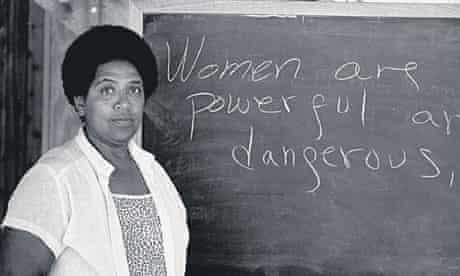
  • My hero: Audre Lorde by Jackie Kay

    The Guardian
    Series: My Hero
    2011-11-18

    Jackie Kay, Professor of Creative Writing
    Newcastle University


    Refusal to be defined by single categories: Lorde in 1983. Photograph: Robert Alexander/Getty Images

    ‘Lorde was openly lesbian before the gay movement existed. Her wise words often seem eerily prescient’

    Audre Lorde dropped the y from Audrey when she was still a child so she could be Audre Lorde. She liked the symmetry of the es at the end. She was born in New York City in 1934 to immigrants from Grenada. She didn’t talk till she was four and was so short-sighted she was legally blind. She wrote her first poem in eighth grade. The Black Unicorn, her most unified collection of poems, partly describes a tricky relationship with her mother. “My mother had two faces and a frying pot / where she cooked up her daughters / into girls … My mother had two faces / and a broken pot /where she hid out a perfect daughter /who was not me.”…

    …I first met Audre in 1984, when I was 22. She told me her grandfather had been Scottish, and that I didn’t need to choose between being Scottish and being black. “You can be both. You can call yourself an Afro Scot,” she said in her New York drawl. Lorde was Whitman-like in her refusal to be confined to single categories. She was large. She contained multitudes…

    Read the entire article here.

  • AAS 310: Mixed Race And The Media

    University of Texas, Austin
    Center for Asian American Studies
    Spring 2012

    Alexander Cho, Assistant Instructor

    What is “race,” and what does it mean to be “mixed”? How is mass media responsible for channeling fears, desires, and anxieties about “mixed” bodies? Why are “mixed race” bodies suddenly desirable and chic? Can one exist in two or more categories at the same time? How do people think of “mixedness” in the U.S., and how is it different in the Caribbean, Mexico, and Brazil? Why do people care so much? Why do categories matter? Isn’t everyone “mixed” somehow? Where do you fit in?
     
    This course will give students the tools to critically respond to these questions via a comparative, historically situated study of the representation of “mixed-race” people in popular media. Major attention will be paid to special concerns for Asian American populations; it includes substantial attention to African American and Latino populations. Chiefly U.S.-centered, but with a large transnational comparative component analyzing “mixed” racial formation in: North America, Latin America, Caribbean, Brazil.