• What race do you identify Obama as? Does President Obama’s race effect your opinion of him?

    SOC 119 – Voices from the Classroom
    World in Conversation Project
    Pennsylvania State University
    2011-09-08

    The first of 138+ student comments…

    1. Personally President Obama’s race does not affect my opinion of him at all. When viewing Obama I consider him black, even though he is multiracial. Part of the reason I consider Obama to be black is because he looks black, and also when he was elected President there was pandemonium and celebration because he was seen as the first black President of the United States. I could not vote in the 2008 election because I was not old enough, but if I was Obama’s race would not have swayed my vote one way or the other in considering a candidate for election…
    2. I consider Presiden Obama as multi racial because he is in fact half black and half white. I dont think it matters what race President Obama is. I think he should be respected as our Commander in Chief no matter what race or religion he is…
    3. Our President, Barack Obama, is black. I have absolutely no opinion about what race my President is or any other important figure for that matter. Different people have different opinions about what President Obama is and if he is American and all of this nonsense but he is an American. He is an American that I consider to be black based on how I categorize people. Others may not agree with how I categorize who he is but that is how I go about business. I consider myself to be white and someone can disagree but I am still going to think I am white. My outlook on what someone is, is straight forward and I do not pass judgment based on what someone looks like besides that that person is what they are. As a result, Mr. Obama is black…
    4. I identify Obama as a mixed race; he is not one hundred percent black, nor is he one hundred percent white. Obviously, his skin is darker than any other president we have had, but I don’t believe that this should be his sole identifier, nor should it be the only thing he is to be remembered for. He was raised by a white mother and is most definitely from a mixed background. Unfortunately, skin color is the first thing people see, and that is what sticks in people’s minds…
    5. I am sure that almost everyone who had one glance at Obama would immediately classify him as Black, even though he is actually multiracial. Even so, his race did not change my opinion of him negatively, but rather positively I must say before and after I learned from class that he is multiracial…
    6. What race do I identify Obama as and does Obama’s race effect my opinion of him? Previously to today’s sociology discussion, I thought that Barack Obama was black. I think I thought this because when he first ran for presidency, everyone made a huge deal that he would be the first black president in the United States. Clearly, I was wrong and learned that he is biracial. His Mother is a White American and his father is a Black Kenyan…
    7. Despite what most people may say, President Barack Obama is multi-racial. He is only fifty percent black despite the fact that people refer to him as our “black president,” while the rest of his makeup includes white and possibly even Native American…
    8. Although I do not know much about Obama’s background, just by looking at him I would classify him as a black person. I think that it was a phenomenal thing when a black man was elected as the president of the United States of America because it showed just how far we had come as a society. We had become one step closer to true racial equality…
    9. First and foremost, I identify President Barack Obama as being a mixed race. Obama is English, Irish, and Kenyan. To me, that does not make him black, that makes him mixed. People were so hyped up with the fact that he is part black that I feel they chose to ignore the rest of his background. I can imagine this made some people upset…
    10. I personally think that it is awesome that Obama is black. When I first heard that a black man was running for president, I was younger and pretty ignorant. I didn’t think he had a chance at winning at all. I figured most of America was more ignorant than I and that they were all republicans and/or racist. Clearly, I was extremely wrong…
    11. Barrack Obama is the nation’s first black president. Most everybody I know categorizes Barrack Obama as a black man, as do I. If you were to ask me if Barrack Obama is black, I would say yes. But if you asked me what race Barrack Obama is, I would say multi-racial like I did on the clicker question asked in class…
    12. I would consider President Obama to be multiracial, his father was black and his mother was white. But, does this affect my opinion of him? To say the honest truth, I absolutely do not have any knowledge in politics or government. I am not registered to vote, nor do I think I should have the right to vote knowing my lack of knowledge on the subject…
    13. I view President Obama as multiracial although when he first started running for president I saw him as black because of all the hype of him possibly being the first black President of the United States. I personally think the debates that occurred about his race and religion got way out of hand during the election and often took the focus away from actual issues. For me personally it does not affect my opinion of him…
    14. I personally identify Obama as a mixed individual. It is clearly seen that he is a man of mixed origins. It is also very apparent that he has some Black in him. Now to get into the total percents I don’t know what fraction of his blood is Black, Asian, etc. but the fact still remains that he has Black blood in him. To say that he is black is not totally wrong either…
    15. Let me start off by saying that I consider Barack Obama to be a black man for the sheer fact that he seemed to identify with the black community throughout his campaign. I also understand that when you could possibly be the first black president in American history you do not want to ruin the hopes of millions of minorities by denying your heritage because you are multi-racial and not a fully black man. But since he does consider himself a black man and not multi-racial I have different feelings towards him than other white candidates…
    16. I dont care at all that Obama is black or part Asian or whatever he is. To me he is black and that is just fine. I dont follow politics much but it’s hard to do worse than Bush. Obama inherited a shitty economy and I dont blame him at all for that. He did manage to catch Osama Bin Laden after Bush failed for however many years. That was pretty badass. He’s just a likable, intelligent, pretty good looking guy. The fact that he’s black doesnt do anything to detract from that…
    17. When I first look at someone, I identify them by the color of their skin. Without talking to someone and finding out how he or she identifies him/herself, that’s all I can go by. With that idea in mind, I identify Barack Obama as a black male because his skin is clearly darker than mine and other white people. That does not affect my views, though…
    18. Barack Obama’s father is from Africa and his mother is white. So I guess I would consider him biracial but I mostly view him as a black man. It is the easiest to identify him with because he is a man of color. To be honest his race does not alter my opinion of him but it does scare me. It makes me afraid for him, for me and for blacks in general. There is a ton of pressure on anybody who decides to become the president of the United States. Him being the first black president brings added pressure because he is the first of his kind to be in such a high position of power. This is a double edged sword because though he is in the position to knock down barriers and give more people of color the opportunity to become president he is also in position to give white America a reason to not vote for another candidate of color…

    Read all of the other comments here.
  • The Racially-Mixed People of the Ramapos: Undoing the Jackson White Legends

    American Anthropologist
    Volume 74, Number 5 (October 1972)
    pages 1276-1285
    DOI: 10.1525/aa.1972.74.5.02a00190

    Daniel Collins
    North Carolina State University

    A review of the literature fails to validate the Jackson White legends which traditionally have accounted for the presence of a racially mixed collectivity in the Ramapo Mountain area. Extant oral traditions supporting the least documented and most pejorative aspects of the legends serve to maintain isolation and threaten the continuation of the Ramapo Mountain community of racially mixed people.

    AMONG LOCAL PEOPLE of the Ramapo Valley, which crosses the New YorkNew Jersey border at Suffern, New York, the term “Jackson White” denotes a group of mixed breed persons who are held to have descended from the amalgamated issue of renegades, outlaws, and whores of various colors who at various times throughout the eighteenth century sought the sanctuary of the Ramapo Mountains. The name “Jackson White” connotes a racial anomaly spawned by inbreeding and intermarriage, born into ignorance and degeneracy, and condemned to poverty, feeblemindedness, and suspicion.

    The difficulty of distinguishing between legend and history has hampered the establishment of a settled account of the racially mixed people of the Ramapo Mountains. They have been defined by one state agency as “a race of people of mixed Negro, Indian, and White blood inhabiting the Ramapo Mountains in the Northern part of New Jersey and extending over the border into the adjoining section of New York State” (Vineland Training School 1911:1). That a people known as “Jackson Whites” inhabit the rugged Appalachian foothills called the Ramapo Mountains is true; whether or not they constitute a “race of people” and what the historical components of that people are until most recently have been open questions.

    There have been three clusters of people referred to as “Jackson Whites” in the valley. In the northern portion “Jackson Whites” have been located around Sloatsburg, Ladentown, and Haverstraw, New York. The other two clusters are centered in the southern portion at Ringwood and Stag Hill (Mahwah) New Jersey.

    The physical characteristics of the racially-mixed people are varied as would be expected. Hair textures are both kinky and straight. Skin pigmentations range from brown through red-brown, tan (called “coffee” locally), white, and albino. Some have facial characteristics which appear to be distinctly Indian, and others seem more Caucasian or Negro in their conformation…

    Read the entire article here.

  • Mixed messages: ‘mixed race’ representations in film

    Concordia University
    August 2004
    124 pages

    Naomi Angel

    The growing interest in issues pertaining to mixed race identities and communities, as well as a surge in films with mixed race characters has prompted this examination of representations of mixed race characters in film from the 1950s to the present. The study consists of an analysis of selected films, including Guess Who’s Coming to Dinner, Jungle Fever, Dr. No, Showboat and Rabbit Proof Fence, and situates this analysis within a historical framework based on the particular context in which each film was set and/or made.

    The value in studying ‘mixed race’ representations in film lies in the reflection it provides of significant moments in ‘mixed race’ histories, and in the portrayal of cultural imaginings of people of ‘mixed race.’ By examining these representations, this thesis traces the development of ‘mixed race’ terminology, interrogates the history of anti-miscegenation law in the United States, and explores the sociological and commonsense views of ‘mixed race’ maladjustment in the early 1900s.

    Read the entire dissertation here.

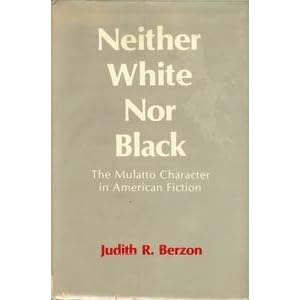
  • Neither White Nor Black: The Mulatto Character in American Fiction

    New York University Press
    1978
    280 pages
    ISBN-10: 0814709966; ISBN-13: 978-0814709962
    9 x 6 x 1 inches

    This book is out of print.

    Judith R. Berzon

    The mulatto character has captured the imagination of American novelist in every period of our literature.  For American writers, the mulatto has long signified a “marginal man,” caught between two cultures and between the boundaries of the American caste system. As such, the mulatto’s biological and psychological responses to his status—attraction and repulsion to both the white an non-white castes—have frequently been fictionalized.

    Neither White Nor Black is the first comprehensive study of the mulatto character in American fiction.  It is interdisciplinary in approach, drawing from literature, history, sociology, psychology and biology, and assessing the influence of racist ideology, social mythology and historical reality upon the portrayal of the mulatto character.  Dr. Berzon examines how the self-concepts of mixed-blood characters are affected by black-white mythology and explores the roles mulattoes have played in American culture.  Among the 19th an 20th-century black and white authors examined here are Mark Twain, William Faulkner, Robert Penn Warren and John A. Williams.

    In Part I of the book, Dr. Berzon provides an introduction to the historical, sociological and scientific backgrounds of the fiction; an overview of the novels; and a discussion of the most prevalent sterotype—“the tragic mulatto.”  Part II defines and illustrates the forms of adjustment to marginality.  Each chapter is organized around a specific mode of adjustment—passing for white, becoming a member of the black bourgeosie, working as leader of his/her race, and failing to achieve identification with either the white or black group.  In the Postscript, Dr. Berzon examines three novels of the 1970s by important black authors—John A. Williams, Ernest J. Gaines, and John Oliver Killens.  Her study is enriched by the recently published but crucial historical scholarship such as Roll, Jordan Roll by Eguene Genovese, White Over Black by Winthrop Jordan, an The Black Image in the White Mind by George Fredrickson, as well as the earlier work by Addison Gayle Jr., The Black Aesthetic.

    In Neither White Nor Black, Dr. Berzon reveals the recurring themes in the portrayal of the mulatto character throughout several periods of the 19th and 20th-century American history.  Central to the portrayal of the mulatto during all these periods is the quest for identity, and Dr. Berzon, through her illuminating analysis, provides her readers, whether students of Black studies, American studies, Southern history, literature, or intellectual history, with an essential understanding of that quest and of the role of the mulatto in American society.

  • Dorothy Roberts – Fatal Invention

    The Tavis Smiley Show
    PRI: Public Radio International
    2011-07-08

    Tavis Smiley, Host

    Dorothy Roberts, George A. Weiss University Professor of Law and Sociology; Raymond Pace and Sadie Tanner Mossell Alexander Professor of Civil Rights
    University of Pennsylvania

    Professor and legal scholar Dorothy Roberts explores the effects of race-based science in her new book, Fatal Invention: How Science, Politics, and Big Business Re-create Race in the Twenty-first Century. It’s the first text of its kind to document the development of racial science and biotechnology based on genetics and to map its implications for equality in America.

  • The Biggest Lie About Race? That It’s Real

    The Root
    2011-07-26

    Jenée Desmond-Harris, Contributing Editor

    Dorothy Roberts says race is a social and political construct, and she won’t rest until we know it.

    There’s a reason we’ll never come to a consensus on the most accurate racial classifications for Barack Obama or Tiger Woods. There’s a reason questions about ethnicity on the census and college applications feel impossible to an increasing number of Americans. There’s a reason you can be black in the United States, colored in South Africa and something else entirely in Brazil.

    According to Dorothy Roberts, author of Fatal Invention: How Science, Politics, and Big Business Re-Create Race in the Twenty-First Century, it’s because, despite centuries of efforts to treat race as if it’s a biological category, it is no more than social construction—created to oppress people—that changes with place, time and perspective.

    The Root talked to Roberts about the profit that’s behind the re-emergence of myths about race, the impact for African Americans and health, and how we can continue to talk about it, minus the long-standing lies.

    The Root: Fatal Invention is an attempt to correct major misunderstandings and myths about race. Explain what race is and what it isn’t.

    Dorothy Roberts: I can say very definitively that race is an invented political system; it is not a natural biological condition of human beings. The human species is a single race. It is not biologically divided up into distinguishable races…

    Read the entire article here.

  • Mestizaje in Ibero-America

    University of Arizona Press
    1995
    378 pages
    6.0 x 9.0
    Cloth ISBN: 978-0-8165-1219-5

    Claudio Esteva-Fabregat
    El Colegio de Jalisco

    Translated by John Wheat

    One of the most remarkable results of the arrival of Europeans in the New World may often be taken for granted: the emergence of the mestizo component in Latin American societies. The racial mixing that occurred in the Hispanic New World is the subject of this important study, which draws on a wide variety of historical, ethnographic, demographic, and biological sources to analyze processes of intermarriage, assimilation, and acculturation that continue in Latin America to the present day. Mestizaje in Ibero-America sheds new light on miscegenation and acculturation: their different levels and proportions in particular periods and in rural and urban areas, and the role of Spanish, Indian, and African women in the historical process of biological fusion. Although racial and cultural mixing usually coincided, Esteva observes that mestizos were often assimilated into Indian or Spanish society during the early colonial period and that acculturation without miscegenation sometimes occurred. He also shows that, contrary to the belief that “pure” Spanish blood was diluted in the New World, racial mixing and acculturation already existed in Iberia, facilitating its occurrence in America.

  • Blood Quantum Land Laws and the Race versus Political Identity Dilemma

    California Law Review
    Volume 96 (2008)
    pages 801-838

    Rose Cuison Villazor, Associate Professor of Law
    Hofstra University

    Modern equal protection doctrine treats laws that make distinctions on the basis of indigeneity defined on blood quantum terms along a racial versus political paradigm. This dichotomy may be traced to Morton v. Mancari and, more recently, to Rice v. Cayetano. In Mancari, the Supreme Court held that laws that privilege members of American Indian tribes do not constitute racial discrimination because the preferences have a political purpose – to further the right of self-government of federally recognized American Indian tribes. Rice crystallized the juxtaposition of the racial from the political nature of indigeneity by invalidating a law that privileged Native Hawaiians. That law, according to the Court, used an ancestral blood requirement to construct a racial category and a racial purpose as opposed to the legally permissible political purpose of promoting the right of self-government of American Indian tribes.

    Close analysis of the dichotomy between the constitutive notion of indigenous blood as either racial or political has largely escaped scholarship. An analysis deconstructing their juxtaposition is sorely needed. As recent challenges to blood quantum laws show, there remain unanswered questions about the extent to which the racialized (and thus invalid) Native Hawaiian-only voting law impact other blood quantum laws. Among the laws implicated by the dichotomy between the racial and political meaning of indigeneity are land ownership laws that privilege indigenous peoples who are not federally recognized tribes. Specifically, in some jurisdictions in the United States, including Hawaii, Alaska, and the U.S. territories, only indigenous peoples may purchase or possess property. Perhaps more problematically, these property laws define indigeneity on the basis of blood quantum. Under the contemporary race versus political meaning of blood quantum, these laws arguably violate equal protection principles because they do not fit the current framing of what constitutes political indigeneity.

    Using these laws, what I collectively refer to as blood quantum land laws, as frames of reference, this Essay interrogates and criticizes the juxtaposition of the racial and political meaning of indigeneity. Specifically, the Essay examines the legal construction of political indigeneity and demonstrates how its narrowed construction would undermine these blood quantum land laws that were enacted to reverse the effects of colonialism. Consequently, this Essay calls for the liberalization of the binary racial and political paradigm by expanding equal protection law’s interpretation of the meaning of political indigeneity. Toward this end, this Essay provides an initial analysis of how to broaden the political notion of indigeneity, focusing in particular on the relationships among property, indigeneity, and the right to self-determination.

    Read the entire article here.

  • Tribal Rights vs. Racial Justice: Was the Cherokee Nation’s expulsion of black Freedmen an act of tribal sovereignty or of racial discrimination?

    The New York Times
    Room for Debate
    2011-09-15

    Kevin Maillard, Associate Professor of Law
    Syracuse University

    Matthew L. M. Fletcher, Professor of Law
    Michigan State University

    Cara Cowan-Watts, Acting Speaker
    Cherokee Nation Tribal Council

    Rose Cuison Villazor, Associate Professor of Law
    Hofstra University

    Heather Williams, Cherokee citizen and Freedman Descendent
    Cherokee Nation Entertainment Cultural Tourism Department

    Carla D. Pratt, Professor of Law and Associate Dean of Academic Affairs
    Pennsylvania State University, Dickinson School of Law

    Tiya Miles, Professor of History and Chair of the Department of Afro-American and African Studies
    University of Michigan

    Joanne Barker (Lenape), Associate Professor of American Indian studies
    San Francisco State University

    Introduction

    When the Cherokee were relocated from the South to present-day Oklahoma in the 1830s, their black slaves were moved with them. Though an 1866 treaty gave the descendants of the slaves full rights as tribal citizens, regardless of ancestry, the Cherokee Nation has tried to expel them because they lack “Indian blood.”

    The battle has been long fought. A recent ruling by the Cherokee Supreme Court upheld the tribe’s right to oust 2,800 Freedmen, as they are known, and cut off their health care, food stipends and other aid in the process.

    But federal officials told the tribe that they would not recognize the results of a tribal election later this month if the citizenship of the black members was not restored. Faced with a cutoff of federal aid, a tribal commission this week offered the Freedmen provisional ballots, a half-step denounced by the black members.

    Is the effort to expel of people of African descent from Indian tribes an exercise of tribal sovereignty, as tribal leaders claim, or a reversion to Jim Crow, as the Freedmen argue? Kevin Noble Maillard, a professor of law at Syracuse University and a member of the Seminole Nation of Oklahoma, organized this discussion of the issue.

    Read the entire debate here.

  • Record-High 86% Approve of Black-White Marriages

    Gallup
    2011-09-12

    Jeffrey M. Jones

    Ninety-six percent of blacks, 84% of whites approve

    PRINCETON, NJ—Americans are approaching unanimity in their views of marriages between blacks and whites, with 86% now approving of such unions. Americans’ views on interracial marriage have undergone a major transformation in the past five decades. When Gallup first asked about black-white marriages in 1958, 4% approved. More Americans disapproved than approved until 1983, and approval did not exceed the majority level until 1997….

    …The latest results are based on an Aug. 4-7 USA Today/Gallup poll, which included an oversample of blacks…

    Read the entire article here. View methodology, full question results, and trend data here.