• The Hybrid in Hawaii as a Marginal Man

    American Journal of Sociology
    Volume 39, Number 4 (January 1934)
    pages 459-468

    William C. Smith
    William Jewell College

    Several factors conspire to make the hybrid in Hawaii occupy a position markedly different from that of the mixed-blood in other areas. The relative absence of race prejudice on the part of the Hawaiians has created an atmosphere which is favorable both to intermarriage and to persons of mixed blood. There are certain differences between the several groups. The Chinese-Hawaiian is, by consensus, a superior product and is accorded a high status. The Caucasian-Hawaiian is given a lower rating and consequently is more sensitive and self-conscious. There is a considerable group of multiple hybrids, the results of several crosses. These tend to form a group of their own since they cannot readily attach themselves to any of the pure-blood groups as do the dual hybrids. The mixed-bloods of all sorts are drawn together, and within this group there is little hesitancy with reference to intermarriage. This entire group mingles rather freely with the Hawaiians, but there is considerable social distance between them and the Nordics. The hybrid plays an important role in the life of Hawaii. As a participant in two or more cultures he acts as an intermediary and interpreter. The presence of a considerable number of hybrids has been responsible for the relative absence of race prejudice. The hybrids are increasing in numbers and in importance, and it is in the minds of these persons that the conflicts and fusions of culture are taking place. To understand fully the life of Hawaii, attention must be directed to this marginal group.

    A study of the hybrids, or racial crosses, in the Hawaiian Islands is interesting because of the contact of so many racial and cultural groups. They constitute one of the major population groups of the Territory. According to the Census of 1930 there are 12,592 Asiatic-Hawaiians and 15,632 Caucasian-Hawaiians out of a total population of 368,336. In addition there are a number of Asiatic-Caucasians and other crosses distributed among the various ancestral groups.

    The situation of the hybrids in Hawaii differs markedly from that of the Eurasian in India or the mulatto in continental United States. They are not all in the same situation, however, for there are certain differences in the treatment accorded the various crosses. In the main they are not sensitive as to their mixed ancestry. It is not at all unusual to hear someone say, “I am of mixed blood, and I am proud of it.”

    Several factors determine their status in Hawaii. For several centuries the Hawaiians had lived in isolation, which precluded the cultivation of prejudices. When Europeans began to make frequent…

    Read or purchase the article here.
  • Beyond Liverpool, 1957: Travel, diaspora, and migration in Jamal Mahjoub’s The Drift Latitudes

    The Journal of Commonwealth Literature
    Volume 46, Number 3 (September 2011)
    pages 493-511
    DOI: 10.1177/0021989411409813

    Jopi Nyman, Professor
    University of Eastern Finland, Finland

    This essay discusses the novel The Drift Latitudes (2006) by the Anglo-Sudanese author Jamal Mahjoub. By telling the stories of the German refugee Ernst Frager and his two British families, I argue that Mahjoub’s novel utilizes the tropes of transnational travel and migration to present a critique of discourses of purity and nationalism. Through its uncovering of silenced family narratives, the novel hybridizes British and European identities and underlines the need to remember the stories of ordinary people omitted from official histories. As the novel’s supposedly British families appear to possess transnational links with Sudan, Germany, and the Caribbean, the novel reconstructs European identity as transnational and in need of historical reassessment. As a further contribution to the importance of hybrid identity, the story of black cultural identity and its construction in post-Second World War Liverpool is told in tandem with the importance of black music as a means of constructing black diasporic identity.

    Read or purchase the article here.

  • The Drift Latitudes

    Chatto & Windus
    2006-02-02
    320 pages
    ISBN-13: 978-0701178222

    Jamal Mahjoub

    Liverpool, 1958, and German refugee and inventor Ernst Frager is in search of a sense of belonging. What he finds is an unusual nightclub on the Merseyside docks, and Miranda: hat-check girl, aspiring jazz singer and daughter of West Indian immigrants. Their doomed love affair will have repercussions for the children waiting for Ernst back in London, but also for the daughter Miranda gives birth to. Almost half a century later, Jade finds herself grappling with the very questions that drove her father into the arms of her mother, and realising that a successful career cannot define an identity; nor can you separate your existence from all the many other stories connected to it …

    Like the jazz that snakes its way though this beautiful novel, The Drift Latitudes is about how we improvise our lives and the chances we take. From the Nubian boy who flees the tedium of home to find the bright lights of New York’s jazz scene, to Ernst’s daughter Rachel who turns her back on Europe and follows her husband to the Sudan, it is about the movement of people around our globe and the interdependence of our dreams. Awash with memorable characters, filled with unputdownable stories, this is a brilliantly intricate novel that lingers in the mind long after its final note.

  • German science and black racism—roots of the Nazi Holocaust

    The FASEB Journal (The Journal of the Federation of American Societies for Experimental Biology)
    Volume 22, Number 2 (2008)
    pages 332-337
    DOI: 10.1096/fj.08-0202ufm

    François Haas, Associate Professor
    Department of Rehabilitation Medicine
    New York University

    The Nazi’s cornerstone precept of “racial hygiene” gave birth to their policy of “racial cleansing” that led to the murders of millions. It was developed by German physicians and scientists in the late 19th century and is rooted in the period’s Social Darwinism that placed blacks at the bottom of the racial ladder. This program was first manifested in the near-extermination of the African Herero people during the German colonial period. After WWI, the fear among the German populace that occupying African troops and their Afro-German children would lead to “bastardization” of the German people formed a unifying racial principle that the Nazis exploited. They extended this mind-set to a variety of “unworthy” groups, leading to the physician-administered racial Nuremberg laws, the Sterilization laws, the secret sterilization of Afro-Germans, and the German euthanasia program. This culminated in the extermination camps.

    If the physician presumes to take into consideration in his work whether a life has value or not, the consequences are boundless and the physician becomes the most dangerous man in the state.

    Christopher Willhelm Hufeland (1762–1836)

    ALTHOUGH THE SLAUGHTER OF INNOCENTS has been a repeating theme throughout human history, only the Nazi-led extermination of millions of people deemed undesirable was framed in the scientific context of “racial hygiene.” At the core of Nazi philosophy was the view of the nation as a living organism. Using Herder’s concept of Volk, Hitler viewed German society as an organism with its own health. “Our people is also a biological entity… German people forms one great relationship, a blood society… This biological unity of people will be known as the people-body.” Because individual human beings were regarded as functional or dysfunctional parts of this larger whole and thus affecting the health of the people-body, racial hygiene became seminal to Hitler’s thinking. As Bavarian Cabinet Minister Hans Schemm declared in 1934, “National Socialism is nothing but applied biology.”

    The rise of science-based medicine combined with physicians’ roles in national health reform during the late 19th century to give physicians first-time political leverage and continuous and unprecedented levels of public recognition. Hitler and the Nazis reached out early to physicians:

    I could, if need be, do without lawyers, engineers, and builders, but… you, you National Socialist doctors, I cannot do without you for a single day, not a single hour. If…you fail me, then all is lost. For what good are our struggles, if the health of our people is in danger?

    Physicians responded in kind (Table 1 ): “The National Socialist Physicians’ League proved its political reliability to the Nazi cause long before the Nazis seizure of power, and with an enthusiasm, and an energy, unlike that of any other professional group.”

    Central to this affinity was the 19th century etiologic notion evolving from Social Darwinism that certain diseases (e.g., mental illness, feeblemindedness, criminality, epilepsy, hysteria, alcoholism) are genetically determined. The physicians who had developed this theory—primarily psychiatrists, neurologists, and anthropologists—became Germany’s eugenicists and authored the country’s racial policy, and it was primarily these physicians and their disciples who eventually led the Nazi government’s policy of ethnic cleansing. This program evolved in a series of discrete steps of ever-increasing barbarism that emerged during the German colonial period in Africa and terminated in the extermination camps of the Holocaust…

    The African colonies and concentration camps also served racial scientific inquiry. Post-mortems were performed to study causes of death and bodies of executed prisoners were preserved and shipped to Germany for dissection (Fig. 1 , (14) ). A 1907 chronicle reported that: “A chest of Herero skulls was recently sent to the Pathological Institute in Berlin, where they will be subjected to scientific measurements.”

    Probably the most well-known study was the physician Eugen Fisher’s evaluation of Basters, the mixed-blood children of Dutch men and Nama women. He argued that “Negro blood” was of “lesser value” and that mixing it with “white blood” would destroy European culture, and advised that Africans should be exploited by Europeans as long they were useful, after which they could be eliminated…

    …In 1920, Doctor F. Rosenberger wrote in the Medical Review, “…Shall we stand in silence and allow it to happen that in the future the banks of the Rhine shall echo not with the songs of beautiful and intelligent white Germans, but with the croaks of stupid, clumsy, half-animal and syphilitic mulattos?” This reiterated the threat first articulated during Germany’s colonial period that racially mixed offspring (called Mischlings) will destroy the purity of the German white race. As Colonial Secretary Solf had incited people in 1912, “You send your sons to the colonies: do you want them to return with wooly-haired grandchildren?…Do you want your girls to return with Hereros, Hottentots and bastards?. …We are Germans, we are white, and we want to stay white…

    Read the entire article here.

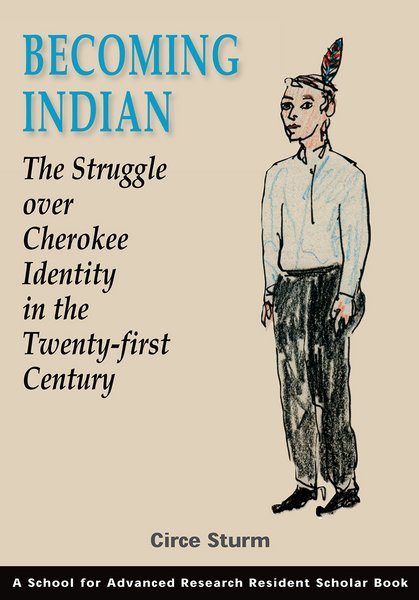
  • Becoming Indian: The Struggle over Cherokee Identity in the Twenty-first Century

    School for Advanced Research Press
    2011
    280 pages
    1 map, 3 tables, 6 appendices, notes, references, index
    7 x 10

    Circe Dawn Sturm, Associate Professor of Anthropology
    University of Texas, Austin

    In Becoming Indian, author Circe Sturm examines Cherokee identity politics and the phenomenon of racial shifting. Racial shifters, as described by Sturm, are people who have changed their racial self-identification from non-Indian to Indian on the US Census. Many racial shifters are people who, while looking for their roots, have recently discovered their Native American ancestry. Others have family stories of an Indian great-great-grandmother or -grandfather they have not been able to document. Still others have long known they were of Native American descent, including their tribal affiliation, but only recently have become interested in reclaiming this aspect of their family history. Despite their differences, racial shifters share a conviction that they have Indian blood when asserting claims of indigeneity. Becoming Indian explores the social and cultural values that lie behind this phenomenon and delves into the motivations of these Americans—from so many different walks of life—to reinscribe their autobiographies and find deep personal and collective meaning in reclaiming their Indianness. Sturm points out that “becoming Indian” was not something people were quite as willing to do forty years ago—the willingness to do so now reveals much about the shifting politics of race and indigeneity in the United States.

    Read the beginning of Chapter 1 here.

    Table of Contents

    1. Opening
    2. What Lies Beneath: Hidden Histories and Racial Ghosts
    3. Racial Choices and the Specter of Whiteness
    4. Racial Conversion and Cherokee Neotribalism
    5. Shifting Race, Shifting Status: Citizen Cherokees on “Wannabes”
    6. Documenting Descent and Other Measures of Tribal Belonging
    7. States of Sovereignty: Tribal Recognition and the Quest for Political Rights
    8. Closing
  • Experiences and Processes Affecting Racial Identity Development: Preliminary Results From the Biracial Sibling Project

    Cultural Diversity & Ethnic Minority Psychology (formerly Cultural Diversity and Mental Health)
    Volume 4, Issue 3, August 1998
    Pages 237-247
    DOI: 10.1037/1099-9809.4.3.237

    Maria P. P. Root, Ph.D.

    Examined what drives the process of racial identity development in general for persons of mixed racial heritage and what experiences account for some differential choices within the same family. 20 sibling pairs of mixed racial heritage (aged 18–40 yrs) completed packets including an extensive background questionnaire, a body image inventory, a racial resemblance inventory, a sibling racial resemblance inventory, a brief mental health inventory, a racial experiences inventory, and an identity questionnaire. Ss also participated in two 2-hr interviews. Four types of experiences surfaced that appear to influence the identity process: hazing, family dysfunction, other salient identities, and the impact of integration. These experiences were explored within the framework of the ecological model of racial identity development.

    For centuries the United States has followed rules of hypodescent, or more colloquially, the “one-drop” rule for racial classification. This rule, implicitly embedded in racial identity theories, is challenged by changes in the contemporary population in which visible cohorts of persons of mixed heritage exist who do not strictly adhere to the one-drop rule.

    Anecdotally, in the models of racial identity that have guided psychological understanding of racial awareness for two decades, persons assigned to the same racial grouping, whether they be siblings or strangers, use labels signifying their location within a single racial group. In contrast, anecdotal information on siblings of racially mixed heritage suggest they often racially or ethnically identify themselves differently from one another. At conferences dedicated to the theme of multiraciality, this difference is often the topic of discussion, with some individuals saying that each of three or four siblings identifies differently. Is this due to stage of racial identity development? Can gender explain these differences? Does phenotype explain the difference? Does birth order explain differences?

    These questions offer a range of explanations and hypotheses about these differences, suggesting that this phenomenon of different racial identities among siblings in the same family would likely be complex. Studies of persons of mixed-race heritage already suggest some counterintuitive findings, and misunderstood findings. For example, phenotype does not determine how people identify themselves (Hall, 1980), though it may certainly predict some experiences one is more likely to have. Hall also found that gender alignment between a child and parent (i.e., mothers and daughters or fathers and sons) did not predict the identity label used by young Black Japanese adults in her study. Other researchers have found that identity can change over the lifetime in a way that does not necessarily reflect a stage process (Root, 1990). Racial identity can be very situational, not necessarily reflecting an ambivalence (Stephan, 1992). And the contemporary cohort of racially mixed young adults, more than at any other point in history, is asserting a racially mixed identity. This assertion, however, is generally misunderstood to reflect a racial hatred of self, a desire to be White, or a personality that is opportunistic. Rather than these explanations being derived from conventional lore, many of these individuals are subverting monoracial paradigms (Daniel, 1992), refusing to adhere to the irrational racial rules of this country (Spickard, 1992), or contextualizing racial identity. An identity choice is possible amid a growing number of mixed-race people in the post-civil rights era. Without most people’s ability to experience the insider perspective on being of mixed parentage, a monoracial framework is usually the guide for interpretation of behavior and process…

    Read the entire article here.

  • Lone mothers of mixed racial and ethnic children in Britain: Comparing experiences of social attitudes and support in the 1960s and 2000s

    Women’s Studies International Forum
    Volume 34, Issue 6, November-December 2011
    Pages 530-538
    DOI: 10.1016/j.wsif.2011.06.007

    Rosalind Edwards, Professor of Sociology
    University of Southampton

    Chamion Cabellero, Senior Research Fellow
    Social Capital Research Group
    London South Bank University

    This article places side-by-side the views from lone mothers bringing up children from mixed racial and ethnic backgrounds in mid-1960s and early 2000s Britain, to consider whether the sorts of social attitudes and support these mothers experienced have changed or persisted over the past half century. The analysis compares and contrasts the general social and official attitudes that lone mothers of mixed children feel that they encounter, the support they receive from the fathers of their children, and their relationships with their own and the father’s wider family, the neighbourhood and friendship networks they draw on, and the formal supports available to them across time. The article concludes by considering some indicative trajectories of change and constancy that looking at these social attitudes and supports reveals, around negative assessments and their social expression, expectations of fathers, the availability of wider family, and the importance of informal daily support from other mothers in the same situation.

    Read or purchase the article here.

  • Blood Politics: Race, Culture, and Identity in the Cherokee Nation of Oklahoma

    University of California Press
    March 2002
    267 pages
    Paperback ISBN: 9780520230972

    Circe Dawn Sturm, Associate Professor of Anthropology
    University of Texas, Austin

    • Finalist in the Non-fiction category of the Oklahoma Book Awards, Oklahoma Center for the Book
    • 2002 Outstanding Book on Oklahoma History, Oklahoma Historical Society

    Circe Sturm takes a bold and original approach to one of the most highly charged and important issues in the United States today: race and national identity. Focusing on the Oklahoma Cherokee, she examines how Cherokee identity is socially and politically constructed, and how that process is embedded in ideas of blood, color, and race. Not quite a century ago, blood degree varied among Cherokee citizens from full blood to 1/256, but today the range is far greater—from full blood to 1/2048. This trend raises questions about the symbolic significance of blood and the degree to which blood connections can stretch and still carry a sense of legitimacy. It also raises questions about how much racial blending can occur before Cherokees cease to be identified as a distinct people and what danger is posed to Cherokee sovereignty if the federal government continues to identify Cherokees and other Native Americans on a racial basis. Combining contemporary ethnography and ethnohistory, Sturm’s sophisticated and insightful analysis probes the intersection of race and national identity, the process of nation formation, and the dangers in linking racial and national identities.

    Table of Contents

    • List of Illustrations
    • Acknowledgments
    • Chapter One. Opening
    • Chapter Two. Blood, Culture, and Race: Cherokee Politics and Identity in the Eighteenth Century
    • Chapter Three. Race as Nation, Race as Blood Quantum: The Racial Politics of Cherokee Nationalism in the Nineteenth Century
    • Chapter Four. Law of Blood, Politics of Nation: The Political Foundations of Racial Rule in the Cherokee Nation, 1907-2000
    • Chapter Five. Social Classification and Racial Contestation: Local Non-National Interpretations of Cherokee Identity
    • Chapter Six. Blood and Marriage: The Interplay of Kinship, Race, and Power in Traditional Cherokee Communities
    • Chapter Seven. Challenging the Color Line: The Trials and Tribulations of the Cherokee Freedmen
    • Chapter Eight. Closing
    • Notes
    • Bibliography
    • Index
  • Miscegenation in South Africa

    Cahiers d’études africaines
    Volume 1, Number 4 (1960)
    pages 68-84
    DOI: 10.3406/cea.1960.3680

    Pierre L. Van Den Berghe
    University of Natal

    A number of related factors make the Union of South Africa an ideal object of investigation in the field of miscegenation. The exceptionally virulent brand of racism that has developed in South Africa since the beginning of the 2oth century was accompanied by an increasingly morbid fear of miscegenation unparalleled in intensity anywhere else in the world. As consequence of this miscegenophobia South Africa went further than any other country in recent times in prohibiting by law all sexual relations whether marital or non-marital between whites and non-whites. Finally the South African government in its concern over bastardization provides the social scientist with the best data on inter-racial marriage and concubinage of any country known to the author.

    The history of miscegenation in South Africa is as old as the first permanent Dutch settlement at the Cape in 1652. In the first few decades, some instances of marriage between Dutchmen and christianized Hottentot women took place as well as extensive non-marital relations between masters and female slaves. In the 1670’s, an estimated 3/4 of all children of female slaves had white fathers. With the rise of colour prejudice in the latter decades of the 17th century, legal unions of whites and non-whites became rare. A 1685 law prohibited marriage between white men and slave women; some legal unions of white men with free women of colour continued to take place, but with decreasing frequency. Miscegenation however, continued to flourish in the form common to most slave societies namely institutionalized concubinage between white men and non-white women.

    The salient fact in the early history of miscegenation in South Africa is that while intermarriage became rapidly condemned, extra marital relations between white men and women of colour were not only tolerated, but even looked upon with amusement The slave lodge of the Dutch East India Company at the Cape was wide-open brothel of which Mentzel gives an interesting account:

    “Female slaves are always ready to offer their bodies for trifle; and towards evening one can see string of soldiers and sailors entering the lodge where they misspend their time until the clock strikes 9… The Company does nothing to prevent this promiscuous intercourse since, for one thing it tends to multiply the slave population and does away with the necessity of importing fresh slaves. Three or four generations of this admixture for the daughters follow their footsteps have produced a half-caste population—a mestizo class—but a slight shade darker than some Europeans.”

    Among the European bourgeoisie, interracial concubinage was also common:

    “Boys who, through, force of circumstances have to remain at home during these impressionable years between 16 and 21 more often than not commit some folly, and get entangled with handsome slave-girl belonging to the household. These affairs are not regarded as very serious… the offence is venial in the public estimation. It does not hurt the prospects; his escapade is source of amusement, and he is dubbed young fellow who has shown the stuff he is made of.”

    British visitor to the Cape in the beginning of the 19th century tells that slave girls were routinely assigned to the bedroom of white guests to enliven the latters’ nights. Slave girls were “loaned out” to Europeans by their masters:

    “Female slaves sometimes live with Europeans as husband and wife with the permission of their masters who benefit in two ways: the cost of upkeep of the slave is reduced through the presents she receives from the man, and her children are the property of her master since children of female slaves are themselves slaves… In this manner the slave population is always increasing.”

    Similarly, the whites interbred extensively with the nominally free Hottentots. Vaillant estimates the number of Bastards (for such was the contemporary designation of white-Hottentot half-breeds) in 1780’s as 1/6 of the inhabitants of the whole Cape Colony. In the first half of the 19th century, entire communities of Bastards settled along the Orange River where they established autonomous “states”. The offspring of these white-slave and white-Hottentot unions, as well as interbreeding between slaves and Hottentots gave rise to the people known today as the “Cape Coloureds”.

    In this early period then, miscegenation was not only common but sanctioned so long as it took the form of concubinage between higher-status men and lower-status women. There was no trace of feeling of horror against miscegenation per se. The main concern of the dominant white group was the preservation of its superior status, and the latter was left unthreatened by master-slave concubinage. Intermarriage on the other hand, entailed measure of social equality and was consequently opposed…

    Read the entire article here.

  • Beyond poverty: the Negro and the Mulatto in Brazil

    Journal de la Société des Américanistes
    Volume 58 (1969)
    pages 121-137
    DOI: 10.3406/jsa.1969.2100

    Florestan Fernandes

    This paper was first presented, in a condensed version, at the seminars on “Minorities in Latin America and the United States”, (The College of the Finger Lakes, Corning, New York, December 5, 1969).

    1. Introduction :

    The most impressive aspect of the racial situation in Brazil appears under the trenchant denial of the existence of any “color” or “racial” problem. Racial prejudice and discrimination, as racial segregation, are seen as a sort of sin and as dishonorable behavior. Thus, we have two different levels of reality perception and of action connected with “color” and “race”: first, overt, in which racial equality and racial democracy are supposed and proclaimed; second, covert, in which collateral functions perform through, below and beyond the social stratification.

    This overlay is not exclusive to race relations. It appears in other levels of social life. In the case of race relations it emerges as a clear product from the prevailing racial ideology and racial Utopia, both built during slavery by the white-dominant stratum—the rural and urban masters. Slavery was not in conflict with the Portuguese law and cultural tradition. The Roman law offered to the crown ordinances the elements with which it would be possible to classify the “Indians” or the “Africans” as things, as moveable property, and establish the social transmission of social position through the mother (according to the principle partus sequitur ventrem), deny to the slave any human condition (servus personam non habet, etc.) On the other hand, slavery was practiced on a small scale in Lisbon, and was attempted in Acores, Madeira, Cabo Verde and Sâo Tome, pioneering the modern plantation system. But slavery was in conflict with religion and the mores created by the Catholic conception of the world. This conflict, of a moral nature, did not give to the slave, in general, a better condition and more human treatment, as Frank Tannebaum believed. It only brought about a tendency to disguise things, separating the permissive from the real being.

    Nevertheless, Brazil has a good intellectual tradition of penetrating, realistic, and unmasking objective knowledge of the racial situation. First of all, the conservative pride had given rise to very clear distinctions (as usually happened with the masters and some aristocratic white families arrogantly self-affirmative on matters of racial inequality and race differences). Second, some outstanding figures, leaders of the ideals of national emancipation or of abolitionism, as Jose Bonifacio de Andrade e Silva, Luiz Gama, Perdigao Malheiros, Joaquim Nabuco, Antonio Bento, etc., tried to point out the nature of the white behavior and value-orientations, connected with the Negroes and the Mulattos. Third, the “negro movements” after the First World War (especially in São Paulo and Rio de Janeiro during the 20’s, 30’s and 40’s), as well as intellectual Negro conferences on race relations, have contributed to a new realistic perception and explanation of the complex Brazilian racial situation.

    The findings of modern sociological, anthropological, or psychological investigations (Samuel Lowrie; Roger Bastide and Florestan Fernandes; L. A. Costa Pinto; Oracy Megueira; A. Guerreiro Ramos; Octavio Ianni, Fernando Henrique Cardoso and Renato Jardim Moreira; Thaïes de Azevedo; Charles Wagley, Marvin Harris, Henry W. Hutchinson and Ben Zimmerman; René Ribeiro; Joao Baptista Borges Pereira; Virginia Leone Bicudo; Aniela Ginsberg; Carolina Martuscelli Bori; Dante Moreira Leite; etc.), have confirmed and deepened the evidence discovered by earlier writers. In the present discussion, I will limit myself to three special topics: the roots of competitive social order in Brazil; some objective evidences of racial ine quality and its sociological meaning; the Brazilian pattern of racial prejudice and discrimination…

    Read the entire article here.