• Colour and Race in Brazil: from whitening to the search for Afrodescent

    Paper presented at XVII ISA World Congress of Sociology
    Gothenburg, Sweden
    July 2010
    21 pages

    Antonio Sérgio Alfredo Guimarães, Professor of Sociology
    University of São Paulo

    Two paradigmatic cases of the building process of post-slavery societies in the Americas were, without a doubt, Brazil and the United States. While the United States had an exceptional and singular development, the Brazilian case can be generalised, with certain caveats, to other countries of Central and South America and the Caribbean in terms of the incorporation of Afro-descendent and Amerindian populations into the free work regime, the formation of a class society, as well as the development of racial and national ideologies. Whereas in Brazil racial democracy was cultivated, segregation still presents a problem in the United States; whilst the former perpetuates pre-capitalist forms of exploitation and precarious employment, the latter provided for the formation of a modern black society, albeit separate from the rest of the nation; if in Brazil we have turned colour into the basic unit of a complicated symbolic system of status attribution, in the U.S. race was built into a descent status group.

    In this article I aim to clarify the way in which Brazil has, since abolition, been developing a system of colour classification with regard to Afro-descendents. Not only do I intend to show how this system has developed through time, but how it is also shaped by the mobilization of the black population around the notion of race—as a group of solidarity and common experiences of subordination and discrimination. My strategy is to trace the terms “colour” and “race” and their meanings through time, as used or systemised into classifications by the state, social movements and social scientists. Certainly, this is a preliminary and incomplete study, but I hope that it can serve as a guide to future and more systematic investigations about specific periods, places and social agents…

    Read the entire paper here.

  • Subverting racial labels is not the same as subverting racism.

    Eric Liu, “Blood Simple: The politics of miscegenation,” Slate Magazine, August 22, 1996. http://www.slate.com/id/2398/.

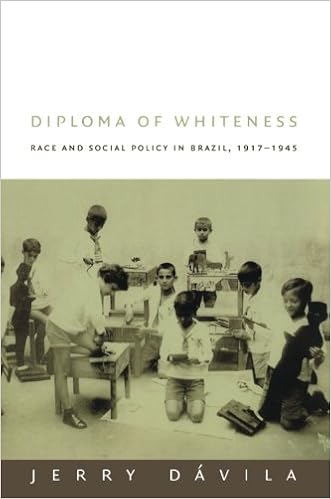
  • Diploma of Whiteness: Race and Social Policy in Brazil, 1917–1945

    Duke University Press
    2003
    312 pages, 41 illustrations
    Paperback ISBN: 978-0-8223-3070-7
    Cloth ISBN: 978-0-8223-3058-5

    Jerry Dávila, Professor of History
    University of North Carolina, Charlotte

    In Brazil, the country with the largest population of African descent in the Americas, the idea of race underwent a dramatic shift in the first half of the twentieth century. Brazilian authorities, who had considered race a biological fact, began to view it as a cultural and environmental condition. Jerry Dávila explores the significance of this transition by looking at the history of the Rio de Janeiro school system between 1917 and 1945. He demonstrates how, in the period between the world wars, the dramatic proliferation of social policy initiatives in Brazil was subtly but powerfully shaped by beliefs that racially mixed and nonwhite Brazilians could be symbolically, if not physically, whitened through changes in culture, habits, and health.

    Providing a unique historical perspective on how racial attitudes move from elite discourse into people’s lives, Diploma of Whiteness shows how public schools promoted the idea that whites were inherently fit and those of African or mixed ancestry were necessarily in need of remedial attention. Analyzing primary material—including school system records, teacher journals, photographs, private letters, and unpublished documents—Dávila traces the emergence of racially coded hiring practices and student-tracking policies as well as the development of a social and scientific philosophy of eugenics. He contends that the implementation of the various policies intended to “improve” nonwhites institutionalized subtle barriers to their equitable integration into Brazilian society.

    Table of Contents

    • Acknowledgments
    • Introduction
    • 1. Building the “Brazilian Man”
    • 2. Educating Brazil
    • 3. What Happened to Rio’s Teachers of Color?
    • 4. Elementary Education
    • 5. Escola Nova no Estado Novo: The New School in the New State
    • 6. Behaving White: Rio’s Secondary Schools
    • Epilogue: The Enduring Brazilian Fascination with Race
    • List of Abbreviations
    • Notes
    • Bibliography
    • Index
  • Tent of Miracles: Myth of racial democracy

    Jump Cut: A Review of Contemporary Media
    Number 21 (November 1979)
    pages 20-22

    Joan R. Dassin

    Tent of Miracles (Tenda dos Milagres), says its director Nelson Pereira dos Santos, is a clear direct film that confronts a human question—that of racial discrimination—with great frankness and humor.

    Completed in December 1975 and first shown in Brazil in October 1977, Tent of Miracles, based on Jorge Amada’s novel, is indeed a richly-peopled, plain-speaking, and even light-hearted picture about the persecution and survival of black African culture in Brazil. With this focus, Nelson Pereira—the patriarch of nationally-minded filmmakers in Brazil for nearly 25 years—has challenged the most widely-held false belief in his society: the myth that Brazil is a racial democracy.

    …This visual parable of “whitening” reveals the ideology implicit in the film’s defense of racial crossbreeding. It also undercuts the energetic and upbeat presentation of an autonomous Afro-Brazilian culture. Unwittingly, perhaps, Nelson Pereira repeats the error of both his literary source (Bahian novelist Jorge Amado’s 1969 novel, Tent of Miracles) and an earlier classic of Brazilian social history (Gilberto Freyre’s The Masters and the Slaves of 1933). Both works uncritically advocate miscegenation.

    Traditionally celebrated in Brazil as the means to ensure the tranquil mingling of the Portuguese, indigenous, and African races, miscegenation has long been glorified as the basis of the “cordial” national character. In contrast, the recognition that in siring the Brazilian race the Portuguese colonizers brutally imposed their will on black female slaves—after largely exterminating or subjugating recalcitrant Indian laborers—has spread very slowly. Indeed, historical truth has only recently made inroads into the national myth that Brazilians are the harmonious products of these three races, and live in an untroubled racial democracy.

    As Brazilian culture critic Sergio Augusto has pointed out, miscegenation—both as a practice and as a widely espoused doctrine—has had two pernicious effects. Rather than fostering egalitarianism, miscegenation has promoted “whitening.” Most seriously, it has denied to blacks (Indians being long out of the picture) the opportunity to develop their cultural identity as an independent group. Another Brazilian commentator, Muniz Sodré, seconds this view. Miscegenation’s hidden value of “whitening,” he asserts, is in fact a rejection of black culture in Brazil, a relegation of the Afro-Brazilian inheritance to a “source of sensationalism, a plethora of genital tricks, and an eternal supplier of recipes.”

    Lamentably, Tent of Miracles does not explore these negative consequences of miscegenation for black cultural survival in Brazil. On the contrary, the philosophy of “whitening” that lies behind supposedly egalitarian racial crossbreeding is visually and emotionally reinforced by the “success story” of Tadeu Canhoto. The U.S. viewer will probably miss the subtle racist implications of lauding miscegenation, because here the “mixed” population is considered black, and as such, is clearly subject to the will of the white majority. But in Brazil, the color line is not drawn so sharply. Indeed, the “democratic” mixing of races is the cornerstone of the dominant national ideology of race, ironically described by Brazilian sociologist Florestan Fernandes as “the prejudice of having no prejudice.”

    Defenders of the doctrine of miscegenation and the myth of racial democracy come from all quarters in Brazil. Gilberto Freyre, who with Jorge Amado is the greatest popularizer of Brazil for North Americans, has proudly noted that Brazil is growing ever “browner.” Freyre sees this trend as “proof” that the Brazilian “meta-race,” supposedly formed in equal parts by blacks, Indians and whites, is at last emerging.  Even some Brazilian blacks have themselves proposed miscegenation so that “the negro will disappear and we will not have racial conflict like they do in the United States.” As the young black Brazilian historian Beatriz Nascimento recently reflected, the 18th century dictum that “Brazil is a hell for blacks, a purgatory for whites, and a paradise for mulattos” is still the accepted national vision. The vision has only one catch: it is predicated on the “total disappearance” of those who live in “hell.”…

    Read the entire article here.
  • Hapa-Palooza challenges mixed-race stereotypes

    The Vancouver Sun
    2011-09-07

    Vivian Luk, Special To The Sun

    ‘We’re 100-per-cent whole, we’re Canadian,’ says filmmaker who faced identity struggles and discrimination while growing up

    The nickname Super Nip – partly derived from a Second World War term to describe Japanese people – and racial jokes followed Jeff Chiba Stearns everywhere when he was growing up in Kelowna.

    More common, however, was the question, “So, what are you anyway?” Back in elementary and high school, Stearns, now 32, would answer truthfully: He is half-Japanese (the other half being a mixture of English, Scottish, Russian and German).

    His “monster truck-driving, redneck” friends would treat him like Fez, the fictional foreign exchange student from Fox Network’s That ’70s Show, whose country of origin was one of the series’ longest-running jokes.

    Other times, given his slightly darker complexion, he would say for fun that he is Hawaiian or Tahitian.

    But asked that question now, Stearns, an animated filmmaker, answers, “I’m hapa.”

    “Hapa” is a Hawaiian term that describes someone of interracial descent. A new cultural festival in Vancouver this week will celebrate and raise awareness of people of mixedroots origins.

    From today to Saturday, Hapa-Palooza will feature film, literature, dance and music produced by mixedrace artists, as well as panel discussions. While the festival is meant to foster dialogue about the identity struggles and discrimination that many mixed-race Canadians face, Stearns, whose documentary on growing up in a hapa family will be featured on Thursday, said the goal is also to challenge the idea that mixed people are only part Canadian.

    “I don’t like that people refer to themselves as half because we’re not broken, we don’t need fixing,” he said. “I’ve grown to understand that we’re still 100-per-cent whole, we’re Canadian.”…

    Read the entire article here.

  • Caught up in a scientific racism designed to breed out the black

    The Sydney Morning Herald
    2008-02-14

    Debra Jopson

    She was removed as a toddler and raped as a ward of the state. Valerie Linow knows only too well the tragedy of assimilation policy, writes Debra Jopson.

    The stolen child Valerie Linow is certain she knows why she and thousands of fellow Aborigines were taken from their families and placed in institutions or with white foster families.
     
    “It was because of the colour of their skin, to make the country whiter and whiter. The way to do it was to get the half-castes out of the way,” she says.
     
    Compassionate Australians recoil from that idea, but the historical record shows that this humble pensioner from Miller, near Liverpool, transported to Bomaderry Children’s Home when she was just two, is right….

    …In 1933 a Sunday newspaper quoted Dr Cecil Evelyn Cook, dazzlingly qualified as an anthropologist, biologist, bacteriologist, chief medical officer and “chief protector” of Aborigines in North Australia, who pronounced there was no “throwback” to the black once enough white blood was bred in. “Generally by the fifth and invariably by the sixth generation, all native characteristics of the Australian Aborigine are eradicated. The problem of our half-castes will be quickly eliminated by the complete disappearance of the black race, and the swift submergence of their progeny in the white,” he said.

    “The Australian native is the most easily assimilated race on earth, physically and mentally. A blending with the Asiatic, though tending to increase virility, is not desirable. The quickest way out is to breed him white,” Cook said.
     
    Scientists and social scientists who calibrated how many drops of white blood made a person civilised gave politicians throughout Australia who were worrying about the “half-caste problem” the arguments needed to remove indigenous children from their families.
     
    The Melbourne University ethnographer Professor Baldwin Spencer, who was made chief protector of Aborigines in the Northern Territory in 1911-12, said: “No half-caste children should be allowed to remain in any native camp.”
     
    In an official 1913 report he wrote: “In practically all cases, the mother is a full-blooded Aborigine, the father may be a white man, a Chinese, a Japanese, a Malay or a Filipino.
     
    “The mother is of very low intellectual grade, while the father most often belongs to the coarser and more unrefined members of the higher races. The consequence of this is that the children of such parents are not likely to be, in most cases, of much greater intellectual calibre than the more intelligent natives, though, of course, there are exceptions to this.”
     
    It seemed only right to give children with enough drops of white blood a chance to join the superior race and for 50 years, from 1919, the NSW Government used its power to take indigenous young from their families and make them wards of the state…

    Read the entire article here.

  • Biracial and Biethnic Identity Development in Vietnamese/Caucasian Adults

    Alliant International University, San Francisco Bay
    May 2011
    75 pages
    Publication Number: AAT 3467139
    ISBN: 9781124783406

    Tien Vu

    A Clinical Dissertation Proposal Presented to the Faculty of The California School of Professional Psychology, San Francisco Bay Campus Alliant International University

    The current study explored factors that contribute to Vietnamese/White biracial identity. Three interview participants who were raised in the United States experienced less racism and discrimination than the two interviewees raised overseas. All of the participants currently have healthy and strong biracial and biethnic identity development. These findings suggest that Vietnamese/White individuals are more resilient and are more likely to have healthy outcomes than previous research has suggested.

    Table of Contents

    • Dedication
    • Acknowledgements
    • I. Introduction
    • II. Literature Review
      • Ethnic Identity Research
      • Biracial People
      • Asian-American Immigration
      • Biracial Asian-Americans
      • Vietnamese Immigration to the United States
      • Vietnamese Biracial Individuals
    • III. Methods
    • IV. Results
    • V. Discussion
    • VI. Implications
    • References
    • Appendix A: Research Study Flyer
    • Appendix B: Script of Subject Screening
    • Appendix C: Consent Form
    • Appendix D: Background Information Form
    • Appendix E: Interview Guide
    • Appendix F: Follow-Up Phone Script

    Purchase the dissertation here.

  • Variability in Race Hybrids

    American Anthropologist
    Volume 40, Issue 4 (October-December 1938)
    pages 680–697
    DOI: 10.1525/aa.1938.40.4.02a00090

    Wilson D. Wallis

    In his revised edition of The Mind of Primitive Man, Professor Boas warns against assuming “on the basis of a low variability that a type is pure, for we know that some mixed types are remarkably uniform. This has been shown for American Mulattoes, Dakota Indians, and made probable for the city population of Italy.” In a footnote to that passage he refers to the studies of Herskovits, Sullivan, and Boas, respectively, presumably in support of this position. Inasmuch as the test of variability used in those studies is the standard deviation of dimensions, and, for reasons which I shall indicate, this is not an acceptable test of variability for this purpose, it seems proper to reexamine the data on variability of race hybrids.

    Although several studies have been devoted to the results of race crossing, there are few definitive results. Some studies suggest hybrid vigor, that is, increase in dimensions over one or both parental strains. Other studies indicate that race hybrids are inferior to one or both parental strains. Some indicate that hybrids are less variable than parental strains; others, that they are more variable. The character of the results may, of course, depend upon the races crossed and upon proximity to original crossing; but on these matters there is little well attested information. Sullivan and Boas find half-breeds among Sioux and other groups taller than pure bloods among each sex. Wissler, in a series of Oglala Dakota, finds half bloods slightly shorter than full bloods. As Sullivan remarks: “No satisfactory solution of these contradictory results can be given so long as our series are incomplete in lacking the measurements on the whites with whom the Indians have mixed.” When all the data are considered, it is not clear that in race crossing any physical trait behaves as a Mendelian recessive or dominant-despite portrayals in fiction. In Hawaiian-European hybrids in Hawaii, however, Dunn finds evidence that the brachycephaly of Hawaiians is inherited as a dominant, and the European type of head (? dolchocephaly) reappears as a recessive in later hybrid generations. Hawaiians are said to contribute to the cross relatively more dominant factors than do Europeans. He finds evidence, also, of “segregation of ‘racial’ characters such as nose form, hair form, hair and skin color in diverse combinations in the F and backcross generation.” There is, however, no evidence of Mendelian inheritance in the ratios with which these traits occur, and no evidence of Mendelian inheritance of a cluster of traits…

    Read the entire article here.

  • Ambiguous Belongings: Negotiating Hybridity in Cape Town, 1940s-1990s

    Kronos: Journal of Cape History
    Number 25, Pre-millennium issue (1998/1999)
    pages 227-238

    Sean Field
    University of Cape Town

    You know you are in-between. You, you don’t fit with the Africans. You don’t fit with the coloureds. You live a normal life, but, you know you don’t fit into everything, you know? It’s with, with apartheid and whatnot, you were forced in-between (Mr. I.Z.).

    Introduction

    Cultural purity is a myth.For example, the apartheid system was constructed around the belief that pure ‘racial’, ethnic and cultural identities were not only real but that they were a desirable basis for ordering and controlling South Africa. However, at the messy level of personal experience and life strategies, the boundaries and categories of cultural identity are constantly blurred and impure. This paper documents and interprets storied fragments of interviewees who were individually classified as ‘African’ or ‘coloured’ under apartheid. These stories were selected from a broader collection of 54 oral history interviews conducted for a Doctoral study on the history of Windermere. Windermere was a part-brick, part-iron shanty community on the urban periphery of the city. This culturally mixed community emerged at the turn of the century and was eventually destroyed between 1958 to 1963 by the politicians and bulldozers of the apartheid regime.

    The rise and demise of the Windermere community of Cape Town, serves as social landscape for the focus on these energetic and emotional men and women. While resident in Windermere they were either friends or neighbours, in the aftermath of forced removals they lived in separate racially defined African and coloured group areas on the Cape Flats. While the cultural hybridity of identities are often erased or concealed, for many South Africans—not only South Africans classified ‘coloured’—this hybridity was more visible to public scrutiny. To varying degrees, the seven interviewees quoted in this paper, experienced living ‘in-between’ (or in another sense across or through) the apartheid classifications ‘African’ and ‘coloured’.

    I will argue that the mixed feelings and painful choices, experienced through living these hybrid identities must not be forgotten or ignored. A historical analysis of oral stories and story telling will be informed by psychoanalytic theory. The cultural hybridity of these interviewees have been shaped by different social, kinship and linguistic histories. They have experienced ambiguous cultural belongings, which have been interwoven with many other belongings. It is especially their sense of spatial belonging for a time and place called ‘Windermere’ which has helped them cope with their ambiguous culturalbelongings. It is particularly important that the feelings people invest in their sense of self and identity, and how others· make them feel about themselves, should be incorporated as an integral part of understanding  hybrid identity formation. It is also crucial to be sensitively aware of the forms of pain experienced by living in-between, through and across the boundaries and spaces constructed by the apartheid system…

    Read the entire article here.

  • Protest and Accommodation: Ambiguities in the Racial Politics of the APO, 1909-1923

    Kronos: Journal of Cape History
    Number 20 (November 1993)
    pages 92-106

    Mohamed Adhikari, Associate Professor of Historical Studies
    University of Cape Town

    Historical writing on the coloured community of South Africa has tended to accept coloured identity as given and to portray it as a fixed entity. The failure to take cognizance of the fluidity of coloured self-definition and the ambiguities inherent to the process has resulted in South African historiography presenting an over-simplified image of the phenomenon. The problem stems partly from an almost exclusive focus on coloured protest politics which has had the effect of exaggerating the resistance of coloureds to white racism and the advance of segregationism. Furthermore, little consideration has been given to the nature of coloured identity or to the manner in which it shaped political consciousness within the coloured community. This is particularly true of analyses of the period following the inauguration of the Union of South Africa in 1910, a time when the legitimacy of coloured identity was not in any way questioned within the coloured community and when coloured protest politics was dominated by one body, the African Political Organization (APO).

    These inadequacies are clearly evident in recent academic writing on coloured history. Richard van der Ross, in his account of the history of coloured political organization, for example, appears oblivious of the need to investigate these issues despite previously having written a polemical book on coloured racial identity. Gavin Lewis view that coloured identity is a ‘white imposed categorization’ is a simplistic formulation which ignores a wide range of evidence to the contrary. Ian Goldin’s book, written from a neo-Marxist perspective, at one point acknowledges the complexity of coloured identity but then proceeds to treat it as little more than a ploy the white supremacist state used to divide and rule the black population.

    By exploring how ambiguities and contradictions within coloured identity helped shape the political consciousness of coloureds this article seeks to draw attention to complexities of their political experience hitherto neglected by historians. It thereby also hopes to contribute to a more nuanced understanding of a crucial period in the political history of the coloured community. Special emphasis is placed on the ways in which the marginality and the intermediate status of this social group resulted in ambivalences in their political outlook. The APO, the first newspaper to be directed specifically at a coloured readership, is an ideal vehicle for such an enquiry. As the mouthpiece of an organization at the very heart of coloured communal life at a time when the direct testimony of coloured people in the historical record is scarce, the APO provides unique insights into the social identity and political attitudes within the coloured community…

    Read the entire article here.