Louisa Picquet, the Octoroon: or Inside Views of Southern Domestic Life (Electronic Edition)
Published by the Author
1861
60 pages
Hiram Mattison, A.M. (1811-1868), Pastor
Union Chapel, New York
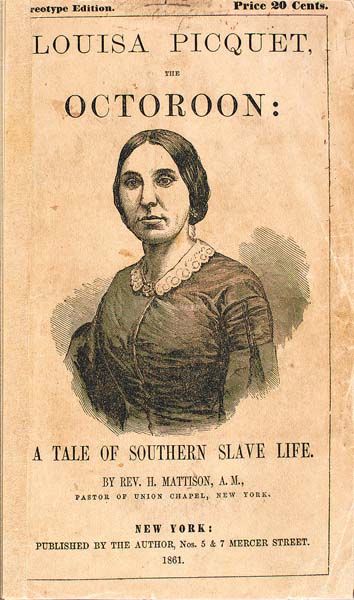

Read the entire novel here.
Scholarly perspectives on the mixed race experience.
Louisa Picquet, the Octoroon: or Inside Views of Southern Domestic Life (Electronic Edition)
Published by the Author
1861
60 pages
Hiram Mattison, A.M. (1811-1868), Pastor
Union Chapel, New York
Read the entire novel here.
Developing: Supreme Court vacates Freedmen ruling
Cherokee Phoenix
2011-08-23
Christina Good Voice, Senior Reporter
Tahlequah, Okla. – The Cherokee Nation Supreme Court issued a 16-page ruling Aug. 22 that reversed and vacated the decision of the CN District Court regarding the Cherokee Freedmen, stating that the Cherokee people had the right to amend the CN constitution and set citizenship requirements.
Acting Principal Chief Joe Crittenden addressed the ruling at the Aug. 22 council meeting in his State of the Nation.
“All of us, the council, the staff and myself got copies (of the ruling,)” he said. “I’m going to defer to our attorney general for some comments concerning this. I know there are a lot of questions on people’s minds.”
Hammons said the ruling, which was filed at 5 p.m. Monday evening, reverses the decision of the District Court…
…The court also found that the Treaty of 1866 only granted to Freedmen the rights of native Cherokees but that it was the constitution of the Cherokee people that granted them citizenship, she said.
“The freedmen at the time gained citizenship status in the Cherokee Nation by the Cherokee people’s sovereign expression in the 1866 constitutional amendment to the 1839 Cherokee Nation constitution,” according to the ruling. “It stands to reason that if the Cherokee People had the right to define the Cherokee Nation citizenship in the above mentioned 1866 Constitutional Amendment they would have the sovereign right to change the definition of the Cherokee Nation citizenship in their sovereign expression in the March 3, 2007 Constitutional Amendment.”…
Read the entire article here.
Into the box and out of the picture: The rhetorical management of the mulatto in the Jim Crow era
Duke University
2005
573 pages
Publication Number: AAT 3250085
Jené Lee Schoenfeld
Dissertation submitted in partial fulfillment of the requirements for the degree of Doctor of Philosophy in the Department of English in the Graduate School of Duke University
Contemporary conventional wisdom maintains that anyone who has any trace of black ancestry is black. This precept, known as the “one drop rule,” was not always so widely accepted; in fact, from 1850 to 1920 an intermediate racial category—mulatto—appeared on the United States Census. Visibly “both/and” in a society of “either/or,” the ambiguous body of the mulatto had the potential to obscure the color line and thus the system of racial hierarchy predicated on the division it marks. Therefore, the limited tolerance under slavery of an intermediate racial status became untenable during Jim Crow. In my dissertation, I argue that the fiction of the Jim Crow era helped the one drop rule gain hegemonic status.
Through sustained close readings of texts by Frances Harper, Thomas Dixon, Nella Larsen, Charles Chesnutt, Mark Twain, and William Faulkner, I argue that the biological determinism of the one drop rule is inadequate to explain what makes their characters—who are often physically, culturally, and even socially aligned with whiteness—”truly” black and suggest that in mulatto fiction, self-identification emerges as the fundamental basis of racial identity. I argue that fiction facilitated the containment of racial indeterminacy by “rhetorically managing” the mulatto into choosing blackness for herself through characterizations of those who remained racially liminal as tragically marginal and generally despicable, and contrasting characterizations of those who chose to identify as black as noble, privileged, and supported by the embrace of their families and their communities. The possibility of choosing one’s racial identification, however, undermines racial ideology’s essentialist pretense to racial authenticity. Therefore, choice must be supplemented by demonstrations of racial allegiance, such as “intraracial” marriage, which preserves at least the illusion of biological and cultural racial continuity, and seamless performances, of blackness or whiteness. Finally, I examine the relative authority—asymmetrical because of the construction of whiteness as pure and exclusive—of self-identification with respect to whiteness and blackness, and the near impossibility of self-identification outside this binary.
Table of Contents
Introduction
The mulatto figure in American fiction is too often treated by critics as though she is static, both within individual texts and over the course of American literary history. Critics tend to assume that the most famous version of the mulatto figure—the antebellum tragic mulatto, whose near-whiteness was used to evoke white readers’ sympathy for the abolitionist cause is the only significant template for the mulatto figure. Moreover, they take for granted the mulatto’s essential blackness, explaining away her apparent whiteness as solely a concession to white racism. My dissertation models an approach to the mulatto figure that is attentive to the figure’s development.
On the scale of American literary history, I argue that the representation of the mulatto is inextricably bound up with the (United States’) political context. Though I am also interested in the way that racial indeterminacy is represented in contemporary texts, in what I think of as the post-mulatto moment, I decided quite early on that this was better saved for a future project. I focus instead on representations of the mulatto during the Jim Crow era and how those representations differ from antebellum representations of the mulatto. At its heart, this project is fundamentally a literary one, but as I sought to explain why the mulatto was represented differently in the Jim Crow era, I became interested in the relationship between those representations and a broader social and political context.
Accordingly, I offer an interdisciplinary hypothesis that literature concerning the mulatto—what I call “mulatto fiction”—was instrumental in facilitating an historical shift in the racial structure of the United States from an antebellum racial system with some possibility of a third racial category (labeled “mulatto”) to a system that is much more rigidly a binary of black and white. The effect of this historical shift was that the mulatto “became” black. While I believe that this may be true, I want to qualify this as a provisional claim. I can and do offer (mostly in chapter one) concrete evidence that such a historical shift occurred. For example, “mulatto” appeared as a category on the United States’ census from 1850 to 1920, but from 1930 onward, mulattoes were moved into the box marked “Negro,” and thus rendered invisible as mulattoes. It is to this shift that my title, “Into the Box and Out of the Picture,” refers. To establish the causal relationship between mulatto fiction and the historical shift that I describe, at this stage I can only offer a theory about why other, more obvious, forms of racial discipline, such as the law, might have had limited power to control the mulatto’s racial identification.
I would also qualify my related claim that mulatto fiction is invested in facilitating the development of the binary racial system through the disappearance of the mulatto. Additional research into authorial biography would allow me to make that claim more forcefully, however, I stand by that claim as a description of a trend in fiction of the early Jim Crow era (in the years shortly after Reconstruction). Some of the most interesting works of mulatto fiction—those by Faulkner and Larsen, for example—are critical of the binary racial schema. Those texts, however, tend to appear later in the Jim Crow era, when the binary is already well-established. Even in those texts, as I argue at length in the body of my dissertation, the critiques are limited by the existing terms of the discourse. In Quicksand, for example, Larsen locates the “problem” of the mulatto in the system—not in her mulatto protagonist, Helga—yet she cannot imagine any positive resolution to the situation. Though Helga eventually marries a black man and settles in the most apparently “authentic” black setting—among the folk of the rural South—almost as soon as she arrives, Helga is (as usual) looking for a way out. Despite Larsen’s critique of the racial system that so confines Helga, there is no way out for her. As in earlier works of mulatto fiction, Helga must fully embrace a black racial identity or die.
Another way in which my dissertation seeks to broaden the context in which we interpret the mulatto figure is by expanding the scope of the texts we might include. I argue for the consideration of what I call “mulatto discourse,” which, in addition to literary texts, includes representations of the mulatto in such fields as law and (pseudo)science. The mulatto, especially in the Jim Crow era, is a site of contestation over the establishment and location of the color line. That is to say, the mulatto figures centrally in arguments about where whiteness (along with “legitimate” access to white privilege) ends and blackness begins. Indeed, this is a question explored in the literature I discuss, but it is a battle fought in other contexts as well. Regarding the literature, I argue that authors on both sides of the color line, and from both racist and antiracist perspectives, are invested in the racial identification of the mulatto figure. The motivation behind such an investment differs; racists, obviously, are interested in supporting racial hierarchy, whereas antiracists may hope that a strategic cssentialism will create a richer base from which to mount challenges to that hierarchy. Similarly, racists and antiracists represent the mulatto differently with respect to the question of racial identity. Racists tend to emphasize the mulatto’s degeneracy, thereby suggesting that the mulatto should not exist. Antiracists tend to push the mulatto away from racial liminality by representing the tragically marginal mulatto negatively, while drawing the mulatto into blackness by representing the “light-skinned” member of the black elite positively. Despite these variations, these approaches are part of a common discourse. What all of the fictional texts under analysis in my dissertation have in common is an interest in the possibilities (in some cases, even the necessity) and the limits of self- identification for the mulatto.
Self-identification is particularly important in mulatto discourse because of the difficulty of using the external evidence of the mulatto’s phenotype to assign the mulatto a racial classification in accord with the rules established by racial ideology, in particular, the one drop rule, which dictates that anyone with a trace of black ancestry is to be considered as unequivocally black. My work focuses on the mulatto figure, exemplified by Frances Harper’s Iola Leroy, whose phenotype suggests a white racial identity; the most “problematic” figure from the perspective of those invested in racial hierarchy. (I deliberately do not say “who could pass for white,” because then I, too, would be assuming the mulatto’s essential blackness, which I do not.) This mulatto’s apparent whiteness often contradicts her legal status as a black. (I say “often” because in some cases the mulatto is not legally black.) Racial ideology developed and deployed a set of narratives in various fields to support its insistence on the mulatto’s essential blackness despite the potentially contradictory “evidence” of phenotype, legal status, or even social acceptance in white communities. Though some texts in mulatto discourse frame their exploration of the contradiction embodied by the mulatto as a critique of the “logic” of racial ideology, the driving force of mulatto discourse during the Jim Crow era seems to be an impulse toward containment of racial ambiguity.
The ramifications for Jim Crow of the problem of the mulatto’s ambiguous body were both practical and ideological. The mulatto presented a practical problem for segregation because she could move out of the places designated for her without being detected. In other words, she could access white privilege without (according to racial ideology) being legitimately entitled to it. Furthermore, the mulatto—whose body is a concrete reminder of intimate relationships between blacks and whites—presented an ideological problem for segregation, a form of racial hierarchy that sought to institute maximum distance between the races.
Because the mulatto’s blackness does not register visually, I argue that agency assumes a greater role in the mulatto’s racial identification than it otherwise might. Racism is implicated in the stakes of how the mulatto identifies racially, but because she is not visually identifiable as black, she may not be personally subjected to racism unless she identifies as black and publicly expresses this identification. For example, in Iola Leroy, set shortly after the Civil War, Iola takes a job in a Northern white establishment as salesperson. She informs the manager that she is “colored,” and he hires her, but cautions her not to tell her fellow employees. Iola does promise this, but she does not go out of her way to broadcast her racial identification either. Then one day, a coworker is where I go.” Confused by her own reluctance to make the connection between Iola’s church attendance and her racial identification—thereby admitting that she has been working with a “colored” woman without knowing it—the other salesperson asks why Iola attends a colored church. Iola finally makes her meaning plain: “Because I wished to be with my own people” Comprehending at last, the (presumably “legitimately”) white salesperson “looked surprised and pained, and almost instinctively moved a little farther from her.” By the end of the day, the entire staff knows about Iola’s racial identification and they insist that Iola be fired, which she is. This is a very clear example of the way in which agency plays a unique role in the apparently white mulatto’s racial identification and attendant experience (or lack thereof) of racism. If she had been characterized by more obvious phenotypic cues suggesting blackness, Iola would probably never have been hired, not even by the manager inclined to give a colored girl a chance. Yet if Iola had simply lied about her church (and other personal details that may have come up), the salespeople and their customers would have continued to assume that she was “legitimately” white, and she would not have been fired…
Purchase the dissertation here.
Identity and Public Policy: Redefining the Concept of Racial Democracy in Brazil
Harvard Journal of African American Policy
2011 Edition
Krystle Norman
Krystle Norman is a recent graduate of the University of Maryland, College Park, where she received her master’s degree in public policy. In 2008, she received her bachelor’s degree from the University of Maryland in Spanish language and literature and a certificate in African American studies. Her research interests include conflict areas, social policy, identity issues, human rights, foreign policy, and parallels between communities within the African diaspora.
In Brazil, the notion that raced-based inequalities have crippled the social, economic, and political progress of Afro-Brazilians is one that is quickly denied by those who are committed to Gilberto Freyre’s concept of racial democracy. However, when disparities between “White” and “Black” Brazilians are noted, it is difficult to attribute them solely to class and not race. By analyzing important concepts coined by two distinguished sociologists, W.E.B. Du Bois and Gilberto Freyre, this article explores the way in which identity affects the ability of public policy to address inequalities in Brazil. From that dialogue, this article develops a normative view of racial democracy and puts forth recommendations that will help facilitate its expansion.
While physically the presence of Afro-Latinos throughout the Latin American diaspora cannot be denied, access to resources, equal protection under the law, and political representation continue to be restricted and, in some countries, justified by law (Cottrol 2007). Essentially, the continuing struggle of Afro-Latinos to obtain these basic rights can be seen as a major pitfall of society, but more generally, it illustrates the degree to which inequality in Latin America still persists today. Since the census is used to determine the allocation of federal funding, provide social services, and guide the creation of infrastructure projects, it serves as a means to not only address inequalities but also understand the implications of identity on public policy. Simply stated, recognition of identity is critical to effective policy making, especially within the context of a country as racially diverse as Brazil.
History of Afro-Latinos
While many Americans have learned about the history of slavery and racial inequality that lies at the very core of the African American struggle in the United States, the experience of Afro-Latinos and their plight for racial equality has not received nearly as much attention (Cottrol 2007). Considering the fact that Latin America is home to the largest population of Africans living outside of Africa itself (Andrews 2004), it is a tragedy that their struggle has been seemingly overlooked…
…Identity Issues in Brazil
Afro-Latinos have struggled to mitigate the tensions that have emerged surrounding their mixed racial heritage. For instance, in the early 1900s Latin America’s response to European pressures to“civilize” was to suppress and/or hide its African heritage, encourage White migration into the region, undergo a “modern European-style” transformation of its urban landscapes, and promote European values and culture in order to “Europeanize Latin American societies” (Andrews 2004, 119).
This strong desire for all the societal gains that were thought to accompany “blanqueamiento” (a term used to describe the Whitening of a region through the settlement of large groups of Europeans) ultimately exacerbated the rate at which Afro-Latinos were marginalized (Cottrol 2007). Psychological remnants from the slavery paradigm continued to perpetuate the problematic notion that, among other things, lighter skin was synonymous with economic and social mobility. This ideology was reinforced when European settlement was encouraged and the White elite began to solidify its influence over the political, economic, and social sectors of society (Andrews 2004). As stated by Robert Cottrol, “If the national ethos dictated that the nation was white, it was all the more prudent, particularly for those of mixed ancestry, not to declare an African heritage. Thus mestizaje [racial mixing] and blanqueamiento [Whitening] both contributed to the pronounced unwillingness of many Afro-Latinos to identify as such, even when phenotype made such identification and the resulting discrimination inescapable” (2007, 4).
Since the combination of Europeans, Native Americans, Spaniards, and Africans created such a hugely multiethnic citizenry in Latin America, this grouping made it all the more difficult to rigidly define class and political status (Andrews 2004). According to Andrews, the Afro-Latino population experienced both “Whitening”and “Blackening” phases because it lacked an appreciation and understanding for its own racial identity (2004, 10). Due to societal pressures, Afro-Latinos were forced to create an identity that was both acceptable to themselves and the larger European diaspora. As a result, social status and economic privilege were determined by one’s light skin color and closeness to a European phenotype. Society would systematically devalue Blackness, which encouraged individuals to disassociate with their African ancestry, even when their phenotype would suggest otherwise (Cottrol 2007). In this way, Brazil was able to maintain a “rigid, racial hierarchy” that reinforced the supremacy of White Brazilians (Telles 2004, 230)…
Read the entire article here.
The increasing, uncritical media attention that both [Heidi] Durrow’s work and mixed-race identity have received lately gives me pause. Accepting and embracing a mixed-race identity hardly reveals racial progress. As it is currently constructed, mixed-race identity does not dismantle racial hierarchies. Rather, it reiterates white supremacy by attempting to etch a space for itself somewhere under whiteness–which it knows it can never access–and definitely above blackness. Even claiming a mixed-race identity requires enough skin privilege to compel the (unscrupulous) gazer to ask, “What are you?”
Summer McDonald, “Canon Fodder: ‘The Girl Who Fell From the Sky’ and the Problem of Mixed-Race Identity,” Specter Magazine: Ghost+Blog, August 18, 2011.
The presence of Eurasian images in fashion representations and their absence from finance representations draw attention to the historical origins, cultural trajectories and ambivalence of meaning associated with ‘raced’ and sexed representations. Although the inclusion of Asian and Eurasian women may be intended to offset their previous absence and secure a wider multicultural appeal, they inadvertently replay processes of racialisation and sexualization. This is because they incite desires for, and identifications with, White/Western/Anglo identities authorised by essentialist and quasi-biological discourses of racialisation and sexualization.
Julie Matthews, “Deconstructing the Visual: The Diasporic Hybridity of Asian and Eurasian Female Images,” Intersections: Gender, History and Culture in the Asian Context, Issue 8, October 2002.
The tan from Ipanema: Freyre, Morenidade, and the cult of the body in Rio De Janeiro
Canadian Journal of Latin American and Caribbean Studies
October 2009
Natasha Pravaz, Associate Professor of Art
Wilfrid Laurier University, Waterloo, Ontario, Canada
She says she has brown skin, and a feverish body
And inside the chest, love of Brazil
“I am Brazilian, my body reveals
That my flag is green and yellow”
In a felicitous turn of phrase, Barbara Babcock once asserted that “what is socially marginal is often symbolically central” (1978, 38). There is no better way to describe the figure of the mulata (a light-skinned black woman) in Rio de Janeiro. As evidenced in popular culture, artistic productions, tourist brochures and TV programs, the mulata is an idealized icon in the contemporary Brazilian imagination. A polysemic category, “mulata” in the Brazilian context can refer to “a woman of mixed racial descent,” but it also connotes the voluptuosity and sensuality characteristic of women who dance the samba onstage. I use the local term mulata in order to make reference to these multiple meanings. The fascination with this local figure is inscribed within the discourse of mesticagem, a dominant narrative emphasizing the process of cultural and biological fusion of the “races,” white and black in particular, as symbol of Brazilianness. I take racial and colour categories such as “white,” “black,” “mulatto,” and “mestico” to be ideological products with material effects vis-a-vis the structuring of power relations across society. These categories acquire different symbolic value within the context of Brazilian “pigmentocracy,” where instead of a colour line, shadism permeates race relations: The lighter the skin, the greater the social value. To a point, that is.
In this article I argue that the most valued bodies in Rio de Janeiro are those of white Brazilians that are able to embody the qualities of mulattoes. In particular, I focus on the characteristics associated with mulatto women in the context of carnival, and look at how in recent years white women have progressively come to occupy the spotlight in this setting. The article explores the Brazilian fascination with the mulata in terms of stereotypes that organize images of social difference and convey specific longings and desire. It situates the emergence of this fascination within the context of colonial gender and race relations and later, the development of a national ideology focused on the value of whitening through “mixing.” I examine the discourse on mesticagem in the work of anthropologist Gilberto Freyre, the most influential thinker in the history of Brazil (Schwartzman 2000). Exploring Freyre’s glorification of the mulata, I look at how women’s bodies have become surfaces upon which masculinist and nationalist desires are deployed. I then move on to argue that morenidade (brownness), while commonly thought of as interchangeable with mulatice (mulatto-ness) as a central value and self-concept in Brazilian society, is in fact the preferred social type. I explore how morenidade is one aspect of the idealized “perfect body” in Rio’s society, and look at how local people invest their physiques with numerous techniques in order to obtain such an ideal for themselves. Woven through the article is an exploration of how these issues are expressed in the narratives of my research participants. In resonance with Malysse (2002), I conclude that Rio’s culture has become obsessed with the image bodies project as expressions of personhood, and bring to bear my reflections on morenidade upon the Carioca (from Rio) perfect body.
National Identity and the “Whitening” Strategy
Why has the mulata become the central object of desire in the Brazilian imagination? How did she become a symbol of national identity, given the generalized denigration of mulattoes in colonial times, and the debased sexual role that women of colour were subjected to? Brazilian intellectual debates over race have become central to understandings of nationhood at least since the beginning of the 20th century. Contemporary gender stereotypes are deeply imbricated with larger narratives on the role of biracial peoples in the formation of Brazil as a modern nation.
The debate over national identity and the future of the nation in Brazil was not a product of independence from Portugal. It actually began to take place at the onset of the abolition of slavery and the institution of the republic in 1889. Racism took a very particular shape in Brazilian intellectual production. It was recast under the native category of branqueamento (whitening). Late-19th and early-20th-century sociological writings in Brazil reflect the ideological supremacy of the white world. Brazilian intellectuals, however, were faced with the following theoretical problem: How to treat national identity vis-a-vis racial inequalities. The solution was to emphasize the mestico element (Ortiz 1985, 20). For the 19th-century intelligentsia the mestico was—more than a concrete reality—a category through which a sociological need was expressed: the elaboration of a national identity. According to these writers, moral and ethnic miscegenation allowed for the environmental adaptation of the European civilization to the tropics. Moreover, the result of this experience permitted the characterization of Brazilian culture as different from the European. In the local appropriation of theories of hybridization, Brazilian intellectuals posited that miscegenation would ultimately derive in a process of branqueamento, through which the gradual predominance of white traits over black ones could be ensured, in both the body and the spirit of mulattoes (see Araujo 1994, 29; Skidmore 1993). As Ortiz states, the social sciences of the time reproduced, at the level of discourse, the contradictions of Brazilian society. Whilst the notion of “racial inferiority” was used to explain Brazilian “backwardness,” the notion of mesticagem also pointed toward a possible national unity. The identity thus produced was ambiguous, integrating both the negative and the positive elements of the races in question (Ortiz 1985, 34). The emphasis placed on the ideology of whitening of the Brazilian population was articulated with the particular interests of the coffee bourgeoisie of Sao Paulo state, which achieved its political hegemony with the rise of the First Republic. State immigration policies in the last quarter of the 19th century initiated programs that attracted millions of Europeans (see Skidmore and Smith 1992). These policies tackled the scarcity of labour power (defined strictly as unavailability of slaves) and established a clear association between mesticagem, whitening, and social progress. Massive immigration programs were seen not only as a solution to the lack of labourers, “but also as part of a long-term modernizing project, in which the whitening of the national population was seen as one of the most desired consequences” (Hasenbalg 1979, 128-129).
With the emphasis on whitening as a Brazilian solution for the “problem” of the races, Brazilian intellectuals such as Joao Batista de Lacerda and Oliveira Vianna shifted away from negative views of hybridity. From thinking of miscegenation as the production of a mongrel group making up a “raceless chaos,” a degraded corruption of the originals, Brazilian intellectuals reconceptualized ideas of amalgamation using elements already present in racist theories, such as the claim that all humans can interbreed prolifically and in an unlimited way, sometimes accompanied by the melting-pot notion that the mixing of people produces a new mixed race, with merged but distinct new physical and moral characteristics (see Da Matta 1981; Skidmore 1993; Stepan 1991; Young 1995). The ideal of whitening was consistently appropriated by Brazilian intellectuals from 1880 to 1920 and became consolidated, albeit transformed, with Gilberto Freyre’s culturalism in the 1930s. Nancy Leys Stepan calls this a shift to “constructive miscegenation” that overtly challenged the notion of mulatto degeneracy and reminded the country that “we are all mestizos” (Stepan 1991, 161). This particular ideology began to play a more “positive” part in Brazilian understandings of the nation…