• For black Britons, this is not the 80s revisited. It’s worse

    The Guardian
    2011-08-11

    Joseph Harker, Assistant Comment Editor

    Our MPs are ‘on message’, our media in decline and the Commission for Racial Equality abolished. Who speaks for us?

    This is not 1981. Nor 1985. As has been pointed out over the past few days, things have changed a lot since the “inner-city unrest”—as it was quaintly named back then—erupted in Brixton, Tottenham, Toxteth, Handsworth and other parts of Britain.

    But with each passing day, the old maxim, “The more things change, the more they stay the same”, has increasing relevance. In the 80s, as now, rioting was sparked by a confrontation between black people and the police and spread to the rest of the country, including to “white” areas. In 1981, the Conservative prime minister dismissed suggestions that the Brixton riot was due to unemployment and racism. Time proved that she was badly wrong. But fast forward three decades, and David Cameron tells the House of Commons that this week’s rioting was “criminality, pure and simple”.

    In the years up to 1981, tension had been building between black people and the police over the “sus” laws, which gave officers powers to arrest anyone they suspected may be intending to steal. For them, a black youngster glancing at a handbag was enough. After Brixton, this law was repealed. Today, however, black people are seven times more likely than white people to be stopped and searched. And under the 1994 Criminal Justice and Public Order Act—which allows police to search anyone in a designated area without specific grounds for suspicion—the racial discrepancy rises to 26 times. This is symptomatic of the many ways in which, for black Britons, life seemingly improved but has steadily descended again…

    …Over the last three decades we’ve allowed ourselves to be fooled that, with greater integration, plus a few black faces in sport and entertainment, things have improved. People gush about the growing mixed-race population, supposedly Britain’s “beautiful” future. Well, Mark Duggan had a white parent but it didn’t make much difference to his prospects…

    Read the entire article here.

  • Ambiguities of Race: Science on the Reproductive Frontier of Australia and the Pacific Between the Wars

    Australian Historical Studies
    Volume 40, Issue 2, 2009
    pages 143-160
    DOI: 10.1080/10314610902849302

    Warwick Anderson, Professor of History
    University of Sydney

    The attitudes of Australian biologists, anthropologists, and historians toward race mixing in the early-twentieth century should be viewed in relation to the investigations of Indigenous depopulation and miscegenation taking place in the Pacific. Those Australian scientists committed to national or continental racial ideals–Cecil Cook and Norman B. Tindale among them–remained resistant to the lessons of the Pacific, favouring ‘half-caste’ absorption. Other scholars such as Stephen Roberts and A. P. Elkin took the oceanic approach, coming to value and harness racial hybridity. This essay shows how much of Australian racial thought drifted in from the Pacific.

    In 1925, as he shuttled between Townsville and Rabaul, Raphael Cilento wrote to extol the new tropical white man evolving in North Queensland. A fierce advocate of white racial purity, the director of the Townsville Institute of Tropical Medicine was convinced the peculiar Australian combination of selected European stock, restriction of intercourse with other races, a tropical environment and modern preventive medicine was producing a more virile white man north of Capricorn, not another degenerate type. ‘He is tall and rangy, with somewhat sharp features, and long legs and arms’, Cilento wrote. ‘Inclined to be sparely built, he is not, however, lacking in muscular strength, while his endurance is equal in his own circumstances to that of the temperate dweller in his. This North Queenslander moves slowly, and conserves muscular heat-producing energy in every possible way’. It was as though the Townsville racial visionary was channelling Marcus Clarke, only the Melbourne novelist’s sardonic 1877 prophecy of the coming man now spawned rhapsodies in the tropical heat. The race is in a transition stage’, Cilento continued, ‘and it is very apparent that there is being evolved precisely what one would hope for, namely a distinctive tropical type, adapted to life in the tropical environment in which it
    is set’. Cilento was certainly not crying in the wilderness. Ronald Hamlyn-Harris, director of the Queensland Museum and scourge of the mosquito, joined him in trying to cultivate ‘in the rising generation year after year a vision of…

    Read or purchase the article here.

  • Children of Colonialism: Anglo-Indians in a Postcolonial World

    Berg Publishers (an imprint of Macmillan)
    October 2001
    272 pages
    5 1/2 x 8 1/4 inches
    Hardcover ISBN: 978-1-85973-531-2, ISBN10: 1-85973-531-2
    Paperback ISBN: 978-1-85973-632-6, ISBN10: 1-85973-632-7

    Lionel Caplan, Emeritus Professor and Professorial Research Associate
    School of Oriental and African Studies
    University of London

    Among the legacies of the colonial encounter are any number of contemporary ‘mixed-race’ populations, descendants of the offspring of sexual unions involving European men (colonial officials, traders, etc.) and local women. These groups invite serious scholarly attention because they not only challenge notions of a rigid divide between colonizer and colonized, but beg a host of questions about continuities and transformations in the postcolonial world.

    This book concerns one such group, the Eurasians of India, or Anglo-Indians as they came to be designated. Caplan presents an historicized ethnography of their contemporary lives as these relate both to the colonial past and to conditions in the present. In particular, he forcefully shows that features which theorists associate with the postcolonial present—blurred boundaries, multiple identities, creolized cultures—have been part of the colonial past as well. Presenting a powerful argument against theoretically essentialized notions of culture, hybridity and postcoloniality, this book is a much-needed contribution to recent debates in cultural studies, literary theory, anthropology, sociology as well as historical studies of colonialism, ‘mixed-race’ populations and cosmopolitan identities.

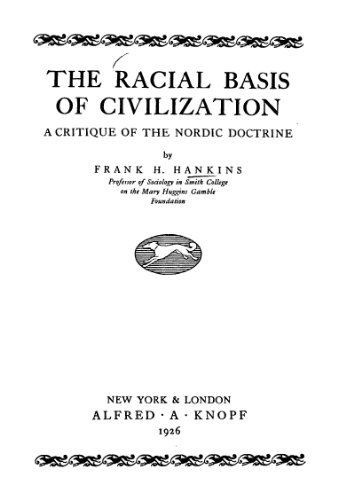
  • The Racial Basis of Civilization: A Critique of the Nordic Doctrine

    Alfred A. Knopf
    1926
    411 pages

    Frank H. Hankins, Professor of Sociology
    Smith College on the Mary Huggins Gamble Foundation
    • PART I–A CRITICAL HISTORY OF THEORIES OF BLOND RACE SUPREMACY
      • I INTRODUCTION
      • II ARYANISM
      • III GOBINISM
      • IV TEUTONISM
      • V ANTHROPO-SOCIOLOGY OR SOCIAL SELECTIONISM
      • VI CELTICISM AND GALLICISM
      • VII ANGLO-SAXONISM AND NORDICISM IN AMERICA
    • PART I–CONCEPT AND SOCIAL ROLE OF RACE
      • I INTRODUCTION
      • II CONCEPT OF RACE
      • III ARE THERE PURE RACES?
      • IV ARE RACE AND NATION IDENTIFIABLE?
      • V POLITICAL SIGNIFICANCE OF RACE
      • VI ARE RACES EQUAL?
      • VII THE PROBLEM OF RACE MIXTURE
      • VIII ARE RACIAL CHARACTERISTICS UNCHANGING?
      • IX CHANGES IN THE HEREDITARY CONSTITUTION OF A POPULATION
      • X RACE AND CULTURAL OPPORTUNITY
      • XI CONCLUSION
    • INDEX

    Preface

    The pernicious propaganda relating to the Nordic doctrine before, during, and since the war is the excuse for this book. From the closing years of the last century to the outbreak of the Great War there was in Germany a rising tide of adulation of the blond dolichocephal as the embodiment of all that was great in creative genius, organizing ability and power of leadership. Before that war actually broke many a glittering wave of that same tide had splashed resolutely and ominously on the shores of England and America. With the actual outbreak of hostilities the doctrines that the Anglo-Saxons were the purest of the Nordics and that the salvation of the world depended on the maintenance of Nordic domination were widely and loudly proclaimed. The virus of that propaganda is as yet by no means spent, though it appears to be weakening.

    The reader of this volume will be convinced that the doctrines of certain American scholars and publicists, which have been hailed by a large part of the American public as more or less fresh discoveries of American scholarship, are very old. Some of them were promulgated several centuries ago and all of them systematically set forth two generations ago. We do not attempt an exhaustive historical study of them. We have subjected a few of their outstanding formulations to internal analysis and self-criticism. When these authors cannot be convicted of gross inconsistency and made to destroy themselves, they are made to destroy each other. We do not, however, anywhere deny that the Nordic race appears to have excellent endowments; we would admit that in this respect it is one of the world’s premier races. We do deny its universal superiority, as also its claim to a monopoly of certain human excellences. We also deny that to this stock can be attributed a special historical role except in a most vague way. Our thesis is that all important historical groups have been heterogeneous in racial composition; and that all areas of high culture have been areas of extensive population movement and race mixture. In such mixtures the Nordic element has been, according to much evidence, a very valuable ingredient.

    Having exposed the fallacies, exaggerations and inconsistencies of the Nordicists, we proceed in Part II to a systematic examination of certain fundamental problems related to the significance of race as a factor in the development of civilization. We contend that racial differences are not those of kind; that all races have all human qualities ; but that they have these qualities in different degrees of development. One race may excel in physical energy, another in creative imagination. This conception does away with the notion of a general or universal superiority on the part of any one race. Moreover, in view of the wide range of variation among the members of the same race, inferiority or superiority cannot be attributed to an individual on account of his race. A short member of a tall race may be distinctly shorter than a tall member of a short race. So with intelligence, organizing ability, or artistic sense. Social barriers on account of race have, therefore, no basis in biological fact.

    A similar conclusion is reached in the study of race crossing: there is no biological mandate against it, even in the case of widely different races. The sociological grounds for opposition to race mixture are doubtless important but their importance derives almost entirely from the fact that race prejudice is a social force and not a theory. Offspring receive their hereditary endowments from their immediate ancestors ; if the parents are of high quality, so also will be the offspring, regardless of race. This fact is not altered by the crossing of races. On the other hand, every form of inferiority and deformity flourishes among the lowest strains of the Nordic stock, however pure. We think it can be shown also that race crossing is a factor in the production of talented men, and hazard the guess that most of the superior men of European history have been of mixed racial ancestry.

    In relating these findings to immigration policy we think it has been shown that the new immigrants, though in the mass less desirable from the standpoint of general intellectual abilities than the native population, nevertheless have brought into the American population endowments of aesthetic appreciation, artistic creation, and sanguine temperament that will contribute much to the enrichment of American life and culture in the years to come. Since the crossing of sound strains of different races is biologically sound, we contend that well-endowed Italians, Hebrews, Turks, Chinese and Negroes are better materials out of which to forge a nation than average or below average Nordics. From this point of view a sound immigration policy, if it could be governed by biological considerations only, would admit, without limitations of numbers, all those of whatever race who can prove themselves free from hereditary taint and pass intelligence tests which show them to be above the average of the present population in native intellectual capacity. Here again the objections are based on sociological considerations, of which the fact of racial antipathy is most important. Were it not for these traditional popular prejudices, America could do no better than to make itself a world asylum for persons of superior quality regardless of race or color.

    While we are denying the extravagant claims of the Nordicists, we also deny the equally perverse and doctrinaire contentions of the race egalitarians. There is no respect, apparently, in which races are equal ; but their differences must be thought of in terms of relative frequencies, and not as absolute differences in kind. They are like the differences between classes in the same population. It thus appears that the eugenic contentions are fundamentally sound, as against both the racialists on one extreme and the thorough environmentalists on the other. From the standpoint of the biology of population quality, superior rank within a race is of more importance than race. From the standpoint of the creation and maintenance of culture, high-grade stock is more important than cultural opportunity, though the latter is doubtless also important. The progress of a people is so greatly dependent on the abilities of its few ablest men that the primary question which a theory of the racial basis of civilization must answer is, what are those conditions which produce the greatest supply of genius? We have tried to show that this is primarily a problem of eugenics rather than of race. It is also a problem of race crossing rather than of maintenance of race purity.

    In the preparation of the manuscript I received assistance for which I am grateful from my colleague, Professor Joseph Wiehr, who assisted in the digest of certain recent German materials relating to the subject. To another colleague, Professor Howard M. Parshley, I am deeply indebted for a careful reading of the manuscript of Part II, which has greatly benefited by his numerous suggestions and criticisms. I wish also to thank Professor Robert C. Chaddock of Columbia University for permission to reproduce the graphs found on p. 265. Words are inadequate to express my gratitude to my wife and to Miss Mildred Hartsough for reading the proofs, and to the latter for compiling the Index.

    F. H. Hankins

    Smith College
    March, 1926

    Read the entire book here.

  • Skin Colour: Does it Matter in New Zealand?

    Policy Quarterly (Institute of Policy Studies, Victoria University of Wellington)
    Volume 4, Number 1 (2008)
    pages 18-25

    Paul Callister, Senior Research Fellow
    Institute of Policy Studies
    Victoria University of Wellington

    Introduction

    Pick up any official New Zealand publication which includes photographs representing the population and it is highly likely that the people featured will have visible characteristics, including skin colour, that are stereotypically associated with the main ethnic groups living in this country. Equally, examine official reports which consider differences in outcomes between groups of people, such as in health and education, and it is very likely that ethnicity will be a key variable in the analysis. But it is extremely unlikely that skin colour will be explicitly mentioned in either type of report.

    This article explores three areas where skin colour might matter. First, with reference primarily to US literature, the question of the role of skin colour in discrimination and, ultimately, economic and health outcomes is examined. Then, turning to New Zealand, there is a discussion of whether skin colour is a factor in why those responding to official surveys who identify themselves as ‘Māori only’ have, on average, worse outcomes than those reporting Māori plus other ethnicities. Finally, two connected health issues are looked at. One is skin colour and the risk of skin cancer; and the second is the hypothesised, but still controversial, links between skin colour, sun exposure, vitamin D production and an inverse risk of developing colorectal cancer. Two main questions are asked in this article. First, in contrast with many other countries, why in recent years have researchers and policy makers in New Zealand been averse to discussing and researching skin colour? Second, is there a case to be made for the use of measures other than self-identified ethnicity – such as skin colour – in official statistics and other large surveys, including health-related surveys?…

    …Single and multiple ethnicity and outcomes

    Moving back to the American context, two hypotheses have been put forward to explain the effect of mixed race on a variety of outcomes, including health status. One is that mixed-race individuals will be at greater risk of poor outcomes than those who affiliate with a single race because of stresses associated with a mixed identity. The other theory is that outcomes will lie between those of the two single groups. Many factors are likely to be influencing these outcomes, but variations in skin colour could be important, either directly or indirectly.

    In New Zealand there has been relatively limited use made to date of single versus dual and multi-ethnic responses when analysing advantage and disadvantage. However, early work by Gould (1996, 2000) suggested a gradient of disadvantage in relation to degree of ‘Māori-ness’. In his 1996 paper Gould associated Ngāi Tahu’s integration into European society with their relative success when compared with other iwi. However, while other people have talked about Ngāi Tahu as being the ‘white tribe’, skin colour was not discussed by Gould in any of his papers.

    In a number of papers, Chapple (e.g. 2000) divided the Māori ethnic group into two groups, ‘sole Māori’ and ‘mixed Māori’, and found better outcomes for ‘mixed Māori’. Chapple raised the idea that the disadvantage amongst Māori is concentrated in a particular subset: those who identify only as Māori, who have no educational qualifications, and who live outside major urban centres. Again, skin colour was not a feature of these studies.

    However, Kukutai (2003) suggests that social policy makers should not put much weight on categories such as ‘Māori only’ and ‘Māori plus other ethnic group(s)’. Using survey data and a system of self-prioritisation, Kukutai showed that those individuals who identified as both Māori and non-Māori, but more strongly with the latter, tended to be socially and economically much better off than all other Māori. In contrast, those who identified more strongly as Māori had socio-economic and demographic attributes that were similar to those who recorded only Māori as their ethnic group. Kukutai’s work shows that some people recording multiple ethnic responses feel a strong sense of belonging in more than one ethnic group. For others, however, a stronger affiliation is felt with one particular ethnic group. While not discussed directly in the study, factors such as visible difference, including skin colour, may influence such decisions.

    What is causing different outcomes between those recording only Māori ethnicity and those recording Māori and European responses? We do not know. No one single factor is likely to be a driver, but skin colour, in a variety of ways, may exert some influence. For example, it may be that those who ‘look more Māori’ (or look more ‘Pacific’) are more likely to record only Māori (or Pacific) ethnicity in official surveys. If this is correct, and if discrimination is common in New Zealand, the Māori-only (or Pacific peoples) group would be more likely to suffer discrimination from police, landlords and healthcare providers…

    Read the entire article here.

  • Prayer, and Bug Juice, at a Summer Camp for Jews of Color

    The New York Times
    2011-08-12

    Samuel G. Freedman, Professor of Journalism
    Columbia University

    PETALUMA, Calif. — On Sabbath morning, as fog still hung over the valley, the campers walked past the Torrey pines and blackberry bushes toward the garden. There, several rows of chairs had been arranged in front of an altar fashioned from a folding table covered with Senegalese cloth and a Torah scroll on loan from an Orthodox synagogue.

    About 15 minutes into the service, two girls rose to lead the congregation in a series of prayers. “Baruch atah Adonai eloheinu, melech ha-olam, she’asani Yisrael,” they said. Then they switched to the English translation: “Blessed are You, Adonai our God, Sovereign of the Universe, who has made me a Jew.”

    In all its ordinariness, as a standard part of liturgy, the assertion could hardly have been bolder, coming as it did from Amalia Cymrot-Wu and her camp buddy Maya Campbell. Maya is the daughter of an interracial black-white marriage, Amalia the product of Brazilian and Chinese bloodlines, and they were matter-of-factly proclaiming their place among the Jewish people…

    Read the entire article here. View the slide show here.

  • Preview Of Essential Guide To Working With Mixed-Race Young People

    Manchester Metropolitan University
    Tuesday, 2011-10-04, 10:00-12:30 BST (Local Time)
    Thursday, 2011-10-06, 10:00-12:30 BST (Local Time)

    ‘Political Correctness’ has gone wrong. Let us help you talk about the subject in a practical and productive way. Come along to our next training session!!

    Who we are:

    Mix-d: is the social enterprise that for the last six years has developed the UK agenda for professionals who work with mixed race young people. Our activities span schools, colleges, universities, social services departments, youth work, the criminal justice system, community groups and the training sector.

    We have engaged with 1,000s of young people, their parents, policy makers and politicians. We are currently working with colleagues in the U.S. and France and recently submitted in person a draft manifesto for working with mixed race young people to the European Commission in Brussels.

    The Mix-d: approach has influenced policy and practice by collaborating with practitioners, politicians and, most importantly, young people to challenges stereotypes, change the language and debunk the myths and historical assumptions about what it means to be “mixed-race.”

    This special half-day session will:

    • Give you deep & privileged first access to the resource.
    • Bring you totally up to speed with leading edge theory and practice.
    • Invite your feedback and input on final version of resource.

    Benefits to Professionals:

    • Offers guidance on uses of Mix-d: resources and philosophy
    • Offers guidance on supporting young people who are exploring / struggling with racial identity
    • Provides guidance for tackling the unseen issues which affect mixed-race young people and how to represent their needs in your organisation.
    • Provides practical responses to challenging comments form a young person regarding race / identity and tips on how to engage in a positive and constructive way

    For more information, click here.

  • Visually white, legally black: Miscegenation, the mulatto, and passing in American literature and culture, 1865–1933

    Illinois State University
    2004
    193 pages
    Publication Number: AAT 3128271

    Karen A. Chachere

    Many historians and literary scholars characterize the period between 1865-1933 as America’s preoccupation with the “Negro Question.” Admittedly, America was intrigued by the idea of the former slave as “citizen.” Seemingly, the more resounding question obscured behind the “Negro Question” was how whites would maintain their privilege. The answer to this question plagued America’s consciousness and manifested itself most obviously in American literature written from 1865-1933. Indeed, the novels, which emerged during this turbulent period, with their focus on miscegenation, the mulatto, and passing, accurately reflect the fear that whites felt at the thought of losing their legal, social, and economic advantages. White and black writers of the era capitalized on the nation’s fear of miscegenation and racial passing and voraciously used these themes to protest the venomous social, legal, and political conflicts that ensued over America’s desire to maintain its whiteness.

    Diverse writers such as Mark Twain, Charles Waddell Chesnutt, and Jessie Redmon Fauset debated the color line in their works. “Visually White, Legally Black: Miscegenation and the Mulatto in American Literature and Culture, 1865-1933” examines the dialectical relationship that emerged between these diverse writers through American literature’s theme of miscegenation and passing narratives and exposes the underlying issue that was not blackness, but whiteness. And yet, the mulatto’s attempt at racial passing has often been misconstrued as an indictment against the black community rather than for what it really is–an indictment against claims of racial purity and white superiority. The first four chapters of this dissertation are grounded in biographical, historical, and legal evidence in order to expose the ways in which writers negotiated the nexus of race, class, and gender. Finally, chapter five illustrates how the passing genre may be used in the literature classroom to challenge and encourage dialogue concerning race, class, and gender superiority/inferiority.

    Table of Contents

    • DEDICATION
    • ACKNOWLEDGEMENTS
    • CONTENTS
    • I. HISTORICAL, LEGAL, AND LITERARY OVERIVIEW OF RACE MIXING
      • Brief Historical Overview of Miscegenation
      • A Divided Sisterhood: The Beginning
      • Building a Case Against Race Mixing
      • Constructing Whiteness Through the Legal System
    • II. PROTECTING THE UNMARKED CATEGORY: WHITENESS RECOVERED IN MARK TWAIN’S PUDD’NHEAD WILSON
    • III. WHITE ACCOUNTABILITY IN CHARLES W. CHESNUTT’S “THE SHERIFF’S CHILDREN”
    • IV. REPRESENTATIONS OF WHITENESS IN JESSIE REDMON FAUSET’S COMEDY: AMERICAN STYLE
    • V. MISCEGENATION, THE MULATTO, AND PASSING: A TEACHING NARRATIVE
    • WORKS CITED

    Purchase the dissertation here.

  • Over the river and through the woods: Miscegenation and the American experiment

    State University of New York at Buffalo
    2007
    214 pages
    Publication Number: AAT 3277744
    ISBN: 9780549178705

    Shelby Lucille Crosby

    This dissertation examines how early American authors utilized the concept of miscegenation as a way to alter the American experiment. By invoking and exploring the paradox that Thomas Jefferson writes into existence with the Declaration of Independence and Notes on the State of Virginia, this dissertation seeks to illuminate the ways that early American authors were influenced by Jefferson’s paradoxical thoughts on race in America. How do these authors attempt to solve the Jeffersonian conundrum?

    In chapter 1, “Practical Love: Lydia Maria Child’s Hobomok, Miscegenation and Nation,” Child forwards miscegenation as a way to successfully combine Native American culture with Euro-American culture. In chapter 2, “The Body Politic and Cultural Miscegenation in Hope Leslie or, Early Times in the Massachusetts, ” I am intrigued by Sedgwick’s character, Magawisca. She becomes an agent of nation formation; it is through her that Hope learns self-control and composure. Ultimately, I interrogate Magawisca’s position in the nation state and her disappearance at the end of the novel.

    In chapter three, “Challenging the Body Politic: William Wells Brown’s Clotel; or the President’s Daughter and Jeffersonian Republicanism” and chapter four, “‘This is my Gun’: Frank J. Webb’s Radical Black Domesticity,” I shift the discussion to African American literature and its use of miscegenation. In Clotel, William Wells Brown creates a fictionalized account of Thomas Jefferson’s African American descendants. Using Jeffersonian myth, Brown invokes the nation’s founding documents and develop mulatto characters that are the physically embodiment of the Jeffersonian paradox. And in chapter four I examine Webb’s use of domesticity and miscegenation as a way to forward a new black middle class that is capable of being free and, more importantly, being citizens.

    A dissertation submitted to the Faculty of the Graduate School of the State University of New York at Buffalo in partial fulfillment of the requirements for the degrees of Doctor of Philosophy

    Table of Contents

    • Abstract
    • Introduction
    • Chapter 1: “Practical Love: Lydia Maria Child’s Hobomok, Miscegenation and Nation”
    • Chapter 2: “The Body Politic and Cultural Miscegenation in Hope Leslie or, Early Times in the Massachusetts
    • Chapter 3: “Challenging the Body Politic: William Wells Brown’s Clotel; or the President’s Daughter and Jeffersonian Republicanism”
    • Chapter 4: “‘This is my Gun’: Frank J. Webb’s Radical Black Domesticity”
    • Conclusion
    • End Notes
    • Sources

    Purchase the dissertation here.

  • San Francisco State Journalism Professor Yumi Wilson’s Multicultural Heritage Helps Connect People

    Diverse: Issues in Higher Education
    2011-08-11

    Lydia Lum

    San Francisco State Journalism Professor Yumi Wilson’s Multicultural Heritage Helps Connect People

    Yumi Wilson teaches news writing, opinion and literary journalism at San Francisco State University where she’s an associate professor of journalism. Formerly a reporter for The Associated Press and the San Francisco Chronicle, Wilson covered hundreds of major stories. They included the 1992 Los Angeles race riots after the acquittal of White police officers in the beating of Black motorist Rodney King and the controversial, voter-approved Proposition 209, which banned California’s public universities and agencies from considering race in admissions, contracting and employment. A Fulbright scholarship enabled Wilson to travel to Japan in 2001 and research military marriages, conduct interviews about interracial identities there and, with the help of translators, ask her relatives about her mother’s early life. Wilson holds an MFA in creative nonfiction writing from the University of San Francisco.

    DI: What are your observations about diversity in the news industry today?

    YW: I’m really worried. Fewer people of color are choosing journalism careers. Entry-level jobs are scarce. The pay is often so low that it seems only people whose families can afford a financial hit can get into journalism. Internships are excellent to gain experience, but nowadays they seem to last much longer than a summer and, at some point, a paying job really should kick in. I would not have been able to get into journalism if these cutbacks had occurred when I was in college. It’s disappointing that young minorities studying journalism are choosing other careers or going to graduate school without working in the field because even if they work in journalism for only five years, they would still make an impact with their energy and ideas. We’re fast losing an important voice of conscience…

    …DI: As the daughter of a Black U.S. Army soldier and a woman from northern Japan, what have you written connected to your heritage?

    YW: I wrote an essay exploring the shifting meaning of multiracial identity, which was published in a Loyola Marymount University literary journal a few years ago. And this year, I presented a paper about Black Amerasians at the Association for Asian American Studies conference. It’s reassuring to know it connects with people helping to spread knowledge.

    Read the entire article here.