• White By Definition: Social Classification in Creole Louisiana

    Rutgers University Press
    May 1986
    325 pages
    Paper ISBN: 978-0-8135-2088-9

    Virginia Dominguez, Professor of Anthropology and Latin American and Caribbean Studies
    University of Illinois, Urbana-Champaign
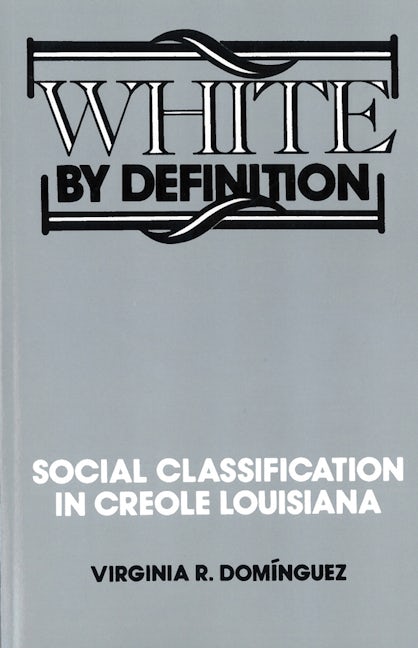
    Table of Contents

    • Preface
    • Acknowledgments
    • 1. Introduction
    • Part I: The Legal Domain
      • 2. Defining the Racial Structure
      • 3. The Properties of Blood
    • Part II: The Political Economy of Labeling
      • 4. Shaping a Creole Identity
      • 5. Racial Polarization
      • 6. Anatomy of the Creole Controversy
    • Part III: Manipulating the Practice and the Practice of Manipulating
      • 7. The Criterion of Ancestry
      • 8. The Logic of Deduction
      • 9. Conclusion
    • Appendix: Mayors of New Orleans and Governors of Louisiana
    • Notes
    • Bibliography
    • Index

    Introduction

    The tension between individual choice and social norm emerges as something of a false dichotomy, and might better be represented as a continued negotiation by actors of how to interpret the norms. … It allows us to see rules not merely as a set of constraints upon people, but as something that people actively manipulate to express a sense of their own position in the social world.

    —Michael Herzfeld in American Ethnologist, 1982

    A recent Louisiana case attracted widespread national attention. In the fall of 1982 Susie Phipps, age forty-eight, went to court to have herself declared white. The headline in the International Herald Tribune read: “Woman Challenges a Race Law: Look at Me, I’m White’; Despite Fair Skin, She is Labeled ‘Colored’ under Louisiana Statute Based on Genealogy” (October 5, 1982).’ In the December 3 People magazine, the headline read: “Raised White, a Louisiana Belle Challenges Race Records That Call Her “Colored.”‘ Even in a small North Carolina paper, the Durham Morning Herald, there was the story and the eye-catching headline: “Woman Files Suit, Says She Is White” (September 15, 1982).

    The details of Susie Phipps s life arc noteworthy, but so is the form in which the “facts” were presented to the public. In each of the headlines quoted above, the papers hinted that there may be more than one basis for racial identification. The International Herald Tribune juxtaposed physical appearance to genealogy. People magazine found a contradiction in being raised white and being called colored. The Durham paper suggested a lack of agreement between self-identification and identification by others.

    Recognition of the inexactitude of race continued in the body of each article. All report the State Bureau of Vital Statistics’ claim that she is legally colored because her great-great-great-great-grandmother was a Negress and a number of other an cestors mulattoes, quadroons, and octoroons. They note, in addition, that the bureau rested its case on a 1970 Louisiana statute that made 1/32 “Negro blood” the dividing line between white and black. To put it in perspective, they informed the public that Louisiana law traditionally held that any trace of Negro ancestry was the basis for legal blackness.

    Both People and the Tribune cited in some detail the expert testimony that anthropologist Munro Edmonson presented in court on Mrs. Phipps’s behalf. According to the Tribune, he testified that there is no such thing as a pure race, no way to determine what percentage of Negro blood Mrs. Phipps’s slave ancestor had and, thus, no way to determine what percentage black Susie Phipps is. In addition, the paper claimed Edmonson called the present law “nonsense” in an interview he granted outside the courtroom. According to People, he testified that the genealogy the bureau prepared to support its case was “impressive, [but that] it says nothing at all about Mrs. Phipps’ race.” He is quoted as saying that genes are “shuffled” before birth, making it at least theoretically possible for a child to inherit all his genes from just two grandparents. Then, as if to appeal to the public at large, the magazine went on to summarize parts of Edmonson’s testimony that, it said, might “elicit a barrage of vigorous objections”: that modern genetic studies show that blacks in the United States average 25 percent white genes and that whites average 5 percent black genes, and that by these statistics, using the 1/32 law, the entire native-born population of Louisiana would be considered black!

    In the wording of these stories, there was a shade of cynicism or disbelief—insinuations that the concept of race contained in the 1970 statute and employed by the Bureau of Vital Statistics was out of date, unscientific, and yet encoded in the law. There were insinuations that this was an issue resurrected from the plaintiff’s zeal, after all, was matched by the bureau’s perseverance—and this in a country where for about a generation there had been official racial equality under the law. The Tribune reported that her story, ‘a story as old as the country, has elements of anthropology and sociology special to this region, and its message, here in 1982 America, is that it is still far better to be white than black.” It went on to say that the 1970 Louisiana statute in question “is the only one in the country that gives any equation for determining a person’s race.” “Elsewhere,” it continued, “race is simply a matter of what the parents tell the authorities to record on the birth certificate, with no questions asked.” The thrust of the argument was the same in the piece in People magazine: “Birth certificates in most states record race for purposes of identification, census, and public health. Most states, and the U.S. States Census Bureau, now follow a self-identification policy in registering race at birth. In Louisiana, however, a 1970 statute still on the books has snared Susie and thousands of others into racial classifications determined by- fractions. … In Susie’s case, . . . the state contended that other ancestors were mulattoes, quadroons, and octoroons—outmoded/expressions denoting mixed blood (December 3, 1982, pp. 135-136; emphasis added). Months later, the New York Times reiterated the theme when it announced the repeal of the 1970 statute late in June 1983. It quoted the New Orleans state representative who wrote the law that replaces the 1970 statute, saying that the state legislature was moved to act “to reflect modern thinking” (June 26, 1983, sect. E, p. 41; emphasis added).

    It is clear throughout the media coverage that the case hinges on competing and coexisting perceptions of the nature of racial identity: the possibility of purity, the arbitrariness of calculations, the nature of reproduction, and the mutability of the criteria of identity. But in and of themselves, thesedisputed points are not novel. After three decades of active struggle for equal civil rights, continued advances in human genetics that make talk of “blood” seem primitive or folklorish, and the publication of both scholarly manuscripts and popular books proclaiming the sociocultural basis of our concepts of race, a localized argument about one woman’s racial identity hardly seems newsworthy.

    The twist, so to speak, in this case is not racial identity per se, but rather the role of law. Louisiana was singled out by the press because it had a statute with an “operative equation for the determination of race” (New York Times. June 26, 1983, sect. E, p. 41), not because it is the only state in which there are varied, often competing bases for racial identification. The issue became one of constitutionality. Did the 1970 statute infringe on the rights granted citizens by the United States Constitution? Is one of those rights the freedom to choose what one is?

    The appealing question is also a nagging one. There is, to begin with, the semblance of a contradiction. To speak of “what one is” is to imply that some identities are fixed, given, unalterable. A change of phrasing makes this clearer. “Freedom to choose what one wants to be” would contain an implicit denial of the fixedness of identity in that it suggests that it might be possible to realize one’s wishes. “Freedom to choose what one is becoming” would convey a similar message. In this case, will and desire seem irrelevant, and extra-individual forces are patently evident in the very phrase “is becoming’; but the words openly assert a process of becoming. The activity would be continuous rather than completed. In both of these alternative forms, there is room for individual choice and action and, thus, room for conceptualizing freedom to choose one’s identity. But how, after all, can we possibly conceive of freedom of choice if we take identities as givens^ And if there is really no choice, how are we to interpret the legal granting of “choice”?

    The United States Supreme Court has taken a pragmatic approach to this question in recent years. In 1944 (Korematsu v. United States. 323 U.S. 214)” and again in 1954 (Boiling v. Sharps. 347 U.S. 497), the Court argued that racial classifications must be subject to strict judicial scrutiny because they deny equal protection of the law under the Fourteenth Amendment. And in 1964 (McLaughlin v. Florida. 379 U.S. 184; Anderson v. Martin, 375 U.S. 399), it held that racial classification is “constitutionally suspect.” But in several more recent cases (cf. Shapiro v. Thompson, 394 U.S. 618 [1969]; Sherbert v. Verner, 374 U.S. 398 [ 1963]; Bates v. The Cityof Little Rock, 361 U.S. 516 [ i960]), the Court has sustained statutes that define racial categories when it has deemed such statutes necessary for the purpose of realizing compelling and constitutionally acceptable state interests (cf. Davis 1976: 199-200).

    Clearly the civil rights movement of the 1960s increased sensitivity to the existence of prejudice and led to the identification of invidious discrimination. But the issue then was the granting of rights to blacks, not the granting of the right to be white or black. The former had compelling state interest but carried ironic implications. Protecting the rights of blacks required the maintenance of a system for distinguishing blacks from whites, even though the system had come into existence for the purpose of disenfranchising those identified as black.

    To redress a legal injustice, then, the Court permits racial classification by institutions. The question is whether the Courts pragmatic concern of protecting the rights of a sector of the population that has historically been subjected to systematic discrimination infringes on the rights of individuals to opt not to be racially classified and to identify themselves racially according to their own criteria of classification…

  • The Author Speaks: Interview With Daniel J. Sharfstein

    AARP Bulletin
    American Association of Retired Persons
    2011-02-17

    Julia M. Klein

    His powerful new book examines how three American families became white

    Before Daniel J. Sharfstein’s senior year at Harvard, he spent the summer of 1993 in South Africa as a volunteer for a voter education project. There, one of his fellow workers told him she had been categorized as “colored,” or mixed-race, because a constable doing the classification appreciated her father’s service as a police officer.

    “As a result of that one simple act, she had led a very different life from her colleagues,” recalls Sharfstein, now associate professor of law at Vanderbilt University in Nashville, Tenn. “That was a revelation to me, that something that could seem as natural and inevitable as race could bend because of a personal relationship or community ties or even just individual whim.”

    He returned to the United States wondering whether the same kind of thing had happened here.

    Sharfstein’s South African experience, followed by a stint as a journalist, Yale Law School and years of archival research and interviews, led to The Invisible Line: Three American Families and the Secret Journey From Black to White. The book interweaves the story of three families with African ancestry—the Gibsons, the Spencers and the Walls—who, over time and in different ways, became identified as white. The color line in America, Sharfstein learned, has been surprisingly permeable. The AARP Bulletin talked to Sharfstein by phone.

    Q. Throughout American history, how important was physical appearance in defining whiteness?

    A. To a certain degree it was important. We have to remember that, for a long time, the United States was a rural society and almost everybody worked outside. There was a really broad range of complexions that could be considered white…

    …Q. What was the legal standard for defining whiteness in the 19th century?

    A. There really was no standard. Virginia for more than a century had a one-quarter rule. If you had one African American grandparent, that made someone legally black. Other states, like North Carolina, had a one-eighth rule, while South Carolina didn’t have any specific fraction. One South Carolina court held in the 1830s that “a man of worth, honesty, industry and respectability should have the rank of a white man, while a vagabond of the same degree of blood should be confined to the inferior caste.”…

    …Q. In slavery’s absence, you write, “preserving white privilege seemed to require new, less flexible rules about race and constant aggressive action to enforce them.” Why?

    A. What really mattered in the South, in the antebellum period, was not who was black and who was white, but who was slave and who was free. The prospect of freedom for African Americans was a motivating force getting people to think about what racial categories themselves meant. In the last days of slavery, because slavery as an institution was under such attack, white Southerners were countering with race-based justifications, and that survived the demise of slavery. After the Civil War, as black freedom was taking root, right alongside it were modern forms of racism that persist to this day.

    Q. You suggest that rigid rules about race only increased the number of people transitioning from black to white. Why was that?

    A. When rules became more rigid, they were almost always accompanied by rules that subjected African Americans to higher taxes, made it harder for them to own land and increased fear that free African Americans would be returned to slavery. The harder these laws made it to live and to provide for their children, the greater the incentives were to make the move from black to white. Because these lines were being drawn in a way that essentially separated people who looked white from [other] people who looked white, it was impossible to make the line between black and white impregnable…

    Read the entire article here.

  • Mixed Blood: Intermarriage and Ethnic Identity in Twentieth-Century America [Review: Diner]

    American Historical Review
    Volume 96, Number 2 (April 1991)
    pages 624-625

    Hasia R. Diner, Paul S. and Sylvia Steinberg Professor of American Jewish History; Professor of Hebrew and Judaic Studies
    New York University

    Paul R. Spickard. Mixed Blood: Intermarriage and Ethnic Identity in Twentieth-Century America. Madison: University of Wisconsin Press. 1989. Pp. xii, 532 pages.

    Paul R. Spickard has performed a tremendous service to historians and other students of ethnicity in writing this study of the historic patterns and changing meaning of out-group marriage. In focusing on the experiences of those Japanese Americans, American Jews, and African Americans who chose to wed nongroup members, and conversely on the experiences of white, Christian Americans as they took spouses from these three minority groups, the author seeks to link social structure and cultural constructs as explanations for particular patterns.

    Spickard ought to be credited for authoring the first serious historical hook on the subject and for taking this extremely important topic out of the sole domain of sociologists, who are eager to build models and are therefore oblivious to subtleties of time and place. Indeed, the sociological generalizations about who has intermarried and why provides Spickard with the departure point for this analysis. He ultimately tests the extant models and asks which ones work under which circumstances. No historian before has tackled this issue, and, where they have attempted to address it, they have subsumed it under the rubric of a study of one group without any benefit of comparative analysis. The fact, for example, that intermarriage rates and patterns for Americans of Japanese ancestry and Jews resemble one another discounts, according to Spickard, the importance attributable to color and physical appearance as a barrier to romance across group lines. On the other hand, among African Americans and Jews the dominant pattern of minority-group men marrying majority-group women—rather than conversely—indicates that out-group marriage patterns can, under certain circumstances, be linked to social and economic mobility.

    This study also takes the issue of intermarriage out of the hands of group activists, leaders, and apologists who are concerned about the implications of intermarriage rates for group solidarity. By offering a dispassionate and comparative study of the topic, analyzed historically and oriented toward looking for change over time, Spickard adds a note of clearheaded rationality to an otherwise intensely emotional subject. He convincingly proves that marriage outside the group does not always mean a loss to the group or a severing of the bonds between the out-marner and the community of his or her birth. Intermarriage, according to Spickard, has different meanings under varying circumstances. Spickard in no place denigrates the passionate feelings of group members worried about intermarriage or its implications for ethnic cohesion; he offers instead an alternative, cooler way of looking at the issues.

    In several other ways, this book ought to be commended and recommended. For one, he treats the issue in its complexity rather than simplicity. To really study intermarriage, the scholar must recognize that members of two groups are involved, and the behavior and attitudes of both are crucial to a thorough analysis. Second, marriage involves both genders, and a study that does not take cognizance of differences in attitude, expectations, and social positions of men and women would not adequately cover the problem. But Spickard addresses these issues and provides historians of ethnicity, gender, and race with a thoroughly researched, sophisticated analysis that should displace the usual sociologically based, model-oriented generalizations that have dominated the field.

  • Cosmopolitan or mongrel? Créolité, hybridity and ‘douglarisation’ in Trinidad

    European Journal of Cultural Studies
    Volume 2, Number 3 (September 1999)
    pages 331-353
    DOI: 10.1177/136754949900200303

    Eve Stoddard, Dana Professor of Global Studies
    St. Lawrence University, Canton, New York

    Grant H. Cornwell, President
    College of Wooster, Wooster, Ohio

    The article examines a Trinidadian calypso and its reception as a case study to weigh the discourses of hybridity, creolisation, and a local variant, ‘douglarisation’. In cultural studies discourse, ‘creolisation’ is often used synonymously with hybridization. However, it is a different metaphor, with a different genealogy, and is much more grounded in specific histories and places, namely the New World sites of plantation slavery. In Trinidad, the pejorative term ‘dougla‘ sigmfies the offspring of a union between persons of African and Indian ancestry, while ‘douglarisation’ denotes the contested processes of Afro- and Indo-Trinidadian interculturation. ‘Douglarisation’ can be read as a particular instance of both hybridity and creolisation, but with very different implications. We argue that hybridity and creolisation advance different political agendas, the former attentive to multiple roots and the latter to new connections.

    Read or purchase the article here.

  • The Invisible Line Between Black and White

    Smithsonian.com
    2011-02-18

    T. A. Frail

    Vanderbilt professor Daniel Sharfstein discusses the history of the imprecise definition of race in America

    For much of their history, Americans dealt with racial differences by drawing a strict line between white people and black people. But Daniel J. Sharfstein, an associate professor of law at Vanderbilt University, notes that even while racial categories were rigidly defined, they were also flexibly understood—and the color line was more porous than it might seem. His new book, The Invisible Line: Three American Families and the Secret Journey from Black to White, traces the experience of three families—the Gibsons, the Spencers and the Walls—beginning in the 17th century. Smithsonian magazine’s T.A. Frail spoke with Sharfstein about his new book:

    People might assume that those who crossed the line from black to white had to cover their tracks pretty thoroughly, which would certainly complicate any research into their backgrounds. But does that assumption hold?

    That’s the typical account of passing for white—that it involved wholesale masquerade. But what I found was, plenty of people became recognized as white in areas where their families were well known and had lived for generations, and many could cross the line even when they looked different. Many Southern communities accepted individuals even when they knew those individuals were racially ambiguous—and that happened even while those communities supported slavery, segregation and very hard-line definitions of race.

    So how did you find the three families you wrote about?

    It was a long process. I began by trying to find as many of these families as I could in the historical record. That involved reading a lot of histories and memoirs, and then moving from there to dozens and dozens of court cases where courts had to determine whether people were black or white, and from there to property records and census records and draft records and newspaper accounts. And I developed a list of dozens, even hundreds of families that I could be writing about, and then narrowed it down. The three families that I chose represent the diversity of this process of crossing the color line and assimilating into white communities. I chose families that lived in different parts of the South that became white at different points in American history and from different social positions.

    And how did those families come to know about their ancestry?

    For many generations, members of these three families tried to forget that they had ever been African-American—and yet when I traced the families to the present and began contacting the descendants almost everyone I contacted knew about their history. It seems that the secrets of many generations are no match for the Internet. In many families, people would talk about going to the library and seeing that it had, say, a searchable 1850 census. One woman described the experience of typing in her great-grandfather’s name, finding him, and then having to call over the librarian to go through the handwritten enumeration form with her—she had to ask the librarian what “MUL” meant, not knowing it meant he was mulatto, or of mixed race. Every family seemed to have a story like this…

    Read the entire article here.

  • A Chat with Kat: Marissa Hui, President of HapaSC

    Her Campus
    2011-02-28

    Katharine Goldman

    I remember clearly the first time someone used the term “hapa”: I was a freshman, waiting for Campus Cruiser in front of New/North, when a random guy asked me if I was hapa.

    Not knowing what it meant, I asked for a clarification. He told me that hapa is Hawaiian for half—it’s traditionally used as a term to refer to people who are half-Asian and half-Caucasian.

    Marissa Hui, a senior communications major, knows the intricacies of this term well. She’s the president of HapaSC, an organization on-campus [University of Southen California] dedicated to exploring what it means to be of mixed race, and the exploration of identity that comes with the territory.

    HC: Tell me about HapaSC.

    Marissa: HapaSC has been around campus for about 10 years. It started originally as a club specifically for students that fit the traditional meaning of “hapa:” half-Asian and half-white. Since then, it’s become an all-encompassing club for students of multiracial, multiethnic, and multicultural backgrounds.

    Our mission is to create a diverse community where people can explore their identity. Specifically we deal with a lot of topics about being mixed raced and try to cater to that student population. Sometimes students who are mixed race don’t identify completely with [single-culture] groups, or want to be able to explore their backgrounds within one group and not have to sacrifice one group for another…

    Read the entire article here.

  • College Essay Part II, Unabridged: The Undergraduate Years

    Amherst College
    The Amherst Story Project
    Fall 2008

    Brunnell Velázquez ’11

    I enjoy looking at myself in the mirror. Lately, I find that the bathroom mirrors in Morrow dormitory give off the clearest reflections of my gorgeous, most handsome features. Since it is not in my nature to carry a portable mirror, I set a picture of myself as the wallpaper for my computer and my cellular phone. I developed a tradition of attaching photos of myself to thank you notes. All of my friends cannot help but notice my vanity. But I kept telling them that not enough people tell me how beautiful I am! No really!

    What they don’t know, however, is that I use the mirror as a means for assurance—to remind myself that I do not look like how people usually perceive me.

    I tell my reflection, I don’t get it, Brunnell. You don’t look Black. You’re Latino…

    …The worst part is that people just assume that I am African-American. I get so offended; it’s like me being Korean and everyone thinks that I am Chinese. Upon meeting people, I have been asked about relations between the Black and African-American communities. I have been told, “Like wow, you’re, like, the first black guy I’ve met who’s not from Africa.” I have received caustic remarks for not being involved in the Black Student Union. A Jewish peer commented to a white friend of mine that I would get offended if she called me nigger. And he had the audacity to say it in front of me and he knew I was Latino. I apologize if the mentioning of this word offends anyone; just understand that to me it carries no emotional and historical weight…

    … It is very hard for me to believe that I am Black because I grew up with a mixed-race family. I have family members (either by blood or marriage) who represent the whole white-black spectrum. Yet, there is the word Dominican that ties us together. I have never noted racism between the lighter ones and the darker ones. I never felt ugly because of my physical features.

    Dominicans mix a lot; many cannot be easily categorized by a certain race. For example, my pastor has strong European features but has a kinky hair. A girl in my church is darker than me but has finer features and very fine hair. She looks Indian. Therefore, we transcend race and this is something I value as a Latino. Racially, we belong on the borderline between black and white.

    The idea that we, Latinos, could be further categorized is absurd to me. What are White Hispanic and Black Hispanic? A “white” Dominican is never white in the U.S. because his culture and his identification with darker Dominicans “colors” him. A darker Dominican is never Black because he identifies with lighter skin people and because he is usually mixed. Black people seem to have the most problems with me not calling myself Black. Some of them claim I am product of racism. But really I must ask them, who told them that they were Black? I know that many African-Americans come in many skin tones. I look more Black than some of my African-American peers, but I see them as mixed race people. I will not tell them that in their face, but they cannot convince me otherwise. Now, if I were Black, then I would be denying my European roots. Part of being Latino is embracing our racial roots and our mixture because it is reflected in our physical features and our culture. I am now discovering that Black isn’t really a racial identity, but a categorization that people put on to mean “not-white.” Any mark of color means you are Black, which the definition is in of itself racist. So how am I a product of racism? Identifying myself Black for me is an act of defeat to racism. I should not let racists call me something that was never part of my identity…

    Read the entire essay here.

  • Brooklyn Museum Acquires Eighteenth-Century Painting by Agostino Brunias Depicting Dominica Mixed Race Colonial Elite

    The Brooklyn Museum
    200 Eastern Parkway, Brooklyn, NY 11238-6052
    T(718) 638-5000, F(718) 501-6134
    January 2011

    Agostino Brunias (Italian, ca. 1730-1796), Free Women of Color with their Children and Servants in a Landscape, ca. 1764-1796, Oil on canvas, 2010.59, Gift of Mrs. Carll H. de Silver in memory of her husband, and gift of George S. Hellman, by exchange.

    The Brooklyn Museum has acquired, by purchase from the London Gallery Robilant + Voena, Agostino Brunias’s (1730–96) painting Free Women of Color with Their Children and Servants in a Landscape (circa 1764–96), a portrait of the eighteenth-century mixed-race colonial elite of the island of Dominica in the West Indies. Brunias, a London-based Italian painter, left England at the height of his career to chronicle Dominica, then one of Britain’s newest colonies in the Lesser Antilles.

    The painting depicts two richly dressed mixed-race women, one of whom was possibly the wife of the artist’s patron. They are shown accompanied by their mother and their children, along with eight African servants, as they walk on the grounds of a sugar plantation, one of the agricultural estates that were Dominica’s chief source of wealth. Brunias documented colonial women of color as privileged and prosperous. The two wealthy sisters are distinguished from their mother and servants by their fitted European dresses.

    The painting is a Caribbean version of contemporaneous English works made popular by artists such as William Hogarth and Thomas Gainsborough, whose art often depicts the landed gentry engaged in leisurely pursuits. Free Women of Color with Their Children and Servants in a Landscape and other Caribbean paintings by Brunias celebrate the diversity of European, Caribbean, and African influences in the region.

    Although Brunias was originally commissioned to promote upper-class plantation life, his works soon assumed a more subversive, political role throughout the Caribbean as endorsements of a free, anti-slavery society, exposing the artificialities of racial hierarchies in the West Indies. Among his supporters was Haiti’s liberator, François-Dominique Toussaint L’Ouverture, who wore on his waistcoat eighteen buttons decorated with reproductions of Brunias’s paintings.

    Free Women of Color with Their Children and Servants in a Landscape will go on view on March 7, 2011, in the European galleries, on the portraiture wall between contemporaneous female Spanish colonial and French subjects.

  • Author and scholar Adele Logan Alexander appears at the 2010 National Book Festival

    2010 National Book Festival
    Library of Congress
    Washington, D.C.
    2010-09-25
    Running Time: 00:32:45

    Adele Logan Alexander, Professor of History
    George Washington University

    Speaker Biography: Adele Logan Alexander’s research and teaching incorporate the black Atlantic world, African-American history, family history, gender issues and military and social history. Her first book examined the lives and significance of nonenslaved women of color in the rural antebellum South. Her second explored the Americanization and evolving citizenship of an African- (and Anglo-) American family in the 19th and 20th centuries. In 2003 the African American Historical and Genealogical Society recognized her contributions to the study of family history with an award for Outstanding Lifetime Contribution. She is an adjunct professor of history at George Washington University. Her books include “Homelands and Waterways: The American Journey of the Bond Family, 1846-1926” and “Ambiguous Lives: Free Women of Color in Rural Georgia.” Her latest book is “Parallel Worlds: The Remarkable Gibbs-Hunts and the Enduring (In)Significance of Race” (University of Virginia Press).

    Read the Questions and Answers transcript here.

    Audience question: In your significant study of African-American families and I guess particularly mixed families, how often did you come across the use of skin products–skin lighteners or whiteners or even darkeners; or was that something that you were able to research or was that something that was talked about at all or written about?

    Adele Alexander: Certainly I don’t write about it because I never found it in any of the people that I happen to write about. However, I’ve done a lot of work with a woman you may know about whose name is A’lelia Bundles whose great grandmother was Madame C.J. Walker who developed hair straightening–she called them hair health products, skin health products that also served to create a more–a whiter appearance. But I guess that one of the things is that it almost seems remarkable to me not that so many people did these things, but that so many did not. Because in our culture there was so much of a premium that has been placed on whiteness–day to day inconveniences, legal restrictions and everything else. It’s easy for me to understand why a number of black people wanted to be part of the majority in this country because they were so discriminated against and any steps in that direction I think were understandable.

  • Shades of White

    The New York Times
    2011-02-25

    Raymond Arsenault, Visiting Scholar, Florida State University Study Center in London
    and John Hope Franklin Professor of Southern History, University of South Florida

    Daniel J. Sharfstein. The Invisible Line: Three American Families and the Secret Journey from Black to White. New York: Penguin Press, 2011. 415 pp. Hardcover ISBN: 9781594202827.

    Racial passing is one of America’s deeply hidden traditions, a largely unacknowledged and unstudied aspect of national life. Historically, African-Americans with identifiably dark skin have had only two choices when confronting racial discrimination and oppression: either they could try to ease their burden through accommodation, making the best of a bad situation, or they could engage in protest and active resistance. The situation was often quite different, however, for light-skinned African-Americans of mixed parentage. For them, there was a tempting third option of trying to pass as white.

    In an illuminating and aptly titled book, “The Invisible Line,” Daniel J. Sharfstein demonstrates that African-Americans of mixed ancestry have been crossing the boundaries of color and racial identity since the early colonial era. An associate professor of law at Vanderbilt University and an author with a literary flair, Sharfstein documents this persistent racial fluidity by painstakingly reconstructing the history of three families. In a dizzying array of alternating chapters, he presents the personal and racial stories of the Gibsons, the Spencers and the Walls. The result is an astonishingly detailed rendering of the variety and complexity of racial experience in an evolving national culture moving from slavery to segregation to civil rights…

    Read the entire review here.