• Miscegenation, assimilation, and consumption: racial passing in George Schuyler’s “Black No More” and Eric Liu’s “The Accidental Asian”

    MELUS
    Volume 33, Number 3 (Fall 2008) Multicultural and Multilingual Aesthetics of Resistance
    pages 169-190

    Hee-Jung Serenity Joo, Associate Professor of English
    University of Manitoba

    “[E]ither get out, get white or get along.”
    —Schuyler, Black No More (11)

    “Some are born white, others achieve whiteness, still others have whiteness thrust upon them.”
    —Liu, The Accidental Asian (34-35)

    In her influential essay “Eating the Other,” bell hooks examines the ways in which race is commodified in our intensifying hypercapitalist world. She expects that “cultural, ethnic, and racial differences will be continually commodified and offered up as new dishes to enhance the white palate”. The other is “eaten” and the white self is satiated through consumption of aspects of the other’s culture—food, tattoos, music, language, tourism, or even the other’s body. Over a decade later, a casual stroll down any drug store cosmetics aisle attests to the voraciousness of this white appetite. L’Oreal’s True Match foundation line caters to a wide range of skin tones, with white, Asian, and black models posing for its stylish magazine spreads. True to hooks’s observations, the darker the color of the foundation, the more edible the skin tone becomes: on the lighter side of the pigment spectrum are colors such as “porcelain,” “alabaster,” “ivory,” “nude,” and “natural.” In contrast, the darker end includes “honey,” “caramel,” “crème café,” “cappuccino,” “nut brown,” and “cocoa.” No matter that the latter colors are also advertised as daily specials on any Starbucks menu, the blatant metaphors of consumption and the exotic appeal of dark skin juxtaposed against the purity and neutrality of light skin are hard to ignore.

    Two seemingly disparate texts, George Schuyler’s Black No More (1931) and Eric Liu’s The Accidental Asian: Notes of a Native Speaker (1998), pick up the question the cosmetic industry begs us to ask: what impact will consumerism have on the perpetually changing meaning of race in this age of late capitalism? In theory, in this post-Civil Rights world the category of race is less dependent on the state for its demands of equality; legally, at least, for example, the state no longer sanctions Jim Crow segregation or condones lynching. Perhaps in this epoch race has become a marker of personal taste, one that can be consumed by the highest bidder. In contrast to hooks’s emphasis on the white cannibalistic consumption of the other, these two texts complicate this racist schema by positing others as the ones who can consume their way out of their respective races and into the white one. This article compares the literary trope of racial passing in Black No More to the social narrative of assimilation in The Accidental Asian to show the changing nature of race under the pressures of late capitalism. In Black No More, racial passing challenges segregation laws that deny racial minorities entry into the labor market in the interest of protecting capitalist accumulation. In The Accidental Asian, assimilation is the contemporary version of racial passing; assimilation is promoted to incorporate racial minorities into the market as consumers, to make them pass into an appropriate category of consumption and whiteness. Despite their attempts at imagining a nation where race no longer matters, the persisting racial passing narratives of both texts question their proclamations of “post-racism.”

    Though written over sixty years apart, both Black No More and The Accidental Asian present eerily similar futures of an anti-racist nation premised on miscegenation. Historically, miscegenation derived from the white slave owner’s exploitation of the black female body in order to protect and increase his property. Under Jim Crow segregation, miscegenation signified a danger to the white racial “purity” of the nation in the form of a supposed black sexual threat against white women. For Asian Americans, miscegenation has served historically as a contested battleground for legal inclusion into the nation in the forms of marriage and immigration laws. At the turn of the twenty-first century, however, miscegenation sometimes is celebrated as a means to achieve a multicultural and racism-less society. Tracing the changing nature of racial passing and miscegenation in these two texts reveals the ongoing political implications of color-blind consumerism and late capitalist consumption.

    Published during the Harlem Renaissance while legal segregation flourished, Schuyler’s Black No More concerns a machine that literally turns African Americans into white (Caucasian) individuals. As Dr. Junius Crookman, the African American scientist who invents the machine, states, this will “solve the American race problem” . After all, he argues, “if there were no Negroes, there could be no Negro problem”. He then opens a business christened “Black-No-More, Incorporated” to capitalize on the success of his scientific endeavor. Predictably and often comically, instead of eliminating the race problem in the United States, Black-No-More, Inc. only thrusts the entire nation into chaos and racial paranoia by making it impossible to distinguish “real” whites from former African Americans who have “become” white via the machine. The complexities of the color line that the characters transgress attests to the intimate relationship between the state and early-twentieth-century mass production (Fordist) capitalism, which created a white working class by rejecting black bodies in the pursuit of a coherent national identity. At the same time, the thrust of the capitalist Black-No-More “machine” already foreshadows the rise of global capitalism that marks Liu’s historical moment.

    Similar to Schuyler’s novel, The Accidental Asian also attempts to depict an ideal anti-racist society. In Liu’s vision, set in an era of globalization and late capitalism, racial identities are fluid and racial passing has become a consumerist choice. He argues that in this day and age, “you don’t have to have white skin anymore to become white”. The book is Liu’s poignant memoir of assimilation into the elite upper class of the US. Journalist, author, and former speechwriter for Bill Clinton, Liu confesses that because US society conflates class and race by equating power and wealth with whiteness, the illogic of assimilation unfortunately but inevitably makes him white; therefore, as his title suggests, he is Asian only by accident. He lists a variety of specifically consumerist practices that make him white, including “wear[ing] khaki Dockers,” “eat[ing] gourmet greens,” and “furnish[ing] [his] condo a la Crate and Barrel”. The contemporary racial passing proposed by Liu shows a significant shift in the social meaning of race; now race is influenced by consumerism and flexible capital spending, rather than by the state. In Black No More, becoming white mediates the state’s racism, while Liu’s text presents a scenario in which certain assimilated and affluent people of color regard racial and ethnic identities as commodities. This relatively malleable definition of race is compounded by the ever increasing popularity of white subjects who desire to pass for exotic ethnics.

    Racial passing narratives have often been used to reveal the constructed and fragile nature of racial categories and to critique the hypocritical and discriminatory system of US democracy that equated white skin with freedom and citizenship? In African American literary history, in particular, the racial passing narrative has been an important genre. Beginning with slave narratives and continuing through the domestic “tragic mulatto” novels of the Civil War and into Harlem Renaissance literature, the trope of the racial passer has been deployed to reveal the unjust treatment of African Americans in US history.  Whether under slavery or during the Jim Crow era, mixed-race subjects with light skin often passed for white in order to gain their freedom or assert their constitutional rights.

    Read or purchase the article here.

  • Critical Mixed Race Studies Conference

    DePaul University, Lincoln Park Campus
    DePaul University Student Center
    2250 N. Sheffield
    Chicago, Illinois USA 60614
    2010-11-05 through 2010-11-06

    Sponsored by DePaul University Asian American Studies and Latin American and Latino Studies and co-sponsored by the College of Ethnic Studies at San Francisco State University and the MAVIN Foundation.

    “Emerging Paradigms in Critical Mixed Race Studies,” the first annual Critical Mixed Race Studies Conference, will be held at DePaul University in Chicago on November 5-6, 2010.

    The CMRS conference brings together scholars from a variety of disciplines nationwide. Recognizing that the diverse disciplines that have nurtured Mixed Race Studies have reached a watershed moment, the 2010 CMRS conference is devoted to the general theme “Emerging Paradigms in Critical Mixed Race Studies.”

    Critical Mixed Race Studies (CMRS) is the transracial, transdisciplinary, and transnational critical analysis of the institutionalization of social, cultural, and political orders based on dominant conceptions of race. CMRS emphasizes the mutability of race and the porosity of racial boundaries in order to critique processes of racialization and social stratification based on race. CMRS addresses local and global systemic injustices rooted in systems of racialization.

    Fanshen Cox, Tiffany Jones, and myself will participate in a Greg Carter (University of Wisconsin, Milwaukee) moderated round-table discussion titled “Exploring the Mixed Experience in New Media” on 2010-11-05 from 10:15 to 12:15 CDT at the conference.

    View the finalized schedule here.

    Organizers:

    Wei Ming Dariotis, Assistant Professor Asian American Studies
    San Francisco State University, IPride Board
    dariotis@sfsu.edu

    Camilla Fojas, Associate Professor and Chair
    Latin American and Latino Studies
    DePaul University

    Laura Kina, Associate Professor Art, Media and Design and Director Asian American Studies
    DePaul University

  • “The Ineffaceable Curse of Cain”: Racial Marking and Embodiment in Pinky

    Camera Obscura – 43
    Volume 15, Number 1
    (May 2000)
    pages 95-121
    DOI: 10.1215/02705346-15-1_43-95

    Elspeth Kydd, Senior Lecturer of Film Studies and Video Production
    University of the West of England, Bristol

    Look at my fingers, are not the nails of a bluish tinge … that is the ineffaceable curse of Cain
    Dion Boucicault, The Octoroon, or Life in Louisiana

    The 1949 film Pinky presents a central mulatto character as a method for focusing attention on issues of race and racism.(1) As one of a series of liberal films released shortly after the Second World War, Pinky approaches issues of race and racism as “social problems.” Yet this film, as do others of this movement, demonstrates more ambiguities around racial categorizations than it offers solutions for dealing with postwar racial tensions.(2) Made during the Hays Code’s ban on the representation of miscegenation, Pinky confronts the issue of interracial relations more overtly than many other films of its time by focusing its narrative on the difficulties experienced by a mixed-race woman. The character of Pinky faces crises over passing, as she is torn between her “birthright” and the “mess of pottage” that she would gain by identifying as white.

    Pinky uses the mulatto character to gain audience sympathies, exploring the effects of Southern racism by subjecting the almost-white main character to racially motivated degradations.(4) Significantly, the film embodies the mulatto through a white actress, producing an ambiguous interplay of audience identifications. The film engages multiple deployments of the mulatto character: Through the actress, through the social context of the Hays Code, through the visual conventions it deploys, and through its narrative, which draws on the historical and rhetorical development of the mulatto character. These multiple and often contradictory impulses provide the film with a complex and conflicted understanding of race. Some moments in the film seem to point to race as a cultural and social construction, whereas at other moments the absolute primacy of race as a social category is reaffirmed and consolidated. These conflicts are most significantly embodied by the main character, Pinky, since her narrative role as the mulatto, trapped between black and white, interacts with her visual portrayal as a character neither black nor white, embodied by a white actress. These ambiguities are also played out in the film’s narrative articulation of the politics of family and inheritance. The history of the representation of miscegenation and mulattos, both in literature and film, frequently focuses on the issue of family ties between black and white Americans. This dramatic “liberal” film overtly uses inheritance as a method for examining racism.

    Based on the 1946 best-selling novel Quality by Cid Ricketts Sumner, Pinky is set in the South, where Patricia “Pinky” Johnson (Jeanne Crain) has returned home from nursing school “up yonder,” in the North. She returns to the small shack where her grandmother, Dicey Johnson (Ethel Waters), makes a living as a washerwoman. As the story unfolds, it becomes clear that Pinky has been passing for white and is involved with a white man, Tom (William Lundigan), whom she is fleeing. Close to where her grandmother lives is an old, decaying plantation where lives an old, decaying member of the Southern aristocracy. Miss Em (Ethel Barrymore) is Dicey’s friend, and when she gets sick, Dicey persuades Pinky to stay on and nurse her. Pinky temporarily agrees but decides to leave as soon as possible after a series of humiliating encounters with Southern racism. When Miss Em finally dies, however, she leaves her house and all her property to Pinky. The will is then contested in court by Miss Em’s relatives, led by Mrs. Wooley (Evelyn Varden), Miss Em’s cousin. Pinky wins the case and stays, despite the appeals of Tom. She turns the house into a clinic and nursery school for the poor and oppressed black community, ultimately identifying with this community herself…

  • The Measure of America: How a rebel anthropologist waged war on racism

    The New Yorker
    2004-03-08
    18 pages

    Claudia Roth Peierpont

    Along with the Ferris wheel, the hamburger, Cracker Jack, Aunt Jemima, the zipper, Juicy Fruit, and the vertical file, the word “anthropology” was introduced to a vast number of Americans at the World’s Columbian Exposition in Chicago. Marking the four-hundredth anniversary of Columbus’s discovery of America-and opening just a little late, in May, 1893, owing to the amount of construction required to turn a marshy wasteland on Lake Michigan into a neoclassical “White City,” as the fair was called-the six-month celebration put on display all that the nation had achieved and still hoped to become. Here proud Americans could view the table on which the Declaration of Independence had been signed, the manuscript of Abraham Lincoln’s inaugural address, and two full-scale replicas of the Liberty Bell-one executed entirely in grain, the other in oranges. As for the future, the fair was ablaze with work-reducing inventions, from the electric kitchen to the electric chair. But the most important promise of an American utopia was the extraordinary assembly of peoples. American Indians and native Africans, Germans, Egyptians, and Labrador Eskimos were just a few of those invited to take part in nearly a hundred “living exhibits”-whole villages were imported and exactingly rebuilt-with the purpose of expanding American minds: “broadening, opening, lighting up dark corners,” a contemporary magazine expounded, “bringing them in sympathy with their fellow men.”

    No one was more devoted to this goal than a young anthropologist named Franz Boas, who had emigrated from Germany ten years before, staunch in the belief that America was “politically an ideal country.” Enthralled by the collections of the American Museum of Natural History, in New York, he had made his field of study the Indians of the Northwest Coast-the artistically accomplished Haida, Kwakiutl, and Bella Coola tribes-and, in the days leading up to the fair’s triumphal opening, he was busy supplying the final timbers for a pair of houses in which a Kwakiutl group would live, on the bank of a pond outside a small pavilion marked “Anthropology.” Inside was a spectacular array of masks and decorated tools, which Boas had spent two years assembling. His expectations for impressing visitors derived less from the works’ richly painted surfaces, however, than from their intellectual and imaginative content-what he described as the “wealth of thought” that was clearly visible if only people learned to look. The Indians had been asked to perform the rituals that would enable viewers to perceive this wealth, and had been assured that at the fair they would receive the respect that was their due, even if it had been no part of their experience in the old, demonstrably un-utopian New World.

    In fact, the wretched history of Indian life in nineteenth-century America had long been justified by the claims of anthropology, a field that originated during debates over slavery and the right of settlers to seize the natives’ lands, and patriotically embraced such practices as part of the natural racial order. The chief means of establishing the racial order was to measure skulls-both the conveniently empty craniums acquired through a thriving graveyard market and the more resistant living models. Anthropologists presented their findings as objective science: elaborate measuring techniques yielded columns of figures that inevitably placed white intelligence at the top of the scale, red and yellow capacities farther down, and blacks at the wholly uncivilizable bottom. It was no coincidence that this science faithfully mirrored popular opinion: published studies were so open in their manipulation of evidence-a higher proportion of male skulls, for example, were employed when larger dimensions were desired-that they appear to have been not conscious attempts at deception but unwitting examples of delusion.

    The effects of such studies, however, were painfully real. At mid-century, the anthropologist Samuel Morton asserted that whites and Negroes belonged to different species, while another anthropologist, Josiah Nott, popularized the view that slavery saved Negroes from reverting to their original barbaric state: these authoritative voices resounded in the Supreme Court’s Dred Scott decision, of 1857, in which Chief Justice Roger Taney resolved that “the Negro might justly and lawfully be reduced to slavery for his benefit.” After Emancipation, theories of separate racial evolutions fuelled the case for black disenfranchisement, right up to the passing of the first Jim Crow laws, around the time of the Chicago fair…

    Read the entire article here.

  • Passing For Horror: Race, Fear, and Elia Kazan’s “Pinky”

    Genders: Presenting Innovative Work in the Arts, Humanities and Social Theories
    Issue 40 (2004)

    Miriam J. Petty, Assistant Professor of Visual and Performing Arts
    Rutgers University, Newark

    Film genres routinely mix and evolve over time in ways that change our expectations of them, and change the way that we as audiences read and receive them. At times, however, the mixing of genres can function to focus our attention on certain film texts, and certain critical moments within these texts. While work on genre by scholars such as Thomas Schatz, Charles Maland, and Steve Neale suggests that social problem films are “too various in their narratives and thematic characteristics to warrant the label ‘genre’” (Maland 307), John Hill, Peter Roffman, and Jim Purdy observe the way that social problem films typically employ “general conventions, especially those of narrative and realism” (Roffman, Purdy 222). In this essay, I use the 1949 Hollywood film Pinky to suggest the ways in which social problem films dealing with the phenomenon of racial “passing” (instances in which light-skinned black characters “pretend” to be whites) use themes and motifs commonly found in horror films.

    A post-World War II offering from the Fox studio, Pinky represents part of what Christopher Jones calls the “culmination of the trend toward black realism in the American cinema of the forties” (110) in 1949. As Jones observes, this year saw the release of films like Lost Boundaries (also a cinematic account of a “black-as-white” passing story), Stanley Kramer’s post-war drama Home of the Brave, and the film adaptation of William Faulkner’s Intruder in the Dust. Pinky’s place as the most popular and critically acclaimed of these films dealing substantially with “blacks at home in the United States, enduring the problems of civilian life” (Jones 110-111) suggests the significance of examining the currents of fear and repression underlying its presentation of racial realities.

    In his noted essay “Ideology, Genre, Auteur,” Robin Wood posits that “in the classical Hollywood cinema motifs cross repeatedly from genre to genre,” and continues by asserting that genres “represent different strategies for dealing with the same ideological tensions” (671). As one of Hollywood’s social problem films on the theme of race, Pinky indeed addresses the profound and lasting ideological tension created by the social construct of race, the taboo of interracial relationships and the children of such relations. Pinky also casts a white actress as a “mulatto” character light-skinned enough to “pass for white,” further complicating the film’s ideological function by making “white as black” passing acceptable, while simultaneously problematizing “black as white passing,” a paradox I will discuss more fully later.

    Throughout this essay, I use the word “mulatto” or the phrase “mulatto figure” to reflect the function that such characters perform—one which disrupts the boundaries of traditional racial stratifications between blacks and whites. In fact, my analysis of Pinky frequently conflates the terms “black” and “mulatto” or “mixed-race,” identities and experiences that are not necessarily one in the same. Pinky itself conflates these terms in its storyline. What is more, historically, Hollywood films that feature the mulatto figure do not attend to such differences, but at once exploit the sensationalism in the issue of passing and use the mulatto as a generic cipher for “the race problem.” Pinky pays more attention to questions of intraracial color difference than most, but still limits Pinky’s experience to a series of problems of race that subside when she accedes to the status quo of segregation. The specificity of her ancestry only serves to give her story an unusual “angle.”…

    Read the entire article here.

  • Picturizing Race: Hollywood’s Censorship of Miscegenation and Production of Racial Visibility through “Imitation of Life”

    Genders: Presenting Innovative Work in the Arts, Humanities and Social Theories
    Issue 27 (1998)

    Susan Courtney, Associate Professor of English and Film Studies
    University of South Carolina

    “A Case Very Near the Borderline”

    Hollywood’s Production Code explicitly banned “miscegenation” from the American screen for nearly thirty years. The files of the Production Code Administration (PCA) which document the interpretation of that ban, however, demonstrate the PCA censors’ utter confusion as to the meaning of the miscegenation clause they were charged to enforce. That confusion is nowhere more apparent than in the PCA’s file on Imitation of Life (1934), a project the PCA originally rejected on the grounds that it “violate[d] the Code clause covering miscegenation, in spirit, if not in fact.” What is strikingly odd about the PCA’s original ruling in this case, however, is that while the clause of the Code that forbade miscegenation defined it as a “sex relationship between the white and black races,” no such “sex relationship” was “in fact” at issue in Imitation of Life. Indeed, like Fannie Hurst’s best-selling novel on which the script was based, the melodrama was far more concerned with relationships among black and white women than with any heterosexual relationships. Specifically, the film’s plot follows the rise to fortune of a white widow on the profits of her black maid’s pancake recipe, and is primarily centered around the relationships among these two single mothers, Bea Pullman and Delilah, and their respective daughters, Jessie and Peola. While the film shows us no heterosexual “sex relationship” between whites and blacks, the considerable extent to which Bea and Delilah function as a couple might invite us to read the relationship between these women as a “sex relationship” of its own. Delilah cooks, cleans and rears Bea’s child during the day and rubs her feet at night—the latter prompting Bea to sigh with pleasure while Delilah lectures her about the joys of passion Bea has yet to find with a man: “You need some loving honey child!” Yet as significant as Bea and Delilah’s relationship is to an understanding of the film, a reading of it as “miscegenation” seems to have been well beyond the sensibilities of the PCA censors who, in my experience, never considered “sex relationship” in anything but the most decidedly heterosexual of terms. Nevertheless, in a letter to Universal that supported (without clarifying) PCA Director Joe Breen’s nebulous interpretation of miscegenation, Will Hays, Breen’s boss, expressed the PCA’s “considerable worry” on the subject and urged the studio to drop the project, lest it “develop into a case very near the borderline.”…

    Read the entire article here.

  • Science: Environmentalist

    Time Magazine
    1936-05-11

    In Washington last week one of the world’s most distinguished anthropologists told the National Academy of Sciences about an Englishman who was raised in Italy and married a Jewess. In consequence this Englishman’s gestures gradually became half Italian, half Jewish.

    Anthropology is neither an old science like mathematics, astronomy and medicine, nor a modern one like genetics or electronics. The ancient Greeks were willing enough to assign man a place in the animal kingdom and some of them, notably Anaximander, had an inkling of evolution. But they were content to speculate and philosophize. In the early 19th Century anthropology as a science had made little headway. Species and varieties of plants and animals were considered changeless, and so were the races of man. The strange manlike bones found here & there in caves and quarries were thought to be the remains of monsters. The beliefs and practices of primitive people were shrugged off as so much sordid playacting. When the origin and fluidity of species, the significance of fossils and the rationale of primitive cultures were better understood, anthropology began to make progress as a serious study of man in all his aspects.

    Franz Boas got into anthropology 53 years ago. He has invaded almost every branch of this science: linguistics, primitive mentality, folklore, ethnology, growth and senility, the physical effects of environment. He reminds his colleagues of the oldtime family doctor who did everything from delivering babies to pulling teeth.

    By no means all anthropologists share Dr. Boas’ belief in the tremendous physical influence of environment. But when he has something to say they listen respectfully…

    …Magna Charta. Currently in England a group of scientists including Sir Arthur Smith Woodward and Julian Huxley are engaged in knocking the flimsy props from under Nazi ideas of race purity and race superiority. A quarter-century ago Franz Boas was attacking the same sort of ideas. At that time the view was popular that different races had their characteristic mentalities which determined their culture. Boas had piled up enough data to convince him that such was not the case. The Mind of Primitive Man was published in 1911. When he was elected president of the American Association for the Advancement of Science in 1931, that book was called “A Magna Charta of self-respect for the ‘lower’ races.”

    Boas observed that nowhere on earth was there such a thing as a pure race, and that the term “race” was a vague and approximate one at best. He doubted that there were any “superior” races. To Boas it seemed that if one person was innately superior to another, it was because there was more genetic difference between family lines than between racial types. Anatomists cannot tell the difference between the brains of a Swede and a Negro. They may distinguish the skulls, but it has been shown over & over that neither the size nor shape of the skull, within the range of normality, has anything to do with intelligence. Dr. Boas has no confidence in intelligence tests as measures of race superiority, because such tests cannot be divorced entirely from environment and experience. During the War it was found that Chicago Negroes did better with intelligence tests than Louisiana blacks, although the two groups were anthropologically alike…

    …Dr. Boas argues that if common race prejudice had “instinctive” antipathy for its source, it would show itself in the most intimate of all contacts, the sexual relation. But throughout history slave-owners have bedded with female slaves of different race, whites have mated with Indians and Negroes. Southern children show no aversion whatever to black nurses, must be taught by their elders not to accept blacks as equals. The strongest antipathies are those between social castes like those of India and ancient Egypt — between people of the same race…

    Read the entire article here.

  • Race-mixing and science in the United States

    Endeavour
    Volume 27, Number 4 (December 2003)
    pages 166-170
    DOI: 10.1016/j.endeavour.2003.08.007

    Paul Farber, Distinguished Professor Emeritus of History
    Oregon State University

    Scientific racism was widely used as a justification to oppose race-mixing in the United States. Historians have justly criticized this abuse of science, but have overlooked some of the important ways in which science was used in the 1930s and 1940s to overturn scientific racism and opposition to race-mixing. Of particular importance was the cultural anthropology of Franz Boas and the evolutionary biology of Theodosius Dobzhansky, which supplied arguments against racism and fundamentally altered the scientific understanding of race.

    The history of scientific racism provides a cautionary tale about the abuse of science by scientists and policy makers, and the ease with which cultural assumptions penetrate our picture of nature. It, therefore, serves as a paradigm case of the relationship of scientific ideas to their social context. Historians have generally castigated the scientists who used and abused their science to justify racist social policy. It would be a mistake, however, if in the discussion of scientific racism we lost sight of the role that science itself played in transforming modern notions of race and in combating racism. Although scholars have generated a vast and complex historical literature on racism and the use of science to legitimate it, they have not paid as much attention to the positive role science played. The history of ideas on race-mixing in the US provides a convenient lens through which to focus on some of the central ideas concerning race and racism, and it is a story that can help make clearer the role science had in influencing the discussion.

    A young couple in the 1960s most likely would not have consulted a biology book to help decide if their different racial backgrounds posed an obstacle to getting married and raising a mixed-race family. But, this is not to say that what went for scientific opinion would have been irrelevant to their decision. In many subtle, and some not-so subtle, ways, scientific judgements influence individual choice, social acceptance and legal constraints. Before 1967, 17 states had anti-miscegenation laws that prohibited marriages involving individuals of certain different races, and an extensive body of literature justified those laws by reference to science. In the three decades before the 1967 US Supreme Court ruled in Loving versus Virginia that such laws were unconstitutional, a shift in thinking occurred in the US concerning inter-racial marriage. In part, that shift reflected a new social landscape altered by World War II, the Civil Rights Movement and the 1960s cultural upheaval. But science also played an important, if generally unrecognized, role in that transformation. In particular the work done in anthropology by Franz Boas and his students, and by Theodosius Dobzhansky and others in formulating the modern theory of evolution were central to the contributions made by scientists to the understanding of race and race-mixing…

    Read the entire article here.

  • Comparing biracials and monoracials: Psychological well-being and attitudes toward multiracial people

    The Ohio State University
    2008
    108 pages
    Publication ID: AAT 3332205

    Peter J. Adams

    A Dissertation Presented in Partial Fulfillment of the Requirements for the Degree Doctor of Philosophy in the Graduate School of The Ohio State University

    The study of biracial individuals and their unique experience has been limited. As biracial individuals increase in number, understanding their experiences will become more important to psychologists and mental health professionals.

    The purpose of the study was to compare biracial individuals and monoracial individuals on measures of psychological well being, ethnic identity, and attitudes towards biracial people. The present study examined one general research question and three hypotheses: General Research Question & Hypotheses . (1) Will scores on measures of ethnic identity, individual self-esteem, collective self-esteem, subjective well being, and attitudes toward biracial children significantly differ between biracial and monoracial groups? (2) Bracey, Bamara, and Umana-Taylor’s (2004) results on self-esteem and ethnic identity will be replicated in this study on adults. (3) When compared to monoracial individuals, biracial individuals will have significantly more positive attitudes towards biracials (4) A positive relationship exists between psychological well being and attitudes towards biracials for biracial individuals.

    Participants completed a web-based survey from an undisclosed location of their choosing. Participants were solicited from various multicultural and professional psychology list serves and through Ohio State University’s Research Experience Program.

    Results indicated that biracial adults appear to be as psychologically well adjusted as their monoracial counterparts. Results even suggested that biracial adults have more realized ethnic identities than their monoracial counterparts. Bracey et al.’s (2004) results were replicated in the present study (biracials were found to be as psychologically well adjusted as monoracials). Also, a positive relationship was found between biracial individuals’ psychological well being and their attitudes towards multiracial children. Support for the second hypothesis was not found – biracial individuals in the study did not have more positive attitudes toward biracials than their monoracial counterparts.

    Implications of the findings along with the limitations of the study are discussed. Recommendations of future research are also given.

    Purchase the dissertation here.

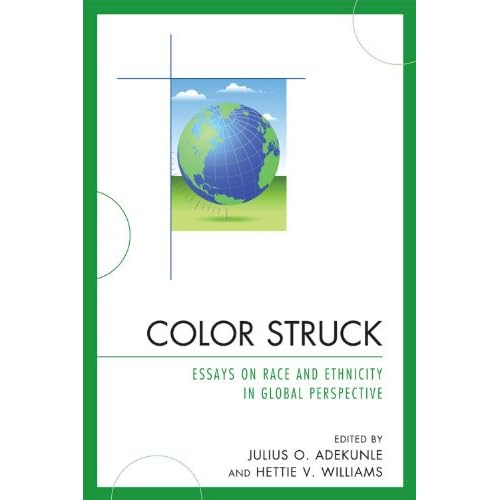
  • Color Struck: Essays on Race and Ethnicity in Global Perspective

    University Press of America
    April 2010
    516 pages
    Paper ISBN: 0-7618-5064-3 / 978-0-7618-5064-9
    Electronic ISBN: 0-7618-5092-9 / 978-0-7618-5092-2

    Edited by

    Julius O. Adekunle, Professor of History
    Monmouth University, West Long Branch, New Jersey

    Hettie V. Williams, Lecturer, African American History
    Department of History and Anthropology
    Monmouth University, West Long Branch, New Jersey

    Color Struck: Essays of Race and Ethnicity in Global Perspective is a compilation of expositions on race and ethnicity, written from multiple disciplinary approaches including history, sociology, women’s studies, and anthropology. This book is organized around a topical, chronological framework and is divided into three sections, beginning with the earliest times to the contemporary world. The term “race” has nearly become synonymous with the word “ethnicity,” given the most recent findings in the study of human genetics that have led to the mapping of human DNA. Color Struck attempts to answer questions and provide scholarly insight into issues related to race and ethnicity.

    Table of Contents

    Preface
    Acknowledgements
    Introduction

    Part 1: The First Complex Societies to Modern Times

    1. Race, Science, and Human Origins in Africa
    Julius O. Adekunle

    2. Race and the Rise of the Swahili Culture
    Julius O. Adekunle

    3. ‘Caste’-[ing] Gender: Caste and Patriarchy in Ancient Hindu Jurisprudence
    Indira Jalli

    4. Comparative Race and Slavery in Islam, Judaism, and Christianity: Texts, Practices, and Current Implications
    Magid Shihade

    5. The Dark Craven Jew: Race and Religion in Medieval Europe
    James M. Thomas

    6. Growth of the Atlantic Slave Trade: Racial Slavery in the New World
    Kwaku Osei Tutu

    7. The Yellow Lady: Mulatto Women in the Suriname Plantocracy
    Hilde Neus

    Part 2: Race and Mixed Race in the Americas

    8. Critical Mixed Race Studies: New Approaches to Resistance and Social Justice
    Andrew Jolivétte

    9. Militant Multiraciality: Rejecting Race and Rejecting the Conveniences of Complicity
    Rainier Spencer

    10. Whiteness Reconstructed: Multiracial Identity as a Category of “New White”
    Kerry Ann Rockquemore and David L. Brunsma

    11. Conversations in Black and White: The Limitations of Binary Thinking About Race in America
    Johanna E. Foster

    12. The Necessity of a Multiracial Category in a Race-Conscious Society
    Francis Wardle

    13. Mixed Race Terminologies in the Americas: Globalizing the Creole in the Twenty First Century
    DeMond S. Miller, Jason D. Rivera, and Joel C. Telin

    14. Examining the Regional and Multigenerational Context of Creole and American Indian Identity
    Andrew Jolivétte

    15. Race, Class, and Power: The Politics of Multiraciality in Brazil
    G. Reginald Daniel and Gary L. Haddow

    16. All Mixed Up: A New Racial Commonsense in Global Perspective
    G. Reginald Daniel and Gary L. Haddow

    Part 3: Race, Ethnicity, and Conflict in Contemporary Societies

    17. Black No More: African Americans and the ‘New’ Race Science
    Hettie V. Williams

    18. Contesting Identities of Color: African Female Immigrants in the Americas
    Philomina Okeke-Ihejirika

    19. Burdened Intersections: Black Women and Race, Gender, and Class
    Marsha J. Tyson Darling

    20. Ethnic Conflicts in the Middle East: A Comparative Analysis of Communal Violence within the Matrix of the Colonial Legacy, Globalization, and Global Stability
    Magid Shihade

    21. Ethnic Identity in China: The Politics of Cultural Difference
    Dru C. Gladney

    22. Shangri-la has Forsaken Us: China’s Ethnic Minorities, Identity, and Government Repression
    Reza Hasmath

    23. The Russian/Chechen Conflict and It’s Consequences
    Mariana Tepfenhart

    Contributors
    Index