• Chameleon Changes: An Exploration of Racial Identity Themes of Multiracial People

    Journal of Counseling Psychology
    Volume 52, Number 4 (October 2005)
    pages 507-516
    DOI: 10.1037/0022-0167.52.4.507

    Marie L. Miville
    Teachers College, Columbia University

    Madonna G. Constantine
    Teachers College, Columbia University

    Matthew F. Baysden
    Oklahoma State University

    Gloria So-Lloyd
    Oklahoma State University

    The current study explored essential themes of racial identity development among 10 self-identified multiracial adults from a variety of racial backgrounds. Participants were interviewed using a semistructured protocol, and the interviews were recorded, transcribed, and then coded for themes by research team members. Four primary themes were identified: encounters with racism, reference group orientation, the “chameleon” experience, and the importance of social context in identity development. A number of subthemes also were identified. Although several of the themes mirrored those associated with contemporary biracial and multiracial identity development models, new themes centering on the adoption of multiple self-labels reflecting both monoracial and multiracial backgrounds emerged as well. Implications of the findings for future research and practice are identified.

    Read the entire article here.

  • Multiracial-heritage awareness and personal affiliation: Development and validation of a new measure to assess identity in people of mixed race descent

    Fordham University
    2003-03-05
    222 pages
    Publication ID: AAT 3098135

    SooJean Choi-Misailidis

    Dissertation submitted in partial fulfillment of the requirements for the degree of Doctor of Philosophy in the Department of Psychology at Fordham University

    The Multiracial-Heritage Awareness and Personal Affiliation (M-HAPA) Theory was proposed to account for mixed race identity. M-HAPA Theory suggests that mixed race identity could be conceptualized by three identity types: Marginal Identity Status, in which the individual does not affiliate with any of the racial groups in their heritage; Singular Identity Status, in which an individual affiliates solely with one racial group in their heritage; and Integrated Identity Status, in which the mixed race individual integrates many racial groups into their identity.

    A self-report measure (M-HAPAs), based on the M-HAPA Theory, was devised and administered to a diverse group of 364 multiracial individuals. Participants were recruited through three major universities in Hawaii. Psychometric properties of the measure were evaluated; the new instrument demonstrated good internal consistency reliability. An exploratory factor analysis revealed that though both 3- and 4-factor models were interpretable, the extraction of the 4-factor model was indicated. Further examination of the results of the exploratory factor analysis revealed that Integrated Identity Status was composed of two sub-types: the Combinatory Factor, in which the mixed race individual integrates their affiliations with all of the racial groups in their heritage into their identity; and the Universality Factor, in which the individual identifies with the commonalities among all racial groups.

    Construct validity was evaluated by comparing the participants’ responses on the M-HAPAs to measures of ethnic identity, ego identity, self-esteem and social desirability. The findings were, in general, consistent with hypotheses drawn from the preponderance of literature that suggested relationships between these variables. The results of the current study lend support to the validity of the proposed Multiracial-Heritage Awareness and Personal Affiliation Theory.

    Purchase the dissertation here.

  • Relation of multiracial identity statuses to psychosocial functioning and life satisfaction

    State University of New York, Albany
    2007
    129 pages
    Publication Number: AAT 3272360
    ISBN: 9780549120537

    Krista Marguerite Damann

    The current “multiracial baby boom” (i.e., the steady increase in this population as well as in the ability to identify them from census data) underscores the need for research on normative experiences of mixed race individuals. The current study, which tested the relation of multiracial identity statuses to psychosocial functioning, was based on the Multiracial-Heritage Awareness and Personal Affiliation (M-HAPA) theory of multiracial identity, developed by Choi-Misailidis (2004). This identity model consists of four multiracial identity statuses: (a) marginal, or lack of affiliation with any racial group, (b) singular, or the affiliation with one racial group to the exclusion of others, (c)  integrated-combinatory, or an identification that combines the racial heritages of both parents, and (d) integrated-universality, or a sense of connection with members of other racial groups. Specifically, the purpose of this study was to explore the degree to which the four multiracial identity statuses as defined in the M-HAPA theory differentially predicted self-reported self-esteem, depression, life satisfaction, and social functioning in a national sample of nonclinical multiracial adults.

    Results indicated that as a group, the four M-HAPA statuses significantly predicted substantial, unique proportions of variance in participants’ reported self-esteem, depression, life satisfaction, and social functioning, over and above various demographic factors (i.e., age, annual income, education level, marital status, and current mental health treatment). However, only two of the four identity statuses, marginal and integrated-combinatory, were uniquely associated with the criterion variables. As predicted, the marginal status was associated with relatively poorer psychosocial functioning, whereas the integrated-combinatory was associated with relatively better psychosocial functioning. Moreover, as predicted, no unique relationship was found between singular and levels of depression. As a group, the multiracial identity statuses accounted for the greatest variance in social functioning (21%).

    All results are tempered by the mediocre fit of the data to the M-HAPA model, as indicated by a confirmatory factor analysis and by the small proportion of the sample endorsing “some agreement” with the marginal and singular identity statuses.

    The results are discussed with respect to theory, research, and practice. Suggestions for further study of this understudied population are provided.

    Purchase the dissertation here.

  • Multiracial Identity Week at Brown University

    Multiracial Identity Week
    Brown Univeristy
    2010-10-24 through 2010-10-31

    Featured Event: Convocation with Rebecca Walker

    Rebecca Walker, one of Time magazine’s 50 most influential leaders of her generation, will give the opening address for the Third World Center’s Multiracial Identity Week. The author of three anthologies and two memoirs, including Black, White, and Jewish: An Autobiography of a Shifting Self, Walker’s work offers new approaches to ideas about race, class, culture, and the evolution of the human family. Following the address, Walker will sign copies of her books. This event takes place at 7 p.m. in the Salomon Center for Learning, De Ciccio Family Auditorium.

    For more information, click here.

  • Letter to the Editor: Multi-ethnic clubs benefit community

    Daily Bruin
    University of California, Los Angeles
    2010-10-18

    Thomas Lopez, Alumnus
    University of California, Berkeley

    What’s in a name?

    Answering that question can be difficult for some multiracial students. So often throughout history, names have been given for us, many of them pejorative, that it becomes difficult for multiracial people to pick just one. I suppose it’s no wonder, then, that when we choose to name ourselves, or the organizations we form, that someone will take an affront to it.

    Salim Zymet, in his article “UCLA needs more than just one multiethnic club” (Oct. 12), seems to be simultaneously lamenting the dearth of multiethnic/multiracial organizations as well as the proliferation of others. It is unclear what organizations he may be a member of, if any, although he does make it clear that he “would never fathom joining the Hapa Club because of the word’s association to Asian heritage.”

    I have been active in the multiracial community for almost 20 years in various organizations. This community includes multiracial and multiethnic people, interracial couples and trans-racially adoptive families. I believe that the more awareness we raise about the multiracial community, the better society may become.

    I may not have the solution to Mr. Zymet’s dilemma, but I can offer up this story. During the early ’90s I was an undergraduate student at UC Berkeley. I joined a student group there called the Multicultural Interracial Students Coalition (MISC) or “miscellaneous” for short. A little tongue-in-cheek, I know, but better than the original name Students of Interracial Descent…

    Read the entire letter here.

  • Nella Larsen and the Veil of Race

    American Literary History
    Volume 9, Number 2 (Summer, 1997)
    pages 329-349

    George Hutchinson

    People see what they want to see, and then they’ll claim you.  Not claim you, but label you. Because it’s not really about claiming you.  The white people don’t want you around.  You’re not really white… And for Blacks—and it’s not for all Blacks—there’s sort of this feeling that, yeah, she is black and yes, we’ll call her black, but she’s not black like we are… I was recognized by the black community as an outstanding black student, of course.  That used to upset me, that they would claim me because I did well academically, but I wasn’t a part of their world.

    Heidi Durrow, daughter of Danish mother and African-American father, quoted in Lise Funderburg, Black, White, Other

    White studies of cultural syncretism, transnationalism, and “hybridity” have lately become all the rage, there is one area in which claims of racially “hybrid” identity are still subtly resisted, quietly repressed, or openly mocked.  The child of both black and white parents encounters various forms of incomprehension in a society for which “blackness” and “whiteness” seems to constitute two mutually exclusive and antagonistic forms of identity.  Moreover, the shift to terms presumably marking ethnic or cultural descent—“European” and “African”—has done little to clarify the situation of those “black” subjects who are at the same time, say, German, or, as in the case of the young woman quoted above, Danish-American.

    For more than a decade, the strongest Nella Larsen scholarship has been motivated by a reaction against earlier approaches to her fiction that stressed the importance of biracial subjectivity, connected to fiction of the “tragic mulatto.”  The best recent criticism tends to focus on other issues, particularly feminist themes.  Often the difficulties of Larsen’s mulatto characters are treated as metaphors for supposedly more important issues such as black and/or female identity generally…

    Read or purchase the article here.

  • The Influence of Bob Marley’s Absent, White Father

    The Dread Library
    Essays from the University of Vermont Class, Rhetoric of Reggae Music
    2002-04-30

    Scott Gurtman

    My fadda was a guy yunno, from England here, yunno?  Him was like…like you can read it yunno, it’s one o’dem slave stories: white guy get the black woman and breed her.  He’s a English guy…I t’ink.  Cos me see him one time yunno.  My mother?  My Mother African.”   (Bob Marley, 1978)

    The psychological aftermath of being an abandoned child of a biracial marriage was something that heavily influenced reggae superstar Bob Marley for his entire career.  Many of Marley’s most loyal fans and the vast majority of reggae enthusiasts are unaware that he was, indeed, born to a white father, Captain Norval Marley, and a black mother, Cedella Booker.  Bob Marley grew up angry with his father who he felt had mistreated him and his mother. Marley was also partially ashamed of his white heritage.  This childhood mentality of resentment and embarrassment sculpted Marley’s youth and eventually influenced the ideals and work of his musical genius for his entire career.  The sentiment of abandonment and the lack of a father figure forced Bob Marley to look to other means, like the ideals of Rastafarianism, for direction, comfort, and a sense of belonging.  The strong allegiance to black culture that resulted from the absence of his white father also partially attributed to Marley’s unwaveringly sense of Pan-Africanism.  The imperfections and almost total absence of Bob Marley’s Caucasian father, Captain Norval Marley, had a profound psychological influence on the great reggae icon…

    Read the entire article here.

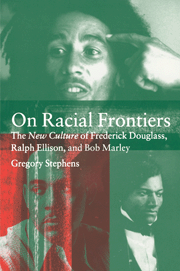
  • On Racial Frontiers: The New Culture of Frederick Douglass, Ralph Ellison, and Bob Marley

    Cambridge University Press
    June 1999
    342 pages
    8 b/w illus.
    Size: 228 x 152 mm
    Paperback ISBN-13: 9780521643931; ISBN-10: 0521643937

    Gregory Stephens

    Douglass, Ellison and Marley lived on racial frontiers. Their interactions with mixed audiences made them key figures in an interracial consciousness and culture, integrative ancestors who can be claimed by more than one group. An abolitionist who criticized black racialism; the author of Invisible Man, a landmark of modernity and black literature; a musician whose allegiance was to “God’s side, who cause me to come from black and white.” The lives of these three men illustrate how our notions of “race” have been constructed out of a repression of the interracial.

    Table of Contents

    • Introduction
    • 1. Interraciality in historical context
    • 2. Frederick Douglass as integrative ancestor: the consequences of interracial co-creation
    • 3. Invisible community: Ralph Ellison’s vision of a multiracial ideal democracy
    • 4. Bob Marley’s Zion: a trans-racial ‘blackman redemption’
  • Video From Angle Event Reopens Subject of Race

    New York Times
    2010-10-19

    Susan Saulny, National Correspondent

    Louie Gong, a 36-year-old Seattle resident who is a mix of American Indian, white and Chinese, is often mistaken for Latino.

    “Most people don’t look at me and say ‘Chinese,’ ” he said. “Then I tell them what my heritage is, and they argue with me, saying, ‘No, you look Hispanic.’ That’s offensive on a whole other level—it’s like their sensibility of racial aesthetics trumps my 36 years of life experience, and the fact that my last name is Gong.” …

    …Further complicating the role of race is that a growing number of Americans are identifying themselves as racial mixtures that can be difficult to categorize based on looks alone. Beyond that, some members of minorities are pushing back against anyone who wants to tell them what race they are, then stereotype them, whether Asian or Latino or black or some combination.

    “We are more complex than our phenotype,” said Mr. Gong, the past president of Mavin, an advocacy group for mixed-race families, and the co-founder of the Mixed Race Heritage Center, an information clearinghouse. “People have the right to self-identify in this country, on the census or in personal actions.”…

    Read the entire article here.

  • The Population Variance of the Proportion of Genetic Admixture in Human Intergroup Hybrids

    Proceedings of the National Academy of Sciences
    December 1971
    Volume 68, Number 12
    pages 3168–3169
    PMCID: PMC389614

    T. Edward Reed, Professor of Zoology and Anthropology; Associate Professor of Paediatrics
    University of Toronto, Toronto, Canada

    For each individual in a human hybrid population there is a proportion μi, whose value is usually unknown, that expresses the fraction of his genes deriving from a specified parental population. The distribution of these individual proportions about the mean proportion μ is not known for any large hybrid population in man. It is of interest to know whether the population variance of individual proportions (μi) can be estimated from the variation between different, independent estimates of the mean proportion (μ).This possibility was tested with data on Negroes of the Oakland, California area, by the use of some of the principles of analysis of variance. Even with a large sample and the useful Duffy blood-group system to indicate admixture, almost no information about the population variance of individual proportions is provided by between-sample variation in estimates of μ. It is concluded that group data on admixture proportions usually do not give useful information about the population variance. It is further concluded that a recent estimate of this variance by Shockley is in error.

    Read the entire article here.