• Distributed intensities: Whiteness, mestizaje and the logics of Mexican racism

    Ethnicities
    Volume 10, Number 3, September 2010
    pages 387-401
    DOI: 10.1177/1468796810372305

    Mónica G. Moreno Figueroa, Lecturer in Sociology
    Newcastle University

    By analysing racist moments, this article engages with debates about the existence of racism in Mexico and how whiteness, as an expression of such racism, operates. It draws on empirical research that explores Mexican women’s understandings of mestizaje (mixed-race discourses) and experiences of racism. It assesses how racism is lived, its distributed intensity, within the specific racist logics that organize everyday social life. I build upon arguments that Latin American racist logics emerge from the lived experience of mestizaje and its historical development as a political ideology and a complex configuration of national identity. Mestizaje enables whiteness to be experienced as both normalized and ambiguous, not consistently attached to the (potentially) whiter body, but as a site of legitimacy and privilege.

    Read or purchase the article here.

  • An Illuminated Life: Belle da Costa Greene’s Journey from Prejudice to Privilege (review)

    Libraries & the Cultural Record
    Volume 45, Number 3, 2010
    E-ISSN: 1932-9555
    Print ISSN: 1932-4855
    pages 375-377

    Nena Couch, Curator and Professor of Theater
    Ohio State University

    The life of the librarian seldom is acknowledged beyond the confines of the community in which she or he is active; therefore, Heidi Ardizzone’s biography of Belle da Costa Greene, librarian to J. Pierpont Morgan and first director of the Pierpont Morgan Library, should be a welcome publication. Greene was a widely respected and successful librarian who made significant contributions to the development and refinement of Morgan’s collection until his death and continued her work with his son John “Jack” Pierpont Morgan, Jr. She was actively involved in the establishment of the Morgan Library as a public institution. Her work had national and international impact and as such is worthy of a full-length biography. Enhancing her story is her testing of boundaries: she was a woman in what was a man’s field, and she was of mixed race passing as white. However, Ardizzone’s primary interests are not in Greene’s significant professional accomplishments—although they are touched upon in An Illuminated Life—but in “Belle’s social life and experiences” (10) and in speculation about a woman…

    Read the entire review here.

  • Trading Races: Joseph and Marie Bunel, a Diplomat and a Merchant in Revolutionary Saint-Domingue and Philadelphia

    Journal of the Early Republic
    Volume 30, Number 3, Fall 2010
    pages 351-376
    E-ISSN: 1553-0620
    Print ISSN: 0275-1275

    Philippe R. Girard, Associate Professor of History
    McNeese State University, Lake Charles, Louisiana

    Based on extensive research in French, British, and U.S. archives, the article focuses on Joseph Bunel, a diplomatic and commercial envoy for Toussaint Louverture and Jean-Jacques Dessalines, and his wife Marie Bunel (Fanchette Estève), who spent her adult life as a merchant in Cap Français (Cap Haïtien) and Philadelphia. Joseph and Marie Bunel were a white Frenchman and a free black Creole, but their careers were shaped more by their social and monetary ambitions than by their racial background. After spending a few years in prerevolutionary Saint-Domingue (Haiti) as a merchant and a plantation manager, Joseph Bunel played an important administrative role in Louverture’s regime after 1798, first as a diplomatic envoy charged with drafting treaties of commerce and non-aggression with the United States and England during the Quasi-War, then as Louverture’s paymaster. Because of his closeness to the regime, he was deported to France during the Leclerc expedition. After moving to Philadelphia in 1803, he became a noted exporter of war contraband to Dessalines’ Haiti and in 1807 settled permanently in this country as a merchant. Marie Bunel, a prosperous free-colored merchant from Cap Français before the outbreak of the Haitian Revolution, continued her mercantile activities throughout the revolutionary period. Though personally close to notable figures like Louverture and Henri Christophe, her political involvement in the revolutionary struggle was limited. Persecuted along with her husband during the Leclerc expedition, she moved to Philadelphia, where she lived as an independent merchant long after Haiti had declared its independence. It was not until 1810 that for personal reasons she moved back to Haiti, where little evidence is available to retrace the end of the Bunels’ eventful lives.

    Read or purchase the article here.
  • Bicultural Identity Formation of Second-Generation Indo-Canadians

    Canadian Ethnic Studies
    Volume 40, Number 2, 2008
    pages 187-199
    E-ISSN: 1913-8253
    Print ISSN: 0008-3496

    Pavna Sodhi, Ed.D, CCC
    Abundant Living Counselling Group, Ottawa, Ontario, Canada

    This article examines the bicultural identity formation and cultural experiences internalized by second-generation Indo-Canadians in their efforts to accommodate the “best of both worlds” into their lifestyle. The objectives of this article are to educate the reader to become cognizant of the bicultural issues encountered by second-generation Indo-Canadians; to demonstrate interventions suitable for the second-generation Indo-Canadian populations; and to increase the readers’ understanding of bicultural identity formation. What becomes evident is that intergenerational dialogue has a profound impact on the bicultural identity formation of this population. It will serve to guide these individuals to find a third space (Bhabha 2004) or zone of proximal development (ZPD) to encourage evolvement of their bicultural identity (Cummins 1996; Gutiérrez et al. 1999).

    Read or purchase the article here.

  • Sandweiss unearths a compelling tale of secret racial identity

    News at Princeton
    Princeton University
    2009-12-17

    Jennifer Greenstein Altmann

    For three decades, history professor Martha Sandweiss had wondered about a little-noticed detail in the life of Clarence King, a well-known figure in the history of the American West. King, a 19th-century geologist and author, was a leading surveyor who mapped the West after the Civil War.

    Back in graduate school, Sandweiss had read a 500-page biography of King that devoted just five pages to a secret, 13-year relationship that King, who was white, had with a black woman.

    “Thirteen years, five pages? It just didn’t seem right to me,” said Sandweiss, a historian of the American West who joined the Princeton faculty last year.

    A few years ago, Sandweiss decided it was time to investigate. Poring through census documents that were available online, she was able to discover in a matter of minutes that King, who was blond and blue eyed, had been leading a double life as a white man passing as a black man.

    “Once I uncovered that, I knew I had to try to unravel the story,” she said.

    The result is “Passing Strange: A Gilded Age Tale of Love and Deception Across the Color Line,” published earlier this year by The Penguin Press…

    …But the most amazing part of King’s story is that someone with fair hair and blue eyes was accepted as a black man. He managed it, Sandweiss said, because of the so-called “one-drop” laws passed in the South during Reconstruction, which declared that someone with one black great-grandparent was considered legally black.

    “The laws were meant to make it very difficult to move from one racial category to the other,” Sandweiss said. “Ironically, they made it very possible to do that, because you could claim an ancestry — or more often hide an ancestry — that was invisible in the color of your skin.”…

    Read the entire article here.

  • The Effect of Interracial Media Portrayals on Perceptions of Multiracialism

    XULAneXUS: Xavier University of Louisiana’s Undergraduate Research Journal
    Research Manuscript
    Volume 5, Number 1, April 2008
    9 pages

    Ashley E. Winston
    Department of Psychology

    The notion that context has an effect on perceptions of multiracialism was investigated. Context was manipulated in terms of exposure to interracial harmony and interracial disharmony in the form of a movie clip from the movie Something New (2006). The effect of the clip on participants’ perceptions of multiracial people was measured by the Attitudes Toward Multiracial Children Scale, and the racial identification of the participants was measured by the Racial Identity Scale. The results from the two measures were calculated with an independent-samples t-test to compare the mean scores of the two groups. Results show that the mean of the group who received the disharmony clip was significantly lower than the mean of the group who received the harmony clip. The results imply an importance of the media portrayal of interracial interaction and racial stereotyping on the perceptions of society for the multiracial community.

    Read the entire article here.

  • Mapping race: Multiracial people and racial category construction in the United States and Britain

    Immigrants & Minorities
    Volume 15, Issue 2 (July 1996)
    pages 107-119
    DOI: 10.1080/02619288.1996.9974883

    Paul R. Spickard, Professor of History
    University of California, Santa Barbara

    The social construction of what are often called ‘racial’ categories has proceeded differently in different places. The bases of ascription and group identity, the placement of the boundaries between groups, and the power dynamics between groups have changed dramatically over time and social and political circumstance in each place. This article is a meditation and speculation on the ways that racial categories have been constructed and have changed in the United States and Britain over the course of the twentieth century.’ It uses the identity situations of people of multiple ancestries – Black and White, Asian and African and so on – as a tool to deconstruct the meanings assigned to racial categories and the power dynamics that underly those categories. The article lays out some things that the situation of multiracial people – people some of whose ancestors were Africans and some of whose ancestors came from somewhere else – tells us about the ways racial categories and meanings have evolved over the course of the twentieth century in the United States and in Britain. It finds, in sum, that White Americans have long had clearer ideas than White Britons about what they wanted to do with race; that those clear categories in the US are now breaking down, partly because of the rise of a multiracial consciousness on the part of some people of mixed parentage; and that a British innovation of the 1970s and the 1980s, a common Black identity for all non-White Britons, is no longer working very well, either.

    Read or purchase the article here.

  • American Lives: The ‘Strange’ Tale Of Clarence King

    National Public Radio
    2010-08-18

    Steve Inskeep, Host
    Morning Edition


    U.S. Geological Survey Photographic Library

    Ada Copeland, an African-American woman born in Georgia just months before that state seceded from the Union, moved to New York City in the mid-1880s. There, she met a man named James Todd. He was light-skinned, handsome, had a good job for an African-American man in that time — a Pullman porter.

    They hit it off, and eventually married. They had five children and a house in Brooklyn. Their story would be unremarkable if not for one detail: Nothing James had told his future wife was true.

    “James Todd was really not black, he was not a Pullman porter, and he was not even James Todd,” author Martha Sandweiss tells NPR’s Steve Inskeep. “He was in fact Clarence King, a very well-educated white explorer who was truly a famous man in late 19th century America.”…

    …Sandweiss’ book, Passing Strange: A Gilded Age Tale of Love and Deception Across the Color Line, examines why King chose to live a double life — and how his experience reflects and represents how Americans, both past and present, have thought about race. In the aftermath of the Civil War, particularly, the U.S. had to recast some of the ways it thought about questions of race and identity…

    Read and/or listen to the story here.

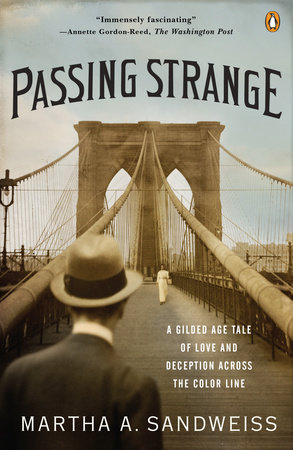
  • Passing Strange: A Gilded Age Tale of Love and Deception Across the Color Line

    The Penguin Press
    2009-02-05
    384 pages
    5.98 x 9.01in
    Hardcover ISBN 9781594202001

    Martha A. Sandweiss, Professor of History
    Princeton University

    National Book Critics Circle Awards Winner

    The secret double life of the man who mapped the American West and the woman he loved

    Clarence King is a hero of nineteenth-century western history. Brilliant scientist and witty conversationalist, bestselling author and architect of the great surveys that mapped the West after the Civil War, King was named by John Hay “the best and brightest of his generation.” But King hid a secret from his Gilded Age cohorts and prominent family in Newport: for thirteen years he lived a double life—as the celebrated white explorer, geologist, and writer Clarence King and as a black Pullman porter and steelworker named James Todd. The fair, blue-eyed son of a wealthy China trader passed across the color line, revealing his secret to his black common-law wife, Ada King, only on his deathbed.

    Noted historian of the American West Martha Sandweiss is the first writer to uncover the life that King tried so hard to conceal from the public eye. She reveals the complexity of a man who while publicly espousing a personal dream of a uniquely American “race,” an amalgam of white and black, hid his love for his wife and their five biracial children. Passing Strange tells the dramatic tale of a family built along the fault lines of celebrity, class, and race—from the “Todds” wedding in 1888 to the 1964 death of Ada, one of the last surviving Americans born into slavery, to finally the legacy inherited by Clarence King’s granddaughter, who married a white man and adopted a white child in order to spare her family the legacies of racism.

    A remarkable feat of research and reporting spanning the Civil War to the civil rights era, Passing Strange tells a uniquely American story of self-invention, love, deception, and race.

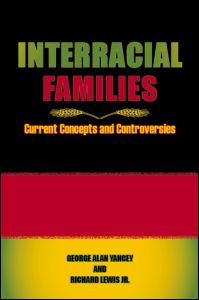
  • Interracial Families: Current Concepts and Controversies

    Routledge
    2008-11-26
    176 pages
    Paperback ISBN: 978-0-415-99034-9

    George Alan Yancey, Associate Professor of Sociology
    University of North Texas

    Richard Lewis, Jr., Special Assistant to the President and Associate Professor of Sociology
    University of Texas, San Antonio

    A unique book offering both a research overview and practical advice for its readers, this text allows students to gain a solid understanding of the research that has been generated on several important issues surrounding multiracial families, including intimate relations, family dynamics, transracial adoptions, and other topics of personal and scholarly interest.

    Table of Contents

    • List of Figures and Tables
    • Chapter 1: Introduction
    • Chapter 2: Overview of Intergroup Relations and Their Impact on Interethnic and Interracial Marriages
    • Chapter 3: Interracial Dating
    • Chapter 4: Interracial Marriage
    • Chapter 5: Multiracial Identity
    • Chapter 6: The Multiracial Movement and the U.S. Census Controversy
    • Chapter 7: Transracial Adoption
    • Chapter 8: Multiracial Families: Conclusions and Looking Ahead
    • Notes
    • Bibliography
    • Index