• Multiracial Identity [Movie] to be screened at the  Portland, Maine International Film Festival

    Portland, Maine International Film Festival
    Saturday, 2010-08-21, 12:00 – 13:30 EDT (Local Time)
    Space Gallery
    538 Congress Street, Portland, Maine 04101
    Phone: 207.828.5600

    Year: 2010
    Director: Brian Chinhema
    Writer: Brian Chinhema
    Producer: Brian Chinhema (Abacus Production)
    Running Time: 01:22:00

    Multiracial people are the fastest growing demographic in America, yet there is no officially political recognition for mixed-race people. Multiracial Identity examines what it means to be multiracial in America and explores the social, political, and religious impact of the multiracial movement.

    The film is produced and directed by Brian Chinhema and features commentary from noted scholars, Rainier Spencer, Naomi Zack, Aliya Saperstein, Aaron Gullickson, Susan J. Hayflick and Pastor Randall Sanford.

  • Forsaking All Others: A True Story of Interracial Sex and Revenge in the 1880s South

    University of Tennessee Press
    2010-11-10
    160 estimated pages
    Cloth ISBN: 978-1-57233-724-4; 1572337249
    Ebook ISBN: 978-1-57233-740-4; 1-57233-740-0

    Charles F. Robinson, Vice Provost for Diversity; Associate Professor of History and Director of African American Studies
    University of Arkansas

    The electronic book (E-Book) is available now.

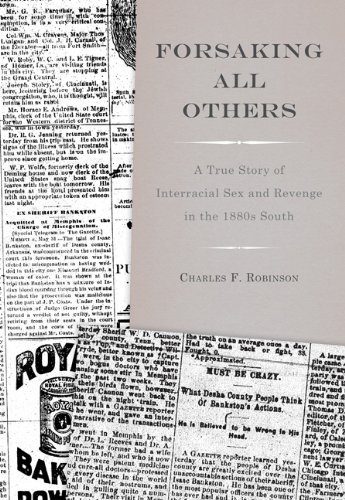
    An intensely dramatic true story, Forsaking All Others recounts the fascinating case of an interracial couple who attempted—in defiance of society’s laws and conventions—to formalize their relationship in the post-Reconstruction South. It was an affair with tragic consequences, one that entangled the protagonists in a miscegenation trial and, ultimately, a desperate act of revenge.

    From the mid-1870s to the early 1880s, Isaac Bankston was the proud sheriff of Desha County, Arkansas, a man so prominent and popular that he won five consecutive terms in office. Although he was married with two children, around 1881 he entered into a relationship with Missouri Bradford, an African American woman who bore his child. Some two years later, Missouri and Isaac absconded to Memphis, hoping to begin a new life there together. Although Tennessee lawmakers had made miscegenation a felony, Isaac’s dark complexion enabled the couple to apply successfully for a marriage license and take their vows. Word of the marriage quickly spread, however, and Missouri and Isaac were charged with unlawful cohabitation. An attorney from Desha County, James Coates, came to Memphis to act as special prosecutor in the case. Events then took a surprising turn as Isaac chose to deny his white heritage in order to escape conviction. Despite this victory in court, however, Isaac had been publicly disgraced, and his sense of honor propelled him into a violent confrontation with Coates, the man he considered most responsible for his downfall.

    Charles F. Robinson uses Missouri and Isaac’s story to examine key aspects of post-Reconstruction society, from the rise of miscegenation laws and the particular burdens they placed on anyone who chose to circumvent them, to the southern codes of honor that governed both social and individual behavior, especially among white men. But most of all, the book offers a compelling personal narrative with important implications for our supposedly more tolerant times.

  • Mixed Messages, Mixed Memories, Mixed Ethnicity: Mnemonic Heritage and Constructing Identity Through Mixed Parentage

    New Zealand Sociology
    Volume 25, Number 1 (2010)
    pages 75-99

    Zarine L. Rocha, Research Scholar in the Department of Sociology
    National University of Singapore

    This article explores the concept of mixed ethnic identity from a social memory-based perspective. Drawing on the personal testimonies of individuals of mixed ethnic heritage in New Zealand, the UK, Australia and Canada, the complex influence of collective memory on the construction of a mixed ethnic identity is drawn out, highlighting the contradictions and reconciliations negotiated by those who feel a strong sense of belonging to two groups, with potentially contrasting stories and memories. Participants express their feelings of belonging in multiple ways, showing how appreciation of heritage and internalization of family memories do not have to be equal nor experienced in the same way for both sides of the family. Rather, the unpredictable way in which collective memory shapes mixed ethnic identity indicates that each collectivity can have its own way of being understood for the individual, without reducing or denying its importance.

    …The lingering idea of marginalization and internal conflict is particularly interesting from the memory perspective. Do individuals of mixed heritage experience internal conflict due to the different experiences and mnemonic heritages of their parents? Is it possible to reconcile “mixed memories”? Vivero and Jenkins (1999, p. 12) describe the “cultural homelessness” of mixed heritage, indicating that the lack of a coherent memory framework can lead to psychological distress: “Culturally homeless individuals may have the intense feeling and longing to ‘go home’; however, they cannot, because they have never had a cultural home… they cannot rely on memories of having had a cultural home”. In contrast, a number of recent studies have found that individuals of mixed descent have multiple and positive senses of identity, identifying to different extents with both sides of their heritage (Binning, et al., 2009; Root, 1992; Stephan & Stephan, 1989; Ward, 2006).

    The reconciliation of mixed memories is illuminated by [Homi] Bhabha’s concept of a “third space” of hybridity, which illustrates new forms of identity and belonging where different cultures collide and collude (Ang, 1999, p. 558; Bhabha, 1994). In contrast to historical discourses of “hybrids” as the mingling of biologically separate “races”, this antiessentialist understanding of identity can instead highlight different forms of cultural recombination, whether based in ancestry or interaction (Bolatagici, 2004, p. 75; Gomes, 2007; Parker & Song, 2001, p. 4). Hybridity thus emphasises the fluidity and multiplicity of mixed ethnic identity, as constructed through memory and experience – suggesting that “cultural homelessness” may not be a lack of a home, but rather “…belonging at one and the same time to several ‘homes’ (and to no one particular ‘home’)” (Hall, 1992, p. 310)…

    Read the entire article here.

  • Understanding the Identity Choices of Multiracial and Multicultural Afro-European and Black Women Living in Germany: Identifying a Model of Strategies and Resources for Empowerment

    Ludwig-Maximilians-Universität, München
    October 2006
    179 pages

    Dominique Michel-Peres

    This grounded theory study investigated the identity choices of highly achieving multiracial and multicultural Afro-European and Black immigrant women living in Germany and the role these choices played in their personal constructs of coping and self-empowerment. 10 openended narrative interviews, field observations formed the data base; whereby the field observations where used to affirm or disaffirm evolving hypothesis. The historical, social, and cultural context in which these women live is reviewed, and key terms such as racism and discrimination are clarified. The individual racial identity choice and coping strategies were analyzed, and a theoretical model was developed describing the a) causal conditions that influence and form racial identity choices, b) phenomena that resulted from these causal conditions, c) the contextual attributes that influenced type of strategy developed, d) intervening condition that have an impact on the type of strategy developed, e) the strategies themselves, and f) the consequences of those strategies. The components of the theoretical model are first described and then illustrated by narrative excerpts.

    Table of Contents

    Acknowledgments
    Table of Contents
    List of Tables
    List of Figures
    Abstract
    Introduction

    1. Conceptual Point of Departure
    1.1. Bi- / Multi-isms and the Precariousness of Recognition
    1.2. Racist Construction in Europe
    1.2.1. European expansion and exploration:-its role in shaping images of Africans and of “races”
    1.2.2. The stage is set: socio-historical and socio-cultural props
    1.2.2.1 Social Darwinism and German colonialism
    1.2.2.2. Internalized Colonialism
    1.3. Representations and Projections
    1.3.1 Postwar Germany’s Black children
    1.3.2. Non-white minorities and the German educational system
    1.4. Summary

    2. Racism and Discrimination
    2.1. Racism, Discrimination and Subjectivity
    2.1.1. Defining racism
    2.1.2 What is racism? Identity Choices of Multiracial & Multicultural Afro-European and Black Women in Germany
    2.1.2.1. Axiom 1: Racism does not implicate the existence of races
    2.1.2.2. Axiom 2: Racism implies the existence of social hierarchies
    2.1.2.3. Axiom 3 Racism requires influence in social structuring processes
    2.2. Racism and Racial Discrimination’s New Attire
    2.2.1. Central Frames in Racism
    2.2.1.1. Abstract liberalism
    2.2.1.2. Abstract liberalism and its role in cultural racism
    2.2.1.3. Cultural racism and self-fulfilling prophecies
    2.2.1.4. Symbolic Racism Excurse: Germany’s discourse on immigration
    2.3. Racial Discrimination : Subjectivity and Psychological Impact
    2.3.1. The Psychological Impact of Perceived Racial Discrimination
    2.4. Summary

    3. Identity Construction, Patchwork Identities and the Stigmatized Self
    3.1. Identity Construction and Patchwork Identities: Who am I?
    3.1.1. Patchworks of Racial and Ethnic choices
    3.2. Multicultural-Multiracial- Who am I?
    3.2.1. Models of ethnic and racial identity development
    3.2.1.1. Visible racial and ethnic group models (V-REG)
    3.2.1.1.1. Cross’s Theory of Black Identity Development Identity Choices of Multiracial & Multicultural Afro-European and Black Women in Germany
    3.2.1.1.2. Helm’s model of White Identity Development
    3.2.1.1.3. Multiracial identity development models
    3.2.1.2. Salience model: Ethnic Identity Development Theory
    3.2.2. Implications for Afro-Europeans and immigrants
    3.3. Cultural Differences and the Salience of Ethnic and Racial Identity and Oppositional Identity
    3.3.1. Voluntary and involuntary minorities
    3.3.2. Oppositional identity and the burden of “acting White”
    3.3.3. Accommodation without assimilation
    3.3.4. Personal and group attributions to racism and discrimination
    3.4. Racial and Ethnic Identity’s Role in the Self-Esteem of Minorities
    3.4.1. Self-esteem
    3.5. Social Identity and Stigmatized Identities
    3.5.1. Social identity and stigmatized identities
    3.5.1.1. Coping with attribution ambiguity
    3.5.1.2. Maintaining a sense of Self independent of the “spoiled collective identity”
    3.5.1.3. Ethnicity, race, gender and other socially defined groups as developmental contexts
    3.6. Summary

    4. Identity Choices in Multiple Contexts: Concepts, Properties and Dimensions
    4.1. Methodology
    4.1.1. Participants
    4.1.2. Procedure
    4.1.2.1. The narrative interview: Identity Choices of Multiracial & Multicultural Afro-European and Black Women in Germany
    4.1.2.2. The interviewing process
    4.1.2.3. The interview
    4.1.2.4. Underlying ethnographic aspects: field notes and observations
    4.2. Verification of Concepts and Categories
    4.2.1. Verification
    4.2.1.1. Quality verification

    5. Analysis and Results
    5.1. Sources of Influence
    5.1.1. Direct and indirect dispositional and situational sources of influence
    5.1.1.1. Dispositional factor
    5.1.1.2. Situational factors
    5.1.2. Higher categories
    5.1.2.1. Coping strategies
    5.1.2.2. Personal characteristics
    5.1.2.3. Social identity: content and salience
    5.1.2.4. Threats
    5.1.2.5. Opportunities
    5.1.3. Core Category, phenomena, and consequences
    5.1.3.1. Core category as causal condition
    5.1.3.2. Phenomenon resulting from racial socialization parental racial-beliefs
    5.1.3.3. Context in which coping strategies develop Identity Choices of Multiracial & Multicultural Afro-European and Black Women in Germany
    5.1.3.4. Intervening conditions influencing coping strategies
    5.1.3.5. Consequences of strategies against powerlessness, helplessness and victimization
    5.2. Multicultural-Multiracial Narratives: Excerpts from two lives
    5.2.1. Jennifer’s story
    5.2.1.1. Explicitness of experienced discrimination and perception
    5.2.1.2. Racial salience
    5.2.1.3. Sense of self
    5.2.2. Angela’s story
    5.2.2.1. Attribution ambiguity
    5.2.2.2. Parent’s experiences with racism and racial discrimination
    5.2.2.3. Internalized racism and race salience

    6. Discussion: Implications for Multicultural Counselling and Empowerment
    6.1. Focus on Primary Socialization Issues and Subjectivity
    6.1.2. Focus on strengths and assets

    References

    List of Tables

    1. Ratio of German to Foreighn Students According to School Track in the Year 2002 in Germany
    2. Discourse on Immigration as Represented in two Major German Publications
    3. Summary of Salient Points in Poston and Kich Multiracial Identity Development Model
    4. Table 4 Participants Ethnic Backgrounds
    5. Dispositional and Situational, Direct and Indirect Factors

    List of Figures

    1. Conceptual framework: The embeddedness of identity
    2. Identity construction as patch-working
    3. Descriptive model of the relationship between ego identity and Nigrescence
    4. Factor Model of Multiracial Identity
    5. Paradoxes found in self-esteem research
    6. Research results on the detrimental effects of membership in devalued Social-groups
    7. Summary of research results on social-group membership and its Consequences
    8. Results of research on the factors affecting social identity development and how they interact
    9. In-group and out-group identification in relation to expectations and Aspirations; group vs. individual based strategies; and attribution style
    10. The results of axial coding: Higher categories and their respective subcategories
    11. Theoretical model for understanding idenitity and strategy choices of multiracial and multicultural women

    Read the entire dissertation here.

  • The Invisible Minorities: Identity Construction of Multiracial Asian Americans

    San Jose State University
    August 2003
    136 pages

    Jennifer Huyhn Thi Ahn Morrison, Lecturer AY-A of Communication Studies
    San Jose State University

    A thesis presented to the faculty of the Department of Communication Studies at San Jose State University in partial fulfulliment of the requriements for the degree Master of Arts.

    A review of the literature found that Ethnic Studies focused on multiracial Asian American identity more than any other field. However, multiracial Asian Americans are still in need of further research because of the many different types of identity construction that may occur. From the array of literature found in Communication Studies, only a few encompass how a multiracial individual communicates her or his identity construction. Thus, in my Master’s thesis I found that the complexity of multiracial identity construction encompasses three types of communication cues in relation to familial closeness. Through the analysis of five in-depth interviews I found there to be a profound influence on how the double minority multiracial individual is raced and how she or he identifies. Therefore, after examining the construction of double minority multiracial Asian Americans, there is a greater ability to understand how a complex multiracial identity is communicated.

    Table of Contents

    CHAPTER 1: THE WORLD OF MULTIRACIALITY

    • Introduction
    • Rationale
    • Key Terms
    • Ethnicity & Race
    • Monoracial
    • Multiracial
    • Minority Group
    • Majority Group
    • Literature Review
    • Identity
    • Multiracial Identity
    • Identity of Multiracial Asian Americans

    CHAPTER 2: INTERVIEWS FROM THE DOMAIN OF MULTIRACIALITY

    • Qualitative In-depth Interviews
    • Research Questions
    • Procedures
    • Mode of Analysis

    CHAPTER 3: SELECTIVE MONORACIAL IDENTITY

    • Selective Monoracial Identity
    • Familial Closeness

    CHAPTER 4: THE ISSUES OF PASSING & BEING RACED

    • Authenticity
    • Racial Status

    CHAPTER 5: DISCUSSION

    • Inclusion of The Invisible Minority
    • SMI
    • Familial Communicative Cues
    • A Visual Represention of Multiracial Identity Development
    • Limitations
    • Implications for Future Research

    REFERENCES

    Read the entire thesis here.

  • The Changing Racial and Ethnic Composition of the US Population: Emerging American Identities

    Population and Development Review
    Volume 35, Issue 1 (March 2009)
    pages 1-51
    DOI: 10.1111/j.1728-4457.2009.00260.x

    Anthony Daniel Perez, Assistant Professor of Sociology
    University of North Carolina, Chapel Hill

    Charles Hirschman, Boeing International Professor of Sociology
    Department of Sociology and Center for Studies in Demography and Ecology
    University of Washington, Seattle

    Images and interpretations of the past, present, and future of the American racial and ethnic landscape are contradictory. Many accounts focus on the increasing diversity that results from immigration and differential natural increase as well as the proliferation of racial and ethnic categories in census data. Less attention has been paid to the formation and erosion of racial and ethnic identities produced by intermarriage and ethnic blending. The framers and custodians of census racial classifications assume a “geographic origins” definition of race and ethnicity, but the de facto measures in censuses and social surveys rely on folk categories that vary over time and are influenced by administrative practices and sociopolitical movements. We illustrate these issues through an in-depth examination of the racial and ethnic reporting by whites, blacks, Asians, and Hispanics in the 2000 census. The emerging pattern, labeled here as the “Americanization” of racial and ethnic identities, and most evident for whites and blacks, is of simplified racial identities with little acknowledgment of complex ancestries. National origin is the predominant mode of reporting racial and ethnic identities among Asians and Hispanics, especially first-generation immigrants. The future of racial and ethnic identities is unknowable, but continued high levels of immigration, intermarriage, and social mobility are likely to blur contemporary divisions and boundaries.

    America was a multiethnic and multicultural society from the outset. The original American colonies were formed during the seventeenth and eighteenth centuries as frontier societies composed of multiple founding populations (Klein 2004: Ch. 2). First among these were the indigenous peoples of North America, who were gradually displaced or absorbed by the more numerous European settlers and indentured servants from various parts of the world. Africans were imported primarily as slave labor from the Caribbean and West Africa, although some arrived as indentured servants on terms similar to whites. In the middle decades of the seventeenth century, some blacks became free settlers, but by the close of the seventeenth century, slavery and African heritage became nearly synonymous (Fredrickson 1981). With unbalanced sex ratios in frontier settings, large populations of mixed ancestry soon emerged, particularly in Southern colonies (Davis 1991). While some unions were the result of intermarriage or consensual liaisons, there was also widespread sexual exploitation of black women by white slave owners (Fredrickson 1981: Ch. 3).

    The ethnic and racial landscape became even more complex during the nineteenth century. Continental expansion added lands that had been home to Native Americans and peoples of mixed indigenous and Spanish origin, and successive waves of immigration from Europe and Asia fueled the rapid growth of an increasingly diverse population. Tracking the mixed and un-mixed descendants from these many threads is a theoretical possibility, but not one that can be easily accomplished with historical or contemporary data. The problem is that the differential rates of settlement, natural increase, and intermarriage (or sexual unions) that produced progeny of mixed ancestry are largely unknown. Small differences in assumptions about the relative magnitudes of these processes can lead to greatly different estimates of the ancestral origins of the contemporary American population.

    An even greater obstacle to describing the ethnic makeup of the American people is the assumption that most people are able and willing to accurately report the origins of their parents, grandparents, and more distant ancestors. In many cases, knowledge of ancestral origins is passed along in families or communities, but in some cases these narratives are suppressed or simply lost to history. As a result, the racial and ethnic composition recorded in censuses, surveys, and administrative records reflects a large degree of subjectivity and even speculation, in addition to actual patterns of genealogical descent. Methodological studies of census questions about race and ethnicity, for instance, show that responses are affected, often remarkably so, by the format of questions, the listed choices, and the examples included in questionnaire instructions (Farley 1991; Hirschman, Alba, and Farley 2000)…

    Read an excerpt of this article here.
    Read or purchase the entire article here.

  • Biracial Utahns seeking identity

    Deseret News
    Salt Lake City, Utah
    2005-03-12

    Elaine Jarvik

    They’re biracial — equally Polynesian and white. But most prefer to think of themselves as Polynesian, says University of Utah graduate student Kawika Allen, who recently studied 84 Polynesian-Caucasian Utahns.

    Allen, who grew up with an Hawaiian mother and a Caucasian father, presented his findings Friday at the ninth annual Pacific Islander Awareness Week at the University of Utah…

    …Growing up in Utah, Allen’s Polynesian friends sometimes thought he wasn’t Polynesian enough, and he wasn’t sure if he fit in his father’s white world either. That angst later led to a master’s thesis on biracial identity among Utah’s biracial Polynesians, who now number more than 3,000.

    Although previous research of other biracial Americans found that children tend to identify more with the same-sex parent, regardless of ethnicity, Allen found that among Polynesian-Caucasian Utahns, children tended to identify more with the Polynesian parent, regardless of gender.

    He also found that biracial Polynesians were more likely to receive negative messages about being biracial if their fathers, rather than mothers, were Polynesian…

    Read the entire article here.

  • Afro-German Biracial Identity Development

    Virginia Commonwealth University
    May 2010
    75 pages

    Rebecca R. Hubbard

    A thesis submitted in partial fulfillment of the requirements for the degree of Master of Science at Virginia Commonwealth University

    An increase in the biracial population has heightened our awareness of unique issues that pervade the experience of these individuals. The importance of environmental influences on biracial identity development has been established, but investigations concerning racial socialization of biracial individuals are scarce. This study, utilizing a qualitative design, explores racial identity development of biracial Afro-Germans living in Germany. The purpose of the study is to understand the strategies that biracial individuals use to negotiate their racial identity, factors that influence their development, cultural influences, and racial socialization processes. Interviews with biracial Afro-Germans were conducted using phenomenological interviewing techniques. Twelve themes emerged from the data that are best conceptualized in an ecological model. Inter-rater reliability was established in two phases. Implications of the findings include a need for continued research with Black-White biracial populations.

    Table of Contents

    • Acknowledgements
    • List of Tables
    • List of Figures
    • Abstract
    • Problem Statement
    • Review of the Literature
      • Developmental Models
      • Developmental Models of Biracial Identity Development
      • Ecological Models
      • Ecological Models of Biracial Identity Development
      • Racial Socialization
      • Racial Socialization of Biracial Individuals
      • Value of Cross-Cultural Comparisons
      • Historical Context of People of African Descent in Germany
      • Empirical Research with Afro-German Populations
      • Theoretical Conceptualization
      • Research Questions
    • Method
      • Purpose
      • Design
      • Role of the Researcher
      • Sampling & Recruitment of Participants
      • Procedure
      • Data Analysis
      • Verification
      • Limitations
    • Themes
      • Intersectional Identity
      • Black Identity
      • German/White Identity
      • Disconnect/Denial
      • Positive Internal Coping
      • Environmental Support
      • Injured Family
      • Person-Environment Discrepancy
      • Multi Kulti
      • American Familiarity
      • Racism, Marginalization, Conflict
      • Progress and Change
      • Ecological Conceptualization of Themes
    • Discussion
      • The Essence of Biracial Afro-German Identity
      • Culture and Nationality
      • Lack of Appropriate Language
      • Future Directions
    • List of References

    List of Tables

    1. Table 1 Mean Age and Parental Heritage by Gender
    2. Table 2 Participant Demographics

    List of Figures

    1. Figure 1 Root’s Ecological Model of Biracial Identity
    2. Figure 2 “Sarotti Mohr” Trademark of a German chocolate company
    3. Figure 3 Hubbard’s Ecological Model of Afro-German Biracial Identity (HEMBAGI)

    Read the entire thesis here.

  • Unmixing for Race Making in Brazil

    American Journal of Sociology
    Volume 114, Number 3 (November 2008)
    pages 577–614
    DOI: 10.1086/592859

    Stanley R. Bailey, Associate Professor of Sociology
    University of California, Irvine

    This article analyzes race-targeted policy in Brazil as both a political stake and a powerful instrument in an unfolding classificatory struggle over the definition of racial boundaries.  The Brazilian state traditionally embraced mixed-race classification, but is adopting racial quotas employing a black/white scheme.  To explore potential consequences of that turn for beneficiary identification and boundary formation, the author analyzes attitudinal survey data on race-targeted policy and racial classification in multiple formats, including classification in comparison to photographs. The results show that almost half of the mixed-race sample, when constrained to dichotomous classification, opts for whiteness, a majority rejects mixed-race individuals for quotas, and the mention of quotas for blacks in a split-ballot experiment nearly doubles the percentage choosing that racial category.  Theories of how states make race emphasize the use of official categories to legislate exclusion.  In contrast, analysis of the Brazilian case illuminates how states may also make race through policies of official inclusion.

    At the federal university in Brazil’s capital city, Brasília, a special committee was constituted in 2004 to evaluate the application file photographs of self-classified negros (read “blacks” or “Afro-Brazilians”) applying to the university via a new racial quota system. An anthropologist, a sociologist, a student representative, and three negro movement actors make up that committee, and their identities are kept sub secreto (Maio and Santos 2005). If the committee does not consider a candidate to be a negro or negra, then he or she is disqualified. The applicant can, however, appeal the decision and appear in person before the committee to contest his or her racial classification (Universidade de Brasília 2004). The State University of Mato Grosso do Sul has also adopted the use of photographs and a verification committee for a racial quota system (UEMS 2004). At that institution, the committee is made up of two university representatives and three negro movement actors (Corrêa 2003).

    This unusual modus operandi highlights a period of instability in racial categories, associated with a novel phase in the political struggle for identity and inclusion by the Brazilian negro movement. Through a multifaceted process, but without disruptive protest or mass mobilizations, the movement has successfully pressured state actors to mandate negro inclusion in higher education and to encode that legislation with language emic to the movement. The label negro is not an official census term; the Brazilian state has for well over a century used a ternary, or three-category, format to represent the black-white color continuum that includes an intermediate or mixed-race category. In contrast, negro is part of a dichotomous racial scheme, counterposed to white, whose novelty in official contexts leads to the thorny issue of defining its boundaries. Nonetheless, some 30 Brazilian public universities have already adopted race-targeted policies (Ribeiro 2007).  Moreover, legislation is now before the national congress mandating that all federal universities adopt racial quotas…

    …The Brazilian census has used the categories branco (white), pardo (brown or mulatto), preto (black), and amarelo (yellow or Asian descent) since 1940 and added the indígena (indigenous) category in the 1991 census. According to its 2000 census, Brazil’s racial or color composition is 54% white, 39% mulatto, 6% black, 0.5% yellow, and 0.4% indigenous. The correspondence of Brazilian census terms with a color continuum is often contrasted with the U.S. use of ancestry for classifying its population (Nogueira 1985). In the United States, ancestry has been historically understood via the rule of hypodescent (Davis 1991). According to that rule’s logic, for any person of mixed ancestry that includes some ponderable African extraction, all other ancestries are generally obviated.

    In Brazil, the mulatto and black census categories are considered by negro movement actors, as well as by many scholars, to comprise persons of some discernible degree of African ancestry, whom they view as members of a negro racial group (Guimara˜es 2001; Ribeiro 2007). Prominent negro politician, movement actor, and scholar Abdias do Nascimento clarifies this specific vision of ancestry, color, and race in Brazil:

    Official Brazilian census data use two color categories for African descendants: preto (literally, “black”) for the dark-skinned and pardo (roughly, mulatto and mestizo) for others. It is now accepted convention to identify the black population as the sum of the preto and pardo categories, referred to as negro, afro-brasileira, or afro-descendente. In English, “black,” “African Brazilian,” and “people of African descent” refer to this same sum of the two groups. (Nascimento and Nascimento 2001, p. 108)

    In contrast to the traditional color classification scheme, this new system approximates the U.S. understanding of racial group membership (Nobles 2000, p. 172; Guimarães 2001, p. 173). That is, the negro-versus-white dichotomous classification scheme in Brazil similarly joins together individuals with some discernible degree of African ancestry into one racial group for race-targeted policy administration, in essence representing an attempt to clarify ambiguous boundaries by “unmixing” the population.

    Mulattos and blacks in Brazil, however, may not view themselves as common members of a negro racial group (Agier 1993; Marx 1998). Winant writes of nonwhites’ tendency in Brazil “not only to deny, but to avoid their own [black] racial identity” (Winant 2001, p. 246; emphasis in original). Hanchard, too, calls attention in his work to Brazilian nonwhites’ “negation of their [black] identity” (Hanchard 1994, p. 22). The term negro, then, may be more a classification attributed to nonwhites by movement actors than a real social group embraced by the general nonwhite population (Nobles 2000; Telles 2004)…

    To read the entire article, click here.
  • Caucasia: A Novel

    Riverhead an imprint of Penguin
    1999-02-01
    432 pages
    5.31 x 7.99in
    Paperback ISBN 9781573227162

    Danzy Senna

    Winner of:

    • Alex Award
    • BOMC Stephen Crane Award 1998
    • Whiting Award 2002

    Birdie and Cole are the daughters of a black father and a white mother, intellectuals and activists in the Civil Rights Movement in 1970’s Boston. The sisters are so close that they have created a private language, yet to the outside world they can’t be sisters: Birdie appears to be white, while Cole is dark enough to fit in with the other kids at the Afrocentric school they attend. For Birdie, Cole is the mirror in which she can see her own blackness.

    Then their parents’ marriage falls apart. Their father’s new black girlfriend won’t even look at Birdie, while their mother gives her life over to the Movement: at night the sisters watch mysterious men arrive with bundles shaped like rifles.

    One night Birdie watches her father and his girlfriend drive away with Cole—they have gone to Brazil, she will later learn, where her father hopes for a racial equality he will never find in the States. The next morning—in the belief that the Feds are after them—Birdie and her mother leave everything behind: their house and possessions, their friends, and—most disturbing of all—their identity. Passing as the daughter and wife of a deceased Jewish professor, Birdie and her mother finally make their home in New Hampshire. Desperate to find Cole, yet afraid of betraying her mother and herself to some unknown danger, Birdie must learn to navigate the white world—so that when she sets off in search of her sister, she is ready for what she will find.