• Lost in the Middle: Growing up Across Racial & Cultural Divides

    The Washington Post
    1998-05-17

    Malcolm Gladwell

    His parents conqured racial difference with dignity and relative ease.  But race became a more complicated question for their son.

    One summer Saturday, when I was growing up, my father piled my brothers and me into the family station wagon and took us to a barn raising. This was in rural southern Ontario, in the heart of Canada’s Old Order Mennonite country, where it was the custom when someone’s barn burned down for friends and neighbors to rebuild it. There were probably 200 people there that day. They came from the surrounding farms in black horse-drawn buggies, the women in gauzy caps and gingham dresses, the men in white shirts and black pants. The women set up long picnic tables outside, and piled them high with bread and luncheon meats and pickles, and pies for dessert. The men swarmed over the skeleton of the barn, those on the roof and on ladders against the walls hammering away in unison, everyone else forming a long human chain, passing plywood and roofing metal and nails hand to hand to hand from the bottom to the top. It was a marvel of improvisational coordination, a communitarian ballet of burly cleanshaven Mennonite farmers in straw hats and loose cotton shirts, and in the midst of it all, in happy and oblivious contrast to everything around him, was my father — slender, bearded and professorial, in the tie he rarely left the house without…

    …Once my mother graduated, they began a period of frantic courtship. Two weeks later, my mother returned to Jamaica to teach again, and my father informed his parents that they intended to marry. It was a difficult moment. My paternal grandparents had grave objections to mixed marriages. They objected, citing New Testament verses to the effect that God had set boundaries for the habitation of nations. “It’s wrong for Graham to have a black child,” my grandmother told my mother. “It is wrong for you to have a white child.” It is easy, I think, with the benefit of hindsight, to conceive of my grandparents as bigoted or small-minded. But that was not it at all. They were simply expressing what my father, apparently, could not see, that his decision to marry my mother was a revolutionary act. When my father made it clear that he would not be moved, they acquiesced. His three sisters were my mother’s bridesmaids. Her wedding veil was my grandmother’s wedding veil…

    …I am not like my parents. I do not have my father’s gift for overcoming social barriers, nor my mother’s gift for appreciating when differences are not relevant. I go back and forth now between my two sides. I never feel my whiteness more than when I’m around West Indians, and never feel my West Indianness more than when I’m with whites. And when I’m by myself, I can’t answer the question at all, so I just push it out of my mind. From time to time, I write about racial issues, and always stumble over personal pronouns. When do I use “we”? In a room full of people I do not know, I always search out the ones who fall into the middle, like me, out of some irrational idea that we belong together.

    I worry sometimes that this is the wrong thing for the child of a mixed marriage to feel. My parents conquered difference, and we would all like to think that sort of accomplishment is something that could be passed down from generation to generation. That’s why we’re all, in theory, so excited by the idea of miscegenation — because if we mix the races, presumably, we create a new generation of people for whom existing racial categories do not exist. I don’t think it’s that easy, though. If you mix black and white, you don’t obliterate those categories; you merely create a third category, a category that demands, for its very existence, an even greater commitment to nuances of racial taxonomy. My mother never had to think about whether she was black. She was. I have to think about it, and turn the issue over in my mind, and gaze in the mirror and wonder, as I was so memorably asked, what I am…

    Read the entire article here.
  • Queer Punk Macha Femme: Leslie Mah’s Musical Performance in Tribe 8

    Cultural Studies↔Critical Methodologies
    Volume 10, Number 4 (August 2010)
    pages 295-306

    Deanna Shoemaker, Assistant Professor of Applied Communication (Performance Studies)
    Monmouth University, West Long Branch, New Jersey

    This essay analyzes the musical performances of Leslie Mah, biracial lead guitarist and backup vocalist for the legendary all-female, queercore punk band Tribe 8, whose members broke up in 2005 after fifteen years together. Inspired by the recent turn in performance studies toward studies of music as performance, this work employs multiple methods and objects to get at the complex totality of popular music’s performativity. Mah’s macha femme persona, playing style, and performance of identity as a lesbian woman of color within queercore punk music allow her to enter a carnivalesque realm of feminist menace, palpable rage, and unruly pleasure. Mah’s performance strategies and articulations of her queer and biracial identities in interviews are contextualized within feminist performance, riot grrrl, and punk music studies. Tribe 8’s lyrics, music, marketing, and band member personas provide cultural context for Mah’s distinctive performance of macha femme.

    Read or purchase the article here.

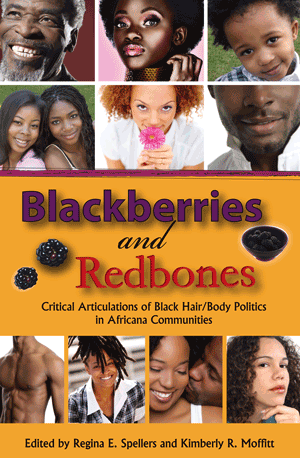
  • Blackberries and Redbones: Critical Articulations of Black Hair/ Body Politics in Africana Communities

    Hampton Press
    July 2010
    484 pages
    Paper ISBN: 978-1-57273-881-2
    Cloth ISBN: 978-1-57273-880-5

    Edited by

    Regina E. Spellers, President and CEO
    Eagles Soar Consulting, LLC

    Kimberly R. Moffitt, Assistant Professor of American Studies
    University of Maryland, Baltimore County

    This book features engaging scholarly essays, poems and creative writings that all examine the meanings of the Black anatomy in our changing global world. The body, including its hair, is said to be read like a text where readers draw center interpretations based on signs, symbols, and culture. Each chapter in the volume interrogates that notion by addressing the question, “As a text, how are Black bodies and Black hair read and understood in life, art, popular culture, mass media, or cross-cultural interactions?” Utilizing a critical perspective, each contributor articulates how relationships between physical appearance, genetic structure, and political ideologies impact the creativity, expression, and everyday lived experiences of Blackness. In this interdisciplinary volume, discussions are made more complex and move beyond the “straight versus kinky hair” and “light skin versus dark skin” paradigm. Instead efforts are made to emphasize the material consequences associated with the ways in which the Black body is read and (mis)understood. The aptness of this work lies in its ability to provide a meaningful and creative space to analyze body politics—highlighting the complexities surrounding these issues within, between, and outside Africana communities. The book provides a unique opportunity to both celebrate and scrutinize the presentation of Blackness in everyday life, while also encouraging readers to forge ahead with a deeper understanding of these ever-important issues.

    Table of Contents

    • Foreword, Haki R. Madhubuti
    • Introduction, Regina E. Spellers and Kimberly R. Moffitt
    • SECTION ONE: Hair/Body Politics as Expression of the Life Cycle
      • The Big Girl’s Chair: A Rhetorical Analysis of How Motions for Kids Markets Relaxers to African American Girls, Shauntae Brown White
      • Pretty Color ’n Good Hair: Creole Women of New Orleans and the Politics of Identity, Yaba Amgborale Blay
      • Invisible Dread: From Twisted: The Dreadlocks Chronicles, Bert Ashe
      • Social Constructions of a Black Woman’s Hair: Critical Reflections of a Graying Sistah, Brenda J. Allen
      • What it Feels Like for a (Black Gay HIV+) Boy, Chris Bell
    • SECTION TWO: Hair/Body as Power
      • Dominican Dance Floor, Kiini Ibura Salaam
      • Covering Up Fat Upper Arms, Mary L. O’Neal
      • Cimmarronas, Ciguapas, and Senoras: Hair, Beauty, and National Identity in the Dominican Republic, Ana-Maurine Lara
      • Of Wigs and Weaves, Locks and Fades: A Personal Political Hair Story, Neal A. Lester
      • “Scatter the Pigeons”: Baldness and the Performance of Hyper-Black Masculinity, E. Patrick Johnson
    • SECTION THREE: Hair/Body in Art and Popular Culture
      • From Air Jordan to Jumpman: The Black Male Body as Commodity, Ingrid Banks
      • Cool Pose on Wheels: An Exploration of the Disabled Black Male in Film, Kimberly R. Moffitt
      • Decoding the Meaning of Tattoos: Cluster Criticism and the Case of Tupac Shakur’s Body Art, Carlos D. Morrison, Josette R. Hutton, and Ulysses Williams, Jr.
      • Blacks in White Marble: Interracial Female Subjects in Mid-Nineteenth-Century Neoclassicism, Charmaine Nelson
      • Changing Hair/Changing Race: Black Authenticity, Colorblindness, and Hairy Post-ethnic Costumes in “Mixing Nia”, Ralina L. Joseph
      • “I’m Real” (Black) When I Wanna Be: Examining J. Lo’s Racial ASSets, Sika Alaine Dagbovie and Zine Magubane
    • SECTION FOUR: Celebrations, Innovations, and Applications of Hair/Body Politics
    • SECTION FIVE: Contradictions, Complications, and Complexities of Hair/Body Politics
      • Divas to the Dance Floor Please!: A Neo-Black Feminist Readin(g) of Cool Pose, D. Nebi Hilliard
      • Coming Out Natural: Dreaded Desire, Sex Roles, and Cornrows, L. H. Stallings
      • “I am More than a Victim”: The Slave Woman Stereotype in Antebellum Narratives by Black Men, Ellesia A. Blaque
      • Two Warring Ideals, One Dark Body: Hegemony, Duality, and Temporality of the Black Body in African-American Religion, Stephen C. Finley
      • The Snake that Bit Medusa: One (Phenotypically) White Woman’s Dreads, Kabira Z. Cadogan
    • Author Index
    • Subject Index
  • Arts and Mixedness [eConference]

    Runnymede Trust
    2010-07-09

    Runnymede is currently hosting an online debate on mixed-race identity and the arts.

    There is a comment from columnist and broadcaster Yasmin Alibhai-Brown: Mixed-Race Britain: Where Next?

    Playwright and poet Sabrina Mahfouz also writes about her thoughts on mixed-race identity: A Reflection on Mixedness. 

    There are also contributions from noted arts practitioners Patricia Cumper – director of the Talawa theatre company, Jane Earl – Director of the Rich Mix Arts Centre, and Jennifer Williams – Founding Director of the British American Arts Association in our live discussion thread.

    They discussed issues of cultural representation in art, the role of funding bodies and policy, the need for specific ‘mixed’ representation and the benefits / dangers of defining mixedness, race or art. Read and contribute to the discussion thread live now.

    Discussion thread started by Nina Kelly on 2010-07-09 at 09:43Z.

    Nina KellyModerator
    Posts: 4
    Jul 09 2010, 10:43

    Panellists Jane Earl, Patricia Cumper and Jennifer Williams will be discussing mixed-race identity and the arts below.
    For their biographies please see the ‘panellist biographies’ option on your left hand side.

    Last edit: Nina Kelly Jul 09 2010, 11:10

     
    PatriciaPosts: 19
    Jul 09 2010, 11:01

    I’m on line.  Pat


    KamaljeetPosts: 22
    Jul 09 2010, 11:02

    Good morning everyone. Welcome to our debate this morning. I guess the first issue to address is a broader one about the term mixed itself: Does the term mixed carry any coherent meaning when discussing Race?


    JenniferPosts: 7
    Jul 09 2010, 11:03

    I am online Jennifer (WILLIAMS)


    PatriciaPosts: 19
    Jul 09 2010, 11:05

    Like all general terms, mixedness is in danger of conflating a number of different social phenomena.  To be mixed race Black/white has a very specific meaning in many societies. Should mixedness be discussed and explored?  Absolutely.


    Read the entire thread here.

  • A Reflection on Mixedness

    Runnymede Trust
    July 2010

    Sabrina Mahfouz, Poet, Writer and Playwright

    On the 27 May Runnymede and the Arts Council held a joint seminar in which they invited a group of arts practioners and policy makers to come and debate the nature of ‘Arts and Mixedness’; as well as what—if anything—the Arts Council should be doing to encourage, fund or facilitate engagement with people racialised as mixed.  Several of the participants subsequently provided reflections on the meeting and on the subject of mixedness and the arts.

    The following submission was kindly provided by the writer, playwright and poet Sabrina Mahfouz.

    ‘Mixedness’ in it’s definition is so complex that it is often shied away from or regarded as being catered for via more specific diversity categories. I think the arts are somewhere to explore the possibility that this is not enough. In a Britain where ‘mixedness’ will one day be the majority minority (if it isn’t already) the arts should be reflecting this in its content, commissioning and – perhaps most importantly, in its casting (without it being a box-ticking exercise). Mixedness of course goes further than race – social class, religion and sexuality are some of the most obvious factors and for the moment it seems that discussion and awareness are much more important than policy and targets…

    Read the entire article here.

  • Lone Mothers of Mixed Racial and Ethnic Children: Then and Now

    Runnymede Trust
    June 2010

    Chamion Caballero, Senior Research Fellow
    Families & Social Capital Research Group
    London South Bank University

    Rosalind Edwards, Professor in Social Policy
    Families & Social Capital Research Group
    London South Bank University

    Information from the UK Census indicates that parents of children from mixed racial or ethnic backgrounds constitute one of the highest lone parent groups in the country. Like all other groups of lone parent families, these are overwhelmingly headed by mothers.

    In this research report Dr. Chamion Caballero and Prof. Rosalind Edwards, of the London South Bank University, pulls together data from interviews with mothers of mixed-race children whose fathers are absent. Some of the anecdotal evidence is from those who brought up their children decades ago, and this is compared with the experiences of women doing the same today.

    The report explores the specific racisms, prejudices and stereotypes that this group of women and children have been faced with – both then and now – and where, if anywhere, they have been able to turn for support.

    To read the report, login or register for free here.

  • Mixed Race Britain: Where Next?

    Runnymede Trust
    2010-07-09

    Yasmin Alibhai-Brown, Independent Journalist

    My two books on mixed race Britons, Colour of Love (1992) and Mixed Feelings (2001) were among the first non-academic explorations of racial mixing in Britain. In the nine years between the two publications, awareness had grown of the fast rising number of mixed heritage families in Britain (some going back three generations) but recognition of multiple identities was yet to come. Public policies, community politics and, arguably, mixed race people and couples themselves, still worked within established mono-racial categories. Black activists forcefully argued that mixed raced people could only be black because that is how society saw them. They, in fact, appropriated the old one drop rule applied during the days of slavery. It wasn’t right in the bad old days and certainly made no sense in the late 20th century. Now that mixed race Britons are set to overtake most other ‘ethnic minority’ groups, the hope must be that old classifications and disagreements will give way to the newer, more pertinent, voices of those who are themselves biracial or even tri-racial and we will find fresh language, modernised concepts and better understanding of human desire and multifarious identities. This hasn’t happened yet. We are in a lacuna at present- in the UK and the US too…

    Read the entire article here.

  • Race, Creole, and National Identities in Rhys’s “Wide Sargasso Sea” and Phillips’s “Cambridge”

    Small Axe
    Number 21 (Volume 10, Number 3)
    October 2006
    pages 87-104
    E-ISSN: 1534-6714, Print ISSN: 0799-0537
    DOI: 10.1353/smx.2006.0035

    Vivian Nun Halloran, Assoiate Professor of Comparative Literature
    Indiana University, Bloomington

    As postmodern historical novels dramatizing slavery and its legacy in the anglophone Caribbean islands, Jean Rhys’s Wide Sargasso Sea (1966) and Caryl Phillips’s Cambridge (1993) problematize Englishness as a national and cultural identity that may or may not be dependent upon race and also reject the Creole as an identity subordinate in status to that of European. By questioning the prevailing nineteenth century assumption of an inherent relationship linking the observable geographical boundaries of a state and the essential character of its national culture, Cambridge destabilizes Englishness as a homogeneous racial signifier for whiteness in its depiction of London as a bustling metropolis with a small but visible population of Black Britons, while Wide Sargasso Sea portrays Creole Jamaican society, black and white, at a moment of crisis, on the eve of the arrival of the first wave of indentured servants from India. Both novels suggest that social demarcations between English and Creole cultural identities are artificial because they ultimately depend on chance — on the geographical accident of a given person’s or character’s place of birth…

    Read or purchase the article here.

  • Situating the Essential Alien: Sui Sin Far’s Depiction of Chinese-White Marriage and the Exclusionary Logic of Citizenship

    MFS Modern Fiction Studies
    Volume 54, Number 4, Winter 2008
    pages 654-688
    E-ISSN: 1080-658X Print ISSN: 0026-7724
    DOI: 10.1353/mfs.0.1561

    Jane Hwang Degenhardt, Assistant Professor of English
    University of Massachusetts, Amherst

    This essay looks at how Sui Sin Far’s [born Edith Maude Eaton] short stories contested an emerging model of national citizenship that attempted to expand the rights of blacks and women by excluding Chinese immigrants. It argues that her depiction of Chinese-White marriage strategically redresses anxieties about black-white miscegenation that were fueled by Progressive and post-Reconstruction reform. While Sui Sin Far counters Chinese national exclusion by strategically pointing up the more offensive threat of black racial difference, she also exposes the disingenuous logic that attempted to situate national and racial exclusions on opposite sides of a hinge.

    Read or purchase the article here.

  • Rene, Louis, and Leopold: Senghorian Negritude as a Black Humanism

    MFS Modern Fiction Studies
    Volume 51, Number 4, Winter 2005
    pages 921-935
    E-ISSN: 1080-658X Print ISSN: 0026-7724
    DOI: 10.1353/mfs.2006.0008

    Michel Fabre

    Randall Cherry

    Jonathan P. (Paul) Eburne, Professor of Comparative Literature and English
    Pennsylvania State University

    Drawing from archival documentation of their long-standing literary relationship, this essay examines the correspondences between the negritude writings of Léopold Sédar Senghor and the assimilationist thought of his literary precursor René Maran. It traces the history of Senghorian negritude as a theory of cultural intermixture or métissage. As Fabre demonstrates, Senghor’s ideas about the ethical and political significance of cultural hybridity, which emerged from his intellectual relations with transnational black figures of the 1920s and 1930s, aimed to counter biologically-rooted forms of racial essentialism with a notion of blackness—what Senghor referred to as the “black soul”—considered as a set of cultural properties.

    Read or purchase the article here.