Mixed Race Studies

Scholarly perspectives on the mixed race experience.

    • About This Site
    • Bibliography
    • Contact Information
    • Date and Time Formats
    • Forthcoming… (Updated 2021-09-01)
    • Likely Asked Questions
    • List of Book Publishers
    • List of Definitions and Terms
    • My Favorite Articles and Papers
    • My Favorite Posts
    • My Recent Activities
    • Praise for Mixed Race Studies
    • Tag Listing
      • Tag Listing (Ordered by Count)
    • US Census Race Categories, 1790-2010
    • 1661: The First ‘Mixed-Race’ Milestone
    • 2010 U.S. Census – Some Thoughts

recent posts

  • The Routledge International Handbook of Interracial and Intercultural Relationships and Mental Health
  • Loving Across Racial and Cultural Boundaries: Interracial and Intercultural Relationships and Mental Health Conference
  • Call for Proposals: 2026 Critical Mixed Race Studies Conference at UCLA
  • Participants Needed for a Paid Research Study: Up to $100
  • You were either Black or white. To claim whiteness as a mixed child was to deny and hide Blackness. Our families understood that the world we were growing into would seek to denigrate this part of us and we would need a community that was made up, always and already, of all shades of Blackness.

about

  • Twitter
  • Facebook
  • Instagram
  • Princess of the Hither Isles: A Black Suffragist’s Story from the Jim Crow South

    2019-09-26

    Princess of the Hither Isles: A Black Suffragist’s Story from the Jim Crow South

    Yale University Press
    2019-09-24
    352 pages
    6⅛ x 9¼
    9 b/w illus.
    Hardcover ISBN: 9780300242607

    Adele Logan Alexander, Emeritus Professor of History
    George Washington University, Washington, D.C.
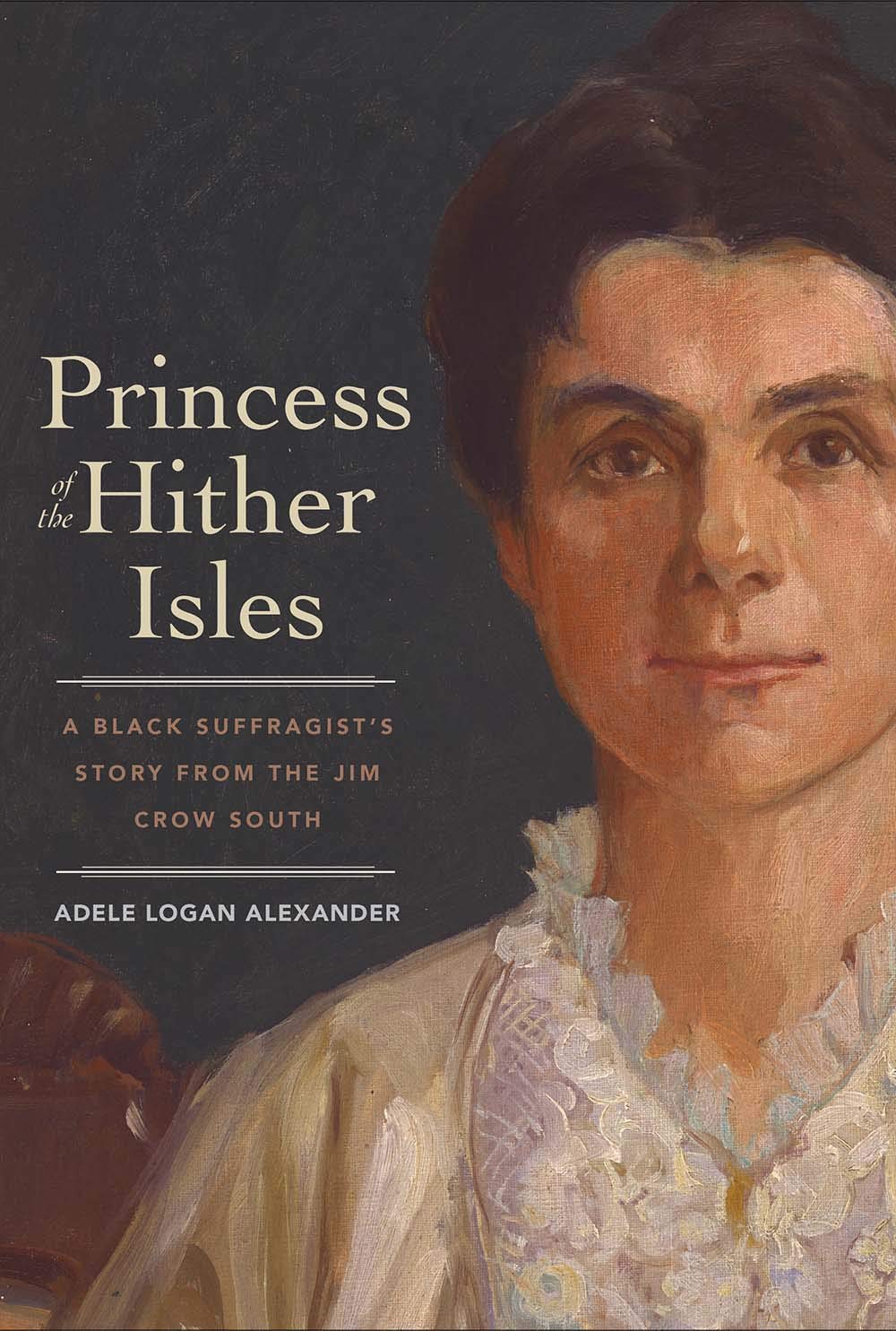
    Born in the late nineteenth century into an affluent family of mixed race—black, white, and Cherokee—Adella Hunt Logan (1863–1915) was a key figure in the fight to obtain voting rights for women of color. A professor at the Tuskegee Institute in Alabama and a close friend of Booker T. Washington, Adella was in contact with luminaries such as Frederick Douglass, George Washington Carver, and W. E. B. Du Bois. Despite her self-identification as an African American, she looked white and would often pass for white at segregated suffrage conferences, gaining access to information and political tactics used in the “white world” that might benefit her African American community.

    Written by Adella’s granddaughter Adele Logan Alexander, this long-overdue consideration of Adella’s pioneering work as a black suffragist is woven into a riveting multigenerational family saga and shines new light on the unresolved relationships between race, class, gender, and power in American society.
  • Imperial Intimacies: A Tale of Two Islands

    2019-09-26

    Imperial Intimacies: A Tale of Two Islands

    Verso Books
    2019-09-24
    416 pages
    6 x 9-1/4
    Hardcover ISBN: 9781788735094
    Ebook ISBN: 9781788735124

    Hazel V. Carby, Charles C. and Dorothea S. Dilley Professor of African American Studies; Professor of American Studies
    Yale University

    Imperial Intimacies by Hazel V. Carby

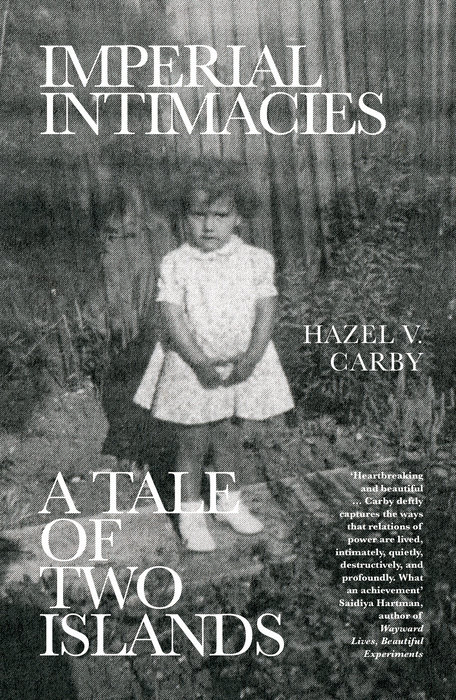
    A haunting and evocative history of British empire, told through one woman’s search through her family’s story

    “Where are you from?” was the question hounding Hazel Carby as a girl in post–World War II London. One of the so-called brown babies of the Windrush generation, born to a Jamaican father and Welsh mother, Carby’s place in her home, her neighbourhood, and her country of birth was always in doubt.

    Emerging from this setting, Carby untangles the threads connecting members of her family to each other in a web woven by the British Empire across the Atlantic. We meet Carby’s working-class grandmother Beatrice, a seamstress challenged by poverty and disease. In England, she was thrilled by the cosmopolitan fantasies of empire, by cities built with slave-trade profits, and by street peddlers selling fashionable Jamaican delicacies. In Jamaica, we follow the lives of both the “white Carbys” and the “black Carbys,” as Mary Ivey, a free woman of colour, whose children are fathered by Lilly Carby, a British soldier who arrived in Jamaica in 1789 to be absorbed into the plantation aristocracy. And we discover the hidden stories of Bridget and Nancy, two women owned by Lilly who survived the Middle Passage from Africa to the Caribbean.

    Moving between the Jamaican plantations, the hills of Devon, the port cities of Bristol, Cardiff, and Kingston, and the working-class estates of South London, Carby’s family story is at once an intimate personal history and a sweeping summation of the violent entanglement of two islands. In charting British empire’s interweaving of capital and bodies, public language and private feeling, Carby will find herself reckoning with what she can tell, what she can remember, and what she can bear to know.

  • Hip Hop Beats, Indigenous Rhymes: Modernity and Hip Hop in Indigenous North America

    2019-09-24

    Hip Hop Beats, Indigenous Rhymes: Modernity and Hip Hop in Indigenous North America

    SUNY Press
    April 2018
    194 pages
    Hardcover ISBN13: 978-1-4384-6945-4
    Paperback ISBN13: 978-1-4384-6946-1

    Kyle T. Mays, Assistant Professor
    Department of African American Studies and American Indian Studies
    University of California, Los Angeles

    Argues that Indigenous hip hop is the latest and newest assertion of Indigenous sovereignty throughout Indigenous North America.

    Expressive culture has always been an important part of the social, political, and economic lives of Indigenous people. More recently, Indigenous people have blended expressive cultures with hip hop culture, creating new sounds, aesthetics, movements, and ways of being Indigenous. This book documents recent developments among the Indigenous hip hop generation. Meeting at the nexus of hip hop studies, Indigenous studies, and critical ethnic studies, Hip Hop Beats, Indigenous Rhymes argues that Indigenous people use hip hop culture to assert their sovereignty and challenge settler colonialism. From rapping about land and water rights from Flint to Standing Rock, to remixing “traditional” beading with hip hop aesthetics, Indigenous people are using hip hop to challenge their ongoing dispossession, disrupt racist stereotypes and images of Indigenous people, contest white supremacy and heteropatriarchy, and reconstruct ideas of a progressive masculinity. In addition, this book carefully traces the idea of authenticity; that is, the common notion that, by engaging in a Black culture, Indigenous people are losing their “traditions.” Indigenous hip hop artists navigate the muddy waters of the “politics of authenticity” by creating art that is not bound by narrow conceptions of what it means to be Indigenous; instead, they flip the notion of “tradition” and create alternative visions of what being Indigenous means today, and what that might look like going forward.

    Table of Contents

    • Preface: A Note on Language: Black English and Uncensored Mode
    • Acknowledgments
    • Introduction: Can We Live and Be Modern and Indigenous?: Toward an Indigenous Hip Hop Culture
    • 1. #NotYourMascot: Indigenous Hip Hop Artists as Modern Subjects
    • 2. The Fashion of Indigenous Hip Hop
    • 3. Indigenous Masculinity in Hip Hop Culture: Or, How Indigenous Feminism Can Reform Indigenous Manhood
    • 4. “He’s just tryna be black”: The Intersections of Blackness and Indigeneity in Hip Hop Culture
    • 5. Rhyming Decolonization: A Conversation with Frank Waln, Sicangu Lakota
    • Conclusion: “It’s bigger than Hip Hop”: Toward the Indigenous Hip Hop Generation
    • Notes
    • Works Cited
    • Index
  • The Shifting Definition of Mixed-Race in America

    2019-09-24

    The Shifting Definition of Mixed-Race in America

    Zora
    2019-09-23

    Kristal Brent Zook, Professor of Journalism, Media Studies, and Public Relations
    Hofstra University, Hempstead, New York

    An illustrated graphic featuring various text such as: #Blackipino, #Blaxican, #Hapa, #Blasian.

    Radical changes in U.S. demographics are reinventing what it means to be multiracial

    “Raise your hand if you would see me on the street and think I’m Black?”

    Several hands went up in an auditorium full of college students.

    “Okay. What about biracial?”

    More hands.

    “Hmm… And what if I wore my hair in an Afro?”

    Still more hands flew into the air.

    What are you?

    Multiracial people field that question daily.

    Not long ago — before, during, and just after the civil rights era — there was often an unspoken understanding that those of us who are biracial should answer to only one race. One reality. One allegiance. Even today, a majority of adults who are multiracial choose not to identify that way.

    But others are beginning to question that arrangement…

    Read the entire article here.

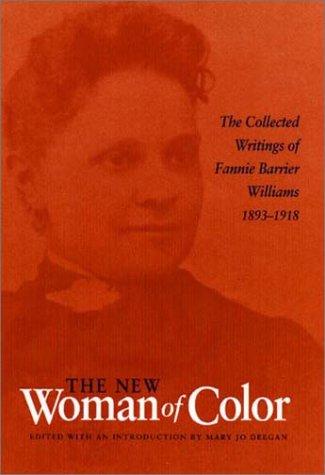
  • The New Woman of Color: The Collected Writings of Fannie Barrier Williams, 1893–1918

    2019-09-24

    The New Woman of Color: The Collected Writings of Fannie Barrier Williams, 1893–1918

    Northern Illinois University Press
    2002-07-23
    222 pages
    6 x 9 in
    ISBN 13: 9780875802930

    Edited by: Kenny Williams

    Cover of: The new woman of color | Fannie Barrier Williams

    Fannie Barrier Williams made history as a controversial African American reformer in an era fraught with racial discrimination and injustice. She first came to prominence during the 1893 Columbian Exposition, where her powerful arguments for African American women’s rights launched her career as a nationally renowned writer and orator. In her speeches, essays, and articles, Williams incorporated the ideas of Booker T. Washington and W.E.B. DuBois to create an interracial worldview dedicated to social equality and cultural harmony.

    Williams’s writings illuminate the difficulties of African American women in the Progressive Era. She frankly denounced white men’s sexual and economic victimization of black women and condemned the complicity of religious and political leaders in the immorality of segregation. Citing the discrimination that crushed the spirits of African American women, Williams called for educational and professional progress for African Americans through the transformation of white society.

    Committed to aiding and educating Chicago’s urban poor, Williams played a central and continuous role in the development of the Frederick Douglass Center, which she called “the black Hull House.” An active member of the NAACP and the National Urban League, she fought a long and successful battle to become the first African American admitted to the influential Chicago Women’s Club. Her efforts to promote the well-being of African American women brought her into close contact with such influential women as Celia Parker Woolley, Jane Addams, Susan B. Anthony, and Ida B. Wells-Barnett.

    Accompanied by Deegan’s introduction and detailed annotations, Williams’s perceptive writings on race relations, women’s rights, economic justice, and the role of African American women are as fresh and fascinating today as when they were written.

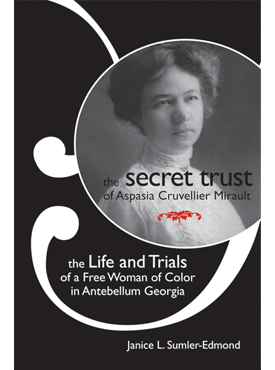
  • The Secret Trust of Aspasia Cruvellier Mirault: The Life and Trials of a Free Woman of Color in Antebellum Georgia

    2019-09-23

    The Secret Trust of Aspasia Cruvellier Mirault: The Life and Trials of a Free Woman of Color in Antebellum Georgia

    University of Arkansas Press
    August 2008
    180 pages
    6 x 0.8 x 9 inches
    Hardcover ISBN-13: 978-1557288806

    Janice L. Sumler-Edmond, Professor Emerita of History
    Huston-Tillotson University, Austin, Texas

    In this fascinating biography set in nineteenth-century Savannah, Georgia, Janice L. Sumler-Edmond resurrects the life and times of Aspasia Cruvellier Mirault, a free woman of color whose story was until now lost to historical memory. It’s a story that informs our understanding of the antebellum South as we watch this widowed matriarch navigate the social, economic, and political complexities to create a legacy for her family.

  • The Greek-American R&B Legend Who Passed as Black

    2019-09-22

    The Greek-American R&B Legend Who Passed as Black

    Zócalo Public Square
    2018-12-17

    Kristen E. Broady, Dean and Professor of Economics
    College of Business
    Dillard University, New Orleans, Louisiana


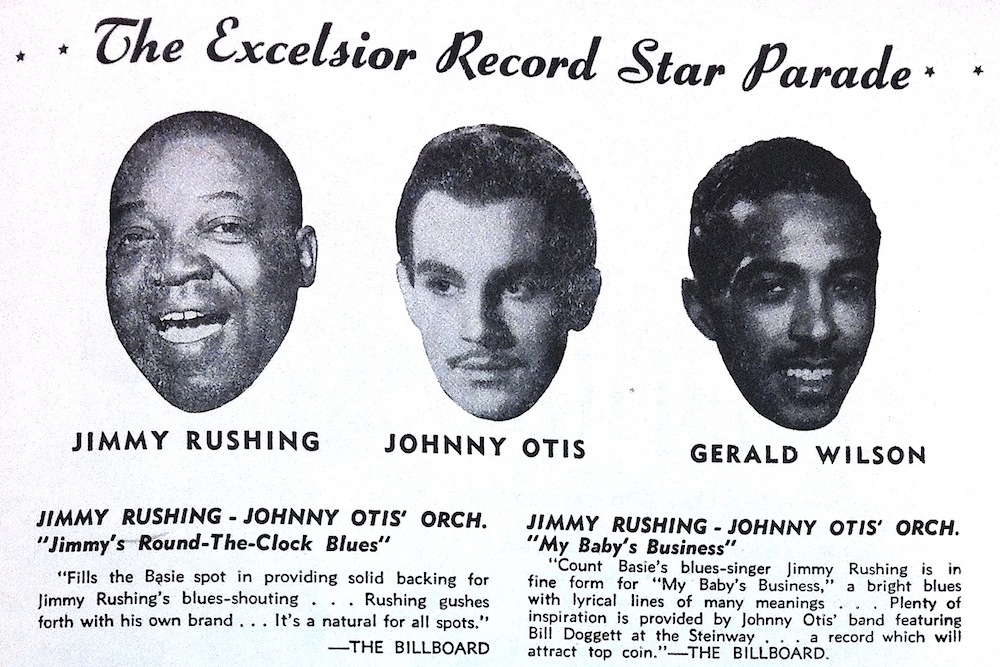
    An Excelsior Records advertisement features R&B pioneer Johnny Otis between blues singer Jimmy Rushing and bandleader Gerald Wilson. Courtesy of Flickr.

    Johnny Otis Felt He Had Been ‘Saved’ by the Political, Spiritual, and Moral Force of African-American Culture

    If a role exists in black music that Johnny Otis couldn’t play, it would be hard to find. Known as the godfather of rhythm and blues, Otis was a bandleader, talent scout, singer, drummer, minister, journalist, and television show host. Between 1950 and 1952, Johnny and his band recorded 15 top 40 R&B blues hits. He discovered, produced and promoted a roster of stars, including Etta James, Little Esther, and Jackie Wilson.

    Otis was not only a trailblazer in the world of music but also a religious leader and political activist. Born seven months after the beginning of the 1921 Tulsa Race Riot, he lived through Supreme Court decisions that decriminalized interracial marriage, barred racial gerrymandering of political districts, and ended covenants barring black Americans from owning property. He witnessed the inauguration of the nation’s first African-American president and was a friend of Malcolm X and an enemy of racial oppression. Yet Johnny Otis, arguably one of the most important figures in mid-century black music in America, was not actually black. He was white, passing as black…

    Read the entire article here.

  • The new one-drop rule: challenging the persistence of white supremacy with in-service teachers

    2019-09-22

    The new one-drop rule: challenging the persistence of white supremacy with in-service teachers

    Teaching Education
    Volume 29, 2018 – Issue 4: What is To Be Done with Curriculum and Educational Foundations’ Critical Knowledges? New Qualitative Research on Conscientizing Preservice and In-Service Teachers
    pages 330-342
    DOI: 10.1080/10476210.2018.1505841

    Benjamin Blaisdell, Assistant Professor
    College of Education
    East Carolina University, Greenville, North Carolina

    Publication Cover

    The one-drop rule refers to the process of being racialized Black when someone contains any amount of Black ancestry, i.e. one drop of Black blood. In this article, I use what I call ‘the new one-drop rule’ to explain how even the smallest presence of white discourse can disrupt racial equity work in schools. Based on a critical race study in a racially desegregated elementary school, I illustrate how one drop of white discourse from even one less racially literate white teacher can cause usually more racially literate white teachers to support white supremacy. I also share how collaborative research utilizing critical race theory (CRT) can help schools build greater racial literacy and resist white discourse. I argue that critical research on race with in-service teachers should not forefront the consciousness-raising of resistant white teachers but rather center the wants, needs, and racial knowledge of racially literate teachers and especially teachers of color.

    Read the entire article here.

  • But in Puerto Rico and other parts of Latin America where racial mixing was common, there are numerous ways to identify racially, with different names for different combinations of skin tones, hair textures, and facial features, such as “negra,” “trigueña,” or “morena.”

    2019-09-22

    In the United States, racial segregation enforced strict political and social barriers between Blacks and whites long after slavery. (“One drop” of African blood designated you as “Black,” no matter what your complexion or ethnicity.) But in Puerto Rico and other parts of Latin America where racial mixing was common, there are numerous ways to identify racially, with different names for different combinations of skin tones, hair textures, and facial features, such as “negra,” “trigueña,” or “morena.”

    It’s one of the reasons that not every Latino who has brown skin or African ancestry calls themselves “Black” or “Afro-Latinx“—and some might even take offense to the suggestion that they should be called anything but Puerto Rican.

    Natasha S. Alford, “This Afro-Latina Started a Magazine in Puerto Rico to Celebrate Black Beauty,” The Oprah Magazine, September 20, 2019. https://www.oprahmag.com/life/a29107354/afro-latinos-puerto-rico-magazine/.

  • Many mixed-race people are not permitted to fully determine their own identity because of how the world insists on defining them. That’s when hair can represent a manifesto of self.

    2019-09-22

    Hair is Africa’s most enduring marker in America, the phenotype most likely to persist through generations of interracial children. Hair is what black folks look at when trying to determine who is one of us. Many mixed-race people are not permitted to fully determine their own identity because of how the world insists on defining them. That’s when hair can represent a manifesto of self.

    Jesse Washington, “The untold story of wrestler Andrew Johnson’s dreadlocks,” The Undefeated, September 18, 2019. https://theundefeated.com/features/the-untold-story-of-wrestler-andrew-johnsons-dreadlocks/.

Previous Page
1 … 134 135 136 137 138 … 1,428
Next Page

Designed with WordPress