• Census: Mixed heritage Utahns — most of them youngsters — fuel diversity in Utah

    Deseret News
    2019-06-19

    Annie Knox


    Scott G Winterton, Deseret News
    Jaelyn Sawyer and Heaven Marie Matthews play as they attend a Juneteenth festival at the Gallivan Center in Salt Lake City on Wednesday, June 19, 2019. As Utah’s population becomes increasingly diverse, those who are biracial and multiracial are fueling much of the change. And young people are in large part responsible for the growing diversity, new census data shows.

    SALT LAKE CITY — On Mother’s Day, 8-year-old A’talia Lepper helped her grandmother stuff dough and fold it into lumpia, the spring rolls popular in the matriarch’s native Phillipines.

    Other times, she chows down on rice cake soup, a nod to her Korean heritage on her mother’s side.

    And when she gets the chance, A’talia will stir up a batch of brownies or cookies at her family’s Clearfield home, “because they’re fun to make because I can do it with my mommy,” she said.

    The budding baker, also part Caucasian and of Spanish descent, is among a growing number of Utahns of mixed heritage — many right around her same age, census figures released late Wednesday show.

    As the Beehive State’s 3.1 million population becomes increasingly diverse, those who are biracial and multiracial are fueling more and more of the change, with a growth rate of 42.5 percent since 2010, according to the 2018 Population Estimates

    Read the entire article here.

  • Is race mixture an antidote to racism?

    Monitor: Global Intelligence on Racism
    2018-12-03

    Monica Moreno-Figueroa, Senior Lecturer in Sociology at the University of Cambridge; Fellow in Social Sciences at Downing College, Cambridge

    Peter Wade, Professor of Social Anthropology
    University of Manchester

    There is a tendency for commentators situated towards the political right to claim that we are living in a “post-racial” age. They point to the fact that since the Second World War, the institutional racism of the US South and of South African apartheid has been dismantled, that scientists now agree that all humans are genetically almost identical, that many societies have officially adopted multiculturalist policies, recognising and respecting the cultural differences that characterise racially diverse societies, and that rates of inter-racial marriage are rising fast as societies become more integrated.

    Within this “post-racial” view, the presence of racism is not necessarily denied, but it is minimised and seen in a certain way. Overtly racist people are deplored as far-right fanatics who are not representative of the main trends in society. Those who protest against racism are accused of being over-sensitive “snow-flakes” who “can’t take a joke”, of unfairly demanding special treatment, or creating counter-productive divisiveness and discord in society.

    In this scenario, post-raciality and racism are seen as being in an either/or relationship, a zero-sum game in which the more post-racial a society is, the less racism it must have. However, Latin American societies can teach us, both in historical and contemporary experiences, that this scenario is misleading. The region shows us that post-raciality and racism can co-exist, with both aspects forming simultaneous dimensions of the same context. What is more, it is not that post-raciality is a mask behind which the workings of racism lurk: they are both deeply-rooted aspects of society…

    Read the entire article here.

  • Racism ‘won’t go away’ even if we’re all mixed-race in the future

    METRO.co.uk
    2019-06-18

    Natalie Morris, Senior lifestyle Reporter

    The idea of ‘divide and conquer’ harks back thousands of years.

    Whether it is by gender, class, wealth or race, humans love walling themselves into distinct categories then using those categories to create hierarchies.

    In the case of race, this hierarchical distinction ended up with slavery, countless programmes of ethnic cleansing and the retention of ‘othering’ based on the colour of skin even to the present day.

    But what happens if we take away these racial categories that divide us into subgroups?

    If, instead of defining as black, white, Asian or any other singular category, we defined ourselves as a little bit of everything, would it herald the dawn of a more accepting, ‘post-racial’ age?

    And would that mean racism would end?…

    Read the entire article here.
  • Chris Abani: Face Value in Brooklyn

    Restless Books
    Brooklyn, New York
    2014-05-19

    attachment-537a688ae4b0e957bf2ed29e

    We were thrilled to welcome our friend and contributor Chris Abani to New York this weekend to participate in Lit Crawl NYC. Chris came to discuss his forthcoming contribution to our series, The Face, and to read from his work-in-progress…

    …When I tell people that my mother was a white English woman and my father Igbo, they look at me skeptically. It’s a pause that really means; are you sure? You’re so dark. It’s a pause that I’ve heard only in the West. In Nigeria most people know on meeting me that I’m not entirely African. Nigeria has a long history of foreigners coming through—the Portuguese in the 14th century, North Africans as far back as the 12th century, Tuaregs and Fulani to name just a few. In fact in the late 80’s and early 90’s the civil war in Chad caused the very light skinned Chadians to pour into Nigeria as refugees. It was a disturbing sight to see hundreds, and sometimes thousands, of homeless Arab looking people begging for food in the streets and markets. The public outcry was so severe that the military government began a program of forced repatriation. Army trucks rolled into markets and soldiers would round up these refugees an, with no thought of separating families, after all they all looked alike, and drive them back to the border. I once found myself being pushed into one such truck but my fluency in several Nigerian languages saved me. I was often confused for being Lebanese, Indian, Arab, or Fulani. But not in England or America. In these places I am firmly black, of unknown origin…

    Read the entire article here.

  • Mixed Up: ‘I worry about unspoken discrimination. Have you judged me before I’ve even said a word?’

    METRO.co.uk
    2019-06-12

    Natalie Morris, Senior lifestyle reporter

    Mixed Up - Lifestyle - Natalie Morris
    ‘Most of my class called me an “Oreo” and bullied me mercilessly for years’ (Picture: Jerry Syder for Metro.co.uk)

    Marie Farmer is a mother and founder of a family nutrition app. She has Jamaican and Scottish heritage, but she doesn’t identify as either black or white. In fact, she hates being asked to choose.

    ‘There were only a handful of non-white children in my primary school, which did lead to certain issues in the playground,’ Marie tells Metro.co.uk.

    ‘Whenever we pretended to be the Spice Girls, I always had to be Scary because I was “brown” – even though I was clearly the best Posh.

    ‘When I was a bit older I remember reading the poem “Half-caste” by John Agard in a class.

    ‘I clearly didn’t understand the message as I was really pleased I had a name to identify myself with. I told my mum and she explained why it was a racist term, so I quickly switched to saying I was mixed.

    ‘That was the first time it occurred to me that being mixed could be controversial. I don’t remember anyone before that pointing out that I was different and that it was a bad thing.’…

    Read the entire article here.

  • Looking white and being Aboriginal

    CBC News
    2017-06-21

    Regan Burden


    Regan Burden is from Port Hope Simpson, but now lives in St. John’s. (Evan Smith)

    It was a beautiful summer day in downtown St. John’s; my friend was working a food truck and on my way to work, I’d often stop to say hello, maybe grab a poutine to eat on my way to work.

    One day, he had a friend with him; he was tall, handsome, had dark hair and a nice smile. He told me he had seen me at a show before, but I couldn’t quite remember talking to him. I met a lot of people that night.

    We got to talking about ourselves and he asked me where I was from.

    Port Hope Simpson. It’s a tiny town in Labrador that I promise you haven’t heard of.” I was right about that. I always am.

    He told me he was from Gander, but had spent some time in Stephenville. His mother was a judge and she got asked to go to Labrador but didn’t want to.

    “Stephenville was bad enough, all those f—ing jackytars stealing everything and sniffing gas. Can you imagine what it would have been like in Labrador?”

    I grew up in Labrador and I had no idea what he was talking about. I didn’t even know what a jackytar was and whatever he thought about whatever they were, I certainly didn’t. I had to get him to explain. “You know, Indians.”

    I explained to him that I was an Aboriginal person and I found what he was saying to be really offensive. He just looked confused.

    “Come on. You can’t be thaaaat Aboriginal, look at you.”…

    Read the entire article here.

  • There’s No Such Thing as Objective Science

    Bitch Media
    2019-05-20

    Abaki Beck


    Illustration of Saartjie Baartman (Wikimedia Commons)

    Scientific racism led to the Holocaust and to the forced sterilization of hundreds of women of color in the United States in the 20th century. And yet it’s still overwhelmingly considered neutral, nonpartisan, and, for all intents and purposes, fact. Though these aforementioned horrors are now considered outliers that have been confronted and fixed, science journalist Angela Saini’s third book, Superior: The Return of Race Science, makes the compelling case that scientific racism is as prevalent as it has ever been, and explores the way such backward beliefs have continued to evolve and persist. And it couldn’t be more timely: The book comes out as white nationalism surges across Europe and America deals with a president who routinely makes racist remarks, including referring to Haiti, El Salvador, and African countries as “shitholes.”

    While researching the book, Saini traveled the world examining how concepts of race developed everywhere from human zoos in Paris to the horrors of the Nazi regime to contemporary American researchers in search of a “Black gene.” What she concludes is depressingly simple: Science intentionally created, and continues to recreate, race. “There are plenty of ignorant racists, but the problem is not just ignorance,” she writes. “The problem is that, even when people know the facts, not everyone actually wants an end to racial inequality. And this means that those committed to the biological reality of race won’t back down if the data prove them wrong.”…

    Read the entire article here.

  • Sociologist’s Book Highlights Experiences of Interracial Couples and the Meanings They Give to Race and Ethnicity

    Rutgers-Camden News Now
    Rutgers, The State University of New Jersey
    2019-06-10

    Tom McLaughlin, Media Relations Specialist


    Throughout her book, Osuji uses her findings to challenge the notion that society should rely on interracial couples and their multiracial children to end racism.

    While people in American society often talk about race mixture as an antidote to the country’s racial problems, interracial couples remain stigmatized, according to a new book by a Rutgers University–Camden sociologist.

    “The idea is that, the more people who are interracially marrying, then we will have more multiracial children and magically there won’t be racial inequality or racism anymore,” says Chinyere Osuji, an assistant professor of sociology at Rutgers University–Camden.

    That’s not the case, says the Rutgers–Camden researcher.

    According to Osuji, looking at interracial couples in Brazil – a country historically known for its racial diversity – shows how racism can coexist with race mixture. She explains that, although the country does have a substantial multiracial population, interracial couples are very much still stigmatized and race mixing is segregated by class – more likely to occur “in poor communities, where brown and black people live.”

    These are just a few of the illuminating findings in Osjui’s groundbreaking new book, Boundaries of Love: Interracial Love and the Meaning of Race (NYU Press, 2019)…

    Read the entire article here.

  • In Search of Julien Hudson: Free Artist of Color in Pre–Civil War New Orleans

    Historic New Orleans Collection
    2010
    128 pages
    70 color images, 7 b/w images
    8″ × 9½”
    Hardcover ISBN: 978-0-917860-57-7

    Edited and with an introduction by Erin M. Greenwald, with essays by William Keyse Rudolph and Patricia Brady

    Julien Hudson, born in 1811 in New Orleans, was the son of a property-owning free woman of color and a white English merchant, ironmonger, and ship chandler. Hudson began painting in the mid-1820s, training first in New Orleans and later in Paris. Little is known about his personal life, outside of scattered details found in a handful of public documents and a pair of early-twentieth-century reminiscences by former student George Coulon and prominent Creole of color Rodolphe Desdunes. This carefully researched volume is the most thorough examination to date of Julien Hudson and his world.

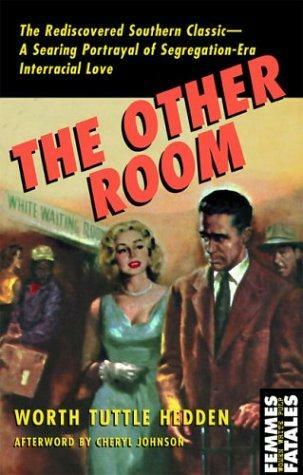
  • The Other Room

    Crown Publishers
    1947
    274 pages
    ISBN 13: 9780000100184

    Worth Tuttle Hedden (1896-1985)

    Winner of the Southern Authors Award

    A Southern White Girl Gets The Shock Of Her Life

    The iron grillwork of the gate stood between them…..and so did years of tradition and social custom. It was a barrier, built by hate and fear, between one color and another. He might have crossed that line, and lived on her side–but he was too proud to pass for white.

    This prize-winning novel is about a young woman who unknowingly signs up to teach classes at an all-black college in New Orleans in 1920. It is one of the best—and earliest—views of breaking the color line as well as a touching love story of a man and woman of different races.

    In the evening she was on a train, rushing towards New Orleans. Her first job waited for her; she was counting off the miles to adventure, romance, and independence. In the morning, shamed and horrified, she was fighting the necessity to quit, to go home to a scornful family and admit failure.

    Nina Latham was a southern girl, trained in a rigid code of black and white. She wanted to get away from home, but when she signed for her new job she didn’t know she would be working with Negroes, eating with them, living among them. And certainly she didn’t know that she would meet handsome young Leon who could have passed for white—but wouldn’t.