• Do Women Have Superpowers? Gugu Mbatha-Raw Says Yes

    The New York Times
    2019-05-10

    Kathryn Shattuck


    Emily Berl for The New York Times

    When Gugu Mbatha-Raw signed up to be a superhero, little did she know she’d be squaring off against Iron Man, Thor, Captain America and the rest of the Marvel universe.

    But two years later, “Fast Color” has found itself in theaters at the same time as “Avengers: Endgame” — and heralded as the antidote to men destroying the world to save it.

    “It’s quite an interesting journey that it’s being compared and contrasted to a huge Marvel juggernaut, which was never our intention,” she said. “But I have to say I’m interested in the conversation. I haven’t always seen myself represented in those kinds of movies, as a lot of people haven’t.”

    Mbatha-Raw is herself a fighter: In 2014, she broke through with Amma Asante’sBelle,” about the mixed-race daughter of an 18th-century British naval captain raised among the white aristocracy — a role she pursued for eight years. Months later, she transformed herself into a flailing pop superstar who divines peace through the music of Nina Simone in Gina Prince-Bythewood’sBeyond the Lights.”…

    Read the entire interview here.

  • Coloring Locals: Racial Formation in Kate Chopin’s “Youth’s Companion” Stories

    University of Iowa Press
    2003
    168 pages
    7 drawings, references, index
    Cloth ISBN: 9780877458289
    eBook ISBN: 9781587294280

    Bonnie James Shaker, Assistant Professor of English
    Kent State University Geauga, Burton, Ohio
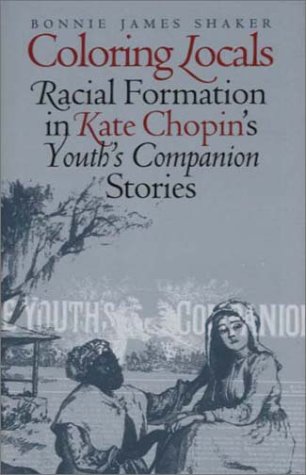
    Coloring Locals examines how the late nineteenth-century politics of gender, class, race, and ethnicity influenced Kate Chopin’s writing for the major family periodical of her time.

    Chopin’s canonical status as a feminist rebel and reformer conflicts with the fact that one of her most supportive publishers throughout her life was the Youth’s Companion, a juvenile periodical whose thoroughly orthodox “family values” contributed to its success as the longest-running and, at one time, most widely circulating periodical in nineteenth-century America. Not surprisingly, Chopin’s Youth’s Companion stories differ from her canonical texts in that they embrace and advance ideals of orthodox white femininity and masculinity. Rather than viewing these two representations as being at odds with each other, Bonnie Shaker asserts that Chopin’s endorsement of conventional gender norms is done in the service of a second political agenda beyond her feminism, one that can help the reader appreciate nuances of identity construction previously misunderstood or overlooked in the body of her work.

    Shaker articulates this second agenda as “the discursive act of coloring locals,” the narrative construction of racial difference for Louisiana peoples of African American, Native American, and French American ancestry. For Chopin, “coloring locals” meant transforming non-Louisianans’ general understanding of the Creole and Cajun as mixed-race people into “purely” white folks, this designation of whiteness being one that conferred not only social preferment but also political protections and enfranchisement in one of the most racially violent decades of U.S. history. Thus, when Chopin is concerned with coloring her beloved Louisiana Creoles and Cajuns “white,” she strategically deploys conventional femininity for the benefits it affords as a sign of middle-class respectability and belonging.

    Making significant contributions both to the scholarship on Kate Chopin and on race and gender construction, this sophisticated study will be of great interest to scholars and students of nineteenth-century ethnic and cultural studies as well as Chopin scholars.

  • Rethinking Transracialism: Ariana Grande and Racial Ambiguity

    Cult Plastic: Dance And Culture In The Plastic Age
    2019-02-19

    Anh Vo


    Ariana Grande from the 2018 Billboard Woman of the Year Cover Shoot

    This article revisits, revises, and expands on the arguments I make in Blackface and Pop Princesses: A Brief Genealogy. Previously, I wrote three brief paragraphs on Ariana Grande, trying to position her donning of black and brown visuality (i.e. blackface/brownface) alongside similar practices of other pop princesses such as Britney Spears, Christina Aguilera, and Miley Cyrus. However, I no longer think blackface as a phenomenon can quite account for how Grande is manipulating the racial ambiguity of her image. Even though she certainly inherits the history of pop princesses borrowing the cultural signification of blackness/brownness to shed their young and innocent facades and sell their more sexually dangerous personas, Grande also departs from this “tradition” radically. She does not borrow; she becomes black, becomes brown, becomes something not quite black or brown, yet not quite white either. She becomes transracial.

    At stake here is not the matter of people simply being confused about Grande’s racial identity. Confusion is almost always inevitable when it comes to race, because the colonial fantasy of racial purity, and even of race itself, always falls apart as it tries to categorize the unruliness of the body to create a hierarchy of humanity (with whiteness at its apex). What so disturbing, then, is the fact that Grande successfully mobilizes, amplifies, and capitalizes on this (trans)racial confusion, and gets away with crossing into non-whiteness the way Rachel Dolezal cannot. My goals in writing this essay are two-fold: (1) to articulate Ariana Grande’s image transformation not as an act of racial passing, but as a gradual racial transitioning from whiteness into ambiguity (2) to redirect the discourse on transracialism away from the monopoly of Dolezal, who, together with her transracial “identity” of blackness, has been too easily brushed off as a joke, a lie, or at best an individual anomaly…

    Read the entire article here.

  • Visual Pleasure and Racial Ambiguity

    University of New Orleans
    August 2018
    54 pages

    Ruth M. Owens MD

    Submitted to the Graduate Faculty of the University of New Orleans In partial fulfillment of the Requirements for the degree of Master of Fine Arts in Fine Arts

    I struggle to present work that reflects a psychological expressivity which at the same time conveys intellectual concepts that are of concern to me. It seems that the fluidity of an image can communicate a certain pathos, and correspond to the fluid nature of one’s identity. Drippy paint, distorted bodies, and vertiginous video clips can give an indication about what a body feels like from within. Depictions of these bodily feelings help to communicate ideas about what it means to be alive in general, and a mixed race woman, in particular.

    Read the entire thesis here.

  • Interraciality in Early Twentieth Century Britain: Challenging Traditional Conceptualisations through Accounts of ‘Ordinariness’

    genealogy
    Volume 3, Number 2
    24 pages
    DOI: 10.3390/genealogy3020021

    Chamion Caballero, Visiting Senior Fellow
    London School of Economics


    Unknown Anglo-Chinese family, Liverpool, c.1930s. Image courtesy of Yvonne Foley. Foley has campaigned for greater recognition of the brutal repatriation of Chinese seaman by the British government in 1945–1946, many of whom were consequently forced to leave their white wives and children behind. See http://www.halfandhalf.org.uk/.

    The popular conception of interraciality in Britain is one that frequently casts mixed racial relationships, people and families as being a modern phenomenon. Yet, as scholars are increasingly discussing, interraciality in Britain has much deeper and diverse roots, with racial mixing and mixedness now a substantively documented presence at least as far back as the Tudor era. While much of this history has been told through the perspectives of outsiders and frequently in the negative terms of the assumed ‘orthodoxy of the interracial experience’—marginality, conflict, rejection and confusion—first-hand accounts challenging these perceptions allow a contrasting picture to emerge. This article contributes to the foregrounding of this more complex history through focusing on accounts of interracial ‘ordinariness’—both presence and experiences—throughout the early decades of the twentieth century, a time when official concern about racial mixing featured prominently in public debate. In doing so, a more multidimensional picture of interracial family life than has frequently been assumed is depicted, one which challenges mainstream attitudes about conceptualisations of racial mixing both then and now.

    Read the entire article in HTML or PDF format.

  • Tia Mowry Talks Adjusting To The Racism She Experiences With Her Black Husband Vs Growing Up With A White Father

    MadameNoire
    2019-05-31

    Veronica Wells, Culture Editor

    I don’t think it’s any secret that Tia Mowry (and Tamera) are biracial. While it was a minute before we saw their parents, their mother, Darlene Mowry, is Black and their father, Timothy Mowry, is White. You might imagine that growing up in that household was a bit different than living in the household she does now. And it is. On her YouTube channel, Tia Mowry’s Quick Fix, she shared the racism her parents experienced when they were initially dating, the racism her mother experienced that her father didn’t, and how it’s different having a White father vs. a Black husband in terms of racial treatment.

    See what Tia had to say about all of this below…

    Read the entire article here.

  • Delaware’s Forgotten Folk: The Story of the Moors and Nanticokes

    University of Pennsylvania Press
    2006 (originally published in 1943)
    232 pages
    13 illustrations
    5 1/2 x 8 1/2
    Paper ISBN: 9780812219838

    C. A. Weslager (1909-1994)

    Photographs by L. T. Alexander
    Drawings by John Swientochowski

    Delaware's Forgotten Folk

    “It is offered not as a textbook nor as a scientific discussion, but merely as reading entertainment founded on the life history, social struggle, and customs of a little-known people.”—From the Preface

    C. A. Weslager’s Delaware’s Forgotten Folk chronicles the history of the Nanticoke Indians and the Cheswold Moors, from John Smith’s first encounter with the Nanticokes along the Kuskakarawaok River in 1608, to the struggles faced by these uniquely multiracial communities amid the racial and social tensions of mid-twentieth-century America. It explores the legend surrounding the origin of the two distinct but intricately intertwined groups, focusing on how their uncommon racial heritage—white, black, and Native American—shaped their identity within society and how their traditional culture retained its significance into their present.

    Weslager’s demonstrated command of available information and his familiarity with the people themselves bespeak his deep respect for the Moor and Nanticoke communities. What began as a curious inquiry into the overlooked peoples of the Delaware River Valley developed into an attentive and thoughtful study of a distinct group of people struggling to remain a cultural community in the face of modern opposition. Originally published in 1943, Delaware’s Forgotten Folk endures as one of the fundamental volumes on understanding the life and history of the Nanticoke and Moor peoples.

    Table of Contents

    • Preface
    • 1. Red, White, and Black
    • 2. The Mysterious Moor
    • 3. Plot in the Swamp
    • 4. The Persistent Red Thread
    • 5. An Unexpected Champion
    • 6. The Good Fight
    • 7. A World Unknown
    • 8. Links with the Past
    • Bibliography
  • There is good reason to expect that in the United States today individuals who identify as multiracial experience negative treatment. Multiracial individuals report encountering discrimination and microaggressive behaviors such as racial exclusion and marginalization, exoticization, invalidation of their racial identities, and racial essentialization.2 These behaviors are in part a result of the kinds of racism that all groups of color face, and in part products of monoracism, a system which privileges single-race categories over racial mixing.3 This system leads to the systematic exclusion and reduction of multiracial identities. For example, during much of the history of the United States, the “one-drop rule” (the idea that every person with any black ancestry was to be identified as only black) was both a social and a legal principle that was heavily enforced.”4

    Monoracism and the discriminatory and microaggressive behavior it produces continue to affect multiracial individuals today. For example, there have been numerous cases of workplace racial discrimination presented to courts by multiracial plaintiffs alleging the violation of Titles VI and VII of the Civil Rights Act of 1964.5 A common type of microaggressive behavior found in many of the court cases was racial essentialization; individuals were assigned to a single, monoracial group by others despite their multiracial background.6 For example, multiracial individuals with a black parent are typically described and treated as if they are solely African American.7 Even the courts themselves generally describe multiracial people with any black ancestry as simply black. Many scholars who are supporters of the “Personal Identity Equality” approach have critiqued this pattern, arguing that the “misrecognition of one’s identity” is a form of “social subordination,”8 although it is not against the law to refuse to acknowledge the racial identity that a person claims.

    Mary E. Campbell and Sylvia M. Emmanuel, “On The Edge: Multiracial Groups and Public Policies,” in How Public Policy Impacts Racial Inequality, Josh Grimm and Jaime Loke eds. (Baton Rouge: Louisiana State University Press, 2019), 96.

  • Girl, Woman, Other

    Hamish Hamilton (an imprint of Penguin UK)
    2019-05-02
    464 pages
    Hardback ISBN: 9780241364901
    Ebook ISBN: 9780241985007

    Bernardine Evaristo

    Teeming with life and crackling with energy – a love song to modern Britain, to black womanhood, to the ever-changing heart of London

    Girl, Woman, Other follows the lives and struggles of twelve very different characters. Mostly women, black and British, they tell the stories of their families, friends and lovers, across the country and through the years.

    Joyfully polyphonic and vibrantly contemporary, this is a gloriously new kind of history, a novel of our times: celebratory, ever-dynamic and utterly irresistible.

  • Mulattoes Cannot Vote Under the Grandfather Clause.

    The Progressive Farmer
    Winston, North Carolina
    Tuesday, 1902-09-30
    page 5, column 4
    Source: Chronicling America (ISSN 2475-2703), Library of Congress, Washington, D.C.

    Thumbnail for 5

    The Observer is in receipt of the following from a friend at Carthage:

    “A question which is having some discussion here is: Can a mulatto whose father was a white man register under the ‘grandfather clause?’”

    Now it is a generally accepted fact that most mulattoes are such from the fact that their fathers and not their mothers were white. Would this general application be sufficient grounds for a general mulatto registration? If not, could a mulatto whose mother was a negro but whose father is unknown register according to law? Is the burden upon the applicant for registration to prove that his father was a white man and could vote prior to 1867?

    “Your subscribers would be pleased to have you give some editorial answers and explanations to the above questions. I am certain such would be of interest to many people throughout the State at this time and the independence of your paper renders it the logical medium through which such information can do the most good.”

    Assuming that the mulatto was the illegitimate son of a white man (which must be assumed, as marriages between whites and blacks is and was unlawful) the mulatto could not vote, as the law does not recognize that an illegitimate has any father and unless the said mulatto is otherwise qualified he cannot get in under the “grandfather clause.”

    As nearly all negroes were slaves prior to their emancipation the presumption is that the grandfather of any mulatto was disqualified from voting prior to 1868, and the burden rests upon him to show to the contrary before he shall be entitled to register or vote. —Charlotte Observer.