• What is Racial Passing?

    Digital Studios: Origin of Everything
    PBS Digital Studios
    Public Broadcasting Service
    Season 2, Episode 13 (First Aired: 2019-02-27)

    Danielle Bainbridge, Host, Writer, and Postdoctoral Fellow
    Northwestern University, Evanston, Illinois

    What motivates someone to disguise their race, gender, religion, etc.? Today Danielle explores the complicated history of passing in the United States.

  • A Proposal for Afro-Hispanic Peoples and Culture as General Studies Course in African Universities

    Humanities
    Volume 8, Issue 1 (2019)
    11 pages
    DOI: 10.3390/h8010034

    Purity Ada Uchechukwu
    Department of Modern European Languages
    Nnamdi Azikiwe University, Awka 0000, Nigeria

    After centuries of denial, suppression and marginalization, the contributions of Afro-Hispanics/Latinos to the arts, culture, and the Spanish spoken in the Americas is gradually gaining recognition as Afro-descendants pursue their quest for visibility and space in Spanish America. Hand in hand with this development is the young generation of Afro-Latinos who, are proud to identify with the black race. Ironically, the young African student has very little knowledge of the presence and actual situation of Afro-descendants in Spanish-speaking America. This is because many African universities still follow the old colonial system which excludes knowledge of the presence and cultures of the once enslaved Africans in the Spanish speaking world. Thus, while Afro-descendants are fighting for visibility and recognition in Spanish America, they remain almost invisible in the African continent. The aim of this paper is to propose a curriculum, Afro-Hispanic Peoples and Culture, as a general studies course in African universities. Such a curriculum would create in Africa the much-needed visibility and contributions of Afro-descendants in Spanish-speaking America, and also foster collaborative works between young African academics and their counterparts in the Americas.

    Read the entire article HTML or PDF format.

  • That was the Worst Day of My Life: Recrafting Family through Memory, Race, and Rejection in Post-WWII Germany

    Genealogy
    Volume 1, Issue 2 (2017)
    25 pages
    DOI: 10.3390/genealogy1020011

    Tracey Owens Patton, Professor
    Department of Communication & Journalism
    University of Wyoming

    Genealogy 01 00011 g001
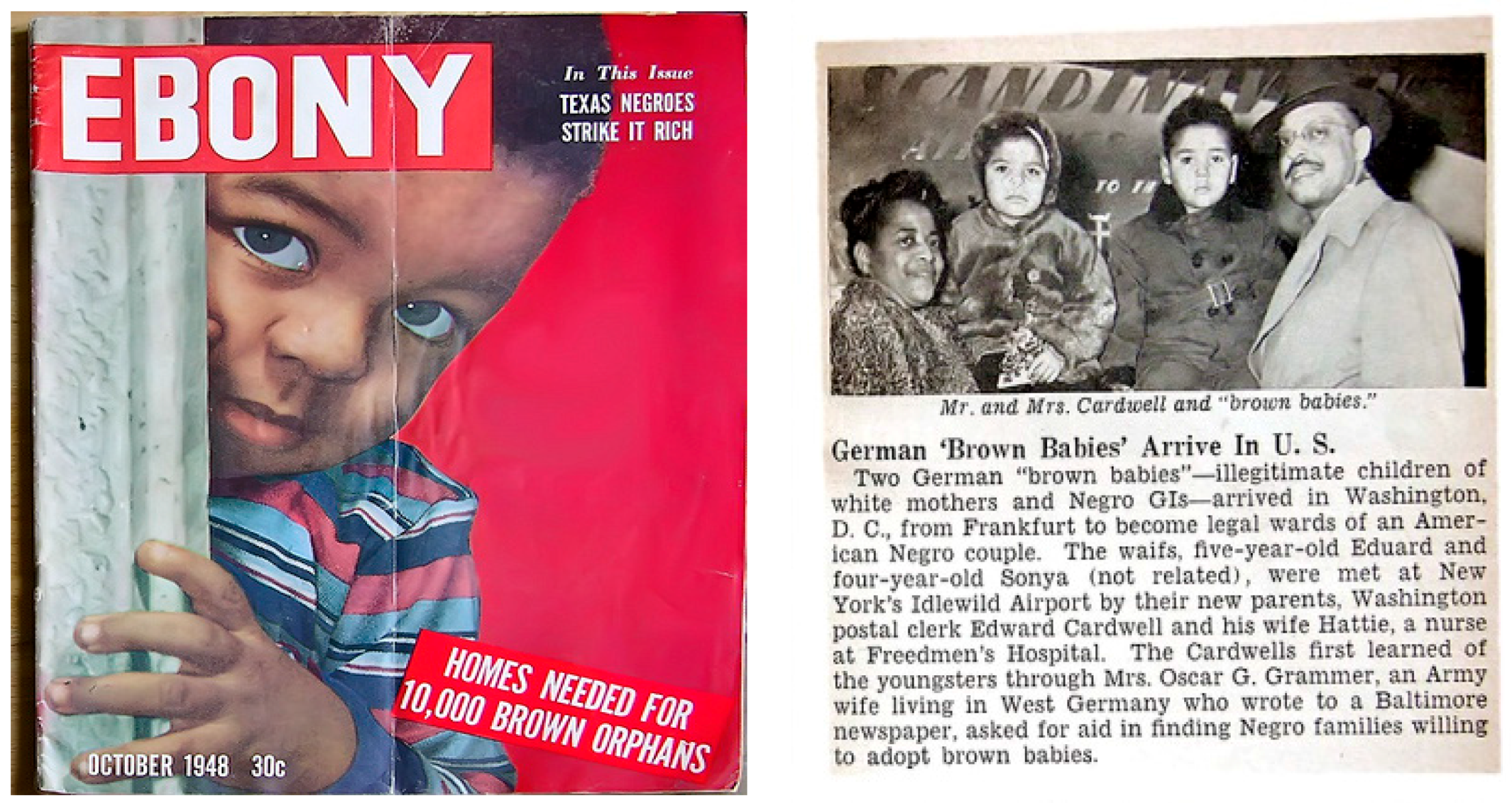
    Figure 1. Ebony October 1948 (on left); “Brown Babies Adopted by African American Families, Jet Magazine, 8 November 1951 (on right) (Jet Magazine 1951).

    This research project is a historical and narrative study of cross-racial, international couplings between Black U.S. servicemen and White German women during WWII and the children who resulted from these relationships. Once pejoratively referred to as “Brown Babies,” or worse, often both the U.S. and German governments collaborated in the destruction of families through forbidding interracial coupling and encouraging White German women to either abort mixed raced babies or give up these children for international adoption in an effort to keep Germany White. Using my own family’s history to show that mixed race children are the dross that needed to be removed from Germany, I employed memory and post-memory as my theoretical framing, coupled with authoethnography, family interviews, and narratives as my methodological tools. Of primary concern is what place Black German children and their mothers were allowed to occupy in the German national imagination and to what extent their individual rights and interests were superseded by the assertion of state interest in managing the German citizenry. Ultimately, it is argued that different tactics of constituting Germanness as homogenously White comes at the expense German women’s rights over their bodies and the exclusion of mixed race Black German children.

    Read the entire article HTML or PDF format.

  • ‘Do you ever think about me?’: the children sex tourists leave behind

    The Guardian
    2019-03-02

    Margaret Simons, Associate Professor of Journalism
    Monash University, Melbourne, Australia

    Brigette Sicat
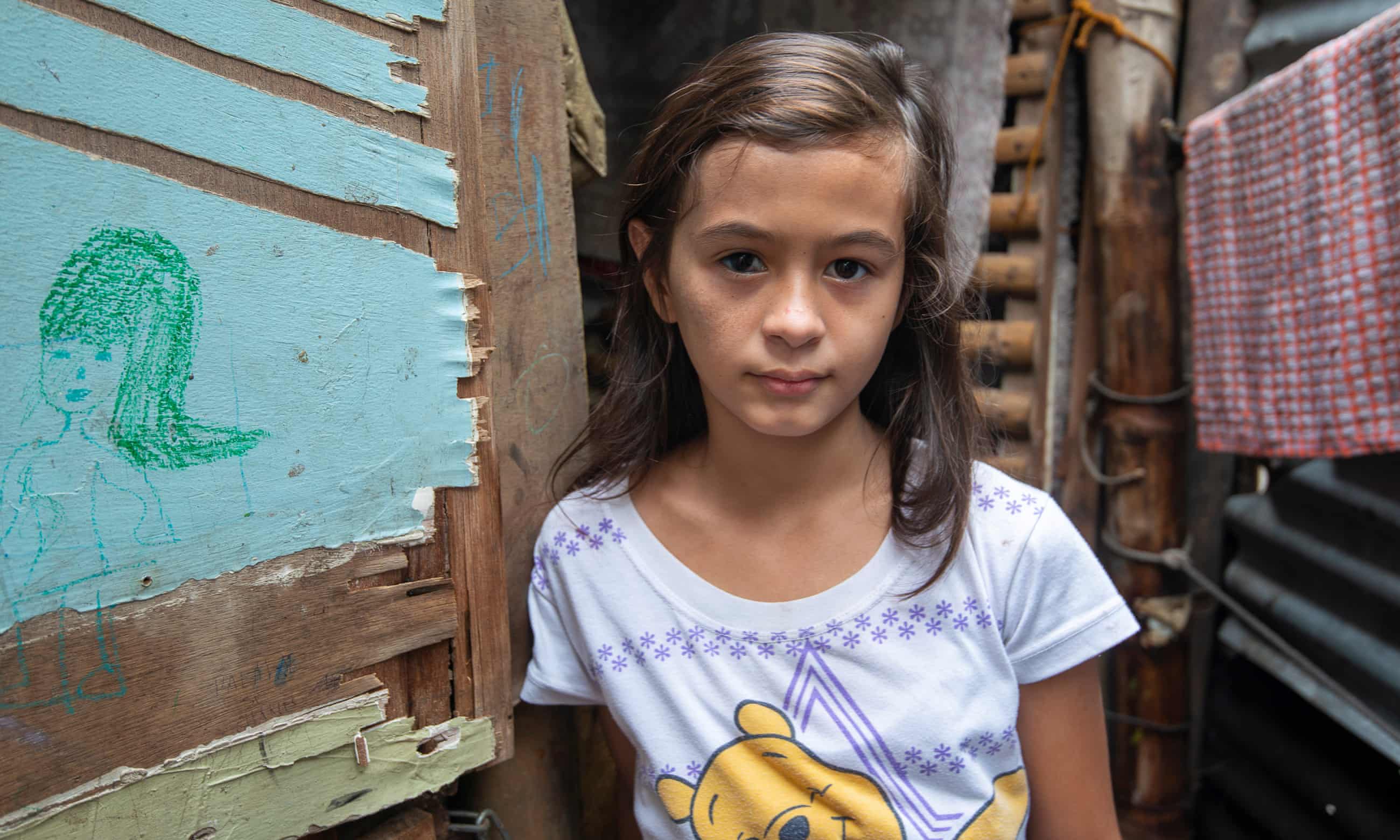
    Brigette Sicat knows that somewhere, far away, in a barely imaginable place called England, she has a father. Photograph: Dave Tacon

    Their fathers visited the Philippines to buy sex: now a generation of children want to track them down

    Brigette Sicat will not be going to school today. She sits, knees to chest, in a faded Winnie-the-Pooh T-shirt, on the double mattress that makes up half her home. At night, she curls up here with her grandmother and two cousins, beneath the leaky sheets of corrugated iron that pass for a roof. Today, the monsoon rain is constant and the floor has turned to mud.

    Brigette, 10, and her 11-year-old cousin, Arianne, aren’t in school because they have a stomach bug. There is no toilet and no running water, and no means of cooking other than over an open fire. Even when she is well, Brigette is often too hungry to tackle the 10-minute walk to school. Brigette’s mother is a sex worker. And Brigette knows that somewhere, far away, in a barely imaginable but often-thought-of place called England, she has a father. She knows only his given name: Matthew.

    Asked what she would say to him, were she able to send him a message, Brigette is at first stumped for words. Then she bursts out in Tagalog: “Who are you? Where are you? Do you ever think about me?” Her grandmother, Juana, her fingers swollen with arthritis and suffering from a lack of medication for her diabetes, sits by her side.

    Juana, Arianne, Brigette and Arianne’s brother, Aris, survive on 200 pesos (£3) a day, contributed by Arianne and Aris’s father. (He drives a Jeepney – a public transport vehicle originally converted from Jeeps abandoned by the US military.) Juana, 61, tells me she thinks she may not live much longer. But she wants the girls to finish school, to keep them from working in the bars.

    These are the slums of Angeles City in the Philippines, and the children here represent a United Nations of parentage. Their faces tell that story – fair skin, black skin, Korean features, caucasian. That’s because their fathers, like Brigette’s, are sex tourists

    Read the entire article here.

  • Seeking participants for a study on multiracial identification

    Laurie T. Resnick, M.S.Ed., Principal Investigator
    Pace University, New York, New York

    2019-02-27

    Pace University

    We are conducting a study on self-identification and identity development in multiracial individuals. The purpose of this study is to understand how the experiences of these individuals relate to their racial identity.

    If you live in the United States, are 18 years or older, and belong to two or more racial/ethnic groups, or your parents belong to different racial/ethnic groups, we invite you to participate in a quick survey about your experiences and your racial identity.

    To begin the study, click here.

    Thank you for your time and consideration!

  • In my adolescence, I referred to myself (and my brother) as blaxican to honor both parents, even though I did not experience the world through a black self and a Mexican self. Many of the biracial kids I grew up around tried desperately to be in two worlds but struggled with the duality. They never seemed comfortable or satisfied with trying to belong in whatever space they occupied. I could not relate. Neither of my parents (or their families) required me to be one thing or another, and they let me decide how I would identify.

    Marguerite Matthews, “A Tale of Two Faces,” The Root, January 31, 2019. https://verysmartbrothas.theroot.com/a-tale-of-two-faces-1832206862.

  • France Winddance Twine | Digging Up the Past: Race & Class in Brazil

    Duke Franklin Humanities Institute
    Duke University, Durham, North Carolina
    2019-02-11

    The From Slavery to Freedom Lab welcomed France Winddance Twine on the occasion of the 20th anniversary of the publication of her book, “Racism in a Racial Democracy: The Maintenance of White Supremacy in Brazil.” Dr. Twine reflected on intersectionality and racial, gender, and class politics in Brazil and the future of Brazilian Studies.

    France Winddance Twine is Professor of Sociology at the University of California, Santa Barbara. She is an ethnographer, a feminist race theorist, and a documentary filmmaker, whose research focuses on multiple dimensions of inequality. Twine’s research provides case studies for a nuanced analysis of the intersections of race, class, sexuality and gender inequality. Twine has conducted extensive field research on both sides of the Atlantic including: Brazil, Britain, and the United States. She is the author and editor of ten books including: Racism in a Racial Democracy: The Maintenance of White Supremacy in Brazil; A White Side of Black Britain: Interracial Intimacy and Racial Literacy; Geographies of Privilege; Outsourcing the Womb: Race, Class, and Gestational Surrogacy in the Global Market; and Girls with Guns: Firearms, Feminism and Militarism.

    Drawing inspiration from John Hope Franklin’s path-breaking 1947 study, the “From Slavery to Freedom” Franklin Humanities Lab seeks to examine the life and afterlives of slavery and emancipation, linking Duke University to the Global South.

  • Rhiannon Giddens Is Reclaiming the Black Heritage of American Folk Music

    TIME
    2019-02-21

    John Lingan


    Shahar Azran—WireImage/Getty Images

    In early 2018, folk-music torchbearer Rhiannon Giddens decamped to Breaux Bridge, La., with minstrelsy on her mind. In her early work with the Grammy-winning bluegrass band the Carolina Chocolate Drops and across two solo albums and a role in the TV series Nashville, Giddens has been as much a historian as a singer and banjoist. She’s won acclaim, including a MacArthur Foundation “genius” grant, for her attention to America’s folk traditions, but she felt that minstrelsy, with its troubled history, remained relatively unexplored…

    ..For the Louisiana trip, she enlisted three of her favorite contemporary musicians: Leyla McCalla, Allison Russell and Amythyst Kiah, all, like Giddens, black women with a focus on the banjo and early American string-music traditions. All four brought original songs to the sessions, and their collaboration quickly expanded beyond its initial historical focus. The resulting album, Songs of Our Native Daughters, which comes out on Feb. 22, has one foot in acoustic minstrel sounds but is also a tribute to the strength and resilience of black women in the antebellum era

    Read the entire article here.

  • New Perspectives on James Weldon Johnson’s The Autobiography of an Ex-Colored Man ed. by Noelle Morrissette (review)

    African American Review
    Volume 51, Number 4, Winter 2018
    pages 344-346
    DOI: 10.1353/afa.2018.0049

    Masami Sugimori, Associate Professor of American Literature
    Florida Gulf Coast University, Fort Myers, Florida

    Ed. Noelle Morrissette. New Perspectives on James Weldon Johnson’s The Autobiography of an Ex-Colored Man. Athens: U of Georgia P, 2017. 272 pp. $59.95.

    More than a century after its initial publication in 1912, The Autobiography of an Ex-Colored Man by James Weldon Johnson continues to generate commentary. The narrator’s racial passing, along with the novel’s twist of genre through “passing” for an autobiography, has led much scholarship to address the issues of race and narrative. At the same time, with the advent and development of new critical and theoretical approaches, more and more topics (pertaining to the literary climate around Johnson’s composition, the novel’s intertextuality with other works both within and outside of the era, and the sociocultural contexts of the early twentieth-century U. S., to name just a few) have arisen and enriched our inquiry. Meanwhile, the novel itself has gone through numerous editions—including, but not limited to, those published by Alfred A. Knopf (1927), New American Library (1948), Vintage (1989), Penguin Books (1990), Library of America (2004), and recently, by W. W. Norton as a Critical Edition (2015)—which attest to its increasingly canonical status in American literature. New Perspectives on James Weldon Johnson’s The Autobiography of an Ex-Colored Man—the first critical anthology devoted entirely to the novel—is a timely addition to this evolution of Johnson scholarship and readership, featuring both established and innovative strategies for analysis and interpretation.

    Editor Noelle Morrissette’s Introduction defines New Perspectives as a product of the ongoing critical history of The Autobiography, on the one hand, and as an embodiment of the “futurity” that explicitly or implicitly informs the novel, on the other. While offering “new perspectives” in their respective ways, the essays in this collection attend productively to the accumulated scholarship that Morrissette surveys in terms of topical trends: Johnson’s authorial achievements and the novel’s documentary values (1960s and ’70s); its intertextuality with African American narratives (late 1970s and early ’80s); modernity, modernism, and racial identity (1990s); and transnationalism, performativity, music, and sound (since 2000). These essays also share an emphasis on the visions of the future Johnson embedded in the novel—not only as an extension of his careful assessment of the contemporary U. S., but also in his resistance to the nation’s racial regime, which denied blacks a legitimate history or a sense of teleological progression in time. Thus, Morrissette designs her anthology to conduct “a reassessment of the author’s writing and legacy and the racial futurity he called for, to which we continue to respond” (15).

    These guiding principles also account for the section organization of New Perspectives, with its ten chapters and an Afterword assigned to four parts according to topical focuses. The three essays in part one, “Cultures of Reading, Cultures of Writing: Canons and Authenticity,” examine Johnson’s complex relationship with “cultural” parameters surrounding his composition: white mentor Brander Matthews’s theory of modern American fiction (Lawrence J. Oliver); the early twentieth-century African American literary scene (Michael Nowlin); and the novel’s “reliably unreliable” white readers (Jeff Karem 67). Each of these relationships consists of transactional negotiation rather than one-way influence. Through careful analysis of Johnson’s œuvre and correspondence, for example, Nowlin reveals that the author’s acute sense of African American literary destitution underlies the way he framed The Autobiography—both in its anonymous publication in 1912 and in the 1927 republication marketed as “a classic in Negro literature” (49)—which went in tandem with his strenuous promotion of other black writers to establish a legitimate and well-recognized African American literary tradition.

    Part two, “Relational Tropes: Transnationalism, Futurity, and the Ex-Colored Man,” features three essays on the transnational and transhistorical potential of, and exploration in, The Autobiography. Diana Paulin compares the novel with Pauline Hopkins’s Of One Blood, and Daphne Lamothe does so with Teju Cole’s Open City, to reveal the “futurity” that Johnson’s work posits in the form, respectively, of…

    Read or purchase the review here.
  • People of Mixed Ancestry in the Seventeenth-Century Chesapeake: Freedom, Bondage, and the Rise of Hypodescent Ideology

    Journal of Social History
    Volume 52, Number 3, Spring 2019
    pages 593-618
    DOI: 10.1093/jsh/shx113

    A. B. Wilkinson, Assistant Professor of History
    University of Nevada, Las Vegas

    This article examines the origins of mixed-race ideologies and people of mixed African, European, and Native American ancestry—commonly identified as mulattoes—in the seventeenth-century English colonial Chesapeake and wider Atlantic world. Arguably, for the better part of the century, English colonial societies in the Chesapeake resembled Latin America and other Atlantic island colonies in allowing a relatively flexible social hierarchy, in which certain mixed-heritage people benefitted from their European lineage. Chesapeake authorities began to slowly set their provinces apart from their English colonial counterparts in the 1660s, when they enacted laws to deter intimate intermixture between Europeans and other ethnoracial groups and set policies that punished mixed-heritage children. Colonial officials attempted to use the legal system to restrict people of mixed ancestry, Africans, and Native Americans in bondage. These efforts supported the ideology of hypodescent, where children of mixed lineage are relegated more closely to the position of their socially inferior parentage. However, from the 1660s through the 1680s, these laws were unevenly enforced, and mixture increased with the growth of African slaves imported into the region. While many mulattoes were enslaved during this period, others were able to rely on their European heritage or racial whiteness. This allowed them to gain or maintain freedom for themselves and their families, before Virginia and Maryland institutionalized greater restrictions in the 1690s.

    Read or purchase the article here.