• Together and apart: relational experiences of place, identity and belonging in the lives of mixed-ethnicity families

    Social & Cultural Geography
    Published online: 2019-01-17
    DOI: 10.1080/14649365.2018.1563710

    Natascha Klocker, Senior Lecturer, Social & Cultural Geography
    School of Geography & Sustainable Communities, Australian Centre for Culture, Environment, Society and Space (ACCESS)
    University of Wollongong, NSW, Australia

    Alexander Tindale, Ph.D. Candidate
    School of Geography & Sustainable Communities, Australian Centre for Culture, Environment, Society and Space (ACCESS)
    University of Wollongong, NSW, Australia

    Intersectionality, as an ‘analytical sensibility’, demands attentiveness to the multiple aspects of identity that interlock to shape privilege and marginality in specific spatial contexts and moments. Notwithstanding their fluidity, intersectional analyses have retained a core focus on the individualized self. This paper articulates an intercorporeal approach to intersectionality, based on interviews with adult members of mixed-ethnicity (mixed-race) families. In public space, family members are exposed to stares, questions, judgements and racisms that metamorphose depending on who they are with. Alone, with a visibly different partner, with mixed-ethnicity children, or as a family unit, the strands of each family member’s multiple identities intersect with those of their loved ones. Each is interpellated – or feels interpellated – differently, in physical proximity to the other. Our empirical analysis sheds new light on the everyday lives of mixed-ethnicity families. Our theoretical pairing of intercorporeality and intersectionality presents an innovative extension to dominant interpretations of the latter. It highlights the analytical utility of adding an extra-individual lens to the intersectionality toolkit. While visibly different mixed-ethnicity families afford a potent example, our approach has broader resonance. An intercorporeal approach to intersectionality offers nuanced perspectives on place, identity and belonging. It is necessary because privilege and marginality are always lived, relationally.

    Read or purchase the article here.
  • A Tale of Two Faces

    America In Black
    The Root
    2019-01-31

    Marguerite Matthews


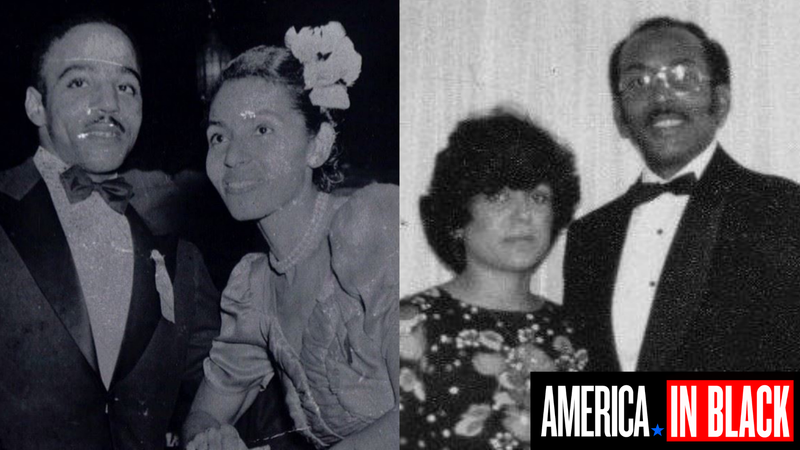
    The writer’s paternal grandparents, left, and her parents.
    Photo: Marguerite Matthews

    America. In Black. is a weekly essay series that examines the myriad experiences of blackness in the United States.

    My mother tells me I look like my grandmother, a brown belle whose features I know only through faded photographs and choppy 8mm film strips. I try to imagine the experience of a woman with whom I seem to share a face, with her growing up under Jim Crow in the 1910s and 1920s as a black girl in Elizabeth City, N.C., and maturing into womanhood in Atlantic City, N.J. I don’t know much about her, but I know she was a badass because she wore pants, traveled the world without her husband, and bore her first child (my father) in her 30s. My grandmother dared to defy the norms of her time, and in that way, I think I look like her, too.

    My friends, on the other hand, tell me I look like my mother, a bronze beauty whose eyes I have been swallowed by for more than three decades. As a child, I looked into the sepia-colored face of my mother’s childhood and declared she was me. She was born and raised in California to Spanish-speaking parents from Texas who were desperate to escape their Mexican-ness and assimilate into white American culture. Without any desire to be or pass as white, my mother bathed her skin in the sun even after warnings of getting too dark and risked being disowned for marrying a black man. A true chingona, my mother has lived life on her own terms. And I hope I look like her in that way, too…

    Read the entire article here.

  • Mixed race of Asian and Western: Asia’s new standard of beauty

    The Independent Singapore
    2019-02-06


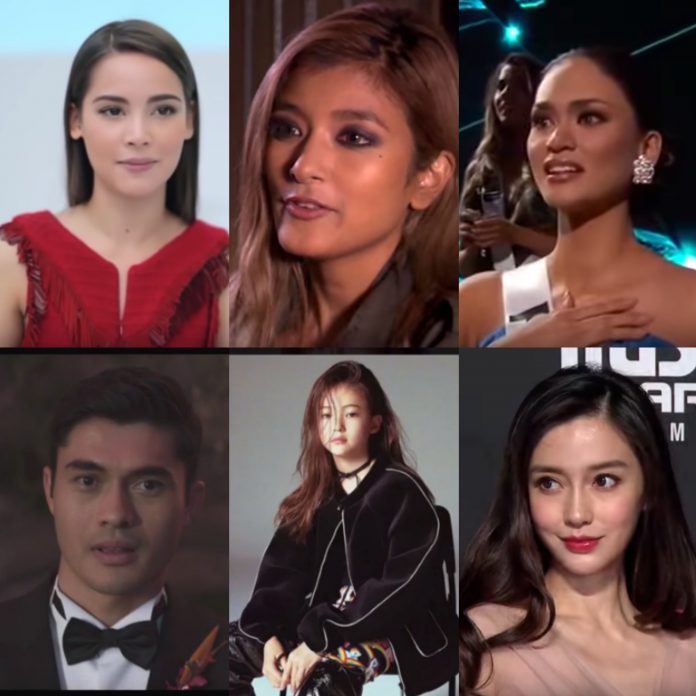
    Asian celebrities with mixed race. (Photo: Screengrab from YouTube)

    It seems the old adage, “Beauty is relative” is not true anymore, as what is beautiful for the Asians nowadays are those who have a mixed race—Asian and Western.

    Certainly, the new standard of beauty has changed over the years. Large, double-lidded eyes, small sharp nose, narrow face, tall figure, and white skin—these Western qualities make Asians sigh and admire.

    In today’s generation, those with Western features have come to represent the beauty ideal in many parts of Asia. There is a long list of mixed race celebrities, actors, models, and beauty titlists in many parts of Asia…

    …The notion of “mixed races” in Asia was invented during the era of European imperialism from the early 1800s. The mix of Eastern and Western is referred to as Eurasian or Pan-Asian. As a matter of fact, these terms are relatively new, with no agreed-upon definition of either.

    According to Emma Teng, the T.T. and Wei Fong Chao Professor of Asian civilizations at the Massachusetts Institute of Technology, intermarriage and intermixing among ethnic groups date back to antiquity.

    “After the Portuguese and other European traders arrived in China, mixed families emerged across different sites where Europeans and Chinese commonly interacted,” she said…

    …Regarding mixed race as the more beautiful can result in an issue of racism. As this heightened to changing one’s perspective about beauty, there is a need to examine the notions of racialised beauty standards…

    Read the entire article here.

  • Yes, Kamala Harris is ‘black enough’

    The Boston Globe
    2019-02-19

    Renée Graham, Globe Columnist

    MANCHESTER, NH - February 19, 2019: - Presidential Candidate, United States Senator Kamala Harris powers a question during "Politics & Eggs" at the New Hampshire Institute of Politics St. at Anselm College in Manchester, NH on February 19, 2019. (Craig F. Walker/Globe Staff) section: Metro reporter:
    Craig F. Walker/Globe Staff
    United States Senator Kamala Harris answers a question during “Politics & Eggs” at the New Hampshire Institute of Politics St. at Anselm College in Manchester, Feb. 19.

    The presidential hopeful knew the comment was coming.

    “There are African-Americans who don’t think you’re black enough, who don’t think you’ve had the required experience,” said the white journalist, trailing off before he could define “the required experience.” In a voiceover, he’d already mentioned that the politician was “not a descendant of slaves,” as if that fact automatically impugns black authenticity.

    The candidate gave a slight, weary smile and responded, “I am rooted in the African-American community, but I’m not defined by it. I am comfortable in my racial identity, but that’s not all I am.”

    That exchange is from a 2007 “60 Minutes” segment with Barack Obama, the son of a Kenyan father and a white American mother. Now Senator Kamala Harris, daughter of a Jamaican father and Tamil Indian mother, is being subjected to the same inane racial purity questions…

    Read the entire article here.

  • The Franklin Institute Speaker Series: Does Race Exist? (9/12/18)

    The Franklin Institute
    Philadelphia, Pennsylvania
    2018-09-13

    On September 12, 2018, as part of The Franklin Institute Speaker Series, University of Pennsylvania professors Sarah Tishkoff and Dorothy Roberts joined The Franklin Institute’s chief bioscientist Jayatri Das for a program titled “Does Race Exist? Exploring the Future of Genetics, Ancestry, and Medicine.”

  • Overflow Crowd Attends Slover Lecture On Jefferson’s Black Daughter

    The New Journal & Guide
    Norfolk, Virginia
    2019-02-03

    Overflow Crowd Attends Slover Lecture On Jefferson’s Black Daughter

    An overflow crowd was on hand Sunday, Jan. 27 at the Slover Library in downtown Norfolk to hear Dr. Catherine Kerrison discuss her latest book, “Jefferson’s Daughters: Three Sisters, White and Black, in A Young America.” Kerrison is an associate professor of history at Villanova University, where she teaches courses in colonial and revolutionary America and women’s and gender history.

    The event was the second of three lectures in the Catherine Lee Brinkley Memorial Lecture Series being offered by the Slover Library to “keep the spirit of community discourse about current events alive and to celebrate recently published books of national note.” It is being sponsored by Jane Batten, who was in attendance, as was former Mayor Paul Fraim, who heads the Slover Library Foundation.

    Kerrison’s expert re-search and writing on Virginia’s Thomas Jefferson, the primary writer of the Declaration of Independence, and the third president of the United States, may have added to the crowd’s interest. Certainly, the sexual liaison between Jefferson and his enslaved companion Sally Hemings has been a topic of discussion and controversy since the relationship was disclosed several years ago…

    Read the entire article here.

  • The Problems With Raced Based Medicine

    LabRoots
    2019-02-18

    Abbie Arce

    Race is often used in medicine to evaluate symptoms, make diagnoses, and decide on a course of care. These systems of evaluation are often inaccurate representations of reality, based on stereotypes.

    For example, minorities are much less likely to be prescribed pain medication based on these kinds of preconceived notions about race. This type of race-based medicine has a way of blinding doctors to other more important factors such as an individual’s family or social history, symptoms, or related illnesses…

    Read the entire article here.

  • NASA Renames Facility After Katherine Johnson of ‘Hidden Figures’ Fame

    The New York Times
    2019-02-23

    Elisha Brown


    Katherine Johnson, left, and Christine Darden, two of the first African-American women to work as mathematicians at NASA. The agency named a facility in Ms. Johnson’s honor on Friday. Chet Strange for The New York Times

    NASA on Friday officially renamed a facility in West Virginia after Katherine Johnson, an African-American mathematician and centenarian whose barrier-breaking career was depicted in the film “Hidden Figures.”

    The 2016 film, based on a book released earlier that year, depicted the struggle of Ms. Johnson and other black women for equality at NASA during the height of the space age and segregation. The mathematician tracked the trajectories of crucial missions in the 1960s.

    “I am thrilled we are honoring Katherine Johnson in this way as she is a true American icon who overcame incredible obstacles and inspired so many,” Jim Bridenstine, the administrator of NASA, said Friday in a statement. A dedication ceremony is to be held at a later time.

    The newly renamed facility, which is in Fairmont, W.Va., will now be known as the Katherine Johnson Independent Verification and Validation Facility. The program housed at the facility monitors the software used to track high-profile NASA missions, according to the agency’s website…

    Read the entire article here.

  • Artists on Artists: Genevieve Gaignard on Real Worlds: Brassaï, Arbus, Goldin

    MOCA
    Museum of Contemporary Art
    Los Angeles, California
    2019-01-24

    Genevieve Gaignard’s work mixes elements of self-portraiture, collage, and sculpture to present nuanced issues surrounding race, beauty, and cultural identity. Gaignard’s staged photographs create a platform for what she calls “persona-play-performances” within these spaces. The performances enacted within her photographic works are a combination of autobiography and allegory. Responding to the photographs on view in Real Worlds: Brassaï, Arbus, Goldin, Gaignard will expand on how these three legendary practitioners have influenced her own photographic work.

  • Amreekiya: A Novel

    University Press of Kentucky
    2018-11-09
    194 pages
    6 x 9 in.
    Cloth ISBN: 978-0-8131-7637-6

    Lena Mahmoud

    Isra Shadi, a twenty-one-year-old woman of mixed Palestinian and white descent, lives in California with her paternal amu (uncle), amtu (aunt), and cousins after the death of her mother and abandonment by her father at a young age. Ever the outcast in her amu and amtu’s household, they eagerly encourage Isra to marry and leave. After rejecting a string of undesirable suitors, she marries Yusef, an old love from her past.

    In Amreekiya, author Lena Mahmoud deftly juggles two storylines, alternating between Isra’s youth and her current life as a married twentysomething who is torn between cultures and trying to define herself. The chapters chronicle various moments in Isra’s narrative, including the volatile relationship of her parents and the trials and joys of forging a partnership with Yusef. Mahmoud also examines Isra’s first visit to Palestine, the effects of sexism, how language affects identity, and what it means to have a love that overcomes unbearable pain.

    An exploration of womanhood from an underrepresented voice in American literature, Amreekiya is simultaneously unique and relatable. Featuring an authentic array of characters, Mahmoud’s first novel is a much-needed story in a divided world.