• Hidden Figures is a Black, not white, Women’s Story

    Medium
    2017-11-22
    Chanda Prescod-Weinstein


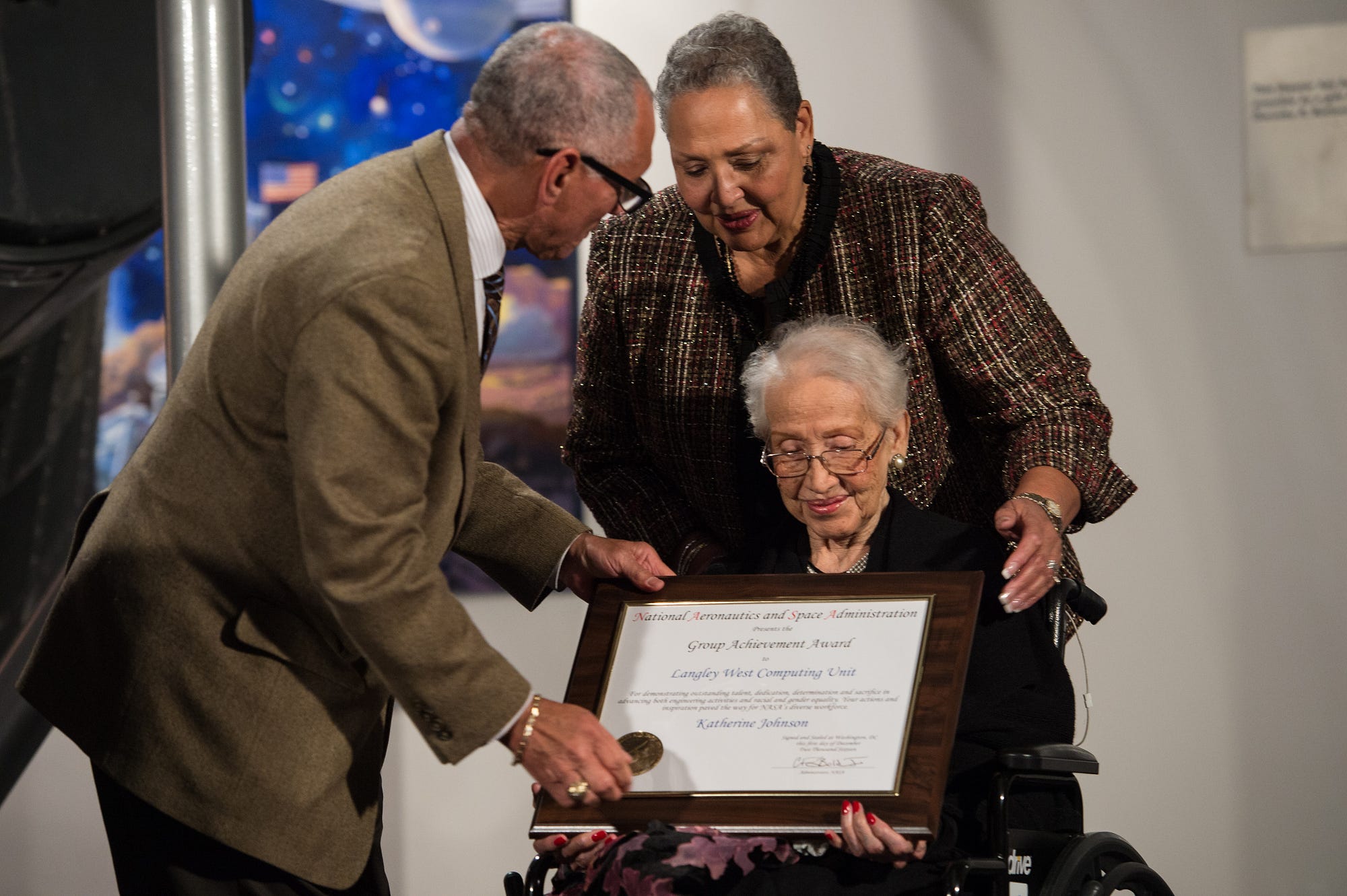
    NASA Administrator Charles Bolden presents an award to Katherine Johnson, the African American mathematician, physicist, and space scientist, who calculated flight trajectories for John Glenn’s first orbital flight in 1962, at a reception to honor members of the segregated West Area Computers division of Langley Research Center on Thursday, Dec. 1, 2016, at the Virginia Air and Space Center in Hampton, VA. Afterward, the guests attended a premiere of “Hidden Figures” a film which stars Taraji P. Henson as Katherine Johnson, Octavia Spencer as Dorothy Vaughan, and Janelle Monae as Mary Jackson. (image: a brown skinned man in a suit handing a plaque to a brown skinned woman in a wheelchair with a brown skinned woman standing behind the wheelchair.)
    NASA/Aubrey Gemignani

    It’s important to know the difference between “marginalized” and “hidden”

    These remarks were made in my role as respondent to a paper on the (white) women students of (white woman) astronomer Maria Mitchell at the 2017 Society of History of Technology meeting. They were well received by the person whose work I was commentating on.

    I will respond by offering a history of my own knowledge of women in astronomy. My interest in the Hidden Figures has been strongly shaped by my own experiences as a Black woman working at the intersection of physics and astrophysics. As an undergraduate at Harvard in the early 2000s, I was aware of the white women who had acted as computers for the Harvard College Observatory — this was history that astronomy undergraduates were privy to and that someone (I don’t remember who) took some effort to ensure that at the least women undergraduates learned about. The idea that their history or role was hidden, for this reason, has always seemed jarring to me. They were not hidden to us even as we recognized that more broadly they were a site of disinterest for many, but it was always made clear to me as an undergraduate that while their opportunities were limited, white women astronomers had been part of early American astronomy and that they had played a significant role in my own sub field, cosmology. (As in, without Harvard Computer Henrietta Leavitt’s discovery of the cepheid variable luminosity relation, Hubble could not have discovered the expansion of the universe. Of course, I didn’t learn until much later that Leavitt was a deaf adult, and it is interesting what parts of her story were left out.)…

    Read the entire article here.

  • What Race-Mixture in Colonial Latin American Literature Can Teach Us About Mixed-Race Identity in the United States and the Fantasy of White Supremacy

    Critical Ethnic Studies
    Published by University of Minnesota Press
    2018-06-29

    Monica Styles

    IMG_2745.jpg

    There is a tendency in the United States to believe mixed-race experiences are exceptional or out of the ordinary because we live in a society that historically silences racial mixture. A recent exhibit at Monticello that highlights the denial of Jefferson’s affair with Sally Hemings is just one high profile example. Contrasting colonial Latin American racial discourses with our own provides a blueprint for understanding erasure of multiracial experiences and white racial anxiety.

    Mixture produces people who inhabit what Zadie Smith defines as the “Dream City [or] a place of many voices, where the unified singular self is an illusion. Naturally, Obama was born there. So was I. When your personal multiplicity is printed on your face, in an almost too obviously thematic manner, in your DNA, in your hair and in the neither this nor that beige of your skin -well, anyone can see you come from Dream City.” As a Black biracial woman, I am confronted with frustration from people who struggle with my mixed identity…

    Read the entire article here.

  • Adrian Piper’s Show at MoMA is the Largest Ever for a Living Artist. Why Hasn’t She Seen It?

    The New York Times Magazine
    2018-06-27

    Thomas Chatterton Williams


    Illustration by Hsiao-Ron Cheng

    The conceptual artist’s life and work push against the boundaries

    Adrian Piper, the conceptual artist and analytic philosopher, is almost as well known for what she has stopped doing as for what she has done. By 1985, she had given up alcohol, meat and sex. In 2005, she took a leave of absence from her job at Wellesley, sold her home on Cape Cod and shipped all of her belongings to Germany. On a lecture tour in the United States the next year, she discovered a mark on her plane ticket that suggested, to her, that she’d been placed on a watch list; she has not set foot in America since. Then, in 2012, on her 64th birthday, she “retired from being black.” She did this by uploading a digitally altered self-portrait to her website, in which she had darkened her skin — normally café très-au-lait — to the color of elephant hide. It was accompanied by a news bulletin announcing her retirement. The pithy text superimposed at the bottom of the photo elaborated: “Henceforth, my new racial designation will be neither black nor white but rather 6.25% grey, honoring my 1/16th African heritage,” she wrote. “Please join me in celebrating this exciting new adventure in pointless administrative precision and futile institutional control!” (Through extensive genealogical work, she later determined that her African heritage is closer to one-eighth.)

    The piece was, like much of Piper’s art and writing, absurdly comical in no small part because it was so brutally honest. It was inspired by Piper’s dawning realization that she was unable to fulfill other people’s expectations through the lens of race; since the early 2000s, she had stopped allowing any of her artwork to be exhibited in all-black shows, which she came to see as ghettoizing. In 2015, she announced that she would no longer talk to the press about her work.

    Such inflexibility has done little to damage her standing in the art world. On a drizzly evening in March, a well-turned-out crowd of several hundred alighted upon the Museum of Modern Art to sip prosecco, schmooze and Instagram snippets of Piper’s immense body of work. The occasion was the opening of the enormous, and enormously demanding for the casual viewer, 50-year career retrospective, “Adrian Piper: A Synthesis of Intuitions, 1965-2016,” on display through July 22. The exhibition draws its title from Kant’sCritique of Pure Reason,” a lifelong touchstone for Piper, and marks the first time in MoMA’s history that the work of any living artist has earned the entirety of its sprawling sixth-floor special-exhibitions gallery. Alongside a Golden Lion award at the Venice Biennale, which Piper won in 2015, this is among the very highest honors the art world can proffer…


    ‘‘Self-Portrait Exaggerating My Negroid Features’’ (1981)
    The Eileen Harris Norton Collection. Adrian Piper Research Archive Foundation Berlin.

    I’d flown from Paris to see the opening of “Synthesis” after having struck up a polite but formal email correspondence with Piper. In the last message she had sent me, about three weeks earlier, she refused to speak to me on the record unless she or her archivist could independently fact-check the article before publication. “I decided a long time ago that I would prefer no representation to misrepresentation,” she wrote, and it seemed that, with this impossible condition, she would not grant an exemption from her indefinite moratorium. She suggested, as an alternative, that I consult her website and extensive body of published writing, an incalculable number of academic articles, essays and books. But I had already read many of those, and they had left me convinced that she has been quietly conducting, from that vexed and ever-expanding blot on the American fabric where white and black bleed into each other, one of the smartest, funniest and most profound interrogations of the racial madness that governs and stifles our national life that I had ever encountered…

    Read the entire article here.

  • A Sign of ‘Modern Society’: More Multiracial Families in Commercials

    The New York Times
    2018-06-03

    Joanne Kaufman

    A hapless man stands on the sidewalk, watching and wincing as an ex-girlfriend tosses his possessions out a second-floor window in a commercial for DirecTV Now. A husband and wife are overjoyed to learn from a Fidelity investments adviser that, yes, they have saved enough for retirement to realize their fondest dream, one that involves a boat and a grandchild. And a considerably younger couple is delighted with the possibilities presented by the Clearblue ovulation test system.

    The men and women vary in age, circumstances and happiness levels, but they have one thing in common. They are all part of interracial couples.

    Recently, companies and brands like JPMorgan Chase, Humira, State Farm, Smile Direct Club, Coors Light, Macy’s, Tide and Cadillac have featured multiracial couples or families in their advertising.

    “There’s no doubt that the incidence of these commercials is at least double what it was five years ago,” said Larry Chiagouris, a professor of marketing at the Pace University Lubin School of Business…

    Read the entire article here.

  • Seeking Multiracial Americans or Brazilian Residing in the United States for Research Study

    Ariane Y. Kreidl, Student ETS Academic Advisor; USC TRiO; Educational Talent Search
    Business Administration 19’
    USC Marshall School of Business
    University of Southern California

    My name is Ariane Kreidl and I am research scholar at the University of Southern California (USC). I am seeking participants for a research study about race. This research aims to understand racial norms through a comparative analysis of biracial/multiracial Americans and Brazilians individuals living in the United States.

    Eligibility criteria. Participants must be one of the following:

    • Biracial/multiracial Americans (i.e., individuals who have mixed ancestry of two-or-more races)
    • Brazilians living in the United States for at least three (3) years.

    There are two (2) ways to participate:

    1. Online Survey (Qualtrics)a: Closed-ended questions related to the research topic. The estimated response time is approximately 20 minutes. Participants will have the opportunity to enter a drawing to win a $50 Amazon/Visa Gift Card.
    2. Interview in-person or via Skypeb: Open-ended questions related to the research topic. Interview will last between 30-75 minutes. Participants will have the opportunity to enter a drawing to win a $100 Amazon/Visa Gift Card! (This interview block is limited to only 20 participants).

    Participation is completely anonymous.

    Thank you for considering this research invitation.

    aIf you are interested, please click on the link for the survey: Qualitrics.Survey.Akreidl.
    bIf you are interested, please click on the following link to select a date and time: Research.Interview.Appt.Slots.

  • The Family Resemblance

    Eugene O’Neill Theater Center
    305 Great Neck Road
    Waterford, Connecticut 06385
    2018-06-23 through 2018-06-29

    THE FAMILY RESEMBLANCE • Book, Music, & Lyrics by Masi Asare
    Book, music & lyrics by Masi Asare

    Akosua and her family are expecting an ordinary Christmas back home in central Pennsylvania, but heavy winds, a corporate crisis, and a visitation from an ancestor mean things do not go as planned. This semiautobiographical musical centers on three generations of one cross-cultural family—a white mother, black father, two mixed race daughters, and the spirit of an African grandmother. Even when your heritage is all over the map, you have to go back to your roots to find your way forward. The score includes American folk and popular song, west African highlife, and Akan classical music.

    For more information, click here.

  • What it is like for a black student to go to Cambridge

    The Financial Times
    2018-05-30

    Rianna Croxford


    Rianna Croxford

    Trailblazer discovers confidence sought by top universities can be learned

    I am the first in my family to go to university and faced a lot of the obstacles students of colour encounter when aiming for Oxford and Cambridge.

    Educated at state school, I graduated from Cambridge last year as one of only seven women of mixed white and black heritage in my year of 3,371 undergraduates.

    As one of the first black students to read English at Trinity Hall college, I had to deal with different degrees of racism day to day, as well as cultural challenges that my background had not prepared me for.

    I want to help make it easier for other students like myself to enter elite institutions that can offer a fast track to a successful career…

    Read the entire article here.

  • What It’s Like Being an “Other”

    College Magazine
    2018-06-19

    Mailinh McNicholas


    Mailinh McNicholas

    I’ve remained on the fringes of two different and separate Anchorage, Alaska communities. I have a Caucasian father and Vietnamese mother. My high school friends often talked about my ethnicity and attempted to place me into a defined racial category. Some of my peers pegged me as an Asian immigrant, some have asked if I am Native Alaskan, and others simply asked ‘What are you?’

    Unfortunately, my hopes did not match my reality. A few months into my freshman year at GW [George Washington University] I found that my college peers also cast me as “the other.” Although I’m equal parts Asian and White, to my white friends I’m Asian and to my Asian friends, I’m white. My bi-cultural heritage once again left me excluded from being included in ether community…

    Read the entire article here.

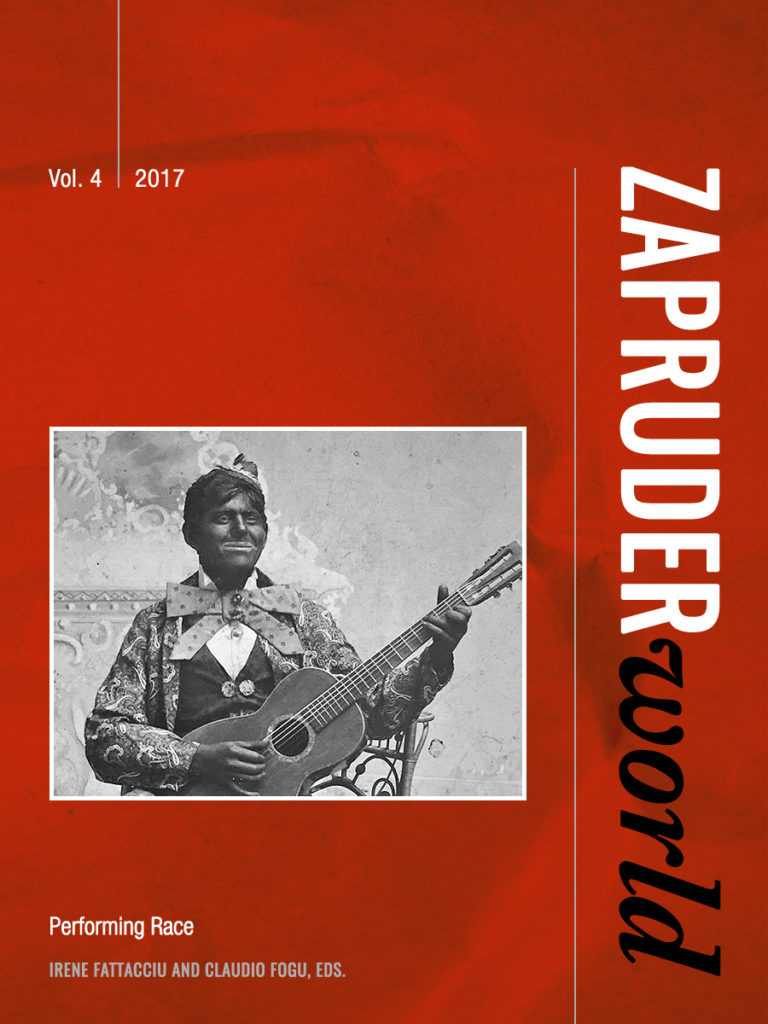
  • “Blood is Thicker than Water”: The Materialization of the Racial Body in Fascist East Africa

    Zapruder World: An International Journal for the History of Social Conflict
    “Performing Race,” Volume 4 (2017)

    Angelica Pesarini, Social and Cultural Analysis, Faculty Member
    New York University

    Introduction

    One of the major issues with the perception of “race” in modern Italy refers to what Alessandro Portelli defines as Italians’ “self-reflexive colour blindness.”1 What occurs in Italy is not simply a denial of race. Rather than seeing themselves as “White,” according to Portelli, Italians see themselves as “normal.” As a result, because colour is unspoken and not openly mentioned, it is believed that Italians are immune from racism. Such a structural colour-blindness, however, is problematic because it associates Whiteness with normality and, consequently, with Italianness.2 Simply put, to be Italian is to be White. Within this discourse, those who do not fit the alleged (White) Italian type are deemed outside the Nation on a number of levels.3

    In order to understand and unpack such dynamics it is necessary to consider the category of “race” and the influence this had on the construction of Italian national identity. If “race” is a social construct devoid of scientific validity, it still retains enormous power in the modern world. In the case of Italy, the racial construction of national identity shows a complex ambivalence embedded in discursive practices revolving around an ambiguous production of both Whiteness and Blackness. Such an ambiguity, as highlighted by Tatiana Petrovich Njegosh stems from Italians’ liminal double racial status as racialisers (of Jews, southerner Italians and Africans) and racialised subjects in the U.S. and Australia.4 As a result, “race” in Italy today seems to be located within the interstices of a polarised discourse based on notions of “unspoken Whiteness”5 able to visually recognise “Italians” from “Others,” namely those called stranieri (foreigners), extracomunitari (a term used to define migrants coming from outside the EU) and the new “migranti” category (broadly used to address African migrants crossing the Mediterranean). Although colour is not openly named, meaningful biological connotations based on phenotypic features located on the body are at the core of Italian national identity. It is important to notice that such a disjunction does not work merely at a visual level. The racialisation of national identity, in fact, transversally affects Italian society and the everyday life of racialised subjects extending from education to housing, labour rights, work opportunities, political participation, health, personal safety, and legal discourse too, as discussed in this paper.

    Drawing on ideas of performativity as applied to race, this essay illustrates some of the reasons why in contemporary Italy the idea of Blackness associated with Italianness still appears, to some, an impossible semantic match, an irreconcilable paradox. Owing to the interdependence of colonialism, ideas of “race” and “mixed race,” and the normative construction of Whiteness in relation to national identity, it seems necessary to investigate the nexus of race, gender and citizenship, through a performative lens. In order to do so, I focus on a series of laws and decrees passed during the Liberal and Fascist periods. These include the Codice Civile per la Colonia Eritrea (Colonial Civil Code for the Colony of Eritrea) of 1909, Law 999 of 1933, introduced to regulate the legal identity of “mixed race” children born in the former Italian colonies in East-Africa, and the racial laws enacted between 1937 and 1940. The investigation of these pieces of legislation is useful to highlight not only the influence that Liberal norms had on the promulgations of Fascist racial laws, but also how Italian citizenship, today, is still rooted in the idea of an alleged “racial citizen.”…

    Read the entire article here.

  • Midwest Home to Most of the Counties With Decreases in Median Age

    United States Census Bureau
    2018-06-21
    Release Number: CB18-78

    A More Diverse Nation

    JUNE 21, 2018 — Approximately half (51.4 percent) of the nation’s 531 counties that were getting younger between April 2010 and July 2017 were in the Midwest, according to newly released 2017 population estimates. Out of the counties that were getting younger, the South also had a high proportion (32.4 percent) of the counties that experienced a decrease in median age — the age where half of the population is younger and the other half is older— followed by the West (14.1 percent), and the Northeast (2.1 percent).

    “Nationally, almost 17 percent of counties saw a decrease in median age from April 2010 to July 2017. The majority of the counties getting younger were in the Midwest, and of these counties with 10,000 people or more in July 2017, some of the largest decreases were in North Dakota, South Dakota and Nebraska,” said Molly Cromwell, a demographer at the U.S. Census Bureau. “Williams County, N.D., had the largest decrease in median age, declining by 7.1 years.”

    Despite the decrease in median age in many of the Midwest’s counties, a majority of counties in the country continued to grow older. The nation as a whole experienced a median age increase from 37.2 years to 38.0 years during the period 2010 to 2017. This continued aging of the country is consistent with the projected changes to the nation’s population through 2060.

    Baby boomers, and millennials alike, are responsible for this trend in increased aging,” Cromwell said. “Boomers continue to age and are slowly outnumbering children as the birth rate has declined steadily over the last decade.”

    Last year, Florida had the largest percentage of seniors (age 65 and older) with 20.1 percent, followed by Maine (19.9 percent) and West Virginia (19.4 percent). Maine also saw its median age increase to 44.7 from 42.7 years old in 2010, making it the state with the highest median age.

    On the other hand, Utah had the smallest percentage of its population age 65 and older (10.8 percent), followed by Alaska (11.2 percent) and the District of Columbia (12.1 percent). Utah is also the state with the lowest median age (30.9 years).

    View our graphics on change in median age from 2010 to 2017 at the county level and the median age in 2017 to see how the nation has changed…

    The Two or More Races Population

    • Those who identify as two or more races made up the second-fastest growing race group (2.9 percent) in the nation. Their growth is due primarily to natural increase.
    • The two or more races group had the youngest median age of any other race group at 20.4 years.
    • California had the largest two or more races population (1.5 million) and Hawaii had the highest proportion (23.8 percent)…

    Read the entire article here.