• Pondering My Black, Biracial and Multiracial Identity Post Hurricane Maria

    Multiracial Media: Voice of the Multiracial Community
    2018-05-27

    Sarah Ratliff

    Biracial and Multiracial

    I have been writing from the Biracial and Multiracial perspective since I co-authored the book, Being Biracial: Where Our Secret Worlds Collide in 2015. Being Biracial is an anthology of essays from either Multiracial people or parents of mixed race kids.

    In my essay I wrote about being the product of a Black and Japanese mother and a White (German, Dutch and Irish) father who were married in New York City in 1960.

    I wrote about my experiences being “light, bright and clearly half White” while being raised to self-identify as Black, and of course, having to explain for the elevendy millionth time why I self-identified this way. I shared moments of complete vulnerability and isolation because I grew so frustrated trying to explain that being Black isn’t just about complexion but lived experiences as well…

    Read the entire article here.

  • Tangled Roots: Real Life Stories from Mixed Race Britain

    Tangled Roots
    2015-12-11
    205 pages
    ISBN: 978-0993482403

    Edited by:

    Katy Massey

    12% of UK households are mixed race. These are our stories.

    The Tangled Roots book brings together over 30 writers to answer the question: What is life like for mixed families in Britain today?

    Five leading authors—Bernardine Evaristo MBE, Sarfraz Manzoor, Charlotte Williams OBE, Diana Evans and Hannah Lowetogether with 27 members of the public tell the story of their mixed lives with heart-breaking honesty, humour and compassion.

  • Natives delivers the answers, and some of them are hard to hear. In one of the most touching of many personal passages in the book, Akala retraces the steps by which he was racialised – as a mixed-race child – into blackness, and by which he realised that his mother, who fiercely protected her children’s pride in their heritage, enrolling them among other things in a Pan-African Saturday school, was racialised as white.

    Afua Hirsch, “Natives: Race and Class in the Ruins of Empire by Akala – review,” The Guardian, May 20, 2018. https://www.theguardian.com/books/2018/may/20/natives-akala-review-destroying-myths-of-race-afia-hirsch.

  • To be mixed and a woman meant my appearance was of the foremost importance to everyone around me ― my mother’s friends would revel in things like how big my eyes were, how petite my lips were or how fit my body looked, but rarely mention my academic accomplishments or opinions except for within the context of my American identity. “Her Chinese scores were higher than Chinese kids! Isn’t it a marvel!” one friend exclaimed, as if I didn’t receive the same education or similar upbringing as her monoracial Chinese child. Other aunties would tell my mom that my academic talent came not from hard work, but from my Jewish ancestry. “Youtairen (Jewish people in Mandarin) are just smart,” they would say. I had no idea what Judaism even was.

    Gen Slosberg, “How I Finally Learned To Accept Both My Chinese And Jewish Identities,” The Huffington Post, May 23, 2018. https://www.huffingtonpost.com/entry/im-chinese-and-jewish-and-always-wanted-to-claim-one-identity_us_5b044e95e4b0740c25e5e2af.

  • A French-Rwandan Rap Star Turned Novelist From Burundi

    The New York Times
    2018-05-29

    Tobias Grey


    Small Country,” by Gaël Faye, is about a boy, living in Burundi during the war between the Hutus and Tutsis, who loses his innocence in spite of desperately wanting to cling onto it.
    Elliott Verdier for The New York Times

    PARIS — “It felt like an injustice to me,” said the rapper and novelist Gaël Faye, about having to leave civil-war-torn Burundi in 1995 to come live in France. Mr. Faye, who was 13 at the time, had to contend with the shock of a new culture and moving with his younger sister into the cramped space of his mother’s apartment in Versailles.

    Months went by without unpacking his suitcases. “When I went to school I used to take what I needed and put it back afterward,” the 36-year-old author said in a recent interview in Paris. “I’d convinced myself that any day my father would ring up and tell us that the war had ended and we could come back. But the war ended up lasting until 2005 by which time I was an adult.”

    In his first novel, “Small Country” — a huge hit in France when it was published in 2016 and where it sold 700,000 copies — Mr. Faye wrote with a rare and subtle yearning about his youthful escapades in and around Bujumbura, the capital of Burundi. It has now been translated from French into English by Sarah Ardizzone and is being released by Hogarth on June 5.

    “Small Country,” which in its original language shares the title of one of Mr. Faye’s most popular songs, “Petit Pays,” is told from the perspective of Gabriel, a 10-year-old boy with a French father and a Rwandan mother (the same mixed-race parentage as Mr. Faye). He is part of a gang of young boys sneaking beers in cabaret bars and stealing mangoes from local gardens to sell on the black market…

    Read the entire article here.

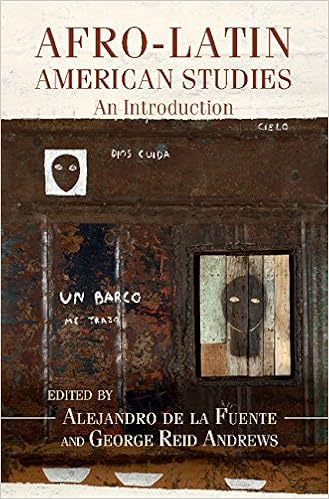
  • Afro-Latin American Studies: An Introduction

    Cambridge University Press
    April 2018
    400 pages
    233 x 165 x 43 mm
    Hardback ISBN: 9781107177628
    Paperback ISBN: 9781316630662
    eBook ISBN: 9781316835890

    Editors:

    Alejandro de la Fuente, Robert Woods Bliss Professor of Latin American History and Economics; Professor of African and African American Studies
    Harvard University, Boston, Massachusetts

    George Reid Andrews, Distinguished Professor of History
    University of Pittsburgh

    Alejandro de la Fuente and George Reid Andrews offer the first systematic, book-length survey of humanities and social science scholarship on the exciting field of Afro-Latin American studies. Organized by topic, these essays synthesize and present the current state of knowledge on a broad variety of topics, including Afro-Latin American music, religions, literature, art history, political thought, social movements, legal history, environmental history, and ideologies of racial inclusion. This volume connects the region’s long history of slavery to the major political, social, cultural, and economic developments of the last two centuries. Written by leading scholars in each of those topics, the volume provides an introduction to the field of Afro-Latin American studies that is not available from any other source and reflects the disciplinary and thematic richness of this emerging field.

    • Presents systematic and synthetic overviews of recent scholarship on topics of major importance in the field of Afro-Latin American studies, for example Afro-Latin American religions, Afro-Latin American political movements, and Afro-Latin American music
    • Covers a broad range of topics, embracing most of the humanities and social sciences
    • Serves as the authoritative introduction for Afro-Latin American history, covering the period from 1500 to the present

    Table of Contents

    • 1. Afro-Latin American studies: an introduction Alejandro de la Fuente and George Reid Andrews
    • Part I. Inequalities:
      • 2. The slave trade to Latin America: a historiographical assessment Roquinaldo Ferreira and Tatiana Seijas
      • 3. Inequality: race, class, gender George Reid Andrews
      • 4. Afro-indigenous interactions, relations, and comparisons Peter Wade
      • 5. Law, silence, and racialized inequalities in the history of Afro-Brazil Brodwyn Fischer, Keila Grinberg and Hebe Mattos
    • Part II. Politics:
      • 6. Currents in Afro-Latin American political and social thought Frank Guridy and Juliet Hooker
      • 7. Rethinking black mobilization in Latin America Tianna Paschel
      • 8. ‘Racial democracy’ and racial inclusion: hemispheric histories Paulina Alberto and Jesse Hoffnung-Garskof
    • Part III. Culture:
      • 9. Literary liberties: the authority of Afrodescendant authors Doris Sommer
      • 10. Afro-Latin American art Alejandro de la Fuente
      • 11. A century and a half of scholarship on Afro-Latin American music Robin Moore
      • 12. Afro-Latin American religions Stephan Palmié and Paul Christopher Johnson
      • 13. Environment, space and place: cultural geographies of colonial Afro-Latin America Karl Offen
    • Part IV. Transnational Spaces:
      • 14. Transnational frames of Afro-Latin experience: evolving spaces and means of connection, 1600–2000 Lara Putnam
      • 15. Afro-Latinos: speaking through silences and rethinking the geographies of blackness Jennifer A. Jones
  • “The law recognizes racial instinct”: Tucker v. Blease and the Black–White Paradigm in the Jim Crow South

    Law and History Review
    Volume 29, Issue 2 (May 2011)
    pages 471-495
    DOI: 10.1017/S0738248011000058

    John W. Wertheimer, Jessica Bradshaw, Allyson Cobb, Harper Addison, E. Dudley Colhoun, Samuel Diamant, Andrew Gilbert, Jeffrey Higgs, Nicholas Skipper

    On January 24, 1913, the trustees of the Dalcho School, a segregated, all-white public school in Dillon County, South Carolina, summarily dismissed Dudley, Eugene, and Herbert Kirby, ages ten, twelve, and fourteen, respectively. According to testimony offered in a subsequent hearing, the boys had “always properly behaved,” were “good pupils,” and “never …exercise[d] any bad influence in school.” Moreover, the boys’ overwhelmingly white ancestry, in the words of the South Carolina Supreme Court, technically “entitled [them] to be classified as white,” according to state law. Nevertheless, because local whites believed that the Kirbys were “not of pure Caucasian blood,” and that therefore their removal was in the segregated school’s best interest, the court, in Tucker v. Blease (1914), upheld their expulsion.

    Read or purchase the article here.

  • Mexico’s Color Line and the Cultural Imperialism of Light-Skin Preference

    Truthout
    2018-05-26

    Roberto Rodriguez, Associate Professor in Mexican American Studies
    University of Arizona

    A busy street in Mexico City. (Photo: Getty Images)
    A busy street in Mexico City. (Photo: Getty Images)

    The color of the people of Mexico is one of the things that had a most profound effect on my psyche when I first visited the place of my birth in 1976 at the age of 22. The people came in all colors, though primarily different shades of red-brown, owing to the nation’s Indigenous roots.

    Having grown up in a white-dominant society, it was an affirmation of my own brown skin color, in sharp contrast with the artificial color of official Mexico. I was used to seeing government bureaucrats and those that graced the nation’s television screens with light skin, bleached blond hair and artificial blue or green eyes.

    The truth is, more than 40 years later, the nation’s color line has seemingly not changed much at all. When I first noticed this preference for light skin in Mexico, it was present at every turn and every corner. It wasn’t just a case of difference, but also disdain. Apparently, all things that were light were “good” and all things dark were “bad.” This was especially true of television. White or light skin was preferred for virtually every role, except the ones for the subservient, demeaning and outlaw roles…

    Read the entire article here.

  • How I Finally Learned To Accept Both My Chinese And Jewish Identities

    The Huffington Post
    2018-05-22

    Gen Slosberg
    Guest Writer

    To be mixed and a woman meant my appearance was of the foremost importance to everyone around me.
    Gen Slosberg
    To be mixed and a woman meant my appearance was of the foremost importance to everyone around me.

    Growing up in China, I never quite understood why I didn’t fit in.

    I ate Chinese food, went to Chinese school, had Chinese friends and did Chinese things. I memorized poems and Confucius passages at school and learned how to play the zither. At night, my grandma would sit next to my bed, fan away mosquitoes with her bamboo fan and sing nursery rhymes about the summer rain in Cantonese. On weekends, I would wake up early to watch my neighbor roll dumpling dough and my mom cut green onions into small pieces for the filling.

    What little exposure I had to American culture was when my Jewish-American father would come home after monthslong business trips and read me Dr. Seuss. Until I was 15, my understanding of America consisted of vague memories of The Boy and The Apple Tree, summer trips to my dad’s hometown Portland, Maine, where his white relatives would look at me in wonder and express concern for my broken English.

    I was, as far as I understood, Chinese. But as far as everyone else in China was concerned, I was only white, Jewish and American because of my father. For reasons incomprehensible to me at the time, I was “different” in the eyes of those in a society so emphatic about its homogeneity…

    Read the entire article here.

  • Portrait Of: ‘The Latinos Of Asia’

    Latino USA
    2018-05-22

    Janice Llamoca, Digital Media Editor
    Futuro Media Group

    When you hear of last names like Torres, Rodriguez or Santos, you might automatically think of Latin America—and you’re not completely wrong. Those surnames are common throughout Latin America, but they’re also common in the Philippines.

    Because of Spanish colonization, Filipinos and Latinos also share —aside from last names— religion, food and even similarities in language. These lines become even clearer here in the United States, as Filipino-Americans grow up in a cities with large Latino populations, like Los Angeles.

    Anthony Ocampo, associate professor of sociology at California State Polytechnic University, Pomona, breaks down these similarities in his book, The Latinos of Asia: How Filipino Americans Break the Rules of Race.

    Maria Hinojosa talks to Ocampo about the book, his experience growing up in Los Angeles as a Filipino-American and what his research tells us about the link between Filipinos and Latinos…

    Listen to the interview (00:19:30) here.