• Natives: Race and Class in the Ruins of Empire by Akala – review

    The Guardian
    2018-05-20
    Afua Hirsch

    Akala on stage
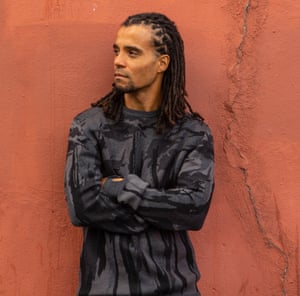
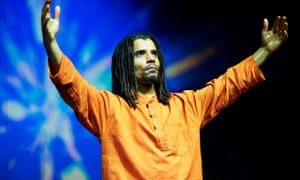
    Akala: ‘a disruptive, aggressive intellect’. Photograph: Rob Baker Ashton/BBC/Green Acre Films

    In a powerful, polemical narrative, the rapper charts his past and the history of black Britain

    In 2010, UK rap artist Akala dropped the album DoubleThink, and with it, some unforgettable words. “First time I saw knives penetrate flesh, it was meat cleavers to the back of the head,” the north London rapper remembers of his childhood. Like so much of his work, the song Find No Enemy blends his life in the struggle of poverty, race, class and violence, with the search for answers. “Apparently,” it continues, “I’m second-generation black Caribbean. And half white Scottish. Whatever that means.”

    Any of the million-plus people who have since followed Akala – real name Kingslee Daley – know that the search has taken him into the realm of serious scholarship. He is now known as much for his political analysis as for his music, and, unsurprisingly, his new book, Natives, is therefore long awaited. What was that meat cleaver incident? What was his relationship with his family and peers like growing up? How did he make the journey from geeky child, to sullen and armed teenager, to writer, artist and intellectual?.

    Natives delivers the answers, and some of them are hard to hear. In one of the most touching of many personal passages in the book, Akala retraces the steps by which he was racialised – as a mixed-race child – into blackness, and by which he realised that his mother, who fiercely protected her children’s pride in their heritage, enrolling them among other things in a Pan-African Saturday school, was racialised as white…

    Read the entire article here.

  • Natives: Race and class in the ruins of empire

    Two Roads Books (an imprint of Hodder & Stoughton)
    2018-05-17
    352 pages
    5.7 x 1.3 x 8.7 inches
    Hardcover ISBN-13: 978-1473661219
    Paperback ISBN: ISBN-13: 978-1473661226

    Akala (Kingslee James Daley)

    Natives

    A searing modern polemic from the BAFTA– and MOBO-award-winning musician and political commentator, Akala

    From the first time he was stopped and searched as a child, to the day he realised his mum was white, to his first encounters with racist teachers – race and class have shaped Akala’s life and outlook. In this unique book he takes his own experiences and widens them out to look at the social, historical and political factors that have left us where we are today.

    Covering everything from the police, education and identity to politics, sexual objectification and the far right, Natives will speak directly to British denial and squeamishness when it comes to confronting issues of race and class that are at the heart of the legacy of Britain’s racialised empire.

  • A Métis Night at the Opera: Louis Riel, Cultural Ownership, and Making Canada Métis

    Adam Gaudry, Ph.D.
    2017-05-18

    Adam Gaudry, Assistant Professor
    Faculty of Native Studies & Department of Political Science
    University of Alberta

    Riel Set

    Taking my seat at the Four Seasons Centre for the Performing Arts, home of the Canadian Opera Company (COC) to watch the debut of Louis Riel, I snap a photo with my camera. (above). Immediately and out of nowhere an usher appears to inform me that I can’t take photos inside the hall, because the set design is copyrighted. I’m surprised by this, as the image used is clearly derived from a public domain photo of Riel, something that Métis rightfully regard as part of our historical legacy.

    In truth though, I’m more annoyed that five minutes before this a number of Nisga’a—represented by the Git Hayetsk and Kwhlii Gibaygum Dancers—had presented to opera-goers on the theft of one of their songs by the opera’s composer, a lament song from the House of Sgat’iin. After contacting the COC, they had worked to educate the audience and the COC on how the composer took one of their sacred songs, without permission or prior knowledge, using Cree words in place of theirs and renamed the Kuyas Aria (read their critique in the opera’s program here).

    The irony, of course, was that while the opera appropriated Indigenous songs and stories, my photo for Instagram was somehow violating the intellectual property of one of the many non-Native people who had decided to remix Indigenous culture, history, and imagery for non-Indigenous consumption. It reinforced the tightly held colonial notion that everything that once belong to us now belongs to “everyone,” and that in the name of art all is open to appropriation—and eventual ownership—by Canadians…

    Read the entire article here.

  • Steve William’s Column: Invisible blackness, can you see it?

    South Strand News
    Georgetown, South Carolina
    2015-05-25

    Steve Williams

    Steve Williams (copy)
    Steve Williams

    Last weekend’s royal wedding in England was a beautiful thing to behold. Many have likened it to Barack Obama’s inauguration in 2009.

    Social media is abuzz with millions who witnessed it; perhaps because Meghan Markle, who is of mixed racial heritage, didn’t diminish her African heritage rather, she celebrated it. When talking about her mixed heritage, race isn’t something she leads with, but she’s clearly comfortable talking about it. She tells a story of growing up and having her mother pick her up from school; how her friends would often ask — “who’s that black lady? Is she your maid?”

    A self-described feminist and egalitarian Meghan has proudly supported many causes for those who are marginalized. Her wedding ceremony spoke volumes for her character. Likewise, kudos must be given to Prince Harry and the royal family for allowing her to express it. Maybe they’re more progressive than I thought…

    While more and more celebrities like Halle Berry, Mariah Carey, Alicia Keys, Sade, Drake, Vin Diesel, and Dwayne “The Rock” Johnson are celebrating their multicultural heritage today, this was not always the case — particularly those black celebrities who could “pass” for white

    …Yet, the question of race for many blacks in America was determined by the so-called “One Drop Rule.” The law adopted by most Southern states originated during slavery and reinforced under Jim Crow, said if an individual has one single drop of “black blood” in their ancestry, then that individual is black regardless of his or her appearance.

    In the early 1900s, being “black” or “colored” had drastic practical consequences even for whites.

    The story is told of John Kirby who was the son of Big John Godbolt. Godbolt was one-eighth African and seven-eighths European. That meant Big John was legally classified as “colored” under South Carolina law. But John Kirby’s mother was white which meant John Kirby and his siblings had less than one-eighth African blood and were legally not “colored.” Instead, having only one-thirty-second African blood they were legally coded as “white.”…

    Read the entire article here.

  • We Are the Original Southerners

    The New York Times
    2018-05-22

    Malinda Maynor Lowery, Associate Professor; Director, Center for the Study of the American South (and Lumbee Indian)
    University of North Carolina


    An Indian delegation visited the White House Conservatory in 1863 during the Civil War. The story of American Indians during that period is largely overlooked in the contemporary struggle over statues of Confederate soldiers and politicians.
    Mathew Brady/Buyenlarge, via Getty Images

    CHAPEL HILL, N.C. — The people clamoring over whether to keep or remove Confederate monuments agree on one thing: This is a black-white issue. Last month, a graduate student doused the University of North Carolina’s Confederate monument in a mixture of her own blood and red ink. The monument, she said, “is the genocide of black people.”

    I recognize my blood on these statues, too.

    When people see Southern history in black and white, where are American Indians? Most people believe that the American Indian genocide took place long ago. But it wasn’t completely successful. There are over six and a half million American Indians, and many of them live in the South. North Carolina is home to the Lumbee Tribe, the largest tribe of American Indians east of the Mississippi (55,000 strong), of which I am a member. We are the original Southerners, and we shaped and continue to shape Southern history.

    And yet even the most progressive Americans don’t seem to realize this. The coalition organized to oppose the Unite the Right rally in Charlottesville, Va., last August did not invite any representatives of Virginia’s seven American Indian tribes to participate…

    …Indian communities defied the logic of racial segregation; their very existence belied whites’ insistence that there were two races, never to be mixed. In 1924, the Virginia legislature passed the Racial Integrity Act, which outlawed interracial marriage, in part by reclassifying American Indians as “colored.” The act erased the distinct identity that people like Chief Branham are still today trying to protect…

    Read the entire article here.

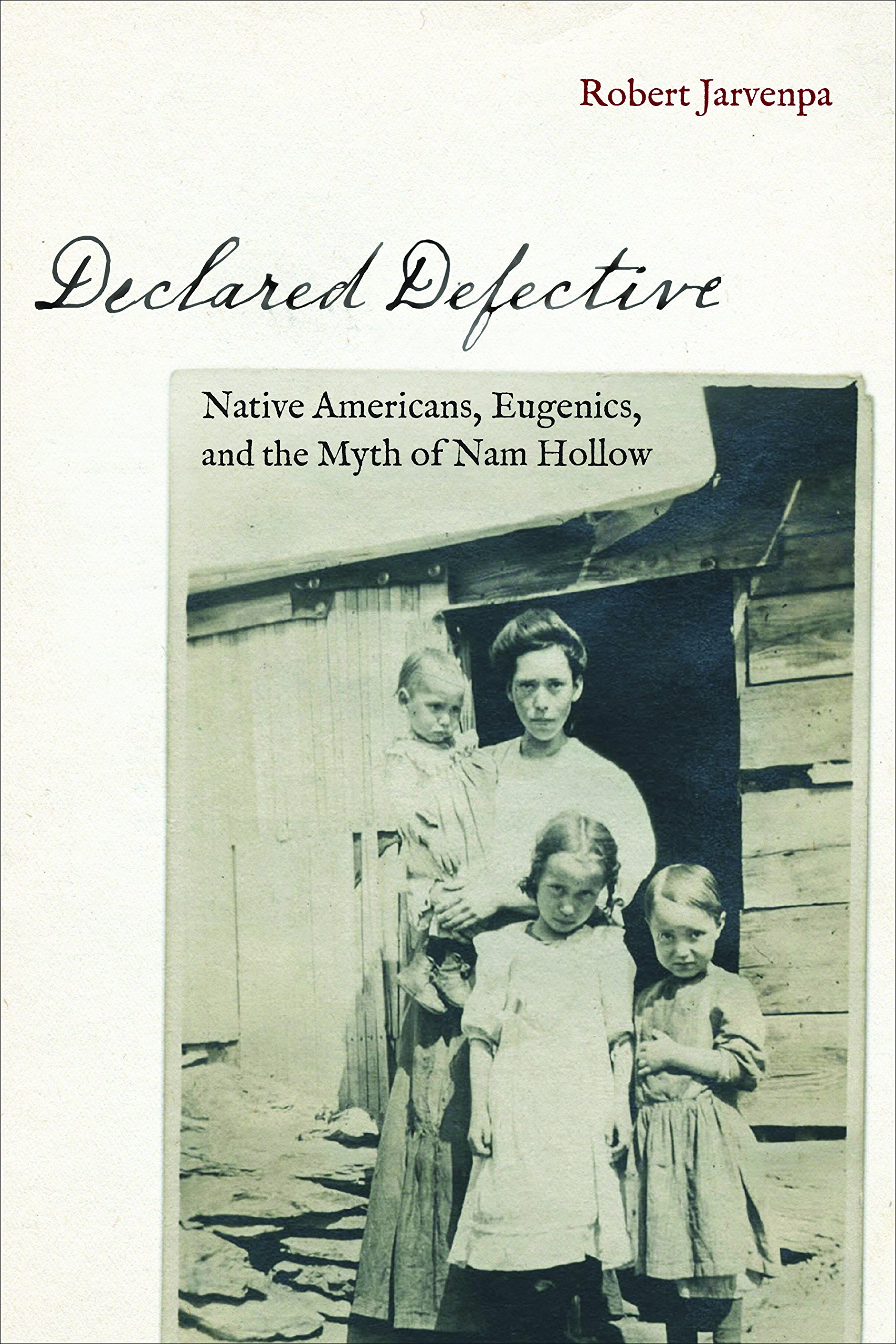
  • Declared Defective: Native Americans, Eugenics, and the Myth of Nam Hollow

    University of Nebraska Press
    May 2018
    246 pages
    9 photographs, 1 illustration, 3 maps, 2 tables, 8 charts, index
    Hardcover ISBN: 978-1-4962-0200-0

    Robert Jarvenpa, Professor Emeritus of Anthropology
    State University of New York, Albany

    Declared Defective is the anthropological history of an outcast community and a critical reevaluation of The Nam Family, written in 1912 by Arthur Estabrook and Charles Davenport, leaders of the early twentieth-century eugenics movement. Based on their investigations of an obscure rural enclave in upstate New York, the biologists were repulsed by the poverty and behavior of the people in Nam Hollow. They claimed that their alleged indolence, feeble-mindedness, licentiousness, alcoholism, and criminality were biologically inherited.

    Declared Defective reveals that Nam Hollow was actually a community of marginalized, mixed-race Native Americans, the Van Guilders, adapting to scarce resources during an era of tumultuous political and economic change. Their Mohican ancestors had lost lands and been displaced from the frontiers of colonial expansion in western Massachusetts in the late eighteenth century. Estabrook and Davenport’s portrait of innate degeneracy was a grotesque mischaracterization based on class prejudice and ignorance of the history and hybridic subculture of the people of Guilder Hollow. By bringing historical experience, agency, and cultural process to the forefront of analysis, Declared Defective illuminates the real lives and struggles of the Mohican Van Guilders. It also exposes the pseudoscientific zealotry and fearmongering of Progressive Era eugenics while exploring the contradictions of race and class in America.

    Table of Contents

    • List of Illustrations
    • List of Tables
    • Series Editors’ Introduction
    • Acknowledgments
    • Introduction: The Menace in the Hollow
    • 1. Native Americans and Eugenics
    • 2. Border Wars and the Origins of the Van Guilders
    • 3. A “New” Homeland and the Cradle of Guilder Hollow
    • 4. From Pioneers to Outcastes
    • 5. The Eugenicists Arrive
    • 6. Deconstructing the Nam and the Hidden Native Americans
    • 7. Demonizing the Marginalized Poor
    • Conclusion: The Myth Unravels
    • Notes
    • Bibliography
    • Index
  • Not a British Subject: Race and Poetry in the UK

    The Los Angeles Review of Books
    2015-12-06

    Sandeep Parmar

    As long as we have literature as a bulwark against intolerance, and as a force for change, then we have a chance. Europe needs writers to explicate this transition, for literature is plurality in action; it embraces and celebrates a place of no truths, it relishes ambiguity, and it deeply respects the place where everybody has the right to be understood…

    Caryl Phillips, Color Me English

    Nature rejects the monarch, not the man;
    The subject, not the citizen: for kings
    And subjects, mutual foes, forever play
    A losing game into each other’s hands,
    Whose stakes are vice and misery.

    Percy Bysshe Shelley, “Queen Mab”

    WHEN I LEFT LOS ANGELES in the summer after 9/11 to study creative writing in England, I was only supposed to be away for a year at most. England was a country I thought I knew — I was born there, lived there for a few years, and returned to visit my maternal grandparents nearly every summer in my teens. Wanting to study poetry, I enrolled in the University of East Anglia’s MA program. Based in Norwich, the writing MA at UEA boasts Kazuo Ishiguro, Anne Enright, and Ian McEwan — along with a host of lesser known but respectable poets — among its graduates. Compared to Los Angeles, Norwich felt strangely remote, enswathed by lakes and rivers and marshland studded by flint houses. Two hours from London, and a bit further to Derby (where my grandparents immigrated in the 1960s from Punjab) I found myself at the desolate end of a train line, cut off from the multicultural Britain of London and the heavily ghettoized Midlands. Norwich — and UEA — could not have been any less ethnically diverse. Whereas inner-city Derby, in particular the multiethnic Normanton road, felt like an entrenched if deeply divided community of Sikhs, Muslims, West Indians, and others, Norwich was eerily homogenous. When I inquired of a local cab driver about racism in the city, he assured me that it was not a problem because “there aren’t any black people.” This did not prove to be exactly true.

    What was I doing there? I should have asked myself. And what kind of poet would I become? I never thought to question my attraction to British poetry, or my unfounded sense of its legitimacy. At 21, I was drawn back to the country of my own and my mother’s childhood for instinctual reasons I would only realize many years later. And so, forsaking sunshine, naively idolizing the English way of life as one giant costume drama, I wasted no time and devotedly read beyond the mere handful of 20th-century British poets I had encountered as an undergraduate at UCLA…

    …A recent review of Sarah Howe’s book begins with the publisher’s blurb:

    Loop of Jade is described as an exploration “of a dual heritage” — Chinese and British — a “journeying back…in search of her roots.” My heart sank a little. Without diminishing the importance of such endeavours, the intervening three decades of identity politics has also led to, perhaps, a sense of, well, here we go again.

    The reviewer misses the point — it is not “identity politics” that is at fault here, but publishers who only stage a poet’s racial identity when that poet is not white. Howe’s book moves between lyric and experimental modes, and dodges the uneasy limits of poetic subjectivity. Her work retains a deeply intellectual authority over itself in an industry that would prefer to ornamentalize poets of color…

    Read the entire article here.

  • Akala: ‘As I grew up, I became embarrassed by my mother’s whiteness’

    The Guardian
    2018-05-26

    Akala (Kingslee James Daley)

    Akala
    Akala: ‘From that day, my relationship with my mother was not just that of mother and son, but of a white mother to a black son.’ Photograph: Antonio Olmos for the Guardian

    At five, the hip-hop poet was racially abused at school. Could his mother ever really understand?

    One day in 1988, at the age of five, I returned home from school upset. My mum tried to work out why but I was reluctant to tell her. After some coaxing, I told her that a boy in the playground had called me a particularly nasty name. As I was about to spill the beans, a strange thing occurred. I said, “Mum, the white boy… ” and trailed off before I could complete the sentence. A profound realisation hit me. With a hint of terror and accusation, I said, “But you’re white, aren’t you, Mummy?”

    Before this, my mum was just my mum, a flawless superhero, as any loving parent is in a five-year-old’s eyes. I sensed that something about that image was changing in the moment, something we could never take back. I wanted to un-ask the question. My mother’s expression was halfway between shock and resignation: she’d known this day would come, but the directness of the question still took her aback.

    She thought for a moment and then, using one of her brilliant if unintentional psychological masterstrokes, replied something to the effect of: “Yes, I’m white, but I’m German and they’re English.” It didn’t matter that my mum was not really German – she was born in Germany but brought up in Hong Kong – or that I was technically English: my mum had created a safety valve for me, so that I could feel comfortable reporting racist abuse to her without having to worry that I was hurting her feelings. Even at five, I knew instinctively that whiteness, like all systems of power, preferred not to be interrogated…

    Read the entire article here.

  • The Life-Giving Art of Adrian Piper

    Shondaland
    2018-04-20

    Rebecca Carroll, Editor of Special Projects
    WNYC New York Public Radio, New York, New York


    GETTY IMAGES/PHOTO BY SUZANNE KREITER/THE BOSTON GLOBE

    I went to college at a small, private liberal arts school in rural Massachusetts on a full financial scholarship. There I navigated two sets of friends: my black friends, and my white friends. The school was, of course, predominantly white, but the students of color created a strong and robust community. For the first couple of years, though, still legit messed up by being adopted by a white family and raised in an all-white town, I placed an inordinate amount of value on proximity to white folks. So I went ahead and kept up with them Saab-driving, co-op shift-having, jazz-loving white friends, who largely performed their wokeness and ignored or exotified my blackness. Enter: the conceptual artist Adrian Piper, who pretty much gave me my life…

    Read the entire article here.
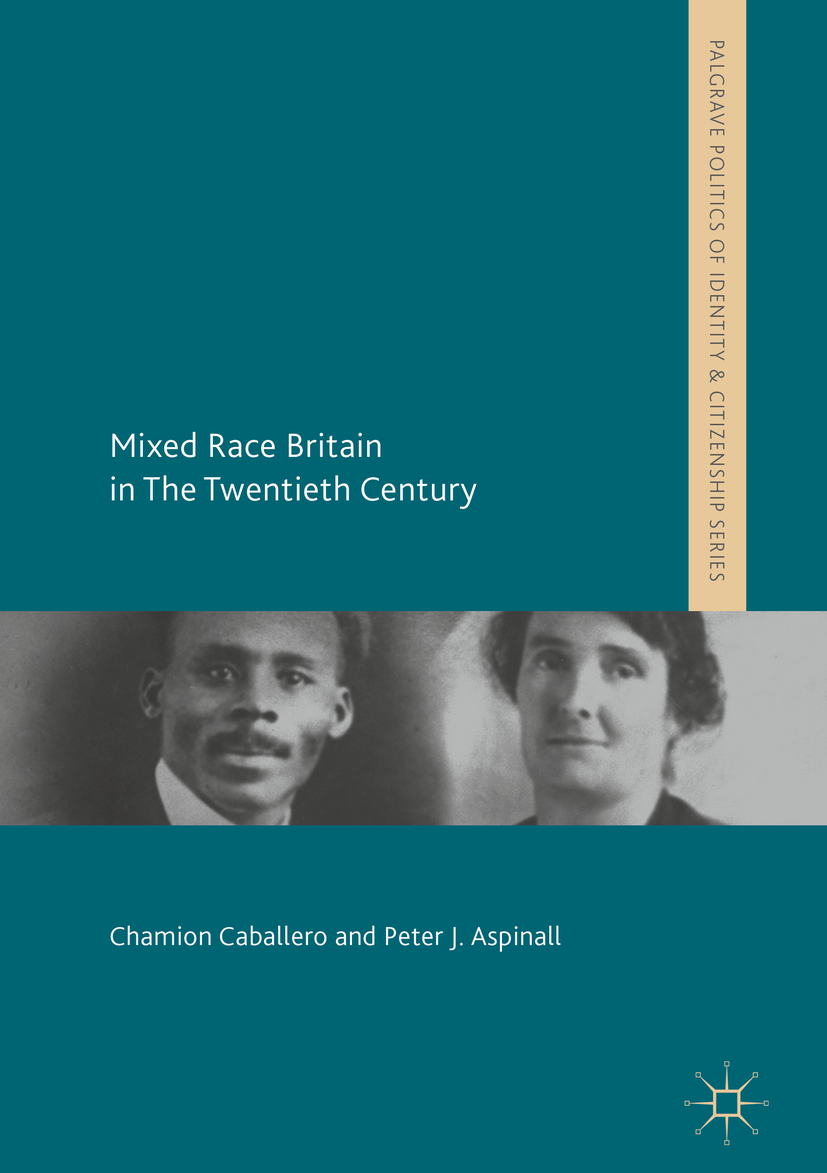
  • Mixed Race Britain in The Twentieth Century

    Palgrave Macmilan
    2018-05-23
    552 pages
    26 b/w illustrations
    Hardcover ISBN: 978-1-137-33927-0
    eBook ISBN: 978-1-137-33928-7
    DOI: 10.1057/978-1-137-33928-7

    Chamion Caballero, Visiting Senior Fellow
    London School of Economics

    Peter J. Aspinall, Emeritus Reader
    University of Kent, United Kingdom

    • Presents a comprehensive history of racial mixing in Britain during the twentieth century
    • Contrasts ‘ordinary’ voices sourced from archival material from across the twentieth century with official media and government accounts of racial mixing in Britain
    • Formed the foundations of the popular BBC Two television series Mixed Brittannia that explored the history of Britain’s mixed-race community

    This book explores the overlooked history of racial mixing in Britain during the course of the twentieth century, a period in which there was considerable and influential public debate on the meanings and implications of intimately crossing racial boundaries.

    Based on research that formed the foundations of the British television series Mixed Britannia, the authors draw on a range of firsthand accounts and archival material to compare ‘official’ accounts of racial mixing and mixedness with those told by mixed race people, couples and families themselves.

    Mixed Race Britain in The Twentieth Century shows that alongside the more familiarly recognised experiences of social bigotry and racial prejudice there can also be glimpsed constant threads of tolerance, acceptance, inclusion and ‘ordinariness’. It presents a more complex and multifaceted history of mixed race Britain than is typically assumed, one that adds to the growing picture of the longstanding diversity and difference that is, and always has been, an ordinary and everyday feature of British life.

    Table of contents

    • Introduction; Caballero, Chamion (et al.)
    • ‘Disharmony of Physical, Mental and Temperamental Qualities’: Race Crossing, Miscegenation and the Eugenics Movement; Caballero, Chamion (et al.)
    • Mixed Race Communities and Social Stability; Caballero, Chamion (et al.)
    • ‘Unnatural Alliances’ and ‘Poor Half-Castes’: Representations of Racial Mixing and Mixedness and the Entrenching of Stereotypes; Caballero, Chamion (et al.)
    • Fitting In and Standing Out: Lived Experiences of Everyday Interraciality; Caballero, Chamion (et al.)
    • ‘Tan Yanks’, ‘Loose Women’ and ‘Brown Babies’: Official Accounts of Mixing and Mixedness During the Second World War; Caballero, Chamion (et al.)
    • ‘Undesirable Element’: The Repatriation of Chinese Sailors and Break Up of Mixed Families in the 1940s; Caballero, Chamion (et al.)
    • Conviviality, Hostility and Ordinariness: Everyday Lives and Emotions in the Second World War and Early Post-war Years; Caballero, Chamion (et al.)
    • Redefining Race: UNESCO, the Biology of Race Crossing, and the Wane of the Eugenics Movement; Caballero, Chamion (et al.)
    • The Era of Mass Immigration and Widespread Population Mixing; Caballero, Chamion (et al.)
    • ‘Would You Let Your Daughter Marry a Black Man?’: Representation and Lived Experiences in the Post-war Period; Caballero, Chamion (et al.)
    • The Emergence of the ‘New Wave’: Insider-Led Studies and Multifaceted Perceptions; Caballero, Chamion (et al.)
    • Social Acceptance, Official Recognition, and Membership of the British Collectivity; Caballero, Chamion (et al.)
    • A Postscript to the Twentieth Century: Mainstream and Celebrated Limitations, and Counter-narratives; Caballero, Chamion (et al.)