• Student group IC Mixed discusses mixed-race experiences

    The Ithacan
    2017-04-04

    Ashae Forsythe, Staff Writer


    Sophomores Walt Martzen and Rianna Larkin listen intently to another IC Mixed member Feb. 22 in Friends Hall as they share personal stories of their multiracial backgrounds. Maxine Hansford/The Ithacan

    In IC Mixed, if there’s one thing the students have in common, it’s that they can’t easily check one box for a race or ethnicity.

    “When you can’t be put into a box, it causes inner turmoil for multiracial people themselves: ‘Where do I belong? I’m not this, I’m not that,’” said junior Luke Watkins, event coordinator for IC Mixed.

    The new student organization creates spaces for people of mixed heritage to express their thoughts freely. Launched in February, IC Mixed aims to strengthen the sense of community among people who identify as mixed or multiracial through discussions, events and other programs…

    Read the entire article here.
  • “I have some Chinese roots, I’m mestizaje [mixed]. I’m always sincere with people who know me. To be honest I never had an interest in Chinese culture before. I never wanted to get involved in the Chinese Association. But my mother always wanted to be connected to the community, to have Chinese friends,” he told me. “But what I’m trying to say is that for me I started to get involved with all this and it changed me.” —Junior Chen

    Nidhi Prakash, “The forgotten history of Chinese immigrants in this Mexican border town,” Fusion, October 13, 2016. http://fusion.net/the-forgotten-history-of-chinese-immigrants-in-this-mex-1793862816.

  • When my son first started to black identify at about 5 or 6 years old, an acquaintance of ours asked my husband, in my presence, if he felt like we were “depriving” our son of his “white side.” My husband, a sociology professor and the author of two books on the failure of housing and school desegregation in the United States, said: “If my parents had instilled any Italian culture in me, I might want to share that with my son. But if you’re talking about general whiteness, there’s nothing there to pass down.”

    Rebecca Carroll, “Black and Proud. Even if Strangers Can’t Tell.The New York Times, April 1, 2017. https://www.nytimes.com/2017/04/01/opinion/sunday/black-and-proud-even-if-strangers-cant-tell.html.

  • People with mixed backgrounds can disrupt notions of purity that undergird race and synthesize vast cultural traditions. People with mixed backgrounds can also internalize and carry out racism.

    Daniel José Camacho, “Diversity doesn’t make racism magically disappear,” The Guardian, April 1, 2017. https://www.theguardian.com/commentisfree/2017/apr/01/diversity-doesnt-make-racism-magically-disappear.

  • Mixed race child zigzags through Shanghai world

    Otago Daily Times
    2017-04-03

    Jessie Neilson, Library Assistant
    University of Otago

    DRAGON SPRINGS ROAD
    Janie Chang
    William Morrow
    (Harper Collins Publishers)

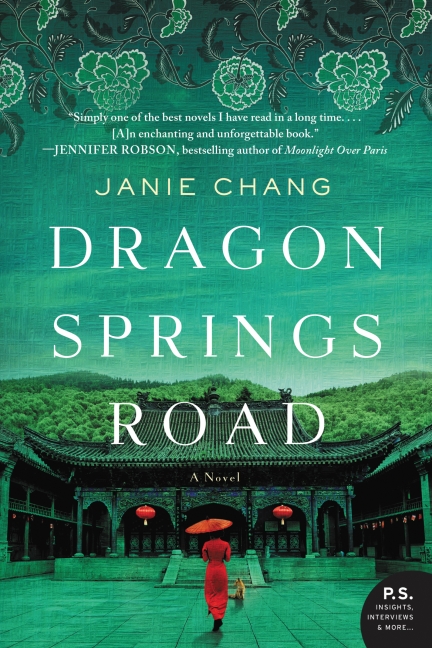
    Janie Chang’s second novel, Dragon Springs Road, details a landscape of memories, where traditional spiritual beliefs coexist with more modern ways of living.

    Author Janie Chang, a Taiwanese Canadian, draws on her own family heritage and ancestors’ beliefs in her second novel.

    It is 1908, the Year of the Monkey, Dragon Springs Road, Shanghai. In a traditional, affluent Chinese housing complex, a young girl is abandoned by her mother, with little explanation.

    The 7-year-old, Jialing, is Eurasian, or za zhong, as strangers insult her, and as such is treated with contempt by most of society. She has little chance of education or opportunity beyond prostitution, but fortunes look up when she is taken under the wing of the new family in residence…

    Read the entire review here.

  • Free People of Color in Slaveholding North Carolina: The Andersons of Granville County

    Renegade South: Histories of Unconventional Southerners
    2017-04-01

    Vikki Bynum, Distinguished Professor Emeritus of History
    Texas State University, San Marcos


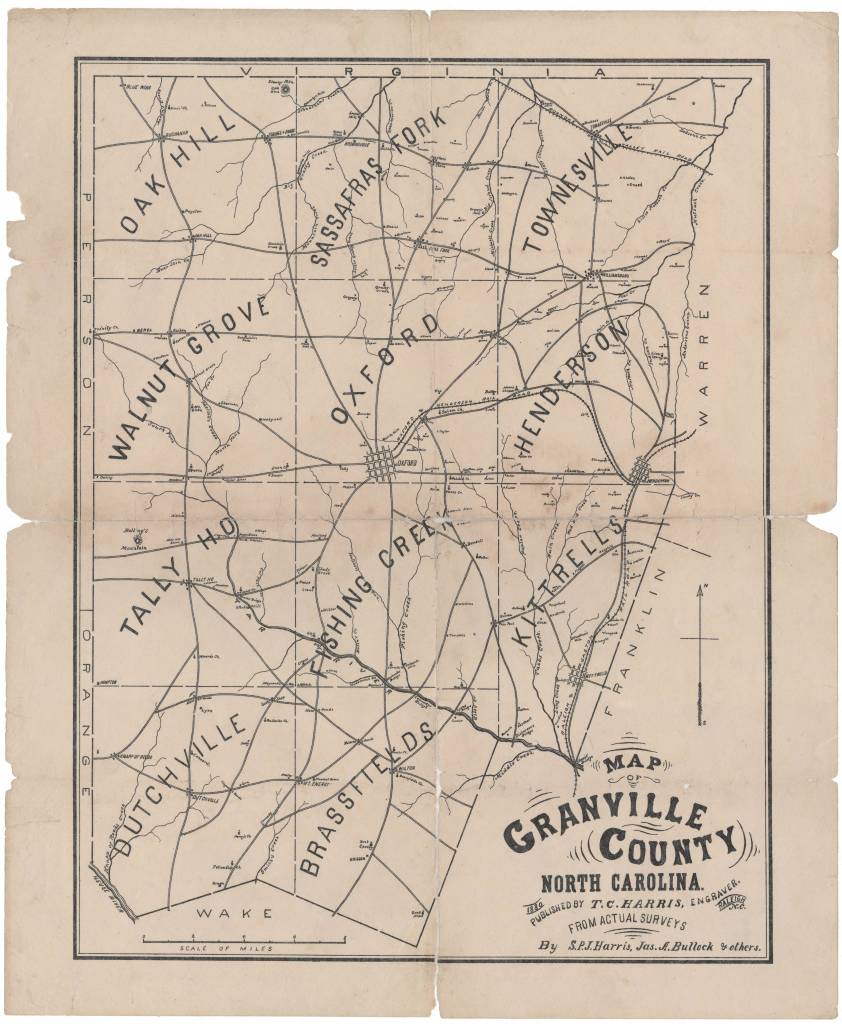
    Map courtesy of Kianga Lucas.

    Late last year, I was contacted by Raymont Hawkins-Jones, a descendant of a family I’d written about many years earlier: the Andersons of Granville County, North Carolina. The Andersons were one of the many fascinating free families of color that I’ve studied over the years, and I enjoyed learning more about their history from Raymont. Back in pre-internet 1992, pretty much everything I knew about my subjects was what I’d learned from records held at the North Carolina State Archives. Today, social media has enabled me to meet many of their descendants and to access additional records posted on the internet. The same digital revolution that stimulated me to create this blog also allows me to revisit my early topics of research and bring their stories up to date! (1)

    The Andersons and the families with whom they intermarried belonged to a community of people defined by society as non-white, but who rarely appeared as slaves in North Carolina’s state and court records. As I’ve noted in earlier Renegade South essays about the mixed heritage communities of Gloucester County, Virginia, and the “Winton Triangle” of North Carolina, the lives of free people of color reveal far more complicated histories of racial identity and race relations than the broad images of “white freedom” and “black slavery” would suggest.

    In fact, families such as the Andersons are central to understanding historical events that preceded and followed the institution of slavery, including colonization, the American Revolution, the Civil War and Reconstruction, the postwar rise of the Ku Klux Klan, and the New South era of white supremacy.

    The very existence of free people of color, especially those in the South, threatened the growing institution of slavery. Southern whites especially feared their influence on slaves as the United States moved toward a Civil War generated by national conflicts over slavery. Determined to prevent free people of color from exercising full rights of citizenship and mobility, lawmakers increasingly policed their behavior through oppressive laws and customs…

    Read the entire article here.

  • Colin Kaepernick Saw This Coming

    Complex
    2017-03-30

    Dria Roland


    Image via USA Today Sports

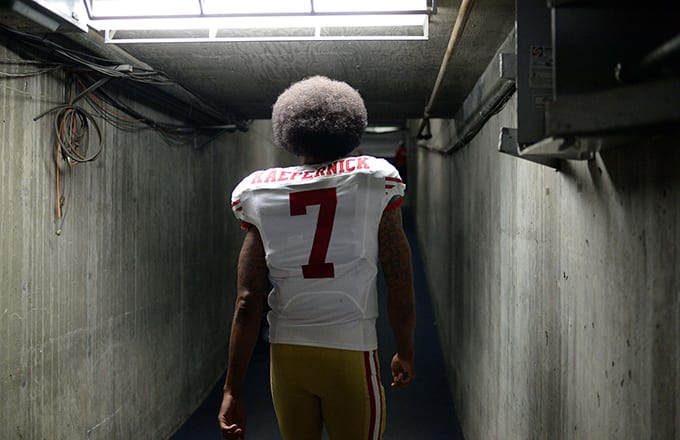
    In pop culture years, 2012 was ages ago. But try to remember. That was the year quarterback Alex Smith suffered a concussion in the first half of the Niners game against the Rams in Week 10, and a backup QB named Colin Kaepernick had to fill in. The game ended in a tie, the NFL’s first in four years. The next week Kaepernick started, and led the team to victory. And even after Smith was declared healthy, Kaepernick continued to start—and to win. A “quarterback controversy” brewed, but coach Harbaugh went with the guy “with the hot hand,” as they say.

    With that, a star was born. A second-year, backup QB led the Niners all the way to Super Bowl XLVII, and even though the Ravens came out on top, all people could talk about was Kap. His spread in the ESPN Body Issue made women swoon all around the nation. He signed endorsement deals with Jaguar, Nike, Beats, and Electronic Arts. Feature stories were written about his tattoos, his pet tortoise named Sammy, his being a biracial kid adopted by white parents…

    Read the entire article here.

  • Dragon Springs Road: A Novel

    William Morrow Paperbacks
    2017-01-10
    400 pages
    5.313 in (w) x 8 in (h) x 0.901 in (d)
    Paperback ISBN: 9780062388957

    Janie Chang

    From the author of Three Souls comes a vividly imagined and haunting new novel set in early 20th century Shanghai—a story of friendship, heartbreak, and history that follows a young Eurasian orphan’s search for her long-lost mother.

    That night I dreamed that I had wandered out to Dragon Springs Road all on my own, when a dreadful knowledge seized me that my mother had gone away never to return . . .

    In 1908, Jialing is only seven years old when she is abandoned in the courtyard of a once-lavish estate near Shanghai. Jialing is zazhong—Eurasian—and faces a lifetime of contempt from both Chinese and Europeans. Without her mother’s protection, she can survive only if the estate’s new owners, the Yang family, agree to take her in.

    Jialing finds allies in Anjuin, the eldest Yang daughter, and Fox, an animal spirit who has lived in the haunted courtyard for centuries. But Jialing’s life as the Yangs’ bondservant changes unexpectedly when she befriends a young English girl who then mysteriously vanishes.

    Always hopeful of finding her long-lost mother, Jialing grows into womanhood during the tumultuous early years of the Chinese republic, guided by Fox and by her own strength of spirit, away from the shadows of her past. But she finds herself drawn into a murder at the periphery of political intrigue, a relationship that jeopardizes her friendship with Anjuin and a forbidden affair that brings danger to the man she loves.

  • Black and Proud. Even if Strangers Can’t Tell.

    The New York Times
    2017-04-01

    Rebecca Carroll, Editor of Special Projects
    WNYC, New York, New York


    Rachel Levit

    My 11-year-old is understated, but not shy. He likes to bake, loves video games, is loyal to his friends and, biased as I may be, is a pretty good-looking kid. He gets mad sometimes, though, that people don’t immediately register him as black. “You’re so lucky,” he said to me a few months ago. “People look at you and know that you are black.”

    Being black in America has historically been determined by whether or not you look black to nonblack people. This keeps racism operational. Brown and black skin in this country can invite a broad and freewheeling range of bad behavior — from job discrimination to a child being shot dead in the street. For my son, though, being black in America is about more than his skin color. It’s about power, confidence, culture and belonging.

    You inherit race, though. You don’t steal it. We’re reminded of this once again by Rachel Dolezal, the white woman who made national headlines in 2015 for claiming a black identity because she felt like it. She released a memoir last week…

    …My son is not the only light-skinned, mixed or biracial person I know who identifies primarily as black. Increasingly, I have observed my adult peers and colleagues who fall into this category not merely identifying as black, but routinely pulling out the receipts to prove their blackness.

    Some of this may have to do with what the brilliant Jordan Peele, who is also biracial and black, tapped into for the plot of his genre-redefining box office hit, “Get Out” — that it’s cool to be black right now, that we are trending…

    Read the entire article here.

  • Diversity doesn’t make racism magically disappear

    The Guardian
    2017-04-01

    Daniel José Camacho
    Duke Divinity School


    ‘Consider Brazil. There, white people are a minority – but are still dominant.’ Photograph: Brazil Photos/LightRocket via Getty Images

    Some hope that changing demographics make us destined to be post-racial. It isn’t so simple

    We can’t screw our way beyond racism. Many think mixed-race babies and browner demographics will automatically usher in a post-racial world. They interpret the projections of a “majority-minority” shift in our nation – now set to take place in 2044 – as a sign of guaranteed progress. Changing faces in the US are seen as anti-racist destiny. But don’t overestimate the power of this post-racial cocktail.

    Jordan Peele’s brilliant film Get Out reminds me of the importance of questioning overly optimistic narratives of racial progress. Made by someone who has been open about being biracial and married to a white women, this film creatively uses the genre of horror to depict the persistence of racism through a story about an interracial couple. In many ways, it can be seen as a strident critique of a liberal brand of racism that has blossomed in the post-Obama era…

    …If more mixed people guarantee greater tolerance, then Brazil – and most of Latin America – should be a racial paradise. Although a great degree of ‘mestizaje’ or racial mixing has taken place since the time of conquest, Indigenous and Afro-descendent people in Latin America remain disproportionately poor, discriminated against, and locked out from opportunity.

    Sociologist Eduardo Bonilla-Silva, in his book Racism without Racists, has speculated whether the racial order in the US might eventually resemble that of Latin American and Caribbean nations. In this case, white supremacy and racial stratification will continue to operate in the US even as it becomes a “majority-minority” nation…

    Read the entire article here.