Mixed Race Studies

Scholarly perspectives on the mixed race experience.

    • About This Site
    • Bibliography
    • Contact Information
    • Date and Time Formats
    • Forthcoming… (Updated 2021-09-01)
    • Likely Asked Questions
    • List of Book Publishers
    • List of Definitions and Terms
    • My Favorite Articles and Papers
    • My Favorite Posts
    • My Recent Activities
    • Praise for Mixed Race Studies
    • Tag Listing
      • Tag Listing (Ordered by Count)
    • US Census Race Categories, 1790-2010
    • 1661: The First ‘Mixed-Race’ Milestone
    • 2010 U.S. Census – Some Thoughts

recent posts

  • The Routledge International Handbook of Interracial and Intercultural Relationships and Mental Health
  • Loving Across Racial and Cultural Boundaries: Interracial and Intercultural Relationships and Mental Health Conference
  • Call for Proposals: 2026 Critical Mixed Race Studies Conference at UCLA
  • Participants Needed for a Paid Research Study: Up to $100
  • You were either Black or white. To claim whiteness as a mixed child was to deny and hide Blackness. Our families understood that the world we were growing into would seek to denigrate this part of us and we would need a community that was made up, always and already, of all shades of Blackness.

about

  • Twitter
  • Facebook
  • Instagram
  • China has an irrational fear of a “black invasion” bringing drugs, crime, and interracial marriage

    2017-03-31

    China has an irrational fear of a “black invasion” bringing drugs, crime, and interracial marriage

    Quartz
    2017-03-30

    Joanna Chiu


    Feeling it in Guangzhou. (Reuters/James Pomfret)

    Beijing—Earlier this month in Beijing, amid the pomp of China’s annual rubber-stamp parliament meetings, a politician proudly shared with reporters his proposal on how to “solve the problem of the black population in Guangdong.” The latter province is widely known in China to have many African migrants.

    “Africans bring many security risks,” Pan Qinglin told local media (link in Chinese). As a member of the Chinese People’s Political Consultative Conference, the nation’s top political advisory body, he urged the government to “strictly control the African people living in Guangdong and other places.”

    Pan, who lives in Tianjin near Beijing—and nowhere near Guangdong—held his proposal aloft for reporters to see. It read in part (links in Chinese):

    “Black brothers often travel in droves; they are out at night out on the streets, nightclubs, and remote areas. They engage in drug trafficking, harassment of women, and fighting, which seriously disturbs law and order in Guangzhou… Africans have a high rate of AIDS and the Ebola virus that can be transmitted via body fluids… If their population [keeps growing], China will change from a nation-state to an immigration country, from a yellow country to a black-and-yellow country.”

    On social media, the Chinese response has been overwhelmingly supportive, with many commenters echoing Pan’s fears. In a forum dedicated to discussions about black people in Guangdong on Baidu Tieba—an online community focused on internet search results—many participants agreed that China was facing a “black invasion.” One commenter called on Chinese people (link in Chinese) not to let “thousands of years of Chinese blood become polluted.”

    The stream of racist vitriol online makes the infamous Chinese TV ad for Qiaobi laundry detergent, which went viral last year, seem mild in comparison. The ad featured a Asian woman stuffing a black man into a washing machine to turn him into a pale-skinned Asian man…

    …Paolo Cesar, an African-Brazilian who has worked as a musician in Shanghai for 18 years and has a Chinese wife, said music has been a great way for him to connect with audiences and make local friends. However, his mixed-race son often comes home unhappy because of bullying at school. Despite speaking fluent Mandarin, his classmates do not accept him as Chinese. They like to shout out, “He’s so dark!”…

    Read the entire article here.

  • William Ellis: The Former Slave Who Became a Mexican Millionaire

    2017-03-31

    William Ellis: The Former Slave Who Became a Mexican Millionaire

    Houston Matters
    Houston, Texas
    2017-03-29

    Guillermo Eliseo was a wealthy Mexican banker and broker who lived in New York City in the early 20th Century.

    But, Eliseo had a secret. He was actually born into slavery on a cotton plantation in southern Texas, and his real name was William Ellis.

    Maggie Martin talks with historian and author Karl Jacoby, who wrote a book about Ellis. It’s called The Strange Career of William Ellis: the Texas Slave Who Became a Mexican Millionaire.

    Jacoby talks about why Ellis made the move to Mexico, the ways his secret life cut him off from his family and the lessons from his life.

    Listen to the interview here (00:09:05).

  • Trevor Noah: What’s the “Middle” Between White Supremacy and Equality for All?

    2017-03-31

    Trevor Noah: What’s the “Middle” Between White Supremacy and Equality for All?

    Son of Baldwin 
    2016-12-07

    Son of Baldwin (Robert Jones, Jr)


    [IMAGE DESCRIPTION: Trevor Noah dressed in a suit, seen from the chest up, smiling.]

    I respect Trevor Noah.

    I respect the position he finds himself in and his attempts at trying to find common ground. It’s hard when your loyalties are split and so you have a particular, if peculiar, idea of where the “middle” is.

    What I’ll need Noah to explain to me is this: What is the middle between white supremacy and equality for all? And does whatever that middle is benefit white supremacy or equality?

    One of the things I dislike about Noah’s perspective is how it misrepresents false equivalence as balance.

    I know that when it comes to racial matters, some people feel that they can “see it from both sides” and, therefore, “know the answer is in the middle.” If black people in the United States were in power equal to that of white people; if the laws and institutions and education and media dipped in favor of black people as much as it does white people, then there might be an actually middle to arrive at.

    But you cannot start from a place where the scales are tipped in favor of one group and treat it as though the scale is level. Your answer will always be incorrect when your starting equation has one of the variables wrong…

    Read the entire article here.

  • Looking at Okinawa: Race, Gender, Nation

    2017-03-31

    Looking at Okinawa: Race, Gender, Nation

    2017 UC Berkeley Graduate Student Conference: On Belonging: Gender, Sexuality and Identity in Japan
    University of California, Berkeley
    Moffitt Undergraduate Library
    340 (BCMN Commons Seminar Room)
    Berkeley, California
    2017-04-09, 10:00-16:00 PDT (Local Time)

    Ishikawa Mao, Photographer

    Wendy Matsumura, Assistant Professor of Professor
    University of California, San Diego

    Annmaria Shimabuku, Assistant Professor of East Asian Studies
    New York University

    This is a one-day event being held in order to create a dialogue on issues of race and gender in the study of Okinawa, and to contemplate the relationship between the study of Japan and the study of Okinawa.

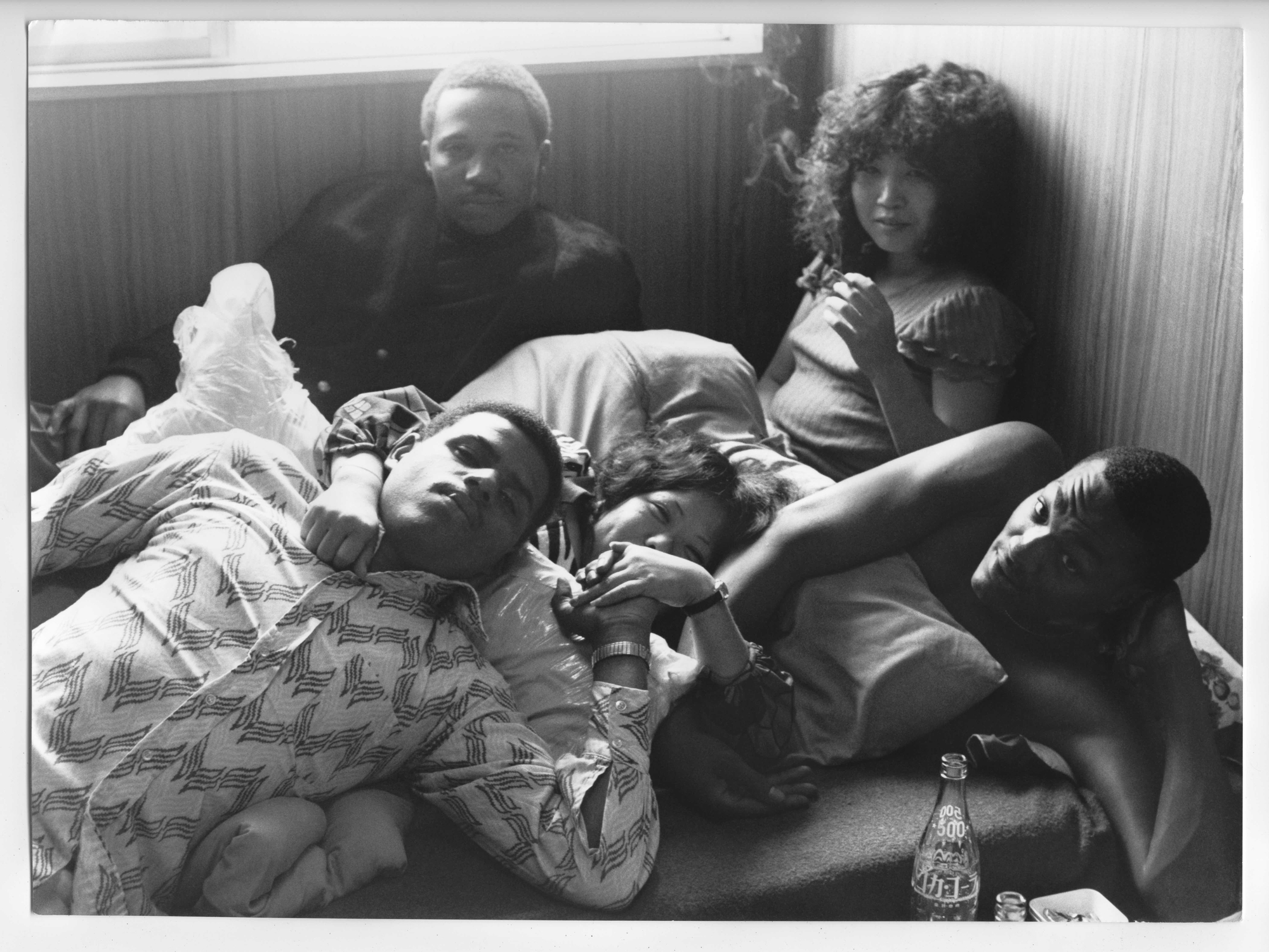
    We will initiate this dialogue with a lecture by photographer Ishikawa Mao, whose work explores the complex relationships of gender, race, and national identity in Okinawa and Japan. Her works have included including candid photographs of African American servicemen and their Okinawan and Japanese wives and girlfriends in Okinawa in the 1970s; and portraits of Japanese and Okinawan people with the national flag of Japan, interacting with it in various ways to demonstrate their complicated and often troubled relationship with the nation of Japan. Ishikawa is to give a slide show and talk about her work, focussing on her photographs of African American servicemen.

    In the afternoon, we will hold a discussion between scholars, students, and members of the public, to be led by Professor Wendy Matsumura (UCSD) and Professor Annmaria Shimabuku (NYU), who, from the fields of cultural studies, sociology, and history, have been engaged in thinking about the role of Okinawan studies and its place in Japanese studies more generally. We will discuss what it means to study Okinawa in the American academy, and, drawing on Ishikawa’s work, we will examine the complicated role of race and gender in Japanese studies and Okinawan studies.

    Sponsored by: Center for Japanese Studies (CJS), Townsend Center for the Humanities, Department of African American Studies, Asian American Studies, Department of Ethnic Studies, Department of Gender and Women’s Studies, Center for Race and Gender, and Department of East Asian Languages & Cultures

    For more information, click here.

  • Jordan Peele Scares America

    2017-03-30

    Jordan Peele Scares America

    The Ringer
    2017-03-09

    Sean Fennessey, Editor-in-Chief


    (Jaya Nicely)

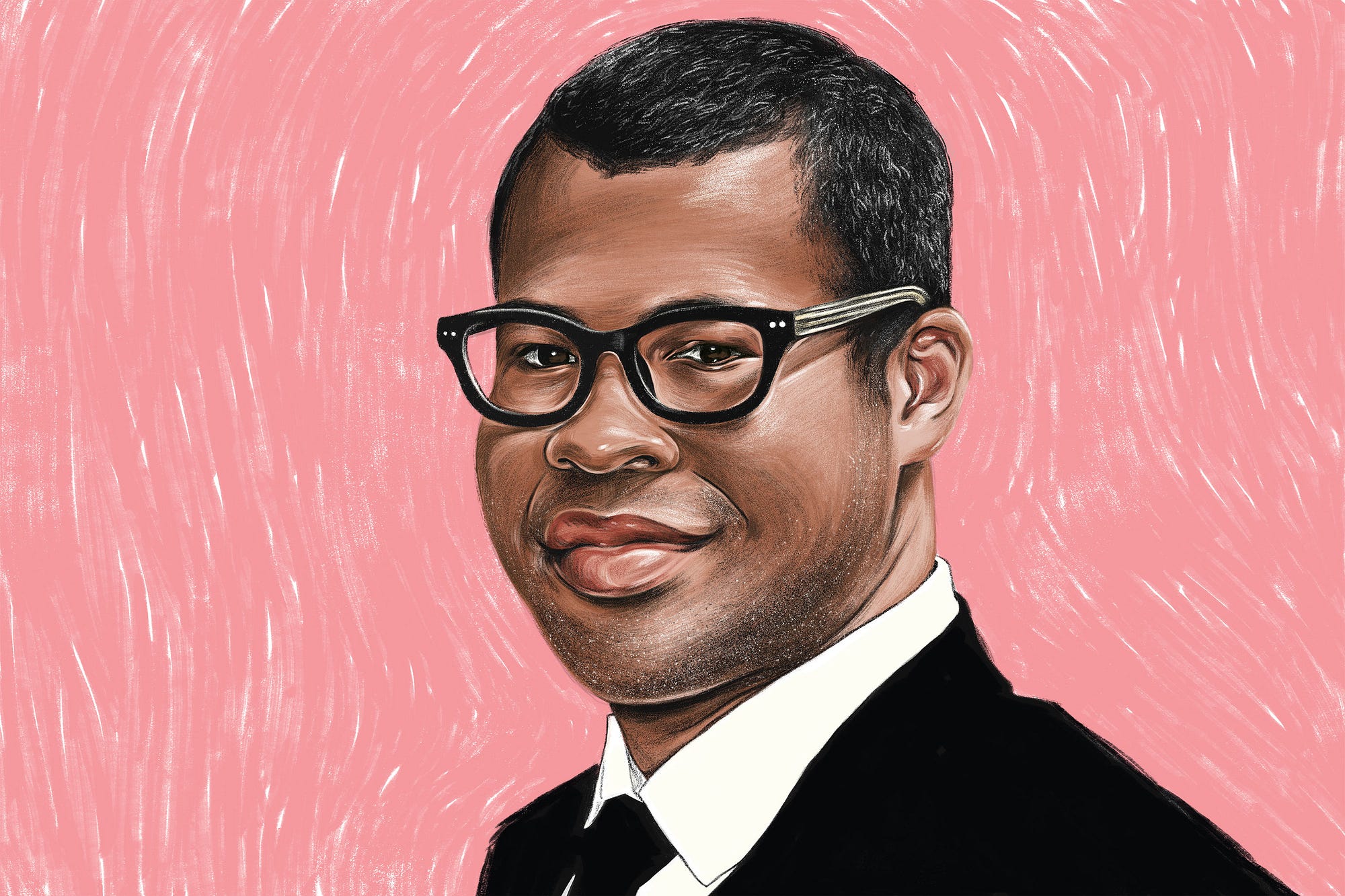
    After the amazing success of his directorial debut, ‘Get Out,’ the ‘Key and Peele’ star sits down for a conversation about how he pulled off his daring horror-satire, the lie of a post-racial society, and what comes next

    Get Out broke out. One year ago, if someone had told you that a movie about a black guy visiting the home of his white girlfriend’s parents for a summer weekend — starring an unknown lead and Marnie from Girls — would become the unmitigated Hollywood success story of the young year, you might tell that person to, well, get out. But that is exactly what Jordan Peele, the 38-year-old sketch star best known for Comedy Central’s Key and Peele, has accomplished with his directorial debut.

    After just two weeks of release, the movie has already earned more than 18 times its reported $4.5 million budget and ignited a new kind of conversation about race, the pitfalls of white liberalism, and what it really means to make a horror movie in 2017. Peele, who also wrote the movie, sat down for a podcast conversation about how he did it and what comes next. This is a condensed and edited version of that conversation…

    Listen to the interview (00:38:05) here. Download the interview here.

  • As Get Out shows, love isn’t all you need in interracial relationships

    2017-03-30

    As Get Out shows, love isn’t all you need in interracial relationships

    The Guardian
    2017-03-27

    Iman Amrani


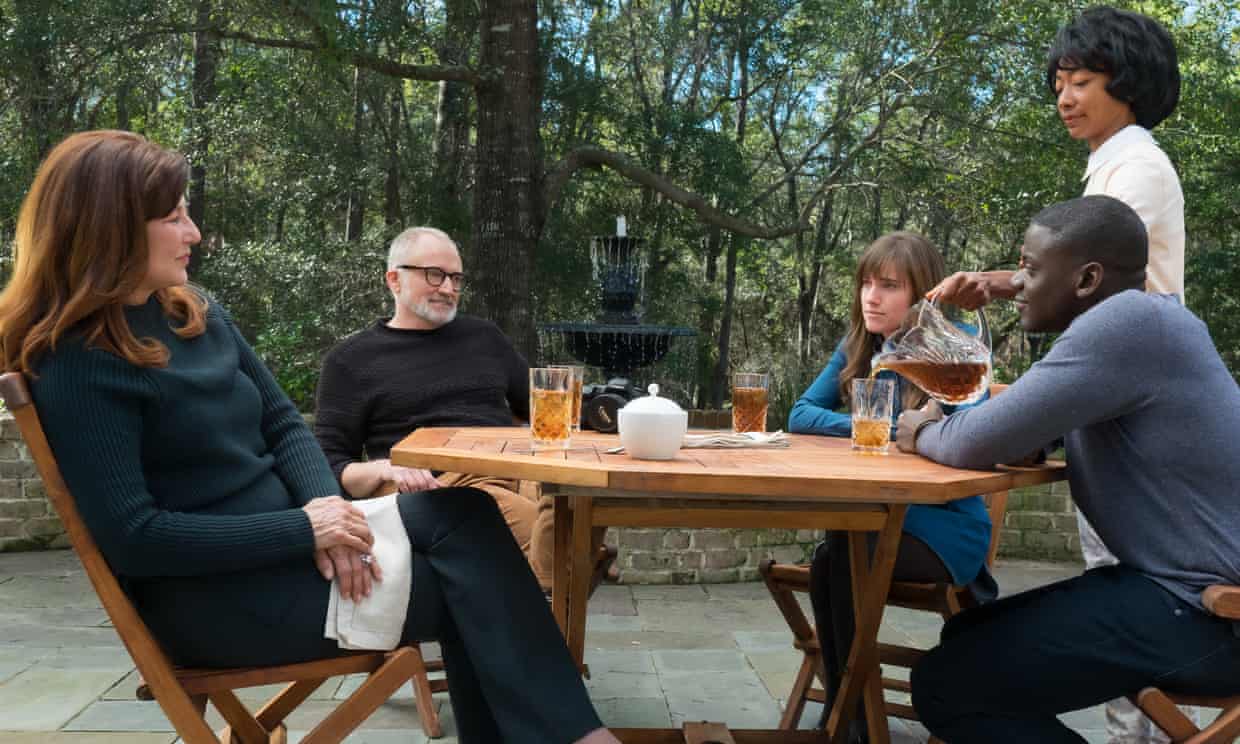
    ‘In Get Out, Peele successfully challenges the way the parents and their friends pride themselves on not being racist, while also objectifying the young man both physically and sexually.’ Photograph: Justin Lubin/Universal Pictures

    Jordan Peele’s film has provoked discussion of issues about race and relationships that often remain too sensitive or uncomfortable to explore

    This year marks the 50th anniversary of the 1967 US supreme court decision in the Loving v Virginia case which declared any state law banning interracial marriages as unconstitutional. Jeff Nichols’s recent film, Loving, tells the story of the interracial couple at the heart of the case, which set a precedent for the “freedom to marry”, paving the way also for the legalisation of same-sex marriage.

    Loving isn’t the only recent film featuring an interracial relationship. A United Kingdom is based on the true story of an African prince who arrived in London in 1947 to train as a lawyer, then met and fell in love with a white, British woman. The film tells the tale of love overcoming adversity, but I wonder whether these films are missing something.

    I can understand how, at the moment, with the backdrop of rising intolerance in Europe and the United States, it’s tempting to curl up in front of a triumphant story of love conquering all, but I grew up in an interracial household and I know that it’s not as simple as that…

    Read the entire article here.

  • Where Black and Jewish Identity Merge

    2017-03-30

    Where Black and Jewish Identity Merge

    Forward
    2013-01-27

    Adam Langer, Culture Editor


    courtesy emily raboteau

    Before they had finished their books, before Sharifa Rhodes-Pitts had published “Harlem Is Nowhere” — a finalist for the 2011 National Book Critics Circle Award — and before Emily Raboteau had published “Searching for Zion,” which was published in January, the two women used to take walks together. They would amble past the George Washington Bridge, the Morris-Jumel Mansion, Jumel Terrace Books and other landmarks in the Upper Manhattan neighborhoods where both authors currently live.

    Both Raboteau and Rhodes-Pitts are young mothers in their 30s whose nonfiction books share a common theme: a yearning for some sort of promised land. For Rhodes-Pitts, whose book is the first in a planned trilogy about black utopias, that place is Harlem; for Raboteau, it is not just one place, but a series of locations where displaced blacks have endeavored to find a homeland.

    Raboteau’s journey began in Israel, where her best friend from childhood had moved to make aliyah, but it also led her through such locations as Jamaica, Ethiopia and Ghana, where she came to challenge some of her long-held assumptions about race and religion. The Forward’s Adam Langer invited the authors to have another conversation, this time at Emily Raboteau’s office at City College where she teaches. The writers discussed parenthood, promised lands, and their thoughts on the relationship between blacks and Jews…

    Read the entire interview here.

  • How do people with multiracial (or multicultural) backgrounds navigate their social identity?

    2017-03-30

    How do people with multiracial (or multicultural) backgrounds navigate their social identity?

    who cares? what’s the point?
    Season 2, Episode 6
    2017-03-27

    Sarb Johal, Host

    In this episode, I talk with Dr. Sarah Gaither, Assistant Professor in the Department of Psychology and Neuroscience at Duke University in the USA. In this conversation, we focus on Sarah’s work on understanding multiracial identities and the costs and benefits of navigating that social terrain.

    The paper we talk about in this week’s show is, ““Mixed” Results: Multiracial Research and Identity Explorations”.

    Here is the abstract for some context:

    Multiracial individuals report that the social pressure of having to “choose” one of their racial groups is a primary source of psychological conflict. Yet because of their ability to maneuver among their multiple identities, multiracials also adopt flexible cognitive strategies in dealing with their social environments—demonstrating a benefit to having multiple racial identities. The current article reviews recent research involving multiracial participants to examine the behavioral and cognitive outcomes linked to being multiracial and pinpoints possible moderators that may affect these outcomes. Limitations in applying monoracial identity frameworks to multiracial populations are also discussed…

    If you do enjoy this episode, and would like to support the show, you can do that in a few ways:

    • You can leave a review and rating on iTunes – that really helps others to find the show.
    • You can follow the show on Twitter @wcwtp, and find the website at whocareswhatsthepoint.com
    • You can also email the show at contact@whocareswhatsthepoint.com
    • Please feel free to share the link to the show with your friends and colleagues. You can subscribe here or via iTunes.
    • Or on Sticher too.
  • Race, Place and Community

    2017-03-30

    Race, Place and Community

    Duke University
    Trent Semans Center
    Great Hall
    Duke University Medical Center Greenspace
    Durham, North Carolina 27710
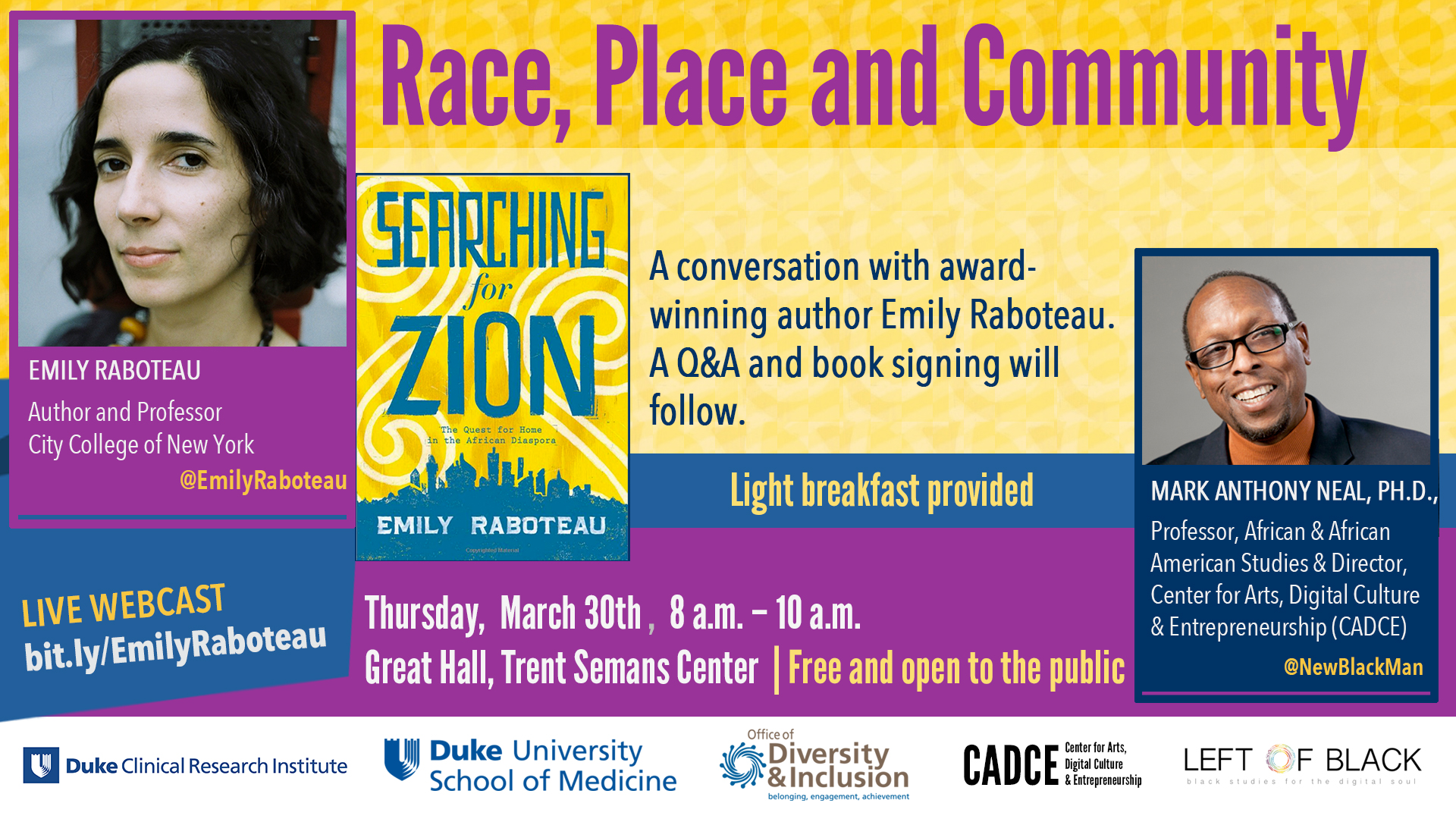
    Thursday, 2017-03-30, 08:00-10:00 EDT (Local Time)

    Emily Raboteau, Professor of English
    City College of New York

    Mark Anthony Neal, Host and Professor of African and African American Studies
    Duke University

    A conversation with award-winning author Emily Raboteau. A Q&A and book (Searching for Zion) signing will follow.

    The event, “Race, Place and Community,” is free and open to the public. Light breakfast will be served. Those unable to attend can watch a live webcast of the event at bit.ly/EmilyRaboteau.

    Organized by the Duke Clinical Research Institute, the event co-sponsors include the Duke School of Medicine, the Office of Diversity and Inclusion, the Center on Arts, Digital Culture and Entrepreneurship, and Left of Black.

  • Ironically, then, in manifesting her blackness she most flagrantly manifests her whiteness.

    2017-03-30

    Just as [Donald] Trump cannot seem to utter “the African Americans” sans “inner city,” [Rachel] Dolezal’s conception of blackness is steeped in a fetishizing of struggle, pain and oppression. Opting into the struggle is yet another place where her whiteness acutely rears its head. The choice to take on a racial mantle at will is a mark of white privilege; so, too, is the choice to take it off when it suits. Ironically, then, in manifesting her blackness she most flagrantly manifests her whiteness.

    Baz Dreisinger, “When saying you’re black and being black are two different things,” The Washington Post, March 24, 2017. https://www.washingtonpost.com/opinions/when-saying-youre-black-and-being-black-are-two-different-things/2017/03/24/d41a6590-0a4b-11e7-93dc-00f9bdd74ed1_story.html.

Previous Page
1 … 294 295 296 297 298 … 1,428
Next Page

Designed with WordPress