• The Beautiful Faces commercial was about thirty seconds long: ‘I am negro, morena, mulata, zamba. I am Afro-descendant. I count. Palenquero, raizal, mulato, negra, I count. Afro-descendant, morena, negra. I’m zambo, raizal. I count. Palenquero, negro.’ It ended with the confident words of Maria Eugenia Arboleda, a famous AfroColombian actress: ‘My people, in this census, count yourself!’ This was followed by the some fifteen Afro-Colombians featured in the commercial exclaiming in unison: ‘Proud to be Afro-Colombian!’ With images of people of various skin tones, urban Afro-Colombians as well as farmers and people in traditional clothes, and music in the background that was not easily identifiable with any specific region in the country, the commercial’s message was clear: they were all AfroColombian.

    Tianna S. Paschel, “‘The Beautiful Faces of my Black People’: race, ethnicity and the politics of Colombia’s 2005 census,” Ethnic and Racial Studies, Volume 36, Issue 10 (2013). 11-12. http://dx.doi.org/10.1080/01419870.2013.791398.

  • The complex issue of indigenous heritage

    The Toronto Star
    2017-01-10

    Don Smith, Professor Emeritus of History
    University of Calgary


    Archie Belaney, famously known as Grey Owl until his dealth in 1938, is an example of the complex issue of indigenous identifcation. (TORONTO STAR ARCHIVES)

    Acclaimed novelist Joseph Boyden faces controversy surrounding his heritage but there is a long history in North American of blurred lines.

    The question of the indigenous identity of prize-winning novelist Joseph Boyden had raised great media attention. It is a complex issue.

    Joseph-Louis Gill (1719-1798), one of the famous 18th century chiefs of the Abenaki First Nations, resident at Odanak, just west of Montreal, was “white.” But only in a biological sense, as both his parents had been captives adopted into Indian families and raised in Indian fashion.

    Among the Red River Métis in the 19th century, the Métis patriot, André Nault (1830-1924), was born of French Canadian parents who had become fully integrated into the Red River Métis community in what is now southern Manitoba. The buffalo hunter and captain of the Métis stood by his first cousin Louis Riel in the Red River Resistance of 1869-70, serving in his provisional government. Three of Nault’s sons took part in the events of 1885 in Saskatchewan.

    In Joseph Boyden’s case no evidence, to my knowledge, has emerged that he was raised in an indigenous community. He was not a Joseph-Louis Gill or André Nault. Instead, his Aboriginal connection relates to his distant indigenous ancestry on both his mother’s and father’s side. This enters into another realm entirely.

    I have studied the life of Archie Belaney (1888-1938), the Canadian writer who presented himself as indigenous, as Grey Owl, the son of a Scot and an Apache woman. He died on April 13, 1938. The day after his death the Globe and Mail termed him, “the most famous of Canadian Indians.” Then, within just one week the story broke. It was revealed that he was actually born and raised in Hastings, England. His “racial” origins were a total fantasy…

    Read the entire article here.

  • An Artist Reinvents Herself to Mine the Fictions of America

    Hyperallergic
    2017-01-09

    Alicia Eler

    Genevieve Gaignard makes the personal political while also creating new American mythologies.

    LOS ANGELES — In the lead-up to a Trump presidency, the worst possible outcome for an America that has come so far in the past 100 years in terms of social progress and civil rights, it’s not insane to think that conservatives could take us back to a pre–Roe v. Wade era, to a time when all race-based hate crimes were labeled as basically normal. Not to mention that the environment and the economy will go to hell. This is not our country, and this is not the new normal — this is a time for refusal, a time to resist rather than to hallucinate into some sort of feeble complacency.

    The election was certainly on my mind when I saw LA artist Genevieve Gaignard’s exhibition Smell the Roses at the California African American Museum. The characterizations that she creates in her work mine the intersections of race, class, and gender, portraying some of the vulnerable Americans who will be most affected by the next four years (or fewer, if Trump gets impeached like Michael Moore is predicting!).

    This is Gaignard’s first solo museum show, which follows her solo exhibition Us Only last year at Shulamit Nazarin Gallery in Venice, California. Here, Gaignard continues her exploration of the space between performance and the reality of race, class, and gender through different personas or avatars, domestic spaces, and collections of Americana kitsch and knickknacks, toeing the line between high and low culture, between fiction and personal history. As the fair-skinned daughter of a black father and a white mother, her work speaks to being mixed race, discussing issues of visibility and invisibility. She mixes highbrow and lowbrow aesthetics — a major influence is John Waters, who similarly indulges in camp and kitsch. Gaignard’s arrangements of objects ranging from books and records to family photographs mix the familial and the political in a way that’s reminiscent of Rashid Johnson’s post-minimalist, cold domestic “shelves.” The difference is that in Gaignard’s work, every object emanates warmth. It’s fitting that her exhibition deals heavily with the emotional experience of loss on both a personal and political level…

    Read the entire article here.

  • La Negra Blanca

    The Collagist: Online literature from Dzanc Books
    Issue Three (October 2009)

    Roxane Gay, Associate Professor of English
    Purdue University, West Lafayette, Indiana

    At the club, Sarah goes by Sierra. The manager gave her the name the day she was hired four years earlier. He asked if she had a preference but she shrugged, took a sip of warm soda, told him to knock himself out. He looked her up and down and up again. “Sierra,” he said. “So you’ll turn your head when your name is called.”

    Sometimes, when she’s opening the refrigerator, or reaching into a drawer for a pair of shorts, Sarah will catch herself swiveling her hips and arching her back. Even when she’s not on the pole, she’s dancing around it. She takes a lot of Advil because even at home she’s always hearing the thump thump thump of the bass line.

    Candy, her best friend at work, took one look at Sarah on her first day and told Sarah to dance to black girl booty shaking music because guys love to see white girls with juicy asses shake their stuff. Sarah blushed, and pivoted to get a better look at her ass. She said, “My ass is juicy?”

    Candy laughed and grabbed a handful of Sarah’s ass, but Sarah already knew she had a juicy ass and where it came from. Her mother is black and her father is white but for years people have assumed she’s a white girl because she has green eyes and straight blonde hair. She’s not ashamed of who she is but in Baltimore it’s easier to be a white girl with a black girl’s ass than to be a black girl who looks white or any other kind of black girl for that matter…

    Read the short story here.

  • In Roxane Gay’s Difficult Women, you’re either difficult or you’re dead

    Vox
    2017-01-03

    Constance Grady, Culture Writer

    When Roxane Gay picks up a label, she’ll play with it, rip it apart a little, break it down, and finally embrace it. She did it in 2014 with her essay collection, Bad Feminist, which explored what it means to be a committed feminist who also likes to dance to “Blurred Lines,” who is not beholden to an ideological purity. And now she’s doing it again in her new short story collection, Difficult Women.

    A difficult woman, in these stories, is usually a woman who has been hurt, typically by living under the patriarchy and under white supremacy. The injuries vary, ranging in scope from the blunt force of unimaginable trauma to the death-by-a-thousand-papercuts of daily microaggressions.

    In “I Will Follow You,” the difficult woman was kidnapped by a child molester when she was 10 years old. In “La Negra Blanca,” she’s a mixed-race med student who moonlights as a stripper and is constantly fetishized by men who think of her as a white girl with a black girl’s ass. In “Best Features,” she’s a fat woman who is quietly furious at how worthless the world considers her to be…

    Read the entire review here.

  • The unbelievable life of the forgotten genius who turned Americans’ space dreams into reality

    Business Insider
    2016-08-22

    Meghan Bartels

    There’s no protocol for women attending,” says a white man in a suit holding a sheaf of papers.

    “There’s no protocol for a man circling the Earth either, sir,” Taraji P. Henson retorts in my favorite line from the new trailer for the movie “Hidden Figures,” due theaters this January.

    Henson plays Katherine Johnson, a brilliant mathematician at NASA working on the space program in its earliest days, beginning in the 1950s. Many of NASA’s first missions were made possible by Johnson’s intrepid, unparalleled calculations.

    The movie is based on a nonfiction book of the same name by Margot Lee Shetterly, who grew up near NASA’s Langley Research Center, where Johnson and her colleagues worked.

    Johnson still lives near Langley in Hampton, Virginia, where she’ll be celebrating her 98th birthday later this month. Keep scrolling to learn the true story of her incredible life…

    Read the entire article here.

  • Peggy McIntosh (1997: 291) describes White privilege as ‘an invisible package of unearned assets’. A discussion on the relative advantages and disadvantages of this analogy in advancing our understanding of Whiteness

    Medium
    2017-01-08

    J. J. Lindsley


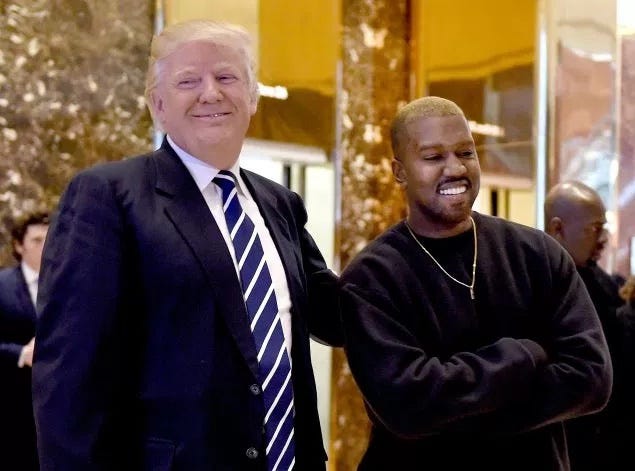
    Kanye West meets with Donald Trump at Trump Tower, December 2016. Credit: Observer.com at http://observer.com/2016/12/is-kanye-west-the-future-voice-of-trump-radio/

    2013 essay revisited

    The analogy put forward by McIntosh (1997) has a number of advantages. It is frequently assumed in social terms that whiteness is immutable. However, the experience of the white Irish in early twentieth-century USA suggests that ‘whiteness’ holds connotations beyond skin colour alone (Guteri, 2009). Similarly, the ‘one drop’ rule that was used to define African Americans in rules regarding segregation in the early Twentieth Century suggested that any individual with one African-American ancestor should be considered as non-white (Khanna, 2011). However, difficulties occur in this analogy when white privilege intersects with other forms (Smith, 2007). White privileges can combine with other foundations with the effect of a different set of advantages and disadvantages; be they represented through as social, economic, gender or sexuality. ‘The cumulative effect of these unseen privileges for whites sustains the current racial group disparity’ (Mallett & Swim, p.58). The questions posed by McIntosh’s (1997) analogy focus on whether we can consider the interactions between all prejudice in solely terms of maintaining white privileges, or whether other factors arise. Are the privileges gained by being ‘white’ and ‘male’ simply the cumulative effect of the assets of either category, or does being a non-white male involve a qualitatively different type of maleness? To examine these issues the following structure will be adopted. First, a discussion will be made of McIntosh’s (1997) analogy in understanding whiteness. The suggestions of McIntosh (1997) and Ignatiev (1997) for active resistance to whiteness will be scrutinised. Second, the contribution of Critical Race Theory (CRT) will be assessed. Third, the intersection of race with other factors, including definitions of race, poverty, and gender will be discussed. In the ensuing discussion, the following disclaimer is made: race and racial terms are understood as social constructs rather than biological facts, and the terms will be used purely as they are understood contextually. This must also be recognised of the term African-American which is used in the ensuing discussion…

    Read the entire article here.

  • The Obama Paradox

    Slate
    2017-01-09

    Jamelle Bouie, Chief Political Correspondent

    Our first black president has an unyielding faith in the goodness of America. It got him elected. And it will cost him his legacy.

    The myth of Barack Obama usually begins with his speech to the 2004 Democratic National Convention, and for good reason—it was the speech that jump-started his political career, putting the then–state senator on the fast track to national office. But it wasn’t the speech that made him president. That speech was delivered at a moment of crisis. His former pastor, Rev. Jeremiah Wright, was in the middle of a media firestorm over a sermon he had given in 2003 in the wake of the Iraq invasion. “No, no, no. Not God bless America,” thunders Wright in the now-infamous video. “God Damn America!”…

    …For Obama, who built his political appeal on his distance from this rhetoric—from the tenor and tone of traditional black politics—Wright’s sermon was a disaster in the making. To operate in the mainstream, to attain influence and power, black public figures have to navigate a narrow strait of acceptable behavior. They cannot indulge their anger or give way to their passions. And for Obama, who sought an office all but reserved for white men, he had to prove that he wasn’t an Al Sharpton or a Jesse Jackson, that he held no resentment or frustration with the country. And so on March 18, 2008, Obama delivered an address in Philadelphia now known as his “A More Perfect Union” speech. In it, he repudiated Wright’s anger without dismissing its sources, and along the way he demonstrated the qualities that have defined him as president: a sense of balance, a willingness to look to the better angels of his opponents, a belief that there is always common ground…

    Read the entire article here.

  • The Verging Cities, Poetry

    Center For Literary Publishing
    2015
    80 pages
    Paperback ISBN: 978-1-885635-43-3
    6.5 x 8.5 inches

    Natalie Scenters-Zapico

    • Poets and Writers Top Debut Poets 2015
    • Great Lakes Colleges Association New Writers Award
    • NACCS-Tejas Foco Best Poetry Book of 2015

    Ninth in the Mountain West Poetry Series, edited by Stephanie G’Schwind & Donald Revell

    From undocumented men named Angel, to angels falling from the sky, Natalie Scenters-Zapico’s gripping debut collection, The Verging Cities, is filled with explorations of immigration and marriage, narco-violence and femicide, and angels in the domestic sphere. Deeply rooted along the US-México border in the sister cities of El Paso, Texas, and Cd. Juárez, Chihuahua, these poems give a brave new voice to the ways in which international politics affect the individual. Composed in a variety of forms, from sonnet and epithalamium to endnotes and field notes, each poem distills violent stories of narcos, undocumented immigrants, border patrol agents, and the people who fall in love with each other and their traumas.

    The border in Scenters-Zapico’s The Verging Cities exists in a visceral place where the real is (sur)real. In these poems mouths speak suspended from ceilings, numbered metal poles mark the border and lovers’ spines, and cities scream to each other at night through fences that “ooze only silt.” This bold new vision of border life between what has been named the safest city in the United States and the murder capital of the world is in deep conversation with other border poets—Benjamin Alire Saenz, Gloria Anzaldúa, Alberto Ríos, and Luis Alberto Urrea—while establishing itself as a new and haunting interpretation of the border as a verge, the beginning of one thing and the end of another in constant cycle.

    Read an excerpt here.

  • That’s the thing; I was never fully accepted as white, even though I’m white passing, which caused a lot of confusion growing up. I didn’t know how I was – was I black or white? Some ungodly mixed between the two, forever existing between the ether, never knowing when white people would decide I could pass for white or when they would want me to be Black. That is part of the diversity of the Black American experience. This isn’t about the “one drop” rule; it’s about how deep white supremacy goes that someone like me can still feel and experience it. That I can be in a group of white people that is in the middle of an encounter with cops, and the officers somehow are more aggressive towards me than the white people around me. I learned, through being aware enough of my experiences, that I am not white, nor will I ever be; white supremacy, white people will make sure to let me know that I am not white. So I claim my black identity with pride, as I want nothing to do with the legacy of white supremacy and want to help this nation break free of that. But more importantly I know there is nothing wrong with being black, that black is beautiful, that that is part of my history, it’s in my blood; my grandfather’s cousin A. Leon Higginbotham helped write the South African constitution, I mean, c’mon. And even more important I love my dashes of melanin and will glow in my blackness; I love my blackness and yours. —Matthew Braunginn

    Henry Sanders, “BEST OF 2016: 12 on Tuesday with Matthew Braunginn,” Madison365, December 21 2016. http://madison365.com/best-2016-12-tuesday-matthew-braunginn/.