• Pity the sad legacy of Barack Obama

    The Guardian
    2017-01-09

    Cornel West, Professor of Philosophy and Christian Practice
    Union Theological Seminary, New York, New York

    Our hope and change candidate fell short time and time again. Obama cheerleaders who refused to make him accountable bear some responsibility

    Eight years ago the world was on the brink of a grand celebration: the inauguration of a brilliant and charismatic black president of the United States of America. Today we are on the edge of an abyss: the installation of a mendacious and cathartic white president who will replace him…

    Read the entire article here.

  • Will Racism End When Old Bigots Die?

    Code Switch: Race And Identity, Remixed
    National Public Radio
    2017-01-14

    Leah Donnella

    Shelly Fields is a 46-year-old white woman living in Richton Park, a racially diverse Chicago suburb. She says she’s raised her four daughters, who are biracial, to see people of all races as equal, just as her parents raised her. Fields doesn’t think that racism will ever disappear completely, but she’s hopeful that it lessens with each passing generation.

    “The more biracial children there are, the more equality we see,” Fields said. “The more people of color we see in positions of power – it will help to change the way people see race.”

    Her oldest daughter, Summer, is a 22-year-old graduate of the University of Chicago. When she was in high school, Summer probably would have agreed that race relations were looking up. The ’90s and early 2000s were “a post-racial fantasy time” in Richton Park, Summer said. “Being firmly in the middle of the Obama era – it [was] a moment of progress. It was validating.”

    Now, as the Obama era ends, she is of the mind that racism isn’t going anywhere.

    “Racism always evolves, and will find a way,” Summer said.

    The question that Shelly and Summer are tackling has been posed in many forms for many generations. Will racism just die off with old bigots? Does the fate of race relations lie with the children?…

    …They’ve argued over things like trigger warnings and safe spaces (her mom says that’s not how the real world works) and about how to self-identify. Summer thought of herself as biracial until she went to college. When she started referring to herself as a black woman, that became another point of contention.

    “My mom doesn’t understand,” she said. “She feels like that’s an affront to her.”…

    Read the entire article here.

  • Katherine Johnson, Va. woman at center of ‘Hidden Figures,’ calls calculation ‘piece of cake’

    CBS 6, WTVR-TV
    Richmond Virginia
    2017-01-13

    HAMPTON, Va. — It is the untold story that has been hidden in Hampton for decades.

    The box office hit “Hidden Figures” highlights the black female mathematicians at NASA who’s brain power helped launch the first Americans into space.

    “It feels good,” said 98-year-old former NASA mathematician Katherine Johnson.

    Johnson, portrayed in the film by Taraji P. Henson, calculated the trajectory for Alan Shepard, the first American in space.  Johnson also confirmed, by hand, the launch calculations for John Glenn, the first American to circle the globe in 1962…

    Read the entire article and watch the story here.

  • Britain’s black history has been shamefully whitewashed

    The Spectator
    2017-01-14

    Hakim Adi, Professor of the History of Africa and the African Diaspora
    University of Chichester, Chichester, West Sussex, United Kingdom


    Author David Olusoga (Photo: Getty)

    I have been researching and writing about black British history for over 30 years but never before have I been fortunate enough to review a 600-page book on the subject, published to accompany a recent major BBC documentary. The book and the four-part series give some indication of the extent of a history which David Olusoga presents as ‘forgotten’: the subject, he argues, has been largely excluded from the mainstream narrative of British history. Why it should be forgotten, and who might have forgotten it should give us all pause for reflection, since the denial of black British history by those who should know better could be considered tantamount to racism.

    Olusoga reminds us that Britain’s ‘island story’ cannot be understood in isolation from the rest of the world and certainly not from Africa and other parts of what was once the British empire. He also demonstrates that Africans were often a central part of Britain’s history centuries before the empire, going back to the Roman period and beyond. Indeed, he argues that black British history is not just about black people but about encounters between blacks and whites, including intermarriage or the ‘mixed relationships’ that have been commented on since Elizabethan times.

    The latest archaeological techniques and historical research show that in Roman Britain there were many individuals of African heritage of all classes. We are now becoming more familiar with the fourth-century ‘Ivory Bangle Lady’ of York and ‘The Beachy Head Lady’ from sub-Saharan Africa, thought to have lived in East Sussex c. 200 AD. It seems likely that soon we will have more conclusive evidence that Africans were travelling to Britain long before the arrival of the Romans

    Read the entire review here.

  • Exclusive: Watch Salena Godden’s ‘Under the Pier’

    The State Of The Arts
    2017-01-10

    Christy Cooney
    Leeds, United Kingdom

    Spoken word artist Salena Godden has kicked of 2017 with the release of a video for ‘Under the Pier’, a piece from her 2016 album LIVEwire.

    Shot on location in Hastings, East Sussex in November 2016, the video was filmed, directed, and edited by Jordon Scott Kennedy of Idle Work Factory, and accompanies a live performance at the BBC Radio Theatre.

    Kennedy said of the project:

    “I jumped at the chance to work with Salena. Her words in particular have the habit of conjuring up imagery that takes us to a specific place and time, and even then, we are left looking forwards, and hopeful, rather than nostalgic or regretful. Behind the scenes she has a way of carrying this spirit at all times, and she made my job fairly easy. “Can you just stand there and think about Salena stuff? Yep. That’s perfect. Cut. Fucking doddle. Pub?”

    “She spent the day showing me around her hometown, which became a blank canvas for me. Her enthusiasm for her roots had all kinds of ideas rushing through my head. I think it could be quite easy to be overwhelmed by her explosive lust for life. There’s definitely something special about the lass, and you feel that listening to LIVEwire…”

    Read the entire article here.

  • Farewell to the chief

    The Times of London
    2017-01-15

    Trevor Phillips


    April 22, 2013: the president pauses for a moment of silence in honour of the victims of the Boston Marathon bombings
    PETE SOUZA

    After eight years in the White House, Barack Obama relinquishes the top job this Friday. Trevor Phillips criticises his legacy on race, while the White House photographer Pete Souza shares candid portraits of the outgoing president

    Most of the 40,000 graves in New York’s Flushing Cemetery are marked by neat marble headstones, mostly white or grey, occasionally black. A few bear elaborate tombs, but for the most part they display the quiet restraint of immigrants for whom the American dream means exchanging a precarious existence in a developing country for a steady blue-collar job in the world’s greatest metropolis.

    These modest memorials also tell the story of the borough where America’s flamboyant president-elect, himself the son of a Scottish immigrant, was born and raised. Queens claims to be the most ethnically diverse urban area in the world. The tombstones carry thousands of names charting two centuries of ceaseless migration: English Quakers, German Protestants, Italian and Korean Catholics, African-American and Caribbean Episcopalians. Under a tree close to the cemetery’s southern boundary lies one marked “Marjorie Eileen Phillips”. My mother.

    I always make a point of running over the family’s news for her benefit. We sometimes also talk politics. Last time I was there, shortly after the presidential election, we reflected on Obama’s tenure. I was keen to know what the wise matriarch thought the legacy would be of America’s first black president, who steps down this Friday…

    Read the entire article here.

  • How Black America Saw Obama

    The New York Times
    2017-01-14

    Michael Eric Dyson, Professor of Sociology
    Georgetown University, Washington, D.C.

    I stood in Grant Park on election night 2008, along with more than 200,000 other people, and watched as a man I’d known as a fellow member of a Chicago church, a man I’d worked to help get elected, took to the stage. He would be the first black president of the United States of America. My joy at the surreal scene was transcendent. The jumbotron flashed the face of the civil rights stalwart the Rev. Jesse L. Jackson, with tears streaming down his cheeks, an image that evoked the profound elation of black America at the election of Barack Obama.

    But his weeping visage summoned a darker prospect for me, one that cast a shadow over Mr. Obama the moment he announced he would make a run for the Oval Office: They might shoot him. Mr. Jackson had been present when the Rev. Dr. Martin Luther King Jr. met his violent end on a balcony in Memphis. As I viewed Mr. Jackson’s watery eyes, I couldn’t help but associate him with Dr. King and the fear that our newly elected president might be assassinated.

    Black America has held its collective breath during every second of Barack Obama’s presidency. I remember stumping early for the Illinois senator, only to have black people I met on the campaign trail tell me that they couldn’t possibly vote for my man. Not only was he not as well known, or beloved, as his opponent Hillary Clinton, but didn’t I know that he’d be harmed if he even got close to the White House? “You know they’re going to shoot him.”…

    …President Obama’s historic tenure ends as the nation celebrates what would have been Martin Luther King’s 88th birthday. As I see it, Mr. Obama is the only figure to ever give Dr. King a run for his money as Greatest Black Man in American history. More than a gentle rivalry for supremacy in the history books joins the two. They are tethered by death, too — if not by its actual occurrence, then by its looming possibility….

    Read the entire article here.

  • Meet the Afro-Mexicans connecting to their African roots through dance

    Ventures Africa
    2017-01-05

    Iroegbu Chinaemerem Oti

    “Based on your culture, history, and traditions, do you consider yourself Black, meaning Afro-Mexican or Afro-descendant?” – MEXICO’S 2015 Intercensal Survey

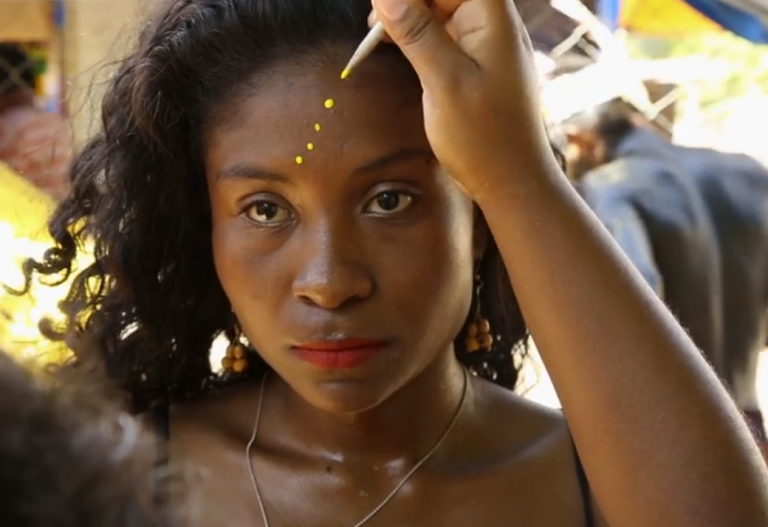
    The sound of Bata drums filled the air as girls, with printed scarfs tied around their waists and white or yellow dots painted on their faces, danced to the fervent rhythm, their feet and waists moving vigorously at the same time. As their left legs leave the floor, their right legs replace them, while their waists responding with a seesaw movement. This is an African dance performed by an Afro-Mexican group, the Obatala, for the purpose of connecting with their African roots. They live in the southern state of Oaxaca, Mexico and tour various regions of the state to create awareness with their energetic and beautiful dance.

    “All the dances are from Africa’s northeastern region, we chose this area because after researching on the internet, we realised that that’s where the slaves that came from our town came from. Our dance troupe did the research and we learned those dances,” Anai Herrera, one of the lead dancers, said…

    Read the entire article here.

  • No Racial Barrier Left to Break (Except All of Them)

    The New York Times
    2017-01-14

    Khalil Gibran Muhammad, Professor of History, Race, and Public Policy, HKS Suzanne Young Murray Professor
    Harvard Kennedy School
    Harvard University

    We can’t create a more just nation simply by dressing up institutions in more shades of brown. Now we must confront structural racism.

    In a moving farewell speech before an enormous crowd in Chicago last week, President Obama evoked the American creed of unity and aspiration as the foundation of our democracy. He has always embraced a vision of America as a “melting pot.”

    Mr. Obama embodied for many Americans the legacy of the Rev. Dr. Martin Luther King Jr., whom we celebrate on Monday. Our national memory of Dr. King has, for nearly 50 years, reinforced the belief that America, unlike any other nation, could extend opportunity to everyone regardless of his or her identity. In Dr. King’s name, assimilation and aspiration have been the keywords of the post-civil rights era, and diversity and inclusion its currency. And Mr. Obama has symbolized more than anyone in American history the idea that racial representation and the content of one’s character were the perfect antidote to racism.

    It’s true that, in fulfilling the duties of the presidency with great dignity, Mr. Obama represents the highest expression of the goal of assimilation. But for African-Americans, he was also the ultimate lesson in how this antidote alone is insufficient to heal the gaping wounds of racial injustice in America. It’s clear that black leadership, in itself, isn’t enough to transform the country. So we must confront the end of an era and the dawn of a new one…

    Read the entire article here.

  • The Boyden affair just got murkier: Salutin

    The Toronto Star
    2017-01-13

    Rick Salutin

    Celebrated author agrees to select interviews, insists he never embellished or lied about his heritage, but also offered platitudes versus confronting precise criticisms

    I found Joseph Boyden’s interview Wednesday on CBC — in a word rarely called for — unctuous. He surfaced three weeks after saying he wouldn’t deal with questions about his Indigeneity publicly but only in a “speaking circle.” This after filling what he calls “airtime” for 10 years on every form of media.

    Now he’s back out there on CBC and in the Globe, though solely with “acceptable” interviewers. APTN, which started all this with a cautious, respectful piece by Jorge Barrera on Boyden’s claims, called it a “PR push.”…

    Boyden’s language was strikingly vague for someone who writes literary fiction. He talked about stories told in his family but gave few examples, instead repeatedly calling them “beautiful” and “amazing.” He said Holy Mackerel and Ohmygosh. He denied making things up but host Candy Palmater didn’t push very hard. As she said, they’re friends and “I know it would be a different conversation if we were alone over a glass of wine.” As troublemaker Robert Jago bracingly tweeted: “Candy Palmater. WTF?”…

    Read the entire article here.