• Afro-Latinos: a vision of Houston’s mixed-race future

    The Houtson Chronicle
    Houston, Texas
    2016-11-19

    Olivia P. Tallet, Reporter

    Afro-Latinos embody Texas’ mixed-race future

    It happens all the time. At the taco truck, Raul Orlando Edwards placed his fajita order: “Señorita, por favor, póngale la cebolla bien cocida” (“I’d like the onions well-done.”)

    “Man,” said the African-American behind him in line, “how did you learn to do that?” Meaning: Why, for a black man, is your Spanish so good?

    “I’m Latino,” Edwards answered. The director of the Strictly Street Salsa Studio and founder of the Afro-Latino Festival of Houston, he’s a Panamanian-Jamaican immigrant.

    The guy stated the obvious: “I thought you were black!”

    “I’m blacker than you are!” Edwards replied. And, he says, they laughed.

    These days, in both Texas and the U.S. at large, skin color is an ever less reliable indicator of identity. According to a 2015 Pew survey, about a quarter of U.S. Hispanics identify themselves as Afro-Latino. Like Edwards, the vast majority (70 percent) are foreign-born.

    Afro-Latinos generally are descendants of African slaves brought to Spanish and Portuguese colonies in Latin America and the Caribbean. Most are biracial or multiracial. Being Afro-Latino, says Alain Lawo-Sukam, professor of Hispanic and Africana Studies at Texas A&M University, is less about skin color than about identity and a sense of belonging.

    By their very existence, Afro-Latinos challenge the traditional “one-drop” view of race in the United States: the idea that one drop of African blood makes a person black. Afro-Latinos like Edwards aren’t simply black, white or Hispanic. They’re a combination – and as such, a vision of the United States’ racially and ethnically complex future. They’re a minority inside a minority; a melting pot within the melting pot…

    Read the entire article here.

  • Between Two Worlds – A conversation with Rain Pryor

    Connecticut Jewish Ledger
    2016-11-22

    Cindy Mindell

    Rain Pryor was born and raised in Los Angeles, the daughter of comedian Richard Pryor and Shelley Bonis (later changed to Bonus), a Jewish go-go dancer. After her parents divorced, Pryor spent time with both grandmothers and in both cultures, forging a unique identity that combined elements from her Black and Jewish legacies.

    In 2004, Pryor created and toured in “Fried Chicken and Latkes,” an award-winning solo show based on her life that played to sold-out crowds and standing ovations across the country and in the UK. In 2005, the show won an NAACP Theatre Award for Best Female Performer Equity, and the Invisible Theatre’s Goldie Klein Guest Artist Award. The 2012 New York Times review of the “effervescent” show described Pryor as “a robust, ebullient performer.”…

    …Recently, she spoke with the Ledger about the evolution of her “Fried Chicken and Latkes” and the influences that shaped it…

    Q: How do you express your dual identity today?

    A: For High Holidays, my mom and I go to the Pico Union [formerly Sinai Temple], the oldest synagogue building in Los Angeles. They do a lot of outreach. I also embrace my Black African-centric heritage and practice Ifá, an ancient and mystical Yoruba tradition honoring the ancestors, which to me went beautifully with the High Holiday services. I embrace culture and tradition and I would say I’m a spiritual being more than I’ll ever be a religious being…

    Read the entire interview here.

  • Award-winning author Danzy Senna speaks at The University of Toledo

    The Independent Collegian: Serving the University of Toledo Community Since 1919.
    Toledo, Ohio
    2016-11-08

    Meg Perry, Staff Reporter


    Savannah Joslin / IC

    Award-winning author Danzy Senna visited the University of Toledo to read from her memoir Where Did You Sleep Last Night? as well as answer questions, and hold a book signing. The event was held Thursday, Nov. 3 for the 27th annual Richard M. Summers Memorial Lecture presented by the English Department.

    Kimberly Mack, assistant professor of English said, “I was blown away by Senna’s skillful and fearless exploration of the complicated topics of racial, class and gender identity. Ms. Senna’s portrayal of biracial sisters, Birdie and Cole Lee, two young girls who struggle to find their places in a society that is uncomfortable with racial gray areas is simultaneously beautiful and devastating.”

    Senna is most widely recognized for her novel Caucasia which has been awarded the Stephen Crane Award for Best New Fiction of the Year, American Library Association’s Alex Award, Finalist International IMPAC Dublin Literary Award, as well as several others…

    Read the entire article here.

  • Artist Explodes Racial Stereotypes In Shape-Shifting Photographs

    The Huffington Post
    2016-10-20

    Priscilla Frank, Arts & Culture Writer


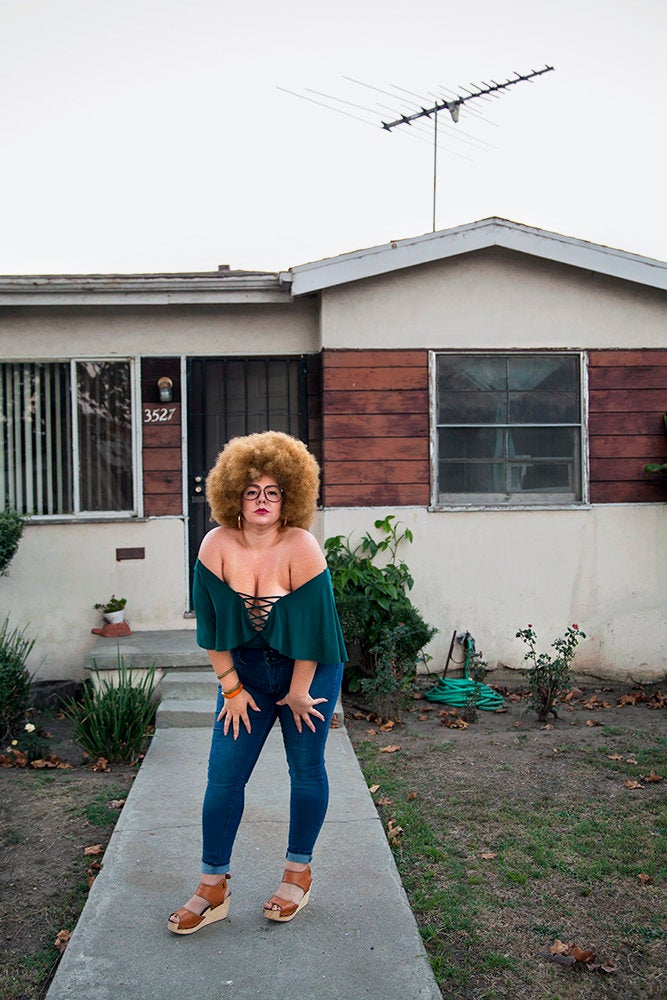
    Shulamit Nazarian

    “My experience as a person of color is different than others’. I have something to say.”

    Artist Genevieve Gaignard grew up in the town of Orange, Massachusetts. Her mother was white, her father black ― one of the first black men to live in the small town. “I was always really aware that we were different,” Gaignard explained in an interview with The Huffington Post.

    While Gaignard was well aware of her biracial identity, most of her classmates and neighborhood acquaintances simply saw her as the pale-skinned, redheaded child she was. They assumed, in other words, like the majority of Orange citizens, that Gaignard was white. “I passed along with everyone else,” she said. “I blended in.”

    As a kid, Gaignard spent a lot of time in her room. “I was shy, quiet, in my own little world,” she recalled. She would listen to the radio, make collages and plaster magazine cutouts on her wall. She’d also obsessively look into the lives of celebrities like Mariah Carey and Alicia Keys, women who also were both black and white. She studied how they defined themselves, the spaces they occupied and the ways they existed in the world. “I would think, ‘Oh, they get to be black,’ or, ‘They’re kind of passing as white,’” Gaignard said. “I would search for images of their parents, trying to get clues. It’s interesting how media or the industry often decides where someone will fit in.”


    “Basic Cable” Shulamit Nazarian

    With no outside force to define her, Gaignard was left, like so many young people, feeling undefined. “It was this not knowing how to identify,” she expressed. “Not feeling black enough, not feeling white enough, that was the struggle.”…

    Read the entire article here.

  • Would-Be Bridegroom Takes Oath He Is Negro

    The San Francisco Call
    Volume 104, Number 70 (1908-08-09)
    Page 31, Column 4
    (Source: California Digital Newspaper Collection)

    Cannot Get License to Wed Mulatto Until He Proves His Race

    ST. LOUIS, Aug. 8.— “You can’t get a marriage license here,” said Leon G. Smith of East St. Louis yesterday when William Hawkins and a mulatto woman named Fanny F. Austin of East St. Louis came into the marriage license clerk’s office and asked for a license.

    Hawkins inquired what the reason was for refusing him a license, and was told that licenses would not be issued for mixed marriages, whites and negroes. Then he laughed and told Smith that while he generally passed for a white man and very few people ever imagined he had negro blood, that he really was a negro. To prove this Hawkins opened his shirt collar and showed that below his throat he was somewhat darker than his face appeared. He also showed his finger nails to prove his negro blood, and finally made an affidavit that he was a negro. Then the license was issued. Hawkins told Smith that he has three sisters married to white men who do not suspect their wives of having negro blood.

  • Trevor Noah on Growing Up in South Africa Under Apartheid

    Literary Hub
    2016-12-02

    Trevor Noah

    “Where most children are proof of their parents’ love, I was the proof of their criminality.”

    When the doctors pulled me out there was an awkward moment where they said, “Huh. That’s a very light-skinned baby.” A quick scan of the delivery room revealed no man standing around to take credit.

    “Who is the father?” they asked.

    “His father is from Swaziland,” my mother said, referring to the tiny, landlocked kingdom in the west of South Africa.

    They probably knew she was lying, but they accepted it because they needed an explanation. Under apartheid, the government labeled everything on your birth certificate: race, tribe, nationality. Everything had to be categorized. My mother lied and said I was born in KaNgwane, the semi-sovereign homeland for Swazi people living in South Africa. So my birth certificate doesn’t say that I’m Xhosa, which technically I am. And it doesn’t say that I’m Swiss, which the government wouldn’t allow. It just says that I’m from another country.

    My father isn’t on my birth certificate. Officially, he’s never been my father. And my mother, true to her word, was prepared for him not to be involved. She ’d rented a new flat for herself in Joubert Park, the neighborhood adjacent to Hillbrow, and that’s where she took me when she left the hospital. The next week she went to visit him, with no baby. To her surprise, he asked where I was. “You said that you didn’t want to be involved,” she said. And he hadn’t, but once I existed he realized he couldn’t have a son living around the corner and not be a part of my life. So the three of us formed a kind of family, as much as our peculiar situation would allow. I lived with my mom. We ’d sneak around and visit my dad when we could.

    Where most children are proof of their parents’ love, I was the proof of their criminality. The only time I could be with my father was indoors. If we left the house, he ’d have to walk across the street from us. My mom and I used to go to Joubert Park all the time. It’s the Central Park of Johannesburg—beautiful gardens, a zoo, a giant chessboard with human-sized pieces that people would play. My mother tells me that once, when I was a toddler, my dad tried to go with us. We were in the park, he was walking a good bit away from us, and I ran after him, screaming, “Daddy! Daddy! Daddy!” People started looking. He panicked and ran away. I thought it was a game and kept chasing him…

    Read the entire excerpt from Born a Crime: Stories from a South African Childhood here.

  • Seminar: Ideals of Miscegenation: Ethnicity, Sexuality, and the Chinese Ideology of “Region”

    University of Sydney
    Old Teachers College
    Room 310
    Sydney, New South Wales, Australia
    2016-12-05, 14:00-15:30 AEDT (Local Time)

    Ha Guangtian, Postdoctoral Research Fellow
    SOAS China Institute, London, United Kingdom

    While the word “miscegenation” normally carries a strongly negative connotation in the history of Western racial politics, in this talk, I use the word to describe an emergent political ideology in China that taps into the underlying assumption of one of the most essential state institutions in the governance of China’s ethnic minorities, namely, ethnic regional autonomy. Two aspects of this assumption will be the focus of my talk: its alleged facilitation of inter-ethnic and cross-cultural economic exchange and commercial flow on the one hand, and its often unspoken yet ever present intention in “consummating” this political economic arrangement with a correlated sexual arrangement, typified by inter-ethnic marriage, on the other. Rather than speaking merely at the general level, however, I choose to examine the ramifications and metamorphosis of this ideology among the elite Hui Muslim intellectuals, a group that include both university professors, think-tank researchers, and government officials. The Hui elites have been among the most enthusiastic proponents of this ideology, due particularly to their understanding of who the Hui are and how they came into being as an ethnic group. This historical presumption receives a new meaning under the “One Belt One Road” initiate. The presumptively “miscegenous” ethno-origin of the Hui is seen to offer them a critical edge in fostering a cross-cultural and cross-ethno-national perspective. This perspective, moreover, fits into a general ideology centred on a certain conception of “region” that is being formulated across different academic disciplines and political discourses in contemporary China. In many respects, this not only raises new issues of political re-alignment – or predictions of a new “great game” – in Eurasia, but also poses new challenges for theoretical critique. For the old criticism of racial, cultural, or ethnic essentialism, dear to leftist intellectuals in the 1980s and 1990s, is barely sufficient to address this new change – if anything, it plays right into its hands. By taking the Hui as an example, this talk tries to respond to this challenge at the level both of theory and of politics.

    For more information, click here.

  • A young playwright’s quest to ask difficult questions about race, class and gender

    The Los Angeles Times
    2016-12-02

    Margaret Gray

    Leah Nanako Winkler’s new play “Kentucky” is a comedy about a Japanese American woman raised in the South. Like her protagonist Hiro, Winkler is half-Japanese and grew up in Kentucky. Like Hiro, she left  for New York and didn’t return for years. And like Hiro, Winkler found her sister’s embrace of evangelical Christianity puzzling and alarming.

    “It was like she’d joined a cult,” recalls Winkler, who clarifies that she wasn’t entirely like the Hiro of her play.

    “I didn’t actually try to stop my sister’s wedding,” she says with a laugh.

    Speaking from the dressing room at East West Players’ theater in downtown L.A., where the West Coast premiere of “Kentucky” runs through Dec. 11, Winkler says the new work is “circumstantially autobiographical.”…

    …Born in Japan, Winkler spent some of her childhood there before moving to Kentucky. She won’t say how old she was at the time. “I don’t like to answer that question because there’s a lot of judgment placed on that,” she says. “There’s a big difference if I say 2 or if I say 12. People like to peg you on how Japanese or how American you are, when you’re mixed race.”

    She will say that she was old enough to experience “a double identity crisis.”

    “In Japan I was a child model because of my Western looks,” she says. “I was considered gaijin, which means foreigner. But in America I was the girl from Japan.”…

    Read the entire article here.

  • A Picture of Her ‘Kentucky’ Home

    The Rafu Shimpo: Los Angeles Japanese Daily News
    2016-11-27

    Mikey Hirano Culross


    Leah Nanako Winkler was born in Japan, raised in Lexington, Kentucky, and now lives in New York City.

    Leah Nanako Winkler arrived more than flustered, bounding into a dressing room at East West Players after having endured what should have been a 20-minute trek from Universal City to Little Tokyo.

    Ms. Winkler, meet the 101.

    The evening’s performance of her new play, “Kentucky,” was barely 90 minutes from curtain, and Winkler had plenty of tasks beforehand, including a quick chat with The Rafu.

    Now a hard-studying MFA student in Brooklyn, Winkler has composed an honest look at family, with all its glory as well as warts, drawing on her experiences growing up in Lexington, Kentucky.

    Her play follows Hiro, a woman on the verge of big-city career success whose homecoming is driven by the desire to dissuade her born-again sister from entering into a marriage that Hiro finds unsavory. Dealing with her family’s southern leanings, her own misgivings and a talking cat, Hiro’s mission is derailed into a completely unplanned direction.

    “For me it was important to see a mixed-race family on stage and not seen through rose-colored glasses, that they have their faults, that they’re not perfect,” Winkler explained…

    Read the entire article here.

  • There is nothing more American than passing, the act of projecting a racial identity other than that assigned.

    Lydia Nichols, “Review: “Krazy” by Michael Tisserand,” Know Louisiana: The Digital Encyclopedia of Louisiana and Home of Louisiana Cultural Vistas, Winter 2016 (December 2, 2016). https://www.knowlouisiana.org/46243-2.