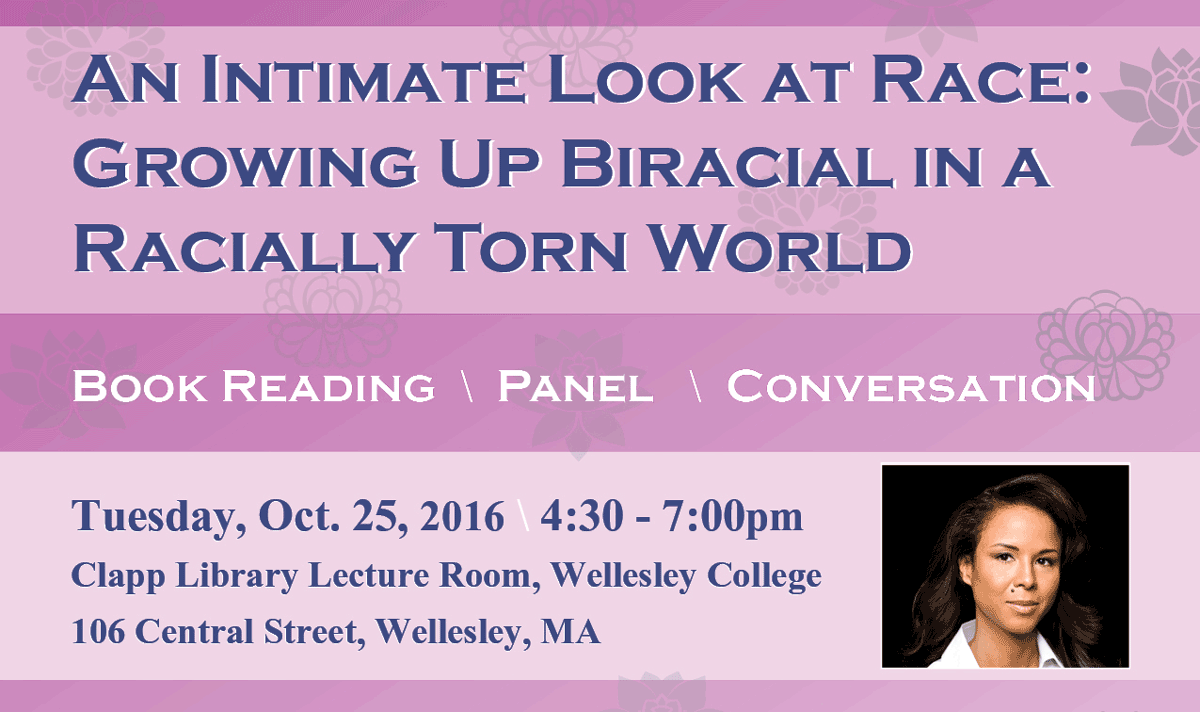
• An Intimate Look at Race: Growing Up Biracial in a Racially Torn World

    Wellesley Centers for Women
    Book Reading \ Panel \ Conversation with Author Sil Lai Abrams
    Clapp Library, Lecture Room
    Wellesley College
    106 Central Street
    Wellesley, Massachusetts
    Tuesday, 2016-10-25, 16:30-17:00 EST (Local Time)

    Presenters: Author Sil Lai Abrams with Linda Charmaraman, Ph.D., Layli Maparyan, Ph.D., Linda M. Williams, Ph.D.

    For more information, click here.

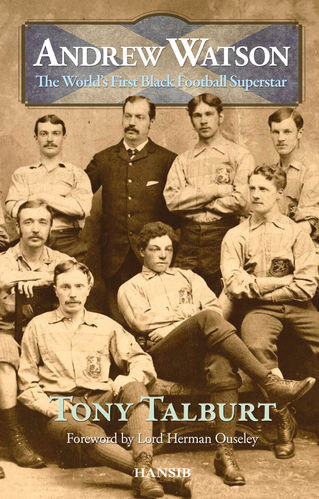
  • Andrew Watson: The World’s First Black Football Superstar

    Hansib Publications
    2016
    136 pages
    216 x 138 mm

    Tony Talburt

    Foreword by Lord Herman Ouseley

    Today, seeing Black footballers playing the game at the very highest level is considered very normal. This, certainly, was not the case one hundred and forty years ago, and this is what makes the story of Andrew Watson so remarkable.

    It seems hard to imagine that a Guyanese-born Black man could head the Scottish national football team in 1881 in a game against England. Not only was he captain, but he also led them to a 6-1 victory in London – an achievement that still ranks as England’s heaviest ever defeat on home soil. If this were all that Watson had been able to accomplish, most people would agree that he should be commended for being the world’s first Black person to captain a national football team. But there was so much more. He was the world’s first Black football administrator, as well as the first Black player to win three national cup winners’ trophies.

    During the 1870s and 1880s, when Watson played, he was regarded as one of the finest players in Britain. The word ‘pioneer’ is often used to describe certain players, but this would certainly be a most fitting expression to encapsulate the remarkable achievements of Andrew Watson.

    This book reflects upon the legend, legacy and pioneering endeavours of a truly great Black British football superstar.

  • This mixed race family didn’t ‘see color.’ Then police said a white supremacist killed their son

    The Oregonian
    2016-10-16

    Casey Parks

    A banner hanging above the couch proclaims it a house divided.

    “But only when it comes to football,” Natasha Bruce said.

    When it came to race, the old wood house in Vancouver, Wash. was a safe space. She was the lightest in every family photograph, a white mom married to a black dad. Together, they raised four kids, each with their own mix of ethnicities and football allegiances.

    “You can’t hate a race because you’re all of them,” Natasha Bruce told the kids. “Unless it’s red and gold or blue and green, we don’t see color.”

    But other people do.

    In August, their youngest died after a hit-and-run that prosecutors now consider a hate crime. Larnell Bruce Jr. was 19 years old, black and Latino. Police say a couple with ties to white supremacist gangs argued with Bruce outside a Gresham convenience store — and then chased him with their jeep as he walked away, running him down…

    Read the entire article here.

  • DNA tests show fallacy of Jim Crow

    The Albuquerque Journal
    2014-03-21

    Henry Louis Gates Jr., Alphonse Fletcher University Professor and Director of the Hutchins Center for African and African American Research
    Harvard University

    I am filming guest interviews for Season 2 of the genealogy series “Finding Your Roots,” airing on PBS this September. One of the most intriguing pieces of information shared with our guests is the “admixture” results contained in their DNA – their percentages of European, Native American and sub-Saharan African ancestors over the past 200 years or so.

    The record of your ancestral past, in all of its complexity, is hidden in your autosomal DNA.

    African-Americans almost always guess that they have much higher percentages of Native American ancestry and much lower percentages of European ancestry than they have. That is not surprising since African-Americans have long embraced the myth that their great-grandmother with “high cheeks and straight black hair” looked that way because of a relationship between an ancestor who was black and another one who was Native American.

    But scientific results show that very few African-Americans have a significant amount of Native American ancestry: In fact, according to a study just published by 23andMe researcher Katarzyna “Kasia” Bryc, only about 5 percent of African-Americans have at least 2 percent of Native American ancestry, while the average African-American has only 0.7 percent Native American ancestry…

    At the same time, Bryc’s research shows that the average African-American has a whopping 24 percent of European ancestry, which explains why great-grandma had those high cheekbones and that straight black hair.

    But what about the presence of recent African ancestors in a “white” person’s family tree?…

    Read the entire article here.
  • Mixed race and mixed reactions

    Columbia Daily Spectator
    2016-10-17

    Laura Salgado

    “But, like, what are you?”

    It’s a question I’m asked pretty often, both inside and outside of Morningside Heights. You’d think that after almost two decades on this planet I’d finally be able to answer it easily, but you’d be wrong. This seemingly innocent query still manages to fill me with dread, discomfort, and anxiety every time I hear it. My heart leaps into my throat, my hands start to sweat, and my words get caught on the tip of my tongue.

    I know how most people want me to answer. They expect to hear something simple and comprehensible, like “Hispanic” or “white.” They want to know which box to put me in. Their world is one of simple distinctions, one where everyone fits into only one category…

    Read the entire article here.

  • Yom Kippur Haftorah: Black Lives Matter

    Medium
    2016-10-12

    Chanda Prescod-Weinstein


    The opening chapter of a handwritten Book of Esther. source: Wikipedia

    You shall love people — including Black people — with all your heart

    I shared this with my synagogue during Yom Kippur 5777 Shacharit services.

    To grow up Black in America is to know that your humanity is always in question.

    I have a lot of memories of this from my childhood, but one stands out in particular.

    When I was 15, I was thrown out of a New Year’s Eve party because Black people — or as they repeatedly shouted at me, N-words — were not welcome.

    Later, when I was an 18 year old college sophomore, a white Jewish leader of Harvard Hillel yelled at me that I was an anti-Semite because I was at a peace rally organized by Arab students. She could not imagine that someone my color was an Ashkenazi Jew too.

    Now at 34, every time my mother calls me, I think it’s to tell me one of my cousins is dead. Or in jail. A couple of weeks ago a phone call from a cousin was in fact about another one who was in jail, falsely accused by a white person who wanted to teach her a lesson…

    Read the entire article here.

  • Jews Of Color Press For Acceptance

    The New York Jewish Week
    2016-10-06

    Hannah Dreyfus, Staff Writer


    The Changing face of the Jewish Community. JW

    This the first of a two part feature on the changing face of the Jewish Community. Read part two here.

    Hair has a lot to do with it, according to Sophia Weinstock.

    Weinstock, 21, the daughter of an Ashkenazi father and African-American and Puerto Rican mother, first noticed her hair was different as a young girl growing up in the Orthodox community of Staten Island. Her dark, tightly bound curls, tinged with blond at the ends, resisted all efforts to be tamed, though she tried desperately to pull them back.

    “People have always looked at my hair, even touched my hair, and said, ‘Wow, you look so ethnic!’” said the law school-bound Columbia University senior. “I hate that word. It’s like this encapsulating term for everything that is ‘other.’”…

    Read the entire article here.

  • Black, Jewish And Avoiding The Synagogue On Yom Kippur

    Code Switch: Race And Identity, Remixed
    National Public Radio
    2016-10-12

    Leah Donnella

    Last time I worshipped in a synagogue was Sept. 5, 2014. And I won’t be going today.

    That might surprise my friends, who put up with my bragging ad nauseam about how Jewish I am.

    You got a great deal on plane tickets? Reminds me of the time I took a free Birthright trip to Israel. Going skating? I haven’t been on skates since my bat mitzvah reception, held at the roller skating rink in Villanova, Pa. You say you love the musicals of George Gershwin? Ha, that sounds just like Gershenfeld, my mother’s maiden name, which is also my middle name, which means “barley field” in Yiddish, the language my ancestors spoke in Eastern Europe.

    Some of this is just me being obnoxious. But it’s also a way to claim a part of my identity that’s hidden from most people. I’m a black woman. No one ever assumes I’m Jewish. When I talk about Judaism, people look at me in a way that makes me feel like I’m breaking into my own house. Especially the people inside the house.

    Read the entire article here.

  • Behind the Scenes of Loving, the Most Beautiful Love Story Ever Told

    Vogue
    2016-10-17 (November 2016)

    Danzy Senna
    photographed by Mario Testino


    Photographed by Mario Testino, Vogue, November 2016

    Meet Ruth Negga and Joel Edgerton, the brilliant stars of Loving, Jeff Nichols’s sweeping portrait of an interracial couple fıghting for their right to marry in 1950s Vırginia.

    We enter the story in 1958, in rural Virginia. A woman and a man stand in an open field of grass; she is telling him she is pregnant. There is a hint of worry in her luminous dark eyes, but the man assures her that they will get married and build a home together. The opening scene of Loving, Jeff Nichols’s quietly devastating new film, feels less like a beginning and more like a happily-ever-after ending. But because this is 1950s Virginia, and the woman is black and the man is white, the story does not unfold in the way of fairy tales. For Mildred Jeter and Richard Loving—a real-life couple played in the film by Ruth Negga and Joel Edgerton—the seemingly straightforward act of getting married becomes a dangerous and transgressive act.

    With its lush cinematography, Loving is a visual paean to the 1950s, but it is also a fierce interrogation of the hypocrisies of that era. It traces the arc of the Lovings’ struggle to live as husband and wife at a time not so long ago when it was illegal in sixteen states to marry someone of a different race. As the Lovings are forced to leave their tight-knit, working-class community and live in Washington, D.C., around them swirls language that evokes the present debate on gay marriage. “It’s God’s law,” the sheriff tells the couple after their harrowing middle-of-the-night arrest. “A robin’s a robin, a sparrow is a sparrow.” As Edgerton says, “That’s the double beauty of the film. It’s a racial period piece, but it also echoes very loudly today.”…

    Read the entire review here.

  • Society still largely operates under the misapprehension that race (largely defined by skin colour) has some basis in biology. There is a perpetuating idea that black-skinned or white-skinned people across the world share a similar set of genes that set the two races apart, even across continents. In short, it’s what Appiah calls “total twaddle”.

    “The way that we talk about race today is just incoherent,” he says. “The thing about race is that it is a form of identity that is meant to apply across the world, everybody is supposed to have one – you’re black or you’re white or you’re Asian – and it’s supposed to be significant for you, whoever and wherever you are. But biologically that’s nonsense.” —Kwame Anthony Appiah

    Hannah Ellis-Petersen, “Racial identity is a biological nonsense, says Reith lecturer,” The Guardian, October 18, 2016. https://www.theguardian.com/society/2016/oct/18/racial-identity-is-a-biological-nonsense-says-reith-lecturer.