• Uchinanchu: The Art of Laura Kina

    Kwan Fong Gallery of Art and Culture
    California Lutheran University
    120 Memorial Parkway
    Thousand Oaks, California 91360
    2016-05-23

    On view: June 10–October 30, 2016
    Artist’s Talk: Thursday, September 29, 2016 | 6 p.m. PDT


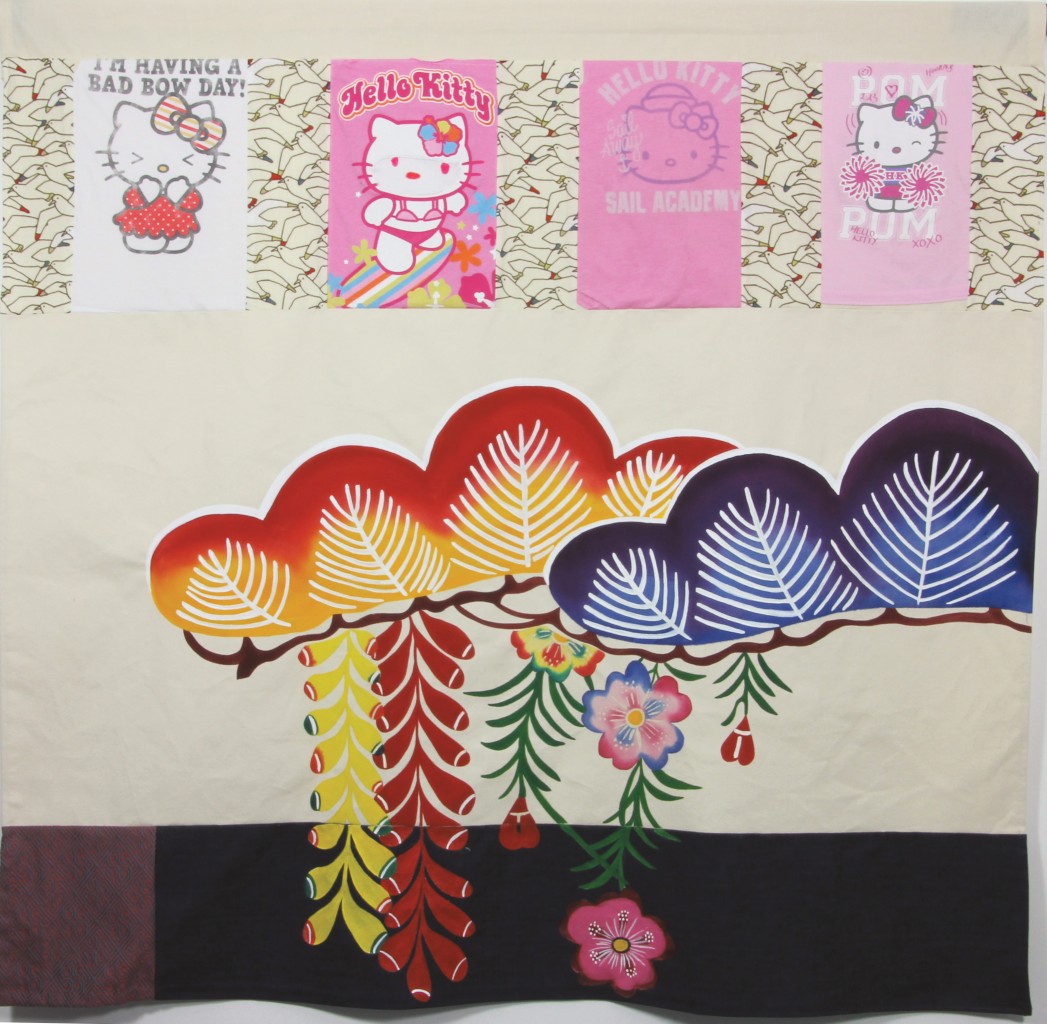
    Image: Laura Kina, Hello Kitty, acrylic on canvas and denim, assorted fabrics, t-shirts from the artist’s daughter Midori Aronson, 57 x 56 inches, 2015.

    Uchinanchu is the term for Okinawan immigrants and their descendants from the Japanese island living in Hawai’i. This exhibit presents patchwork and textile-based paintings by Laura Kina through moving autobiographical pieces that examine mixed race identities, indigenous communities, colonization, and globalized pop culture–all in the form of traditional craft practices. Images feature deconstructed articles of clothing, from fleeting moments and memories of specific events to time-honored symbols.

    Kina explains,

    “My artwork focuses on themes of distance, belonging and cultural reclamation… Taken together, the works are about islands of diaspora and explore themes of transnational family ties and heritage tourism, mixed-ness, ethnic pride and solidarity, military and colonial histories, and current geopolitical military/environment issues in Okinawa and Hawai’i.”

    Kina is Vincent de Paul Professor of Art, Media, & Design at DePaul University in Chicago and co-founder of the biennial Critical Mixed Race Studies conference. She co-authored War Baby/Love Child: Mixed Race Asian American Art (University of Washington Press, 2013) and acts as reviews editor for Asian Diasporic Visual Cultures and the Americas. She is working on a forthcoming anthology Queering Contemporary Asian American Art. Her work has been widely exhibited in galleries and museums nationally and internationally, including in the Smithsonian National Museum of American History and the Japanese American National Museum.

    For more information, click here.

  • Intermarriage and Mixed Parenting, Promoting Mental Health and Wellbeing: Crossover Love

    Palgrave Macmillan
    2015
    262 pages
    eBook ISBN: 978-1-137-39078-3
    Hardcover ISBN: 978-1-137-39077-6
    Softcover ISBN: 978-1-349-48271-9
    DOI: 10.1057/9781137390783

    Rashmi Singla, Associate Professor
    Department of Psychology and Educational Research
    Roskilde University, Denmark

    Marriages across ethnic borders are increasing in frequency, yet little is known of how discourses of ‘normal’ families, ethnicity, race, migration, globalisation affect couples and children involved in these mixed marriages. This book explores mixed marriage though intimate stories drawn from the real lives of visibly different couples.

  • Opinion: “White spaces” are everywhere – including ARC

    The American River Current
    Sacramento, California
    2016-09-26

    Shiavon Chatman

    Imagine being alone in a place where there was no one who looked like you or understood your experiences.

    Imagine having a conversation with someone who assumed the actions and behaviors of people who looked like you and made predictions about the way you conducted yourself.

    Being a person of color in a predominantly “white space” is similar to this.

    Author Toni Morrison addresses this very idea of oppression and loneliness that comes with being racially stereotyped in her first novel entitled “The Bluest Eye.”

    In her novel, the main character Pecola is “(the) little black girl who want(s) to rise up out of her pit of her blackness and see the world with blue eyes.”

    The idea of “colorblindness” doesn’t exist. No matter how progressive and accepting a person is, they will see color.

    Recognizing color, or rather, race and ethnicity, is being consciously aware of the social injustices and stereotypes that people of color experience.

    American River College [(ARC)] student Alyssa Senna said “I feel like there’s a stereotype for all people of color and that’s how white people see us.”…

    …The stigma of being a person of color in predominantly white spaces has the same level of intensity for mixed people.

    “I feel almost like an alien at times,” said ARC student, Sade Butler, “because I’m black, white, and Filipino and I’m of a medium complexion, (so) a lot of people don’t see me as a person of color.”

    Mixed people typically experience more privilege, referred to as “passing”, than non-mixed people of color, except in predominantly “white spaces.”…

    Read the entire article here.

  • Colin Kaepernick Had No Choice but to Kneel

    TIME
    2016-10-03

    John McWhorter, Associate Professor of English and Comparative Literature
    Columbia University, New York, New York

    ‘We must understand what Kaepernick is protesting’

    The idea that Colin Kaepernick’s refusal to stand during the national anthem is unpatriotic fails doubly: first, in a mistaken notion of what real patriotism is, and second in missing a larger point.

    For one, the idea that to not stand while the anthem is played signals a lack of allegiance to one’s nation is simplistic to the point of stretching plausibility, seemingly designed more as a way to hate on someone than to grapple with the complexities of the real world. Is patriotism a matter of either/or? Perhaps in terms of military service, although we find gray lines even there.

    Elsewhere, however, critique and even scolding are fundamental facets of loving. What would be unpatriotic of Kaepernick, given his views, would be to refrain from sitting out the national anthem out of an unreflective sense of patriotism as an on/off switch. Kaepernick thinks his country is capable of changing and wants to help it do so…

    Read the entire article here.

  • Black Journalist T. Thomas Fortune Prophetically Predicts Today’s Political Climate

    African American Intellectual History Society (AAIHS)
    2016-09-24

    Shawn Leigh Alexander, Associate Professor of African and African American Studies and Director of the Langston Hughes Center
    University of Kansas

    Newspaper editor and former slave T. Thomas Fortune formed the National Afro-American League, heralded as the first major all-black civil rights organization.

    Civil rights activist and journalist T. Thomas Fortune was one of the most eloquent and instrumental voices of black America from 1880 to 1928. In 1883 Fortune, who was born into slavery in Florida, relocated to New York and became the lead editor of the New York Globe (subsequently named the Freeman and the Age), which quickly became the most widely read black paper of the era.

    Using the paper as his pulpit he became a prominent outspoken critic of southern racism, a promoter of racial solidarity and race pride, and an uncompromising advocate for civil and political rights of African Americans. He was also the mastermind behind the creation of the nation’s first national civil rights organization, the Afro-American League, which provided the framework for National Association for the Advancement of Colored People

    Read the entire article here.

  • Real Native Genius: How an Ex-Slave and a White Mormon Became Famous Indians by Angela Pulley Hudson (review)

    The Journal of the Civil War Era
    Volume 6, Number 3, September 2016
    pages 439-442
    DOI: 10.1353/cwe.2016.0058

    Adam Pratt, Assistant Professor of History
    University of Scranton, Scranton, Pennsylvania

    Real Native Genius: How an Ex-Slave and a White Mormon Became Famous Indians. By Angela Pulley Hudson. (Chapel Hill: University of North Carolina Press, 2015. Pp. 270. Paper $29.95.)

    Angela Pulley Hudson’s Real Native Genius traces the lives of two individuals who, in the 1840s, convinced thousands of Americans that they were Native Americans. Calling themselves Okah Tubbee and Laah Ceil, the couple toured the Northeast as musicians who performed for large audiences and, later, offered medical cures. Hudson argues that audiences took the couple’s Indianness seriously and offers a host of cultural factors, such as the market revolution and religious revivalism, that explain their success. What she finds is that the Indian portrayals by Warner McCary, a mixed-race former slave from Mississippi, and Lucy Stanton, a Mormon from New York, tapped into Americans’ perceptions of Native people. Their performances lacked authenticity, but they were readily believable to an eastern, white audience that shared the same misconceptions about Native beliefs and practices. When evangelicals or early Mormons spoke in tongues, they were thought to be “talking Injun” (49); likewise, remedies hocked by charlatans were called “Indian cures” (124). These widely held ideas about a singular Native culture and identity, one that was widely constructed by white popular culture, allowed the couple to don identities believable enough to American audiences desperate for Native authenticity.

    Born a slave in Natchez, Mississippi, around 1810, Warner McCary had a sad childhood. His purported mother, a slave, and her other children were manumitted, while he was not. McCary long disputed the idea that his owner was his father and instead claimed a Choctaw father. Although McCary lacked a sense of belonging from his family, he found respite in the fact that, starting at a young age, he could please people by playing them music. By 1839, he had run away to New Orleans, where he became something of a renowned musician and fashioned a new identity for himself as a performer. Urged to travel to widen his audience, in 1843 he met Lucy Stanton, a divorcée with three children, whose life had been spent with the nascent Mormon Church. Because Native Americans “were seen as an essential part of the faith’s millenarian promise,” they played a vital role in Mormon theology (45). Mormonism, according to Hudson, was instrumental when it came to the couple’s adoption and perpetuation of ideas about Indians.

    In early 1846, the couple married and soon thereafter moved to Cincinnati, where they attempted to convert followers. McCary claimed to be both an Indian and a resurrected Christ, which caused several raised eyebrows. The local press portrayed McCary as “a unique sort of pied piper, leading followers to ruin and relieving them of their dollars” (72). This was the couple’s first foray into being “professional Indians,” an antebellum phenomenon that capitalized on “audiences’ desires for trivia on the vanishing race” (74–75). However, by early 1847 they had joined the Mormons at Winter Quarters, where they soon found themselves in trouble. It appeared that McCary had been seducing Mormon women with the help of his wife. McCary’s behavior, combined with lingering questions about his race, led to his being forced out of town by angry neighbors. By the fall of 1847, McCary and Stanton had traveled east and become professional Indians.

    Unlike so many Americans who chased their fortunes in the west, Okah Tubbee and Laah Ceil understood that their brand could succeed only in the East. Impersonating Indians could work only where Indians no longer existed and where misconceptions were widespread. In the East, Tubbee demonstrated his “native genius” when he performed renditions of “La Marseillaise,” a way to show that he was untaught and that he possessed natural gifts because of his heritage. After several years of touring, Tubbee became embroiled in controversy when he married another woman who was unaware of the fact that he already had a wife. As public opinion turned against him, he vanished, lost to the historical record.

    Laah Ceil made a name for herself in Buffalo, where she sold medicines until the 1860s. Her…
  • A Qualitative Analysis of Multiracial Students’ Experiences With Prejudice and Discrimination in College

    Journal of College Student Development
    Volume 57, Number 6, September 2016
    pages 680-697
    DOI: 10.1353/csd.2016.0068

    Samuel D. Museus, Associate Professor of Higher Education and Student Affairs
    Indiana University

    Susan A. Lambe Sariñana, Clinical Psychologist
    Cambridge, Massachusetts

    April L. Yee
    University of Pennsylvania

    Thomas E. Robinson

    Mixed-race persons constitute a substantial and growing population in the United States. We examined multiracial college students’ experiences with prejudice and discrimination in college with conducted focus group interviews with 12 mixed-race participants and individual interviews with 22 mixed-race undergraduates to understand how they experienced prejudice and discrimination during their college careers. Analysis revealed 8 types of multiracial prejudice and discrimination which were confirmed by individual interviews: (a) racial essentialization, (b) invalidation of racial identities, (c) external imposition of racial identities, (d) racial exclusion and marginalization, (e) challenges to racial authenticity, (f) suspicion of chameleons, (g) exoticization, and (h) pathologizing of multi-racial individuals. Implications for research and practice are discussed.

  • Meta-Melodrama: Branden Jacobs-Jenkins Appropriates Dion Boucicault’s The Octoroon

    Modern Drama
    Volume 59, Number 3, Fall 2016
    pages 285-305

    Verna A. Foster, Professor of English
    Loyola University Chicago

    In adapting the nineteenth-century melodrama The Octoroon, Jacobs-Jenkins both satirizes Boucicault’s racial assumptions and emulates his aesthetic principles to produce a meta-melodrama, a play that at once celebrates and critiques its own form while providing a stinging indictment of racial attitudes in the twenty-first century. This essay draws on both the published script and audience responses to Soho Repertory Theatre’s two stagings of the play in 2014 and 2015 gleaned from reviews, blogs, and interviews. The contemporary context and cross-racial casting of An Octoroon ironize and adapt the meaning of Boucicault’s play, making it appropriate for the twenty-first century. Through his use of italicization, Brechtian quotation, the new contemporary dialogue he writes for the slave characters, and his shocking updated sensation scene, Jacobs-Jenkins induces his audience to question their own and each other’s racial reactions even as they are caught up in the play.

  • This Movie Was Nearly Lost. Now They’re Fighting to Save It.

    The New York Times
    2016-09-23

    John Anderson


    Richard Romain in the 1982 film “Cane River.”
    Credit IndieCollect

    When it debuted in 1982, “Cane River” was already a rarity: a drama by an independent black filmmaker, financed by wealthy black patrons and dealing with race issues untouched by mainstream cinema. Richard Pryor had even tried to take it to Hollywood.

    But since a negative resurfaced two years ago, it has attained a certain mythic quality, connecting a disparate group of people across the country: New York preservationists dedicated to restoring it; a cultural historian in Louisiana devoting an academic paper to it; an archivist in Los Angeles fascinated with it. And the director’s son, the music journalist and filmmaker Sacha Jenkins, who knew about the film but has never seen it, and who has been left with a question no small number of sons have asked about their fathers.

    “Who was this guy?”…

    Cane River itself is a historically multicultural area in Natchitoches Parish in Louisiana, and the movie, in addition to being a Romeo-Juliet romance, deals with land swindles perpetrated against people of color, and “colorism”— that is, social hierarchy as dictated by skin tone.

    “It’s a common issue, because there was a lot of intermarriage and, of course, slavery,” said Carol Balthazar, who was Horace Jenkins’s partner, and whose family history provided the movie’s historical backdrop…

    …Ms. Spann watched a bootleg DVD of “Cane River.” “I can’t think of any film that dealt with colorism in such a serious way,” she said. She is writing a paper on “Cane River” for the Louisiana Historical Society, and said some of the scenes seemed too long. Debra I. Moore, who edited the film in 1980, said there’s a good reason for that…

    Read the entire article here.

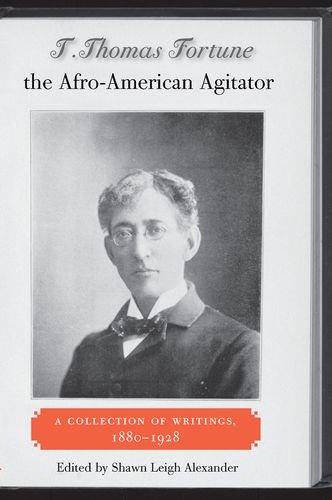
  • T. Thomas Fortune, the Afro-American Agitator: A Collection of Writings, 1880-1928

    University Press of Florida
    2008-06-15
    342 pages
    6 x 9
    Hardcover ISBN 13: 978-0-8130-3232-0
    Paper ISBN 13: 978-0-8130-3548-2

    Shawn Leigh Alexander, Associate Professor of African-American Studies
    University of Kansas

    Born into slavery, T. Thomas Fortune was known as the dean of African American journalism by the time of his death in the early twentieth century. The editorship of three prominent black newspapers–the New York Globe, New York Freeman, and New York Age–provided Fortune with a platform to speak against racism and injustice.

    For nearly five decades his was one of the most powerful voices in the press. Contemporaries such as Ida B. Wells, W.E.B. Du Bois, and Booker T. Washington considered him an equal, if not a superior, in social and political thought. Today’s histories often pass over his writings, in part because they are so voluminous and have rarely been reprinted. Shawn Leigh Alexander’s anthology will go a long way toward rectifying that situation, demonstrating the breadth of Fortune’s contribution to black political thought at a key period in American history.