• Mixed race children celebrate their ‘cultural cocktail’ heritage

    Times Live
    Johannesburg, South Africa
    2016-09-23

    Nomahlubi Jordaan, Courts and Law Reporter

    Food‚ language and tradition of diverse cultures are the essence of the heritage of children born from multiracial families.

    Mark Andrew Sunners‚ a hip hop producer‚ was born in Liverpool in England from a white English father and Xhosa mother from Grahamstown. He was raised in Gaborone in Botswana.

    He describes himself as “a bit of a cultural cocktail”.

    “I follow both sides. When my mother was still alive I would go to umgidi [traditional celebration of a rite of passage] and imisebenzi [traditional ceremonies] with her as often as she asked. I do from time to time now‚ but definitely not as often.

    As a “multicultural” Sunners says he celebrates “typical Western holidays”‚ “but I don’t celebrate a lot of my Xhosa practices as much as I did growing up”.

    “I don’t feel I belong to just one culture because I don’t. I belong to both. It is difficult to celebrate Heritage Day purely from a Xhosa or from an English perspective.

    “I celebrate Heritage Day with those who mean the most to me‚ family and friends alike. We are all South African‚” says Sunners.

    Born from a Xhosa father and English South African mother‚ Cayla Zukiswa Jack‚ 20‚ a University of Cape Town student‚ says a mixed race woman she prefers being in a “diverse” atmosphere.

    “That is where I feel comfortable.”…

    Read the entire article here.

  • ‘Growing up in Ireland I was the only black person’

    The Irish Times
    2016-09-30

    Anthea McTeirnan


    Lorraine Maher, aged nine and today, who is curating the exhibition of photos of mixed-race Irish people at the London Irish Centre in Camden.

    A new exhibition in London challenges the perceptions of what Irish people look like

    Lorraine Maher’s son Aaron died from cancer two years ago. Aaron, who along with his brothers, Dwayne, Darnel and Rù-ffel, had visited his mother’s homeplace in Carrick-on-Suir, Co Tipperary, many times and met his Irish family often, was proud to be Irish. Aaron would have chosen to play soccer for the Republic of Ireland, no doubt about that. He was also a fervent Tipperary supporter.

    Maher visits his grave often.

    “In the graveyard in London, he has his Irish flag and his Tipperary flag on his grave with his St Lucia flag.”

    His dad is from St Lucia, and Aaron was proud of his dual heritage.

    Aaron’s photograph is on his gravestone, too. “I see people looking at the grave like they are thinking: what has Ireland got to do with him?”

    But Aaron was proud of his Irishness, she says. “He had two heritages and both made him proud.”

    Even though it is now more common in Britain to use the term “dual heritage” rather than “mixed race”, Maher is not completely sold on the newer description.

    “It is challenging because my only heritage is Irish,” she says. “So that is what the conversation I wanted to have is about. For mixed-race Irish people our ancestry, our roots, our blood are Irish.”…

    …Maher was never an “immigrant”. She grew up in 1960s-1970s Carrick-on-Suir, Co Tipperary, where she was the only black person she knew. After Presentation Convent Primary, she moved to Scoil Mhuire in Greenhill.

    “I’m mixed race. I identify as a black woman from Ireland, who is quite pale,” she laughs. “The only heritage I ever had was Irish heritage.” Maher is aware of her other ancestry, “but it is not important at the moment for me”, she says…

    Read the entire article here.

  • Canada’s racial divide: Confronting racism in our own backyard

    The Globe and Mail
    2016-09-26

    Tavia Grant, Reporter


    Nova Browning Rutherford, who is half black and half white, and has lived in Ontario, Alberta and Los Angeles, poses for a photo at her home in Mississauga, Ont. on Friday. (Michelle Siu for The Globe and Mail)

    Growing up in Jacksonville, Fla., Rhonda Britton experienced occasional moments of racism. As the only black girl in her junior-high class, she was once told by a white friend that she wasn’t allowed to come over and play.

    But it was when she moved to Canada as an adult that she felt racism more overtly: In 2011, she discovered a historic plaque in front of her church in Halifax spray painted with the words: Fuck All Niggers.

    It was a shock, and not the only one: She’d expected Canadians would be kinder and more welcoming than Americans.

    But in Nova Scotia, where a large, historic black community has long faced racial discrimination, racist acts are both subtle and blatant…

    …Like Dr. Britton, Nova Browning Rutherford has lived in both countries. She was born in Chatham, Ont., to a black father and white mother, and raised in Edmonton and London, Ont., before spending five years in Los Angeles.

    She says that a big difference in the U.S. is the separation of people based on race or ethnicity. She often felt pigeonholed. “Black people don’t do that,” she was told when she’d mention to colleagues she was going hiking, or out to a Korean restaurant.

    She feels relieved to now live in Toronto. But any notion that Canada is morally superior vanishes when she thinks of the deep disparities in living conditions of indigenous peoples…

    Read the entire article here.

  • Afro-Latinos Have a Well-Deserved Place at the New National Museum of African American History

    Remezcla
    2016-09-27

    Yara Simón, Trending Editor

    This weekend marked the opening of the National Museum of African American History and Culture. After Rep. John Lewis and others spent decades battling Congress for funding, the museum opened its doors on Sunday from 7 a.m. to midnight, according to the New York Times. It’s a celebration of the black community’s contributions to the United States, but it also highlights the injustices faced by an often marginalized group. More than anything, it’s crucial to our understanding of our national identity. The museum comes at a time when racist policing has taken center stage, and just months before the first black president of the United States steps down.

    On Saturday, President Barack Obama helped inaugurate the museum. He stood in front of thousands and repeated Langston Hughes’ words, “I too, am America.” “African American history is not somehow separate than the American story,” he said according to the Washington Post. “It is not the underside of the American story. It is central to the American story.”

    The 400,000 square-foot museum sits on the National Mall and features more than 36,000 artifacts that aim to explore all parts of blackness. While the intersection between black and Latino identities aren’t always acknowledged, it’s an important part of both groups. The National Museum of African American History and Culture doesn’t ignore the Afro-Latino experience. Check out a few ways they’re being included in African-American history below:…

    Read the entire article here.

  • For Affirmative Action, Brazil Sets Up Controversial Boards To Determine Race

    Parallels: Many Stories, One World
    National Public Radio
    2016-09-29

    Lulu Garcia-Navarro, South America Correspondent

    When the test scores came out, Lucas Siqueira, 27, was really excited. His high mark on the Foreign Service exam earned him a coveted position at Brazil’s highly competitive Ministry of Foreign Affairs.

    “They hire 30 diplomats a year and thousands of people sign up,” he says in fluent English from his home in Brasilia, the capital.

    It was, he says, a great day.

    Siqueira considers himself to be mixed race, known in Brazil as pardo, or brown.

    “I consider myself to be a very typical Brazilian and I’ve always been very proud of it. In my dad’s family, my grandfather is black, my grandmother has Indian and white roots. And on my mother’s side they are mostly white, mostly Portuguese,” he said.

    How he defines himself matters because he was required to self-identify on his application. In 2014, the government introduced a quota system for federal jobs. The affirmative action regulations require that 20 percent of all government positions be filled by people of color — either black or mixed race.


    Lucas Siqueira identified himself as mixed race on his application for a job at Brazil’s Ministry of Foreign Affairs. The government decided he wasn’t, and his case is still on hold. As part of the affirmative action program in Brazil, state governments have now set up boards to racially classify job applicants.
    Courtesy of Lucas Siqueira

    The problem came once the announcement of the appointments was made public…

    Wide disparities

    The legacy of the period can still be felt today. Even though the majority of the population is of African descent, only 5 percent of Afro-Brazilians were in higher education as recently as 10 years ago. Because of affirmative action, that number is now 15 percent. Vaz says these are hard won gains, but there is a long way to go.

    “Only 5 percent of executives are black in Brazil, politicians, diplomats, all things, so the black people don’t access the space of power in my country. This is the real issue we have,” he says.

    In the U.S., race is still largely determined by parentage because of the history of the “one drop rule,” where white institutions historically deemed a person black if they had even one drop of black blood.

    In Brazil, he says, the criteria is different. Skin tone matters more than race, because so much of the population is mixed…

    Read the entire story here. Download the story here.

  • Brown Bodies, White Babies: The Politics of Cross-Racial Surrogacy

    New York University Press
    September 2016
    320 pages
    Cloth ISBN: 9781479808175
    Paper ISBN: 9781479894864

    Laura Harrison, Assistant Professor
    Department of Gender and Women’s Studies
    Minnesota State University, Mankato

    Brown Bodies, White Babies focuses on the practice of cross-racial gestational surrogacy, in which a woman—through in-vitro fertilization using the sperm and egg of intended parents or donors – carries a pregnancy for intended parents of a different race. Focusing on the racial differences between parents and surrogates, this book is interested in how reproductive technologies intersect with race, particularly when brown bodies produce white babies. While the potential of reproductive technologies is far from pre-determined, the ways in which these technologies are currently deployed often serve the interests of dominant groups, through the creation of white, middle-class, heteronormative families.

    Laura Harrison, providing an important understanding of the work of women of color as surrogates, connects this labor to the history of racialized reproduction in the United States.  Cross-racial surrogacy is one end of a continuum in which dominant groups rely on the reproductive potential of nonwhite women, whose own reproductive desires have been historically thwarted and even demonized.  Brown Bodies, White Babies provides am interdisciplinary analysis that includes legal cases of contested surrogacy, historical examples of surrogacy as a form of racialized reproductive labor, the role of genetics in the assisted reproduction industry, and the recent turn toward reproductive tourism.  Joining the ongoing feminist debates surrounding reproduction, motherhood, race, and the body, Brown Bodies, White Babies ultimately critiques the new potentials for parenthood that put the very contours of kinship into question.

  • ‘Pigmentocracy’ a Major Factor in Brazil, Venezuela Turmoil

    Fordham Law News: From New York City To You
    2016-08-11

    Ray Legendre

    A global audience watched Brazil unveil the 2016 Olympics earlier this month with a flashy, jubilant opening ceremony that celebrated its racial diversity and belied its ongoing political and economic strife. But acting President Michel Temer’s maneuvering in the months before the Games revealed a racial reality in South America’s most populous country that is anything but golden, Fordham Law School Professor Tanya Hernández said.

    “It looked like a racial utopia during the opening ceremonies, but if you look at the cabinet this president has put into place there’s nary a dark-skinned person in the crowd,” said Hernández, associate director and head of global and comparative law programs and initiatives for the Center on Race, Law & Justice at Fordham Law. “You would think you were looking at Sweden, as opposed to Brazil, when you look at the cabinet.”

    Temer’s rapid assembly of lighter-skinned cabinet members in the wake of President Dilma Rousseff’s suspension of powers in May highlights the implicit racial bias that exists in Brazil and other Latin American countries with large mixed-race populations. The so-called “pigmentocracy” considers “lighter as brighter” and more capable of excelling in government and other high paying jobs, said Hernández, author of Racial Subordination in Latin America. Lighter-skinned people, of European heritage, are also less likely to suffer the rampant violence and housing displacement as poor black citizens of African descent…

    Read the entire article here.

  • Towne Street Theatre Announces Special Events During the Limited Engagement Run of PassingSOLO

    BroadwayWorld.com
    Los Angeles
    2016-09-21

    Towne Street Theatre, L.A.’s premiere African-American Theatre Company, is proud to announce that there will be a number of special events during the limited engagement run of “PassingSOLO.” The production, which runs for three weeks only from October 8 – 23 at the Stella Adler Theatre, will offer theatre-goers receptions, special presentations, and talkbacks.

    Nancy Cheryll Davis’ acclaimed one-woman show is adapted from Nella Larsen’s 1927 novella and the Towne Street Theatre play “Passing.” “PassingSOLO” will be in L.A. for a limited engagement before she takes it to Germany this fall, where it will be presented at the University of Duisburg in Essen, Germany.

    It’s the height of the 1920s Harlem Renaissance and like a moth to a flame, Irene Westover Redfield is drawn to childhood friend Clare Kendry Bellew, who’s suddenly reappeared in her life. Both share a secret. Their birth certificates read “Negro” but both can – and do – pass as white. In fact, Clare’s been married to a wealthy, white racist for twenty years. Now she’s sought out Irene as she flirts with her roots. A memory play, “PassingSOLO” explores the conflicting demands of race and friendship; the slippery line between trust and deception – always with the danger of discovery. Nancy Cheryll Davis portrays both Irene and Clare, as their renewed friendship exposes the price we pay in a society where freedom is bought with deceit. Check out this video on Youtube to learn more about PassingSOLO

    Read the entire article here.

  • A hidden bias against interracial couples

    The Seattle Times
    2016-09-23

    Allison Skinner, Postdoctoral Researcher
    Institute for Learning and Brain Sciences
    University of Washington

    Although most white Americans self-report little to no racial bias against black people, they tend to show robust implicit, or unconscious, biases.

    NEXT year marks the 50th anniversary of the U.S. Supreme Court ruling that found laws banning interracial marriage to be unconstitutional. Although polls indicate that acceptance of interracial marriage has increased dramatically since then, incidents of prejudice and violence against interracial couples continue.

    In April, a Mississippi landlord evicted a family after he found out the couple was interracial. Then in August, a man stabbed an interracial couple in Olympia after seeing them kiss in public.

    As a social psychologist, I wondered if these types of incidents are aberrations or indications of a persistent underlying bias against interracial couples.

    Read the entire article here.

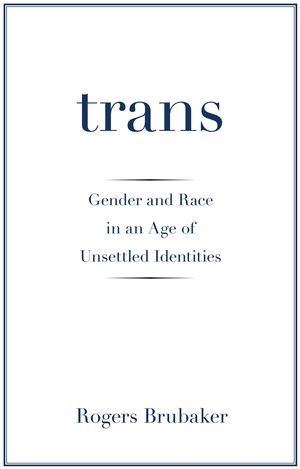
  • Trans: Gender and Race in an Age of Unsettled Identities

    Princeton University Press
    2016-09-27
    256 pages
    5 1/2 x 8 1/2
    Hardcover ISBN: 9780691172354
    eBook ISBN: 9781400883233

    Rogers Brubaker, Professor of Sociology
    University of California, Los Angeles

    In the summer of 2015, shortly after Caitlyn Jenner came out as transgender, the NAACP official and political activist Rachel Dolezal was “outed” by her parents as white, touching off a heated debate in the media about the fluidity of gender and race. If Jenner could legitimately identify as a woman, could Dolezal legitimately identify as black?

    Taking the controversial pairing of “transgender” and “transracial” as his starting point, Rogers Brubaker shows how gender and race, long understood as stable, inborn, and unambiguous, have in the past few decades opened up—in different ways and to different degrees—to the forces of change and choice. Transgender identities have moved from the margins to the mainstream with dizzying speed, and ethnoracial boundaries have blurred. Paradoxically, while sex has a much deeper biological basis than race, choosing or changing one’s sex or gender is more widely accepted than choosing or changing one’s race. Yet while few accepted Dolezal’s claim to be black, racial identities are becoming more fluid as ancestry—increasingly understood as mixed—loses its authority over identity, and as race and ethnicity, like gender, come to be understood as something we do, not just something we have. By rethinking race and ethnicity through the multifaceted lens of the transgender experience—encompassing not just a movement from one category to another but positions between and beyond existing categories—Brubaker underscores the malleability, contingency, and arbitrariness of racial categories.

    At a critical time when gender and race are being reimagined and reconstructed, Trans explores fruitful new paths for thinking about identity.

    Table of Contents

    • Preface
    • Acknowledgments
    • Introduction
    • Part One: The Trans Moment
      • 1. Transgender, Transracial?
        • “Transgender” and “Transracial” before the Dolezal Affair
        • The Field of Argument
        • “If Jenner, Then Dolezal”: The Argument from Similarity
        • Boundary Work: The Argument from Difference
      • 2. Categories in Flux
        • Unsettled Identities
        • The Empire of Choice
        • The Policing of Identity Claims
        • The New Objectivism
    • Part Two: Thinking with Trans
      • 3. The Trans of Migration
        • Unidirectional Transgender Trajectories
        • Reconsidering “Transracial”
        • Transracial Trajectories, Past and Present
      • 4. The Trans of Between
        • Transgender Betweenness: Oscillation, Recombination, Gradation
        • Racial and Gender Betweenness
        • Recombinatory Racial Betweenness: Classification and Identification
        • Performing Betweenness
      • 5. The Trans of Beyond
        • Beyond Gender?
        • Beyond Race?
        • Conclusion
    • Notes
    • Bibliography
    • Index