Mixed Race Studies

Scholarly perspectives on the mixed race experience.

    • About This Site
    • Bibliography
    • Contact Information
    • Date and Time Formats
    • Forthcoming… (Updated 2021-09-01)
    • Likely Asked Questions
    • List of Book Publishers
    • List of Definitions and Terms
    • My Favorite Articles and Papers
    • My Favorite Posts
    • My Recent Activities
    • Praise for Mixed Race Studies
    • Tag Listing
      • Tag Listing (Ordered by Count)
    • US Census Race Categories, 1790-2010
    • 1661: The First ‘Mixed-Race’ Milestone
    • 2010 U.S. Census – Some Thoughts

recent posts

  • The Routledge International Handbook of Interracial and Intercultural Relationships and Mental Health
  • Loving Across Racial and Cultural Boundaries: Interracial and Intercultural Relationships and Mental Health Conference
  • Call for Proposals: 2026 Critical Mixed Race Studies Conference at UCLA
  • Participants Needed for a Paid Research Study: Up to $100
  • You were either Black or white. To claim whiteness as a mixed child was to deny and hide Blackness. Our families understood that the world we were growing into would seek to denigrate this part of us and we would need a community that was made up, always and already, of all shades of Blackness.

about

  • Twitter
  • Facebook
  • Instagram
  • Mestizaje in the Age of Fascism: German and Q’eqchi’ Maya Interracial Unions in Alta Verapaz, Guatemala

    2016-05-20

    Mestizaje in the Age of Fascism: German and Q’eqchi’ Maya Interracial Unions in Alta Verapaz, Guatemala

    German History
    Volume 34, Issue 2 (June 2016)
    pages 214-236
    DOI: 10.1093/gerhis/ghw017

    Julie Gibbings, Assistant Professor of History
    University of Manitoba, Winnipeg, Manitoba, Canada

    In contemporary Guatemala, Q’eqchi’ Mayas of German descent are reclaiming identities as ‘the improved race’ (la raza mejorada), which allows them claim both tradition and authenticity as well as racial whiteness and modernity. While surprising to contemporary observers, these identities have longer histories, rooted in the interwar period, when Guatemalan urban intellectuals and statesmen looked to German-Maya sexual unions as the racial solution to Guatemala’s failure to forge a modern and homogenous nation. Like national racial mixing (mestizaje) projects found in Mexico and elsewhere in Latin America, Guatemalan intellectuals in the 1920s and 1930s argued that racial mixing with Anglo-Saxons led not to racial degeneration, but—potentially—to new and more vital races. While long ignored by historical scholarship, hybrid Q’eqchi’-Germans, however, unravel a priori assumptions of German diasporic political and social insularity. By examining the potent symbolic and cultural dimensions Guatemala’s unique mestizaje project had for the formation of both German and Guatemalan nationalist projects during the rise of German National Socialism and Guatemala’s own populist dictatorship under President Jorge Ubico (1931–1944), this article argues for an understanding of German diasporas in Latin America that places them squarely in the transnational space between competing nationalisms and political agendas. By further examining the important material and social dimensions of mixed-race families, this article reveals the crucial ties Germans forged in Latin America and how who counted as German and by what measure was a subject of considerable debate with important political consequences.

    Read or purchase the article here.

  • poem: Casey Rocheteau

    2016-05-19

    poem: Casey Rocheteau

    Union Station
    January 2014

    Casey Rocheteau

    The first time I was black

    I was staring out the sliding glass door
    at the mourning doves in the back yard.
    My white mother came up
    behind me and said that if anyone
    didn’t want to be my friend at school
    it was their loss. I asked,
    Why would anyone not want to be my friend?
    well, because you’re black.
    I looked at my hands
    uncomprehending…

    Read the entire poem here.

  • Black Velvet: redefining and celebrating Indigenous Australian women in art

    2016-05-19

    Black Velvet: redefining and celebrating Indigenous Australian women in art

    The Conversation (US Pilot)
    2016-05-08

    Sandra Phillips, Lecturer
    Creative Writing and Literary Studies, School of Media, Entertainment and Creative Arts, Creative Industries Faculty
    Queensland University of Technology, Brisbane, Queensland, Australia

    *Warning: This article contains graphic language that may upset some readers, while Aboriginal and Torres Strait Islander readers should be aware that it may contain images, voices or names of deceased people.

    With her first solo exhibition, artist Boneta-Marie Mabo has been inspired by the State Library of Queensland’s collections to create new works that speak back to colonial representations of Indigenous womanhood.

    She found portraits of Indigenous women without any name, or with labels such as “black velvet” or “gin”; objects, rather than women. Men on the frontier sought to control Aboriginal lands as well as women’s bodies – with or without consent.

    The 2005 documentary Pioneers of Love discusses the colonial fetish for Indigenous women.

    Revered author Henry Lawson was one of the first to popularise the phrase ‘black velvet’. It described the soft, smooth skin of Aboriginal women – or ‘gins’, as they were referred to then. The men who associated with Aboriginal women were known as ‘gin jockeys’. And their children were often referred to as ‘burnt corks’. – Watch from 1:52 of this clip of the documentary.

    But Boneta-Marie’s exhibition, Black Velvet: your label, is more than a response to the past. It’s also about the struggle not to let others define our identity. And it’s a celebration of Indigenous women today, including Boneta-Marie’s grandmother, activist and Order of Australia winner Bonita Mabo…

    Read the entire article here.

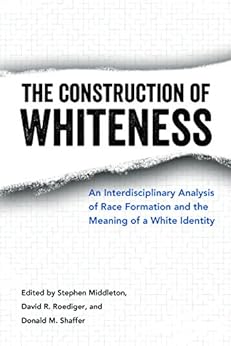
  • The Construction of Whiteness: An Interdisciplinary Analysis of Race Formation and the Meaning of a White Identity

    2016-05-19

    The Construction of Whiteness: An Interdisciplinary Analysis of Race Formation and the Meaning of a White Identity

    University Press of Mississippi
    April 2016
    256 pages (approx.)
    6 x 9 inches
    introduction, 8 b&w illustrations, bibliography, index
    Hardcover ISBN: 9781496805553

    Edited By:

    Stephen Middleton, Professor of History and Director of African American
    Mississippi State University

    David R. Roediger, Foundation Professor of American Studies and History
    University of Kansas

    Donald M. Shaffer, Associate Professor of African American Studies and English
    Mississippi State University

    A critical engagement with the origins, power, and elusiveness of white privilege

    Contributions by Sadhana Bery, Erica Cooper, Tim Engles, Matthew W. Hughey, Becky Thompson, Veronica T. Watson, and Robert St. Martin Westley

    This volume collects interdisciplinary essays that examine the crucial intersection between whiteness as a privileged racial category and the various material practices (social, cultural, political, and economic) that undergird white ideological influence in America. In truth, the need to examine whiteness as a problem has rarely been grasped outside academic circles. The ubiquity of whiteness–its pervasive quality as an ideal that is at once omnipresent and invisible–makes it the very epitome of the mainstream in America. And yet the undeniable relationship between whiteness and inequality in this country necessitates a thorough interrogation of its formation, its representation, and its reproduction. Essays here seek to do just that work. Editors and contributors interrogate whiteness as a social construct, revealing the underpinnings of narratives that foster white skin as an ideal of beauty, intelligence, and power.

    Contributors examine whiteness from several disciplinary perspectives, including history, communication, law, sociology, and literature. Its breadth and depth makes The Construction of Whiteness a refined introduction to the critical study of race for a new generation of scholars, undergraduates, and graduate students. Moreover, the interdisciplinary approach of the collection will appeal to scholars in African and African American studies, ethnic studies, cultural studies, legal studies, and more. This collection delivers an important contribution to the field of whiteness studies in its multifaceted impact on American history and culture.

  • Sweden: People didn’t turn on refugees; system maxed out

    2016-05-19

    Sweden: People didn’t turn on refugees; system maxed out

    Cable News Network (CNN)
    Amanpour
    2016-05-08

    Christiane Amanpour speaks with Alice Bah Kuhnke, Swedish Minister for Culture and Democracy, about the crushing refugee crisis in Europe.

  • “My aim is to locate myself in this discussion as a biracial Black man who has both been the victim of racism and has in some instances “passed” for white because of my light skin.”

    2016-05-18

    “Along with my personal identity struggles, the historical legacy of racism in the United States for communities of color informs my experiences. My current work responds to the police killings of unarmed Black men, women, and children across America. While this is a constant attack on the Black community, the increased international media attention, public awareness, and public movements are new phenomena. The recent killings of Trayvon Martin and Eric Garner to Tamir Rice and Michael Brown, illustrate that Black victims can range in age from 12 to 50 years old. This raises the question of the value of Black bodies in contemporary America, which is linked to a long history of violence against its Black population through slavery, Jim Crow, and mass incarceration. My aim is to locate myself in this discussion as a biracial Black man who has both been the victim of racism and has in some instances “passed” for white because of my light skin. I see this as the cost of a legacy of racism that is particularly troublesome to me and this conversation must continue.” —Michael Dixon

    Tasha Mathew, “Michael Dixon: A Discussion About Race, Representation, and Biracial Identity,” Or Does It Explode, March 14, 2016.
    http://www.ordoesitexplode.com/#!Michael-Dixon-A-Discussion-About-Race-Representation-and-Biracial-Identity/pidwk/56e5a6850cf26296007f90ad.

  • How street kids in the Bronx taught me it’s OK to be biracial and gay

    2016-05-18

    How street kids in the Bronx taught me it’s OK to be biracial and gay

    Fusion
    2016-05-18

    Terry Blas

    As a “nerdy, Mexican, gay, Mormon child of the ’80s and ’90s,” cartoonist Terry Blas had trouble figuring out his identity… until an experience in New York taught him a valuable lesson.

    …

    Read the entire comic strip here.

  • Michael Dixon: A Discussion About Race, Representation, and Biracial Identity

    2016-05-18

    Michael Dixon: A Discussion About Race, Representation, and Biracial Identity

    Or Does It Explode
    2016-03-14

    Tasha Mathew

    Michael Dixon is a California-born artist who teaches as an associate professor at Albion College and was recently awarded studio space in New York through the Sharpe-Walentas Studio Program. His paintings direct us toward controversy, self-reflection, and an appreciation for the value of these experiences.

    Dixon explores the personal experiences of biracial blacks, including an immersive investigation into his own experiences. As such, concepts of social psychology condense within each portrait – concepts such as social identity theory and self-categorization theory – allowing us to explore our identification with one particular group over another.

    His most recent projects include Shared Histories/Turkey: an investigations into Turkish, biracial blacks and The More Things Change, The More Things Stay The Same: a reflection upon the recent killings of unarmed black men…

    Read the entire interview here.

  • A Culture of Identity Choice: Assertions of Mixed Race, Transgender, and Other Identities and the Implications for Politics

    2016-05-18

    A Culture of Identity Choice: Assertions of Mixed Race, Transgender, and Other Identities and the Implications for Politics

    Stanford University
    Black Community Services Center
    The Brandon Room
    Wednesday, 2016-05-18, 12:00 PDT (Local Time)

    Natalie Masuoka, Associate Professor of Political Science
    Tufts University

    While Americans have always connected with different social identities, today we find the assertions of identities such as “biracial,” “swirlies,” “boi,” and “transwomen” to be particularly significant. What is notable about these types of identities is that they communicate a person’s preferred self-identification relating to individual features historically understood as rigid and inherent. Masuoka argues that Americans today increasingly embrace a culture of, what she calls, identity choice in the United States. In today’s post-Civil Rights context, Americans increasingly believe and accept the idea that individuals can choose identities that were once seen as immutable. This presentation will trace the historical developments that have led to this new cultural perspective and offer a discussion about the possible political implications.

    This talk is part of the 2015-16 RICSRE Seminar Series Spotlight on Race and Politics, co-sponsored by the Institute on the Politics of Inequality, Race, and Ethnicity at Stanford (InsPIRES). The event is also co-sponsored by the American Politics Workshop, Feminist, Gender, and Sexuality Studies, and the Clayman Institute for Gender Research.

    For more information, click here.

  • ‘We are Iranians’: Rediscovering the history of African slavery in Iran

    2016-05-17

    ‘We are Iranians’: Rediscovering the history of African slavery in Iran

    Middle East Eye
    2016-05-09

    Jillian D’Amours

    ST CATHARINES, Canada – Behnaz Mirzai’s students often say her office is like a museum.

    With shards of ancient pottery recovered from the mountains of Iran’s Sistan and Baluchistan province, colourful vases from Isfahan, and tribal masks from Zanzibar adorning the shelves, it is easy to see why.

    Mirzai has spent nearly 20 years studying the origins of the African diaspora in Iran, including the history and eventual abolition of slavery in her native country.

    It was a topic that few knew about in the late 1990s, when she began her research, and one that remains unfamiliar to many today.

    “Living in Iran for all my life, we had never heard about slavery in Iran,” Mirzai told Middle East Eye from Brock University, where she now works as an associate professor of Middle Eastern history…

    Read the entire article here.

Previous Page
1 … 425 426 427 428 429 … 1,428
Next Page

Designed with WordPress