White People Can Be President, Too
The Daily Show with Trevor Noah
2016-03-08
After interviewing kids who have grown up under President Obama, Jordan Klepper explains that even white people can hold the nation’s highest office. (5:10).
Scholarly perspectives on the mixed race experience.
The ‘anti-racist’ crowd have resorted to the old politics of racism
The Spectator
2016-03-07
The self-important slayers of ‘cultural appropriation’ have gone too far this time. Clearly they didn’t get a big-enough moral kick from chastising white people who do yoga (on the basis that yoga has ‘roots in Indian culture’), moaning about Beyonce donning a sari (‘how is this different from white folks wearing cornrows?’, the racial police demanded), and fuming about middle-class indie kids who wear Native American headdresses at music festivals (apparently this ‘perpetuates damaging, archaic and racist stereotypes’).
So now they’re turning their fire on a black actress who, in their view, is not black enough to play Nina Simone. Yes, even black people can now be accused of being insufficiently black for certain cultural pursuits.
The actress in question is Zoe Saldana, a fine actress whose curious combination of vulnerability and steeliness has made her the darling of the modern Hollywood blockbuster. She’s one of the best things in the Star Trek reboot movies and she even managed to inject some humanity into James Cameron’s otherwise soulless, eco-miserabilist epic, Avatar. And next she will play Simone, in a big biopic, the trailer for which was released last week.
But the identity-politics mob isn’t happy. Why? Because Saldana is a light-skinned black person, a ‘half black’, as some have foully put it, and she used make-up to make herself as black as Simone…
Read the entire article here.
Why Zoe Saldana was the wrong black woman to play Nina Simone
The Telegraph
2016-03-04

With her long silky hair and brown tan skin, Zoe Saldana may well be black. But is she “black enough” to play Nina Simone?
Some people seem to think not. Ms Simone’s surviving family have asked Saldana, who darkened her skin with make-up to star in the upcoming biopic Nina, to “take [her] name out of your mouth for the rest of your life.” Many Americans agree.
.@zoesaldana Cool story but please take Nina's name out your mouth. For the rest of your life.
— Nina Simone (@NinaSimoneMusic) March 3, 2016
To some it may seem strange that a woman with parents from Puerto Rico and the Dominican Republic – where 85 per cent of people have African ancestry – should be regarded as not being “black”. But to understand this, we need to consider the way race has been constructed by our society.
As a mixed women with a white mother and black father, I should logically be regarded as “half-white” as often as I am “half-black”. Yet this doesn’t happen, because race is not logical. Instead, whiteness is a social construct which depends on a myth of racial purity and exclusivity, with no room for anyone with visibly African ancestry, no matter how light our skin. In the USA, this was typified by the “one drop rule” – a legal principle which decreed that anyone with a single African ancestor was “black” for the purposes of segregation. For many people, black is simply black.
This can be a powerful concept: I identify as black, not mixed-race, precisely because it is an inclusive category which allows unity between a very wide range of people. But that plurality can also obscure things. I am always sensitive to the advantages I might have in comparison with darker skinned black women, because the truth is that there is a huge difference in how society treats us…
Read the entire article here.
WUNC 91.5 North Carolina Public Radio
2016-03-07
Charlie Shelton, Digital News Producer
Frank Stasio, Host
“The State of Things”
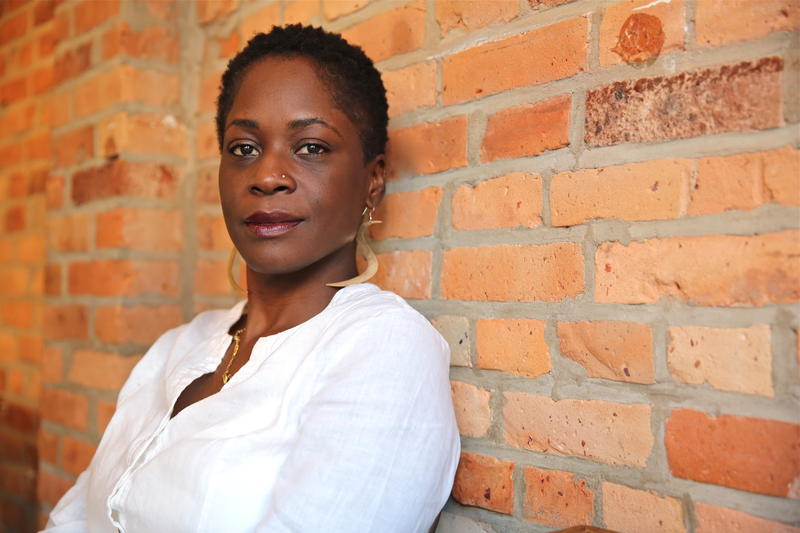 Yaba Blay is the Dan Blue Endowed Chair in Political Science at N.C. Central University Sabriya Simon |
Growing up in New Orleans, Yaba Blay saw firsthand the different roles one navigates as an African-American. At home, she had to adjust to the Ghanaian culture of her parents, but outside the house, her dark skin set her apart from New Orleans’ light-skinned Creole community.
As Blay grew older, she began to explore how the ways in which she presented herself as a black woman defined her sense of self. Her work as a scholar, producer and publisher includes projects analyzing skin color in the U.S. and Ghana and hair care in black communities.
She is the author of the book “(1)ne Drop: Shifting the Lens on Race” (BLACKprint Press/2013), and she served as consulting producer for the CNN television documentary “Who Is Black in America?” She now serves as the Dan Blue endowed chair in political science at N.C. Central University in Durham.
Host Frank Stasio talks with Blay about growing up in New Orleans and her multimedia work.
Listen to the interview (00:48:10) here. Download the interview here.
The Lucky Seven Interview, with Adebe DeRango-Adem
Open Book: Toronto
2016-02-28
Grace O’Connell, Senior Editor
The metaphor of striking out to explore unknown land is a particularly apt one for the act of writing, so the title Terra Incognita (Inanna Publications) fits Adebe DeRango-Adem’s new collection of poetry perfectly.
Exploring racial discourse in both contemporary and historical contexts, Terra Incognita teases out cultural memory and the impact of social and racial histories on the personal experience. Questioning what these forces mean for the creation (and imposition) of identity, Adebe’s deft verse mimics the physical and spiritual movement of those seeking identity within and beyond social and political borders.
We’re thrilled to welcome Adebe as our March 2016 writer-in-residence at Open Book!
Check out our conversation with Adebe, part of our Lucky Seven series, where she tells us about seeing eye to eye with your words, good advice from Ta-Nehisi Coates and the insurgency of a great book.
Open Book:
Tell us about your new book, Terra Incognita.
Adebe DeRango-Adem:
Titled after the Latin term for “unknown land” — a cartographical expression referring to regions that have not yet been mapped or documented — Terra Incognita is a collection of poems that explores various racial discourses and interracial crossings both buried in the grand narratives of history and the everyday experiences of being mixed-race. In my most recent book, the quest for the meaning of identity in the interracial context becomes part of the quest to unearth the territory of those who cross borders — racially, ethnically, culturally and geographically…
Read the entire interview here.
“But how Indian are you?”: notes on being a mixed-race Indigenous person.
A Halfbreed’s Reasoning
2012-11-15
Samantha Nock
I am mixed. It’s not like it’s a secret. I am a mixed-race, mixed-blood, hybrid, mud blood, halfbreed; these things I know to be true. The thing is, I know my identity. I am accepted by my community, yet when I tell folks, especially non-Native folks, I get one of two reactions:
It’s not the act itself that bothers me, as a light skinned, white passing, Indigenous individual, I get it. But it’s the fact that people assume that because I am mixed that I am less of an individual, that now, my parts don’t make a whole and each aspect of my identity is up for scrutiny. Automatically, I lose sovereignty over my identity and my body because I become a subject to be “made sense of.” Invasive questions about blood and family are deemed okay, because I have become the embodiment of anti-dichotomous reasonings of identity: “but how can you be more than one thing!”…
Read the entire article here.
black girls rule: celebrating brazilian women of colour
i-D
2016-03-08
Weudson Ribeiro’s new photobook Black Girl Power is shining a light on black female identity and LGBT women of colour in brazil.
 Brasilia based photographer, journalist and political scientist Weudson Ribeiro is known for his images celebrating Brazilian queer culture. In his latest series, Superafro: BLACK GIRL POWER, Ribero documents Brazilian LGBT women who proudly express their sexuality and their blackness as a political statement… |
Tell us about Black Girl Power and what you wanted to document, not only regarding black female identity, but that of LGBT women of colour.
With Superafro: BLACK GIRL POWER, I intend to document the huge diversity within the Afro-Brazilian spectrum, celebrate the beauty of women of colour and, hopefully, make a positive difference in the fight for freedom and equality by raising awareness of issues that affect the reality of black people in Brazil, since we live in a society moulded by racism, pigmentocracy, disenfranchisement and sexism. With the phenomenal rise of feminism amongst young women and a greater access to information provided by digital inclusion, I notice females feel more encouraged to wear their hair natural, or as they will, express their sexuality and reject euphemisms employed to address Afro features as though Negroid was a burden…
…What do the women of your pictures represent?
Those women represent the stand against the odds of a judgemental society. Personally, meeting such beautiful and smart black women was a watershed. Being the only son of mixed-race parents, I had a hard time understanding and accepting my own blackness. It’s a problem that affects the vast majority of Brazilians as a result of our highly mixed ethnic backgrounds. So, as in the womb, this series marks to me a rebirth as a proud black LGBT man, after 24 years struggling with my racial identity…
Read the entire interview here.
The Curious Presidency of Barack Obama
Political Insight
Volume 7, Number 1 (April 2016)
pages 8-11
DOI: 10.1177/2041905816637452
James D. Boys, Associate Professor of International Political Studies
Richmond University, London, United Kingdom

After two terms in the White House, Barack Obama’s Presidency has entered its final year. James D. Boys assesses his record in office and finds an historic US President who leaves behind a nation more divided than ever.
In 1922, F. Scott Fitzgerald published the incredible tale of a man who effectively lives his life in reverse: born old, he grows younger as each subsequent year passes. In many ways, Fitzgerald’s Benjamin Button encapsulates the Presidency of Barack Obama, a President who has lived his Presidency in reverse.
Tradition holds that a president enters office with as much political capital as he will ever have and that over the course of his presidency (be that one or two terms) he expends it to such an extent that by the end of his tenure, he is a spent force, or rather, a lame duck. Tradition also suggests that as his time in office ends, a period of reflection begins, during which he is lauded for his achievements.
This has not happened, however, in the case of Barack Obama. Instead, he arrived in office garnered in plaudits, but struggled to achieve concrete goals or to find his presidential voice until late in his second term, when he suddenly hit his stride in terms of foreign policy achievements and his willingness to champion gun control efforts. Passage of ‘Obamacare’, the signature achievement of his first term, was an important exception to his narrative, but Obama’s most definable achievements have come in his second term when he was beyond the will of the electorate and when Vice President Biden had chosen not to seek office. Both aspects reveal telling factors about the Obama Presidency which betray his bold and optimistic clarion call for change that carried him to office in the election of 2008…
Read the entire article here.