• “Lying about a Lie”: Racial Passing in US History, Literature and Popular Culture

    Journal of American Studies
    Volume 50, Issue 2 (May 2016)
    DOI: 10.1017/S0021875816000219

    Sinéad Moynihan, Associate Professor of English
    University of Exeter
    In June 2015, the parents of Rachel Dolezal, president of the Spokane, Washington chapter of the NAACP, claimed that their daughter was passing as black. While she professed to be of mixed (white, African American) racial heritage, her parents asserted that she was of white European descent, with some remote Native American ancestry. The revelations precipitated Dolezal’s resignation from her role at the NAACP and a flurry of articles about the story that were disseminated around the world on Twitter under the “Rachel Dolezal” hashtag.

    Much of the media coverage attempted to account for the fact that this story should elicit such impassioned reactions given that race has long been acknowledged as a performance. As Jelani Cobb wrote in the New Yorker, Dolezal had dressed herself in “a fictive garb of race whose determinations are as arbitrary as they are damaging.” This does not mean that Dolezal “wasn’t lying about who she is.” It means that “she was lying about a lie.” Meanwhile, in the New York Times, Daniel J. Sharfstein pointed out that the kind of passing we saw in Dolezal’s case – passing from white to black; so-called “reverse passing” – was not as historically uncommon as other writers had claimed. What is unusual is that Dolezal should feel the need to pass as black when there were no legal (and comparatively few social) obstacles to her forming “meaningful relationships with African-Americans, study[ing], teach[ing] and celebrat[ing] black history and culture and fight[ing] discrimination.” For Sharfstein, the explanation lies in the fact that “when blackness means something very specific – asserting that black lives matter – it follows for many people that categorical clarity has to matter, too.”

    The pervasive media and public interest in the Dolezal story confirms the ongoing fascination with racial passing within and beyond the United States, a popular interest that has its counterpart in the proliferation of academic studies of the subject that have been published in the past twenty years. The scholarly attention paid to racial passing inaugurated, arguably, by Elaine K. Ginsberg in her edited volume Passing and the Fictions of Identity (1996) continues unabated in two recent works on the subject. Julie Cary Nerad’s edited volume Passing Interest is concerned with cultural representations of passing, while Allyson Hobbs’s A Chosen Exile grapples with its history.

    Read or purchase the article here.
  • Majority of Latinos Say Skin Color Impacts Opportunity in America and Shapes Daily Life

    Pew Research Center
    Washington, D.C.
    2021-11-04
    63 pages

    Latinos with darker skin color report more discrimination experiences than Latinos with lighter skin color

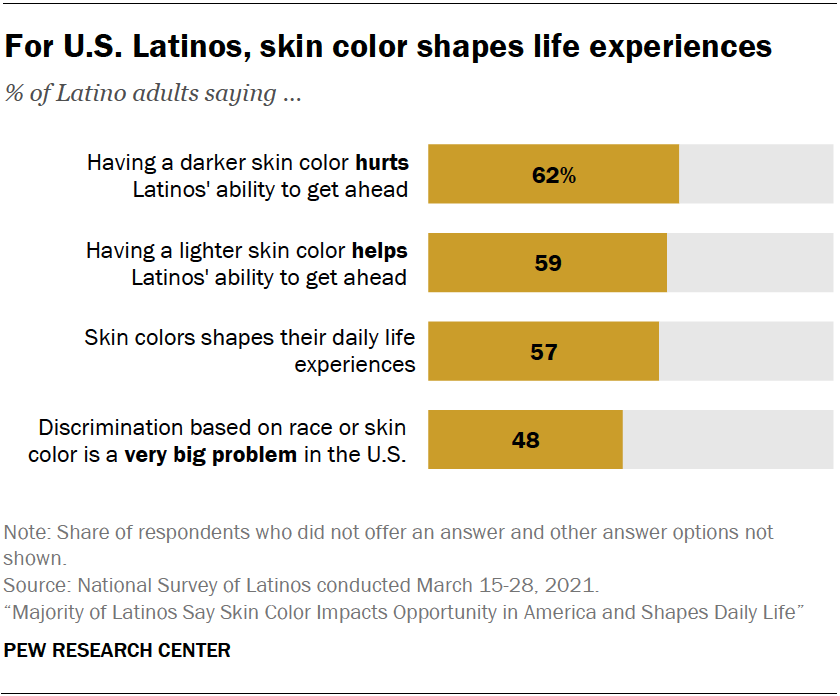
    The perceived impact of skin color in the lives of U.S. Latinos is broad. From impacting their ability to get ahead in the country to shaping their daily life experiences to dealing with discrimination, skin color is seen by Latinos as an important factor affecting their lives and life chances.

    A majority (62%) of Hispanic adults say having a darker skin color hurts Hispanics’ ability to get ahead in the United States today at least a little. A similar share (59%) say having a lighter skin color helps Hispanics get ahead. And 57% say skin color shapes their daily life experiences a lot or some, with about half saying discrimination based on race or skin color is a “very big problem” in the U.S. today, according to Pew Research Center’s National Survey of Latinos, a bilingual, national survey of 3,375 Hispanic U.S. adults conducted in March 2021.

    Colorism is a form of discrimination based on skin color, usually, though not always, favoring lighter skin color over darker skin color within a racial or ethnic group. While it can be tied to racism, it is not necessarily the same. (Racism is prejudice directed at members of a racial or ethnic group because of their origin.) For example, Hispanics in the U.S. may face discrimination because they are Hispanic (a form of racism), but the degree of discrimination may vary based on skin color, with those of darker shades experiencing more incidents (a form of colorism). And because of colorism’s deep roots in the histories of Latin America and the United States, discrimination based on skin color can occur among Hispanics just as much as it can be directed at Hispanics by non-Hispanics.

    To measure this dimension of Latino identity in the United States, the survey asked respondents to identify the skin color that best resembled their own using a version of the Yadon-Ostfeld skin-color scale. Respondents were shown ten skin colors that ranged from fair to dark (see text box below for the images and scale used). Fully 80% of Latino adults selected a color between one and four, or lighter skin colors, while 15% selected a color between five and ten on the scale, or darker skin colors.1

    Table of Contents

    • Majority of Latinos Say Skin Color Impacts Opportunity in America and Shapes Daily Life
      • Discrimination and skin color
      • Impact of race, skin color is a topic of conversation with relatives and friends for Hispanics
      • Half of Latinos say there is too little national attention on racial issues concerning Latino people
      • Hispanics often hear other Hispanics make racially insensitive comments and jokes about Hispanics and non-Hispanics alike
      • While Hispanics say skin color affects their ability to get ahead in America, other factors are seen as important as well
      • For Latinos, discrimination experiences and views about skin color and race are linked
    • 1. Half of U.S Latinos experienced some form of discrimination during the first year of the pandemic
    • 2. For many Latinos, skin color shapes their daily life and affects opportunity in America
    • 3. Latinos divided on whether race gets too much or too little attention in the U.S. today
    • 4. Measuring the racial identity of Latinos
    • Acknowledgments
    • Methodology
    • Appendix: Additional tables

    Read the entire report in PDF or HTML format.

  • The Ghost of Hendrix, and Fans Who Think I’m White

    The New York Times
    2021-11-03

    Tom Morello

    Mr. Morello has spent over three decades melding music and political activism as a power guitarist with Rage Against the Machine, Audioslave and Bruce Springsteen and the E Street Band, with the acoustic chords of the Nightwatchman and in protests around the country.

    In 1965, I literally integrated the town of Libertyville, Ill., at least according to the real estate agent who helped my mom and me find our first apartment.

    My Irish-Italian mom had excellent teaching credentials, but the school boards in Northern Illinois made clear that while as a single mother she was welcome to teach in their town, we would have to live elsewhere because we were an interracial family.

    I was the interracial part, as my dad is from Kenya. Libertyville, however, was willing to give my mom a shot, with the caveat that the residents of the apartment complex across the street from the school approved. Our helpful real estate agent assured the neighbors that this was no ordinary 1-year-old “Negro” child entering their building, but rather an exotic East African princeling. This false tale haunted me throughout my youth, but it gave my mom and me a toehold among the locals…

    Read the entire article here.

  • Interview with Virginia Summey, Part 1

    Merrittocracy: History to the People
    2019-08-22

    Keri Leigh Merritt, Host
    Atlanta, Georgia

    In the first part of my interview with Ginny Summey, an independent scholar, we talk about her forthcoming book on Elreta Melton Alexander, one of the first Black women to become a lawyer in the US, and North Carolina’s first Black woman district court judge. We also discuss the challenges and benefits of being independent scholars.

    Watch Part 2 of the interview here.

  • I have three different racial identities—white, Indian, and multiracial. It is not that I present as one more than the others; they are all whole and complete, and I am all of them. I identify as white when people blame white people for racism and call for them to be better, and as the Indian person who needs them to speak up in places where they hold power, and as the multiracial person who reminds everyone that the racial structures some imagine to be rigid quickly break down under the slightest scrutiny.

    Jaya Saxena, “Explaining My Multiracial Identity (So Others Don’t Do It For Me),” Catapult, January 4, 2017. https://catapult.co/stories/explaining-my-multiracial-identity-so-others-dont-do-it-for-me.

  • Language as a Kind of Home: Talking with Anne Liu Kellor

    The Rumpus
    2021-09-02

    Grace Loh Prasad


    Anne Liu Kellor

    How far do you need to travel to unlock the truth of your own heart? This is the central question in Anne Liu Kellor’s lyrical memoir Heart Radical: A Search for Language, Love, and Belonging, forthcoming from She Writes Press on September 7. Propelled by a spiritual quest and a longing to reconnect with the language her mother spoke to her growing up, Kellor left the comfort of her Pacific Northwest home to embark on a journey to Tibet and China in her twenties. Although it wasn’t her first time there—she’d visited before in college—this time she returned to China with a stronger resolve to find a sense of purpose and renew a part of her identity that felt stifled at home.

    After traveling to Lhasa, visiting a remote monastery, and almost losing her passport, Kellor set up a home base in Chengdu, a bustling metropolis in Western China that’s bigger than New York City. She found work teaching English to college and graduate students but quickly became overwhelmed with the workload and the stress of having to be a role model and tiptoeing around sensitive topics such as Tibet and Tiananmen. Without a job and determined to stay in Chengdu, she moved in with an artist friend, Yizhong, who soon became her lover.

    The safe shelter of her tender relationship with Yizhong allowed her to explore more confidently, develop her vocabulary, and pursue her creative impulses to paint and write in her journal. But even as her Mandarin fluency grew and she settled into a comforting rhythm, as a mixed-race and bicultural woman living in China she ultimately decided she wanted more—choosing a life that would be expansive enough to embrace all of her various identities.

    I spoke with Kellor in late July about her debut memoir, her relationship to language, her evolving impressions of China, and having the heart of a seeker…

    Read the entire interview here.

  • Explaining My Multiracial Identity (So Others Don’t Do It For Me)

    Catapult
    2017-01-04

    Jaya Saxena

    Tallulah Pomeroy

    Every time someone guesses wrong, I am the one to apologize.

    My mom always laughs when remembering how she was mistaken for an Irish nanny when taking me to the park as a baby. This was back when nannies were more likely to be Irish, when interracial marriages were less common, and long before I grew up to look like her in every way but my coloring. Sometimes I try to imagine how that conversation would go—“Excuse me, ma’am, I just wanted to inquire about your race and how it relates to the child you are holding”—and how dim you have to be to not realize a redhead can birth a brunette.

    They were always mistaken, and it was our job to correct them; otherwise we’d be lying. She’s American, not Irish. I am biologically hers. My mother is white and I am not. Or I am, and not, at the same time. Other people’s false assumptions about what people can and should look like, about who could possibly exist, became our burden…

    Read the entire article here.

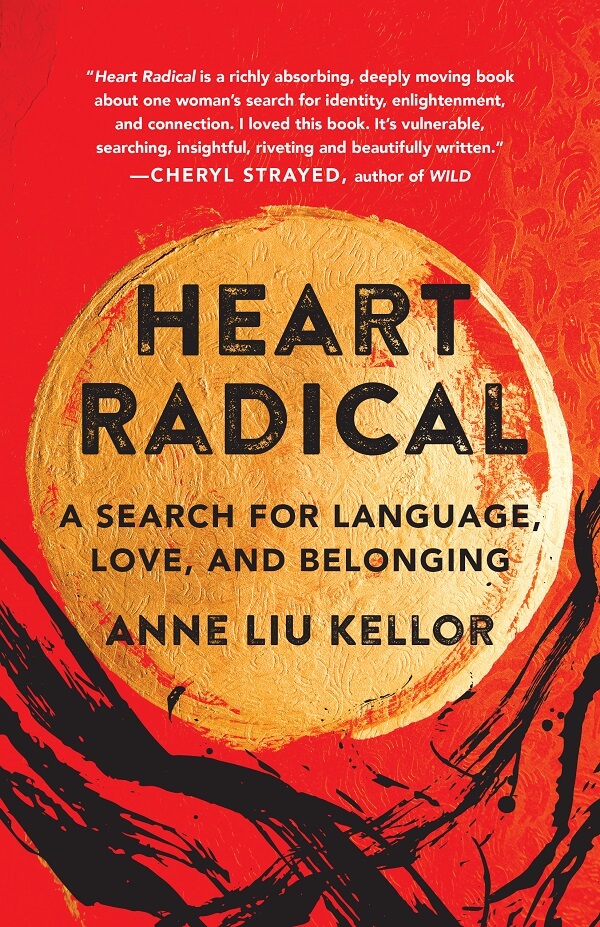
  • Heart Radical: A Search for Language, Love, and Belonging

    She Writes Press
    2021-09-07
    253 pages
    5.43 x 0.94 x 8.35 inches
    Paperback ISBN: 978-1647421731

    Anne Liu Kellor

    Wanting to understand how her path is tied to her mother tongue, Anne, a young, multiracial American woman, travels through China, the country of her mother’s birth. Along the way, she tries on different roles—seeker, teacher, student, girlfriend, artist, and daughter—and continually asks herself: Why do I feel called to make this journey?

    Whether witnessing a Tibetan sky burial, teaching English at a university in Chengdu, visiting her grandmother in LA, or falling in love with a Chinese painter, Anne is always in pursuit of intimacy with others, even as she is all too aware of her silences and separation. For two years, she settles into a comfortable routine in her boyfriend’s apartment and regains fluency in Chinese, a language she spoke as a young child but has used less and less as an adult. Eventually, however, her desire to know herself in other ways surfaces again. She misses speaking English, she feels suffocated by urban, polluted China, and she starts to fall for another man. Ultimately, Anne realizes that to live her truth as a mixed-race, bilingual woman she must embrace all of her influences and layers. In a world that often wants us to choose a side or fit an ideal, she learns that she can both belong and not belong wherever she is, and that home is ultimately found within.

  • Identity as a Hall of Mirrors: Descent by Lauren Russell

    The Rumpus
    2020-10-07

    Jesi Buell (Bender)

    Lauren Russell, Descent (Grafton, Vermont: Tarpaulin Sky Press, 2020).

    A while back, my husband and I took DNA ancestry tests. When the results come in, they give you a map with circles colored in to indicate where your ancestors came from. My husband’s blue-green circles swallowed almost the entire world. Mine, on the other hand, was a dot above England and Ireland with a small opaque dip down into Germany. One tiny point in the entirety of the world. It reminded me of a Conan O’Brien segment where he did his own test and it came back one hundred percent Irish.

    I’m not sure if it was a bit but the technician told him it was a certainty that his family was inbred. Joking aside, it struck me then that how we see ourselves and how we understand the past can be, for some people, as simple as looking into a mirror and, for others, as complicated as walking through a hall of mirrors.

    As a biracial woman, Lauren Russell examines her history in Descent through many mirrors, from both personal and cultural memories, and through prose, verse, and historical documents, to better understand herself. The title itself suggests a delving, a digging into, and we join Russell as she explores her family’s past like a new land, like something that has long been buried.

    In my high school U.S.
    History class, when we
    got to the part on the
    inhumanity of slave
    holders, I said,
    “Actually, I am
    descended from slave
    holders.” For some
    reason nobody stated
    the obvious: that I am
    also descended from
    slaves

    Read the entire review here.

  • Descent

    Tarpaulin Sky Press
    2020-06-02
    120 pages
    6 x 0.4 x 9 inches
    Paperback ISBN: 9781939460219

    Lauren Russell

    In 2013, poet Lauren Russell acquired a copy of the diary of her great-great-grandfather, Robert Wallace Hubert, a Captain in the Confederate Army. After his return from the Civil War, he fathered twenty children by three of his former slaves. One of those children was the poet’s great-grandmother. Through several years of research, Russell would seek the words to fill the diary’s omissions and to imagine the voice of her great-great-grandmother, Peggy Hubert, a black woman silenced by history. The result is a hybrid work of verse, prose, images and documents that traverses centuries as the past bleeds into the present.