• I Am Radar: A Novel

    Penguin Press
    2015-02-24
    672 pages
    Hardcover ISBN: 9781594206160

    Reif Larsen

    The moment just before Radar Radmanovic is born, all of the hospital’s electricity mysteriously fails. The delivery takes place in total darkness. Lights back on, the staff sees a healthy baby boy—with pitch-black skin—born to the stunned white parents. No one understands the uncanny electrical event or the unexpected skin color. “A childbirth is an explosion,” the ancient physician says by way of explanation. “Some shrapnel is inevitable, isn’t it?”

    A kaleidoscopic novel both heartbreaking and dazzling, Reif Larsen’s I Am Radar begins with Radar’s perplexing birth but rapidly explodes outward, carrying readers across the globe and throughout history, as well as to unknown regions where radio waves and subatomic particles dance to their own design. Spanning this extraordinary range with grace and empathy, humor and courage, I Am Radar is the vessel where a century of conflict and art unite in a mesmerizing narrative whole.

    Deep in arctic Norway, a cadre of Norwegian schoolteachers is imprisoned during the Second World War. Founding a radical secret society that will hover on the margins of recorded history for decades to come, these schoolteachers steal radioactive material from a hidden Nazi nuclear reactor and use it to stage a surreal art performance on a frozen coastline. This strange society appears again in the aftermath of Cambodia’s murderous Khmer Rouge regime, when another secret performance takes place but goes horrifically wrong. Echoes of this disaster can be heard during the Yugoslavian wars, when an avant-garde puppeteer finds himself trapped inside Belgrade while his brother serves in the genocidal militia that attacks Srebrenica. Decades later, in the war-torn Congo, a disfigured literature professor assembles the largest library in the world even as the country around him collapses. All of these stories are linked by Radar—now a gifted radio operator living in the New Jersey Meadowlands—who struggles with love, a set of hapless parents, and a terrible medical affliction that he has only just begun to comprehend

    As I Am Radar accelerates toward its unforgettable conclusion, these divergent strands slowly begin to converge, revealing that beneath our apparent differences, unseen harmonies secretly unite our lives. Drawing on the furthest reaches of quantum physics, forgotten history, and mind-bending art, Larsen’s I Am Radar is a triumph of storytelling at its most primal, elegant, and epic: a breathtaking journey through humanity’s darkest hours only to arrive at a place of shocking wonder and redemption.

  • Deconstructing Pseudo-Scientific Anthropology: Anténor Firmin and the Reconceptualization of African Humanity

    The Journal of Pan African Studies
    Volume 7, Number 2, August 2014
    pages 9-33

    Gershom Williams, Adjunct Professor of African-American History and African-American Studies
    Mesa Community College, Mesa, Arizona

    “The science of inequality is emphatically a science of White people. It is they who have invented it, and set it going, who have maintained, cherished and propagated it, thanks to their observations and their deductions.” –Jean Finot, Race Prejudice (1907)

    “A preponderance of (fossil) and genetic evidence has revealed, virtually beyond a doubt, that the same Europeans who created the idea of race and White supremacy are the genetic progeny of the very Africans they devalued.” –Salim Muwakkil, Chicago Tribune

    Abstract

    Euro-American ideas and assumptions regarding African innate inferiority and racial inequality are central to the pseudo-scientific ‘race myth’ of White supremacy. In their search to find an expedient explanation, rationalization and justification for the horrific holocaust of enslavement, Europeans and later White Americans developed the international thesis and concept of African biological and intellectual inferiority.

    In this exploratory essay, I am endeavoring to present a critical review of the anti-racist, vindicationist tradition of African American and Haitian intellectuals who challenged, rejected and refuted the ‘scientific racism’ of Euro-American ethnologists, Egyptologists, anthropologists, historians, philosophers, and physicians.

    In another essay that we discuss in the contents of this manuscript, anti-racist theorists Stepan and Gilman argue that those stigmatized and stereotyped by the ideology of ‘scientific racism’ published prolific counter narratives that remain obscured and unrecognized by the historians of mainstream science.

    What did the men and women of African descent in the diaspora, categorized by the biological, medical and anthropological sciences as racially inferior have to say about the matter? How did they respond to the charges and claims made about them in the name of science? In seeking to provide credible answers to the latter questions, we are re-visiting the powerful and illuminating publications by Black American and Haitian writers of the pre-Antènor Firmin era which are viable proof of the vindicationist tradition inherent among diasporan Black intellectuals. This school or community of literate intellectuals boldly offers a passionate and consistent rhetoric of resistance to economic and psychological enslavement and the mis-education of their people.

    This essay remembers and pays homage to those public intellectuals of the early and late nineteenth century who dared to disagree with popular opinion and proceeded to debate the dangerous discourse of race and the fallacy of White supremacy. Central to our narrative are the names and voices of David Walker, Lydia Maria Child, Frederick Douglass, Martin R. Delaney and George Washington Williams. All of the aforementioned writers preceded the publication of Haitian scholar and statesmen Joseph Antènor Firmin’s The Equality of the Human Races in 1885. Haitian anthropologist, Egyptologist, Pan-Africanist and politician J. Antènor Firmin did not rise out of an intellectual vacuum to conduct study and research for his massive and masterful manuscript.

    As I attempt to demonstrate in this paper, there is a long standing pre and post Firmin intellectual tradition in the United States and Haiti during the early nineteenth and continuing throughout the twentieth century. Like many of the intellectuals already mentioned, Antènor Firmin (a descendant of the Haitian intellectual Maroons) obviously did not possess an inferiority complex. He was not intellectually intimidated by the dominant thinking and behavior of the advocates of racial ranking and hierarchy.

    A bold and brilliant thinker, he re-envisioned and re-conceptualized the image and pre-colonial cultural heritage of African descended people. Lastly, my essential purpose in presenting this paper is to convey to the reader(s) that prior to the invention and propagation of the ‘race myth’, the concept and belief in Black inferiority was non-existent.

    As classicist historian Frank M. Snowden Jr. writes in his iconic text, Before Color Prejudice: The Ancient View of Blacks, “…Nothing comparable to the virulent color prejudice of modern times existed in the ancient world. This is the view of most scholars who have examined the evidence and who have come to conclusions such as these: The ancients did not fall into the error of biological racism; Black skin color was not a sign of inferiority…” (Snowden 1983: 63) By confronting and deconstructing the multitude of racial myths and stereotypes fashioned by Euro-Americans centuries ago, Antènor Firmin and others who believed in liberty, equality and fraternity could dismantle and destroy the foundational pillars of scientific racism. It is indeed instructive to remember what anthropologist Melville J. Herskovits stated a half century ago. “…The myth of the Negro (African) past is one of the principal supports of race prejudice in this
    country…”

    Read the entire article here.

  • Brittany Howard of the Alabama Shakes: “I Don’t Think About Color”

    Black Entertainment Television
    2013-06-25

    Clay Cane

    Brittany Howard of the Alabama Shakes: “I Don’t Think About Color”

    If you haven’t heard of Brittany Howard of the Alabama Shakes, the 24-year-old is making jaws drop in the music industry. Armed with ferocious vocals, passionate lyrics and a dynamic presence — on and off stage — Howard as the front woman of the Alabama Shakes is bringing rock and blues back from the grave for a new generation.

    On Sunday night at the Capital Theatre in Port Chester, NY, the Grammy-nominated Alabama Shakes performed to a sold-out show, performing music from their latest album Boys & Girls. Hours before hitting the stage, Brittany was prepping for her first one-on-one interview with BET.com.

    Just finishing a cigarette, Howard sat down to discuss her roots, music and fame. Although surprisingly reserved, the Athens, AL, native possessed a quiet strength. Interviews, celebrity and folks wanting to know your business is new for Brittany and the band who never strived be the next big thing in music: “It’s a miracle that we are sitting in Port Chester, New York doing an interview with BET. Like, what the hell?”

    When did you first fall in love with rock music?
    Sitting in my grandmother’s kitchen, she always had solid golden oldies on the radio. The grittiest music, I was like, “That’s my s–t.”

    You’re often compared to ’60’s rocker Janis Joplin. How do you feel about that comparison?
    People hear a powerful female singer in a rock and roll band and they say, “Janis Joplin.” I think people just make that comparison because it’s easy. But I don’t think I sound like her at all. What do you think?…

    …What is your racial background?
    Mom is white, dad is Black.

    Do you identify as Black, mixed — how do you see yourself?
    I’m both. Everything and nothing…

    Read the entire interview here.

  • “General Heads,” Great Minds, and the Genesis of Scientific Racism

    Journal for Early Modern Cultural Studies
    Volume 15, Number 2, Spring 2015
    pages 112-118

    Robin Runia, Assistant Professor of English
    Xavier University of Louisiana, New Orleans, Louisiana

    It is commonly presum’d that the Heat of the Climate wherein they live, is the reason, why so many Inhabitants of the Scorching Regions of Africa are Black; and there is this familiar Observation to Countenance this Conjecture, That we plainly see that Mowers, Reapers, and other Countrey-people, who spend the most part of the Hot Summer dayes expos’d to the Sun, have the skin of their Hands and Faces, which are the parts immediately Expos’d to the Sun and Air, made of a Darker Colour than before, and consequently tending to Blackness; And Contrarywise we observe that the Danes and some other people that Inhabit Cold Climates, and even the English who feel not so Rigorous a Cold, have usually Whiter faces than the Spaniards, Portugalls and other European Inhabitants of Hotter Climates. But this Argument I take to be far more Specious than Convincing. (153–54)

    There is another Opinion concerning the Complexion of Negroes, that . . . the Blackness of Negroes [is] an effect of Noah’s Curse ratify’d by God’s, upon Cham; But though I think that even a Naturalist may without disparagement believe all the Miracles attested by the Holy Scriptures, yet in this case to flye to a Supernatural Cause, will, I fear, look like Shifting off the Difficulty, instead of Resolving it; for we enquire not the First and Universal, but the Proper, Immediate, and Physical Cause of the Jetty Colour of Negroes; And not only we do not find expressed in the Scripture, that the Curse meant by Noah to Cham, was the Blackness of his Posterity, but we do find plainly enough there that the Curse was quite another thing, namely that he should be a Servant of Servants, that is by an Ebraism, a very Abject Servant to his Brethren. . . . Nor is it evident that Blackness is a Curse, for Navigators tell us of Black Nations, who think so much otherwise of their own condition, that they paint the Devil White. Nor is Blackness inconsistent with Beauty, which even to our European Eyes consists not so much in Colour, as an Advantageous Stature, a Comely Symmetry of the parts of the Body, and Good Features in the Face. So that I see not why Blackness should be thought such a Curse to the Negroes, unless perhaps it be, that being wont to go Naked in those Hot Climates, the Colour of their Skin does probably, according to the Doctrine above deliver’d, make the Sunbeams more Scorching to them, than they would prove to a people of a White Complexion. (159–60)

    Greater probability there is, That the Principal Cause (for I would not exclude all concurrent ones) of the Blackness of Negroes is some Peculiar and Seminal Impression. (161)

    —Robert Boyle, Experiments and Considerations Touching Colours (1664)

    The above extracts present Robert Boyle’s delineation of racialized difference, as produced and evaluated by the Royal Society; this delineation, production, and evaluation is the lifeblood of Cristina Malcolmson’s Studies of Skin Color in the Royal Society. Exploring the development of the modern notion of race within the context of colonialism, Malcolmson argues that “the attention to skin color in the Royal Society allowed racialization to develop and eventually flourish within the practices of the new science” (7). Specifically, attention to the imbrication of this process within institutional and economic commitments to British imperial dominance helps to fill in the gaps between an attention to skin color, consideration of its causes, and the dehumanization and subjugation of non-European individuals. Malcolmson’s focus on the Royal Society’s activities and publications and on Margaret Cavendish’s and Jonathan Swift’s reactions to them provides an important and nuanced contribution to the recent scholarship in this area as well as a call for additional work to be done.

    The value of this volume lies in Malcolmson’s thorough presentation of compelling evidence and insightful close readings that expose the Royal Society’s complicity in the spread of racialized discourse and racist thought. In addition, Malcomson’s original contributions to scholarship on the historical construction of race include her critique of polygenesis as inherently racist and her methodical…

  • 6 things I wish people understood about being biracial

    Vox
    2015-03-11

    Jenée Desmond-Harris, Race, Law, and Politics Reporter

    According to the results of a DNA test I took recently, my ancestors on my father’s side are mostly from West Africa (via Arkansas), and the ones on my mom’s side come from Europe. When strangers inquire about my racial background, I tend to try to de-escalate their interest. I say things like, “I’m just your run-of-the-mill mixed person with a white mom and a black dad.” In other words: nothing super exotic. Nothing to see here.

    Why am I so dismissive? I’m a little self-conscious about engaging in excessive navel-gazing regarding my racial identity. It hasn’t been particularly difficult for me to manage. If anything, it may have made life easier for me and meant I’ve encountered less racism than people who have two parents who identify as black. I definitely don’t consider myself a “tragic mulatto.”

    And with 9 million Americans selecting more than one race on the last Census — not to mention a president who has a white mother and a black father — it’s hard to argue that being “mixed,” “multiracial,” or “mulatto” (I’ve been called all of those) in 2015 is really all that unusual.

    But I can’t deny that as long as race and racism are hot topics in our culture, biracial and multiracial people will continue to be a source of curiosity and fascination. Confession: even I find myself looking a little longer at mixed-race families on the streets of Washington, DC, craning my head to see which parent the children resemble most and wondering how they’ll see themselves. As a writer, I’ve been amazed by the way articles about interracial couples, families, or biracial children intrigue readers every single time. My guess is that it’s because these stories provide fodder for people to grapple with the nuances of their own identities and push the limits of racial categories, which is itself sort of fascinating.

    So there’s nothing wrong with the continued curiosity about the experience of biracial people — whether their parents identify as black and white or some other combination society sees as interesting — but there are a few things I’d like people to know about those of us who are living it…

    Read the entire article here.

  • EXCLUSIVE: Michelle Obama’s mother was worried about her daughter marrying a biracial man

    The New York Daily News
    2015-03-18

    Celeste Katz

    Long before Michelle Obama became First Lady, her mother had misgivings about her marrying a young man named Barack Obama — because he was biracial.

    In a Chicago TV interview that aired during Obama’s 2004 U.S. Senate campaign — and newly resurrected by Michelle Obama biographer Peter Slevin in a book due out next monthMarion [Marian] Robinson confessed to being “a little bit” wary about her future son-in-law being the product of a white mom and black dad.

    But it could’ve been worse, according to Robinson…

    Read the entire article here.

  • Fifteen Projects Selected for Tribeca Film Institute All Access Grants

    Filmaker
    2015-03-19

    Scott Macaulay, Editor-in-chief

    Fifteen works — scripted, documentary and interactive — were selected today for the Tribeca Film Institute‘s All Access program, which offers grant monies and other non-monetary support to projects by creators from statistically underrepresented communities. The projects were chosen from a submission pool of 710 entries. In addition to the 15 projects, two filmmakers from the LGBT community were chosen to take part in TFI Network Market, a one-on-one industry meeting forum, with their feature films. They are Ingrid Jungermann, a 25 New Face appearing with her project Women Who Kill, and Hernando Bansuelo, with Martinez, CA.

    The complete list of selected projects, from the press release, is below…

    So Young So Pretty So White: Directed by Chanelle Aponte Pearson and Terence Nance; produced by Yaba Blay and Michelle Serieux. Weaving together the lives of several compelling men and women from across the globe, the film is a window into the world of skin bleaching, unveiling what drives people to lighten their skin and the complex factors that make it difficult to stop…

    Read the entire article here.

  • New Orleans Loving Festival

    2015-03-21

    The New Orleans Loving Festival™ is a Multiracial Community Celebration and Film Festival that challenges racism through outreach and education. The “Loving Festival” was inspired by the actions of a Hammond, Louisiana Justice of the Peace who refused to issue a marriage license to an interracial couple in 2009.

    The festival is an important community platform for showcasing films and other creative works that explore racial stereotypes and inspire people to work together for racial justice.

    The Loving Festival is modeled after Loving Day multicultural celebrations across the country that organize people to fight racial prejudice through education and build multicultural community. The Loving Festival also honors the legacy of Richard and Mildred Loving, the interracial couple whose 1967 landmark civil rights lawsuit “Loving v. Virginia” ended all race-based legal restrictions on marriage in the United States.

    For more information, visit the website or the Facebook page.

  • Scholar’s debut novel ties black, Native-American history

    The Detroit Free Press
    2015-03-22

    Cassandra Spratling

    Tiya Miles got it honest.

    Straight from her grandmother’s garden. That knack for telling stories that pull at your heartstrings.

    “I’m one of those people who had a storytelling grandma,” says Miles. “We’d be in the garden or snapping peas on the porch and my grandma would be telling stories, about life in Mississippi, about how the family lost their farm to a white man, about how they came up North on a train. Those stories riveted me and they shaped me.

    “If my grandmother had had my life, she would have won three MacArthur Fellowships,” Miles says of her grandmother, the late Alice King.

    But it was Miles, 45, who was granted a prestigious MacArthur Fellowship in 2011, and it was that award that gave her the shot of confidence she needed to up her game and write her first novel, which will be released next month.

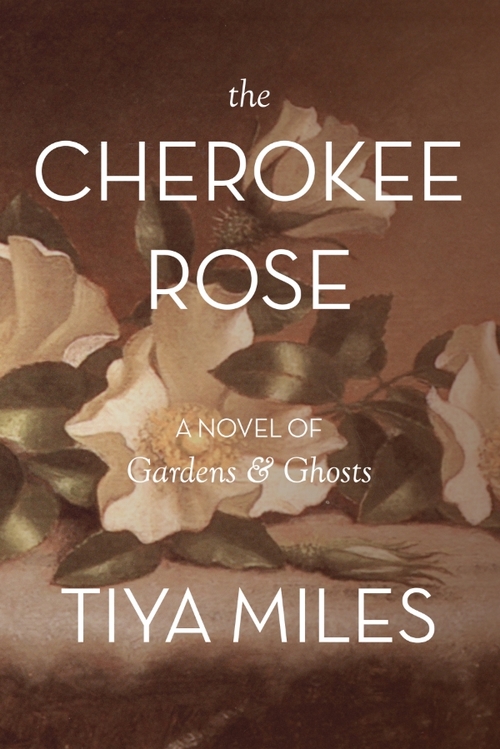
    Friends and coworkers at the University of Michigan are hosting a book launch party for “the Cherokee Rose” (John F. Blair, $26.95) Tuesday…

    …Not that she doesn’t greatly appreciate the fellowship that annually doles out a ton of money to selected people in a variety of areas so that they can pursue their areas of interest, unencumbered by money woes.

    Without it, she doubts she would have completed “the Cherokee Rose,” a novel that uses three modern day women to take readers on a haunting, sometimes horrific, but redemptive journey to a little-known past on a Southern plantation where Native-American and African-American lives were intertwined. In the process, the women make unexpected connections to one another and others…

    Read the entire article here.

  • The Cherokee Rose: A Novel Of Gardens & Ghosts

    John F. Blair
    2015-04-07
    264 pages
    6×9
    Hardcover ISBN: 978-0-89587-635-5

    Tiya Miles, Elsa Barkley Brown Collegiate Professor of African American Women’s History
    University of Michigan

    Written by an award-winning historian and recipient of a recent MacArthur “Genius Grant,” The Cherokee Rose explores territory reminiscent of the bestselling and beloved works of Alice Walker, Octavia Butler, and Louise Erdrich. Now, Tiya Miles’s luminous but highly accessible novel examines a little-known aspect of America’s past—slaveholding by Southern Creeks and Cherokees—and its legacy in the lives of three young women who are drawn to the Georgia plantation where scenes of extreme cruelty and equally extraordinary compassion once played out.

    Based on the author’s in-depth and award-winning research into archival sources at the Chief Vann House Historic Site in Chatsworth, Georgia, and the Moravian mission sponsored there in the early 1800s, Miles has blended this fascinating history with a contemporary cast of engaging and memorable characters, including Jinx, the free-spirited historian exploring her tribe’s complicated racial history; Ruth, whose mother sought refuge from a troubled marriage in her beloved garden and the cosmetic empire she built from its bounty; Cheyenne, the Southern black debutante seeking to connect with a meaningful personal history; and, hovering above them all, the spirit of long-gone Mary Ann Battis, a young woman suspected of burning a mission to the ground and then disappearing from tribal records. Together, the women’s discoveries about the secrets of the Cherokee plantation trace their attempts to connect with the strong spirits of the past and reconcile the conflicts in their own lives.