• Diversity Week Keynote Speaker 2015: “One Drop of Love” perfomed by Fanshen DiGiovanni Cox

    Miami University
    Oxford-Armstrong Student Center
    Harry T. Wilks Theater
    550 E. Spring Street
    Oxford, Ohio
    Thursday, 2015-03-12, 19:00-21:00 EDT (Local Time)

    One Drop of Love produced by Ben Affleck and Matt Damon, performed by Fanshen Cox Digiovanni is a multimedia solo show that tells the story of how the notion of ‘race’ came to be in the United States. In addition, Fanshen whom is of mixed race shares personal accounts of how it affected the relationship with her father.

    Every spring, specifically in the month of March, the Diversity Affairs Council (DAC) plans and coordinates a week-long program known as “Diversity Week.” This week serves as a campaign that seeks to raise awareness of social differences, promote an appreciation for such differences, and encourage open dialogue about topics involving diversity.

    The Diversity Keynote Address provides an opportunity for open dialogue about various diversity topics with students and the speaker.

    For more information, click here.

  • Color Erases, Color Paints

    Tablet: A New Read on Jewish Life
    2015-03-10

    Isaiah Rothstein

    Each day this week, the Scroll will be featuring a post from a writer at JN Magazine—short for “Jewnited Nations”—a website “here to change the monochromatic monolithic perception of Judaism.” Each post has been commissioned and edited by MaNishtana, the pseudonym of Shais Rishon, a Tablet contributor and editor-at-large at JN Magazine.

    Growing up mixed race in Monsey, N.Y.

    I often relate to my peer group that both my maternal and paternal ancestors were slaves: As Hebrews in the desert hills of Egypt, and as Africans on the southern plantations of Alabama.

    “And he (Moses) called his (son’s) name Gershom, because he was a stranger in a strange land.” (Exodus 2:22)

    I grew up in the Orthodox Jewish community of Monsey, N.Y. With my peyot until I was 10 years old and my father’s unwavering affiliation with the Chabad Lubavitch movement, I think it would be safe to say I was raised in what one would call the Haredi community. But our Thanksgiving family reunions revealed a whole other aspect of my family tree, and from a young age I was forced to consider what my own identity would be and what I would make my legacy.

    Once Tanya Maria Robertson, my mother split her own sea and converted to Judaism in 1982, becoming Shulamit Geulah Rothstein. And so, as with her own parents, two worlds came together, creating another dimension of civil rights and Jewish unity: the Rothstein family. But with such realities came great complexity…

    Read the entire article here.

  • IRRPP Annual Bowman Lecture: Fatal Invention: Why The Politics of Race and Science Still Matters

    Institute for Research on Race and Public Policy
    University of Illinois, Chicago
    Student Center East
    750 S. Halsted St, Room 302
    Chicago, Illinois
    2015-03-12, 16:00 CDT (Local Time)

    Dorothy Roberts, Professor of Law and Sociology
    University of Pennsylvania

    Co-sponsors: Medical Education, Institute for the Humanities Health and Society Working Group, Gender & Women’s Studies, Sociology, Biocultures, Racialized Body Cluster, African American Studies

    An acclaimed scholar of race, gender, and the law, Professor Dorothy Roberts is the fourteenth Penn Integrates Knowledge Professor, George A. Weiss University Professor, and the inaugural Raymond Pace and Sadie Tanner Mossell Alexander Professor of Civil Rights at University of Pennsylvania. She holds appointments in the Law School and Departments of Africana Studies and Sociology. Professor Roberts received her Doctor of Jurisprudence from Harvard Law School.

    This lecture was established to honor Phillip J. Bowman’s contributions to UIC during his tenure as Director of IRRPP and Professor of African American Studies. It features national scholars of race, ethnicity, and public policy who provide timely analysis of issues of critical importance to the field and to communities of color.

    For more information, click here.

  • Don’t Starve the Census

    The New York Times
    2015-03-10

    The Editorial Board

    Some Republicans in Congress are calling for cuts to the Census Bureau’s budget that would impair the agency’s already strained ability to gather basic data.

    An accurate census is essential to determining the correct number of representatives from each state, the effectiveness of voting laws and the allotment of federal aid to states. In fact, information from the census and other surveys by the bureau is crucial to anyone — policy makers and businesspeople, researchers and citizens — who wants to understand the United States, assess where it is headed and influence its course on the basis of hard data.

    The White House has requested a slim $1.5 billion for the bureau for fiscal year 2016. Much of that would be for the 2020 census, the planning of which is already behind schedule because of previous budget cuts. Next year is critical for the testing of data-gathering technology; Congress’s failure to provide timely financing to try out hand-held computers before the 2010 census forced a last-minute reversion to paper forms, which proved costlier than an orderly roll out of the computers would have been…

    Read the entire article here.

  • Bodies Under Re/view? Mediating Racial Blackness

    InVisible Culture: An Electronic Journal for Visual Culture
    2013-08-20

    Tiffany E. Barber, Adjunct Instructor African and African American Studies
    University of Oklahoma

    “In our allegedly postracial moment, where simply talking about racism openly is considered an impolitic, if not racist, thing to do, we constantly learn and re-learn racial codes. [. . .] In short, it was Trayvon Martin, not George Zimmerman, who was put on trial. He was tried for the crimes he may have committed and the ones he would have committed had he lived past 17.” – Robin D.G. Kelley, “The U.S. v. Trayvon Martin: How the System Worked

    In a 1995 keynote address titled “On Identity Politics,” critical race theorist Mari J. Matsuda cautions against assumptions “that racial identity is the cause of racial division rather than a product of it.” For Matsuda, critical race theory emerges “[o]ut of the struggle to understand the ways in which mainstream legal consciousness is white, male, Christian, able-bodied, economically privileged, and heterosexual.” That is, how legal consciousness itself signifies a type of whiteness that excludes and marginalizes difference, difference that is seen in opposition to this constructed whiteness – i.e. black and other non-white subjects, queer subjects, women subjects, and so on. Matsuda’s assertions bring into relation a politics of law, race, and gender that persist today, and demand a consideration of what these mediated relationships tell us about histories of identity formation particular to race, gender and sexuality in the U.S….

    …To address these questions, I turn to two cases of precedence that establish relations between the U.S. justice system, racial blackness, and visuality. In 1921, Leonard ‘Kip’ Rhinelander, an affluent white male from a wealthy New York family met and courted Alice Beatrice Jones, a working-class woman of mixed-race ancestry. Jones’s fair skin color permitted her to pass for white and it is unclear whether or not she self-identified as white. Over the next few years, Rhinelander and Jones grew closer and shared a number of intimate encounters, at least two of which were known to be sexual. The couple eloped in October 1924 and enjoyed secluded bliss – Rhinelander’s parents did not approve of Jones – until scandal ripped through the relationship. Soon after, Rhinelander filed for an annulment. The charge? Racial fraud; Rhinelander claimed Jones had misrepresented her blackness…

    Read the entire article here.

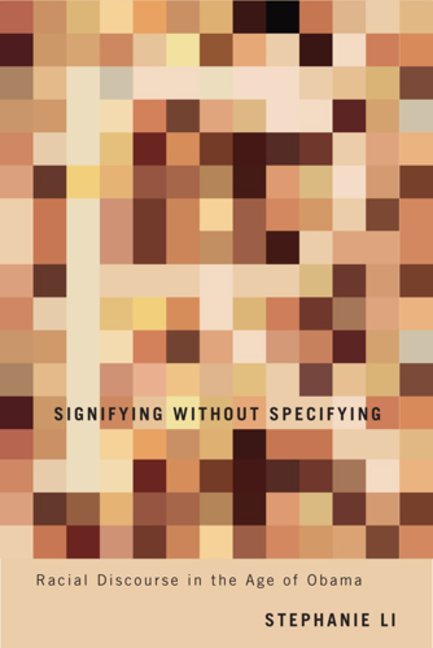
  • Signifying without Specifying: Racial Discourse in the Age of Obama

    Rutgers University Press
    2011-11-01
    218 Pages
    Cloth ISBN: 978-0-8135-5143-2
    Paper ISBN: 978-0-8135-5144-9
    eBook ISBN: 978-0-8135-5210-1

    Stephanie Li, Professor of English
    Indiana University, Bloomington

    On the campaign trail, Barack Obama faced a difficult task—rallying African American voters while resisting his opponents’ attempts to frame him as “too black” to govern the nation as a whole. Obama’s solution was to employ what Toni Morrison calls “race-specific, race-free language,” avoiding open discussions of racial issues while using terms and references that carried a specific cultural resonance for African American voters.

    Stephanie Li argues that American politicians and writers are using a new kind of language to speak about race. Challenging the notion that we have moved into a “post-racial” era, she suggests that we are in an uneasy moment where American public discourse demands that race be seen, but not heard. Analyzing contemporary political speech with nuanced readings of works by such authors as Toni Morrison, Jhumpa Lahiri, and Colson Whitehead, Li investigates how Americans of color have negotiated these tensions, inventing new ways to signal racial affiliations without violating taboos against open discussions of race.

    Table Of Contents

    • Preface
    • Acknowledgments
    • Introduction
    • 1. Violence and Toni Morrison’s Racist House
    • 2. Hiding the Invisble Hurt of Race
    • 3. The Unspeakable Language of Race and Fantasy in the Stories of Jhumpa Lahiri
    • 4. Performing Intimacy: “Race-Specific, Race-Free Language” in Political Discourse
    • Conclusion: The Demands of Precious
    • Notes
    • Bibliography
    • Index
  • First Look at Matthew McConaughey in The Free State of Jones

    ComingSoon.net
    2015-03-09

    Max Evry

    Motion picture and television studio STX Entertainment has begun principal photography on the theatrical feature The Free State of Jones in and around New Orleans, Louisiana, it was announced by Adam Fogelson, Chairman of STX Entertainment’s Motion Picture Group.

    The epic action-drama is written and directed by four-time Oscar nominee Gary Ross (The Hunger Games, Seabiscuit, Pleasantville), and stars Oscar-winner Matthew McConaughey (Interstellar, Dallas Buyers Club), Gugu Mbatha-Raw (Beyond the Lights), Keri Russell (Dawn of the Planet of the Apes) and Mahershala Ali (The Hunger Games: Mockingjay Part 1, “House of Cards”)…

    …Set during the Civil War, The Free State of Jones tells the story of defiant Southern farmer Newt Knight, and his extraordinary armed rebellion against the Confederacy. Banding together with other small farmers, and with the assistance of local slaves, Knight launched an uprising that led Jones County, Mississippi to secede from the Confederacy, creating a Free State of Jones.

    His marriage to a former slave, Rachel, and his subsequent establishment of a mixed race community was unique in the post-war South. Knight continued his struggle into Reconstruction, which distinguished him as a compelling, if controversial, figure of defiance long beyond the War.

    Read the entire article here.

  • Madison Police Shooting: Not Just About Race Because Victim Was Biracial, Family Says

    ABC News
    2015-03-09

    Meghan Keneally, Digital Reporter

    The uncle of the 19-year-old who was fatally shot by a police officer in Madison, Wisconsin, over the weekend said that his nephew “just wanted to be loved.”

    Tony Robinson Jr., who was known to his family as Tyrell, was fatally shot by a police officer on Friday and the incident is now the subject of a state Department of Justice investigation.

    Robinson’s mother is white and his father is African American, and at a news conference this afternoon, Robinson’s uncle, Turin Carter, spoke out on behalf of the family about how this is a universal issue that should be understood by people of all races…

    Read the entire article here.

  • Wisconsin chief treading carefully after fatal shooting

    The Washington Post
    2015-03-08

    The Associated Press

    MADISON, Wis. — Within hours of a white officer shooting an unarmed black man, the police chief of Wisconsin’s capital city was praying with the man’s grandmother, hoping to strike a conciliatory tone and avoid the riots that last year rocked Ferguson, Missouri.

    Chief Mike Koval said he knows Madison is being watched across the nation since 19-year-old Tony Robinson’s death Friday evening, and he has gone out of his way to avoid what he once called Ferguson’s “missteps.”

    “Folks are angry, resentful, mistrustful, disappointed, shocked, chagrined. I get that,” Koval said Saturday. “People need to tell me squarely how upset they are with the Madison Police Department.”

    The contrasts with Ferguson are many…

    Read the entire article here.

  • Book Discussion on A Chosen Exile

    C-SPAN: Created by Cable

    Recorded on 2015-02-27 at:

    The National Archives Museum
    William G. McGowan Theater
    Washington, D.C.

    Allyson Hobbs talked about her book A Chosen Exile: A History of Racial Passing in American Life, in which she examines the lives of African Americans who chose to pass as white between the 18th and mid-20th centuries. In her book, the author reports on the political and social ramifications of “passing,” which included greater rights and opportunities but also isolation and disregard from the greater African American community.

    [I ask Dr. Hobbs the final question for her at 00:56:26.]

    Watch the entire video and read the transcript here.