• Panel discusses effect of race in relationships in second interracial dating panel

    The Daily Northwestern: Northwestern and Evanston’s Only Daily News Source Since 1881
    Evanston, Illinois
    2015-03-06

    Emily Chin, Assistant Campus Editor

    Jakara Hubbard said she has been told throughout her life that her race is a problem and must be difficult to deal with.

    Hubbard, who identifies as mixed race, spoke Thursday about different perspectives about mixed-race people during a panel on interracial dating at Northwestern.

    The panel, hosted by the Mixed Race Student Coalition, discussed how relationship dynamics differ in monoracial and interracial relationships before a room of more than 80 people. The panel was a celebration of Loving Days, a series of events that commemorate the Supreme Court case Loving v. Virginia, which legalized interracial marriage.

    Panelists included Hubbard, a couple and family counselor, Cristina Ortiz, a graduate student at the University of Chicago, and Kai Green, a postdoctoral fellow at NU…

    Read the entire article here.

  • Tangled Roots: Celebrating mixed race people and families

    Tangled Roots
    2015-03-04

    Tangled Roots publishes books, and stages events and performances which explore the mixed race experience in the UK

    NOW ACCEPTING STORIES FOR OUR NEXT BOOK!

    Submission Guidelines:

    • Please send up to 2,000 words cut and pasted into an email to tangledroots@live.co.uk.
    • Sorry, attachments will not be considered.
    • If you have relevant photographs, please tell us about these too.
    • Closing date for BOOK submissions is April 30 2015. However, website submissions are on-going and until further notice.
    • If you have a story to tell, we would like to hear from you. Please don’t worry about your spelling, grammar, etc. We have editors who can take care of that. It is great stories we are after!
    • YOU DO NOT HAVE TO BE MIXED-RACE YOURSELF TO SUBMIT YOUR STORY – Tangled Roots is open to EVERYONE who has experienced of a mixed family or household.
    • We are aware that definitions of race and religion can sometimes overlap, therefore we welcome stories where religious tensions has/can form a significant barrier to personal relationships.
    • For more information about Tangled Roots and the kind of stories we’re looking for please click on the ‘Stories about mixed lives’ tab above. However, regrettably, there will not be space for poetry in the new collection.

    For more information, click here.

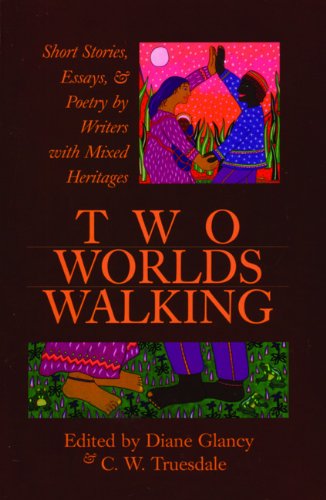
  • Two Worlds Walking: Short Stories, Essays, and Poetry by Writers of Mixed Heritages

    New Rivers Press
    January 1996
    256 pages
    ISBN-13: 978-0898231496

    Edited by Diane Glaney & C. W. Truesdale

    In this landmark collection, 42 writers — including Diane Glancy, Siv Cedering, and Lewis Turco — go beyond a simple idea of diversity to explore what it means to “walk in two worlds.” While many of the poems, short stories, essays, and memoirs in this anthology explore the tensions of being “mixed blood,” all of the pieces offer a surprising and resilient perspective on what it means to be “American” today.

  • The Men Who Left Were White

    Gawker
    2014-04-12

    Josie Duffy

    There are three things you should know.

    First: I’m not biracial.

    “What are you?” people ask, and they expect me to say something thrilling and tribal. I answer, but still they press. “Where are your ancestors from?” people ask, and they want answers that aren’t San Antonio and Wheeling, West Virginia. But that’s all I got. My story is both simple and untold.

    The bones of it, of me: I’m black, despite the skin that goes virtually translucent in the winter. Despite the thin unpredictable curls. My mom and dad are black, as are my grandparents. That’s all she wrote. That’s all there is, even as I write this sentence. My parents, usually liberal employers of nuance, have always been militant-clear about drawing that line. We aren’t biracial.

    When I tell people I’m black, they find it unsatisfying. “That’s no fun,” one girl joked to me recently. “I thought you were going to have a story.”

    Second: I’m 44% European, 49% African. Not exactly an equal split, but pretty damn close.

    I hear the same sentence twice…

    Read the entire article here.

  • The Next Great Migration

    The New York Times
    2015-03-01

    Thomas Chatterton Williams

    PARIS — AT dinner last summer with my brother-in-law, a grandson of Jews who fled Algeria for France, the conversation turned to the rash of anti-Semitic incidents plaguing the country. At such times, the question inevitably arises in the minds of many Jews: “Where could we go?” He mentioned Tel Aviv, London and New York, but the location mattered less than the reassurance that departure remained an option. He’s not alone in this thinking: 7,000 French Jews emigrated in 2014.

    Over the past year, as I watched with outrage at the dizzying spate of unpunished extrajudicial police killings of black men and women across America, I’ve wondered why more black Americans don’t think similarly. Why shouldn’t more of us weigh expatriation, even if only temporary, as a viable means of securing those lofty yet elusive ideals of life, liberty and the pursuit of happiness?

    Blacks leaving America in search of equality is not new. The practice dates from at least antebellum Louisiana, when free mulattoes in New Orleans sent their children to France to live in accordance with their means and not their color. It continued after World War II, when a number of black G.I.s, artists and jazzmen shared Richard Wright’s sentiment that there is “more freedom in one square block of Paris than there is in the entire United States of America.”…

    Read the entire article here.

  • Being Mixed Race

    Women of the World Festival 2015
    Blue Bar at Royal Festival Hall
    Southbank Center
    Belvedere Road, London
    Saturday, 2015-03-07, 13:30-15:00Z

    Building on the findings of the Being Mixed Race panel discussions during WOW 2013 and WOW 2014, this workshop expands on issues identified during the previous conversations and focuses specifically on issues of terminology, colourism, hair and parenting. Led by visual sociologist Emma Dabiri.

    Emma Dabiri is researching a PhD in visual sociology at Goldsmiths, and works as a teaching fellow in the Africa Department at SOAS, University of London. As a commentator she is frequently invited to contribute to discussions relating to Africa and the African Diaspora on topics including futures, gender, feminism, identities, literature, film and the politics of beauty. She has published in a number of academic journals, as well as in the national press and is one of the BBC’s Expert Voices.

    For more information, click here.

  • The Right Words to Say: On Being Read as White

    The Toast
    2015-03-05

    Dahlia Grossman-Heinz

    When you meet me for the first time, you read me as if I were a book. Every idea you have about me and every word I say is part of that book.

    When you look at me, you will think I am white. I already know this. When you shake my hand and meet me for the first time, you always already read me as white. You will hear me speak English without an accent and think I am white. You will hear or read my last name and think I am white. You read me wrong.

    We all have crowded bookshelves in our heads crammed with texts for every person we know. They knock about in our skulls, falling off the shelves. We refer to them again and again, wearing the pages thin. When you read me wrong, everything that follows is askew.

    I have strategies I use to tell you who I am. They have different rates of success, but I will employ them all whenever the situation allows. I mention my quinceañera. I tell the story of the first time my parents heard me speak English. I say words deliberately correctly in Spanish like guerrilla. I talk about Mexican music I like. I note that I am a bilingual Spanish speaker on my resume. I talk about Mexican movies I like. When I am with people, I answer phone calls from my mom and tell her I can’t talk, but I do it in Spanish. I keep her on the phone a little longer than I have to. Whenever the topic of family comes up, I say that most of mine lives in Mexico. I am prepared with these tactics when I have to tell you who I am, ready to fit them in between the pauses so that you might reread me. I’m better at it now than I used to be—I’ve been practicing a long time, figuring out the right words to say…

    Read the entire article here.

  • Imagining a future where racial reassignment surgery is the norm

    Quartz
    2014-09-27

    Marcia Alesan Dawkins, Communications Professor
    University of Southern California, Annenberg

    Jess Row’s haunting new novel, Your Face In Mine, is an invitation to the future, an era bound only by the limits of imagination, money, and technology. It’s a time when you can edit anything about yourself—your location, occupation, your status and even your race—if you are a part of the right network.

    In the future Row casts, some of us have grown accustomed to the sights and sounds of diversity and the ideal that law and culture treat every person equally. While others are experiencing “racial dysphoria,” or significant discontent with the racial identities we’ve been assigned at birth or the stereotypical roles associated with those racial identities. Row’s novel argues that racial dysphoria stems from the failure of racial assimilation in our techno-driven world. It’s a sign that racism persists even as race no longer seems to matter. The future Row casts is eerily reminiscent of what many cultural critics call our “post-racial” present, a time in which real racism persists without any real racists to blame…

    Read the entire article here.

  • Multiracial Community Organizations Response to #Ferguson

    2014-11-26

    As members of the multiracial community, we want to express our concern and compassion for the family of Michael Brown Jr. We are connected to these events and stand in solidarity with the many individuals and communities that have been harmed by the legacies of white supremacy, privilege, and racism. As community organizers, scholars, activists, writers, and artists, we remain resolute in dismantling racism through our work and actions.

    #BlackLivesMatter

    Critical Mixed Race Studies
    Loving Day
    MAVIN
    Mixed Roots Stories
    Mixed Race Studies
    Multiracial Americans of Southern California (MASC)
    Multiracial Asian Families
    National Association of Mixed Student Organizations (NAMSO)
    Kaily Heitz

  • I’m mixed with the bravery of a soldier and the passion of activists. I’m mixed with the rage of a victim and the hope of a survivor. I’m mixed with brilliance of a polymath and the swag of a “hood boy.” I’m mixed with the past and present and my future is as bright as my skin. I’m mixed, because I’m both spiritual and human and my life is both joyous and challenging. I’m mixed with big ideas and the skills to execute them. What am I mixed with you ask? I mixed with great thought and measured action, which is helping to create a world where one day people will ask “How are you doing?” before asking “What are you mixed with?

    Christopher “Flood the Drummer®” Norris, “The Question I’m Often Asked as a ‘High Yellow’ Black Man,” The Good Men Project, (February 21, 2015). http://goodmenproject.com/featured-content/cnorris-the-question-im-often-asked-as-a-high-yellow-black-man/.