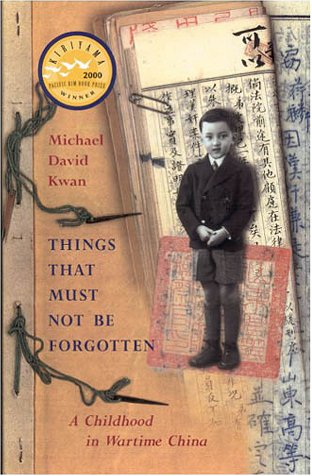
• Michael David Kwan, Things That Must Not Be Forgotten: A Childhood in Wartime China, reviewed by Yuxin Ma

    International Journal of China Studies
    Volume 4, Number 1, April 2013
    pages 169-171

    Yuxin Ma, Associate Professor of East Asian History
    University of Louisville, Louisville, Kentucky

    Michael David Kwan, Things That Must Not Be Forgotten: A Childhood in Wartime China, Long Grove, Illinois: Waveland Press, Inc., 2000, reprinted 2012, 240 pp. + xvi.

    Telling stories of wartime China from the perspective of a Eurasian boy, Kwan’s memoir reconstructs a lost China where unforeseen wars and revolution, international politics, and economic disorders in the 1930s and 1940s changed people’s life courses as they carried on their patriotic struggle for survival. The 2012 new edition adds a preface by the author’s son on his father’s late years in China since 1980s, which presents the author’s life story in a Chinese emotion yeluo guigen – fallen leaves return to the root of the tree. The book provides fascinating details on the lives of a Chinese family with a British housewife, their interactions with other Westerners, Eurasians, and Chinese folks. Kwan focused on how turbulent changes in China affected his coming- of-age, his family members and their friends. Through the inquisitive eyes of a biracial child in search for his identity at home, within the small Western community, and in Chinese society at large, Kwan presented the contradictions, brutality and ruptures in wartime China with fresh and humane touches.

    The first eight chapters described the sheltered and privileged life of David’s childhood. Born in Japanese occupied Harbin in 1934 as the youngest son to an influential railway administrator who worked underground for the Nationalist government, Kwan’s Swiss biological mother jilted him, and he called his father’s new British wife Ellen as Mother. Under his father’s tutelage, David had lived with Anglo-Chinese friends in British Concession in Tienjin, developed friendship with a tenant farmer who engaged in guerilla activities in Beidaihe, and enjoyed the life of the Western community at the Legation Quarter in Beijing which isolated them from “war, disease, poverty and starvation.” (p. 56) David was not immune to the suffering of ordinary Chinese through shared experiences of Japanese bombing, gunfight, and martial law, and interactions through shopping, sightseeing, and vacation breaks. First tutored by Chinese teachers then attended the International School, David grew up bicultural with the knowledge his father was a secret agent for the Nationalist government in Chungking. After the Pearl Harbor Incident, Japanese sealed the Legation Quarter and closed the International School. David attended a Chinese school briefly where he suffered from excruciating racism and bullying…

    Read the entire review here.
  • The Future of Multiracial Identity with Sylvia Targ (Palo Alto High School ’16)

    TEDxYouth
    2014-04-19

    Sylvia Targ (Palo Alto High School ’16) discusses biracial identity and revolutionary ideas regarding how we view ourselves and others. Sylvia is an avid intern at Stanford Behavioral Sciences & Psychology.

    In the spirit of ideas worth spreading, TEDx is a program of local, self-organized events that bring people together to share a TED-like experience. At a TEDx event, TEDTalks video and live speakers combine to spark deep discussion and connection in a small group. These local, self-organized events are branded TEDx, where x = independently organized TED event. The TED Conference provides general guidance for the TEDx program, but individual TEDx events are self-organized.* (*Subject to certain rules and regulations)

  • Things That Must Not Be Forgotten: A Childhood in Wartime China

    Waveland Press, Inc.
    2000
    240 pages
    Paperback ISBN 10: 1-57766-784-0; ISBN 13: 978-1-57766-784-1

    Michael David Kwan

    Winner of the Kiriyama Pacific Rim Book Prize

    Things That Must Not Be Forgotten is a beautifully written collection of Michael David Kwan’s childhood experiences in China during the 1930s and 1940s. Born into privilege, David saw his pampered life disintegrate as the Japanese overran China. His father, the wealthy administrator for China’s railroads, took a position in the pro-Japanese government to work covertly for the Chinese resistance.

    In Beijing, the Kwan household became a gathering place for resistance members. At their summer villa in Beidaihe, the family surreptitiously aided the guerillas in the nearby mountains. In Qingdao, the Kwans lived next door to a Japanese admiral and his wife. From a tree house overlooking their garden, young David enjoyed listening to the music they played, while his father worked secretly for the resistance. David’s other memories (for example, cricket hunting with his father’s tenant farmer, performing rituals as an altar boy, being tormented in school, gardening with the owner of an antique shop, and participating in Boy Scouts) provide fascinating insights into life in China during those turbulent times.

    In August 1945, the United States dropped atomic bombs on Hiroshima and Nagasaki. Within days, Japan surrendered. Chiang Kai-shek’s regime replaced the Japanese puppet government in Nanking. Chiang declared that all who had links to the defunct government would be considered traitors until proven otherwise. David’s father was imprisoned. During the Japanese occupation, Chiang’s Kuomintang and Mao Zedong’s Communists had been united against the invaders, but once Japan was defeated, China moved toward chaos as the two factions vied for power. At age twelve, David was sent to live with relatives in Shanghai before being spirited out of the country, not knowing if he’d ever see his family again. Things That Must Not Be Forgotten will stay in readers’ hearts and minds long after they’ve turned the final, wrenching page.

  • The Influences Affecting and the Influential Effects of Multiracials: Multiracialism and Stratification

    Sociology Compass
    Volume 8, Issue 1 (January 2014)
    pages 63-77
    DOI: 10.1111/soc4.12100

    Hephzibah V. Strmic-Pawl, Assistant Professor of Sociology
    Coastal Carolina University, Conway, South Carolina

    Early research on multiracials documents the existence of a newly emergent population, those who identify with more than one race or what is commonly now known as multiracials. Contemporary research on multiracialism has a new focus on the stratification that multiracials experience and how multiracials may be influencing a new racial hierarchy. This paper discusses some of the primary issues of multiracialism and stratification including colorism, the racial hierarchy, social class, gender and sexual orientation, and multiracial as a celebrity-like status. As the multiracial population grows, so must the field of multiracialism grows to include critical issues and questions regarding stratification.

    Read the entire article here.

  • Witnesses to History: Children’s Views of Race and the 2008 United States Presidential Election

    Analyses of Social Issues and Public Policy
    Volume 13, Issue 1 (December 2013)
    pages 186–210
    DOI: 10.1111/j.1530-2415.2012.01303.x

    Meagan M. Patterson, Associate Professor of Psychology
    University of Kansas

    Erin Pahlke, Assistant Professor of Psychology
    Whitman College, Walla Walla, Washington

    Rebecca S. Bigler, Professor of Psychology and Women’s and Gender Studies
    University of Texas, Austin

    The 2008 presidential election presented a unique opportunity to examine children’s attention to racial issues in politics. We conducted interviews with 6- to 11-year-old children (70 boys, 60 girls; 29 African Americans, 58 European Americans, 43 Latinos) within 3 weeks prior to and after the election. Interview questions concerned knowledge, preferences, and perceptions of others’ attitudes concerning the election, views of the implications of the election for race relations, and personal aspirations to become president. Results indicated that children were highly knowledgeable about Obama’s status as the first African American president. Most children felt positively about the presence of an African American candidate for president, although a few children showed clear racial prejudice. Overall, children expected others to show racial ingroup preferences but simultaneously endorsed the optimistic view that Obama’s race was a slight asset in his bid for the presidency. Older children were somewhat more likely to view Obama’s race as negatively impacting his chances of being elected than younger children. African American and Latino children were more interested in becoming president than European American children; aspiration rates did not change from pre- to post-election.

    Read or purchase the article here.

  • Validity of Infant Race/Ethnicity from Birth Certificates in the Context of U.S. Demographic Change

    Health Services Research
    Volume 49, Issue 1 (February 2014)
    pages 249–267
    DOI: 10.1111/1475-6773.12083

    Lisa Reyes Mason, Assistant Professor of Social Work
    University of Tennessee, Knoxville

    Yunju Nam, Associate Professor of Social Work
    State University of New York, Buffalo

    Youngmi Kim, Assistant Professor of Social Work
    Virginia Commonwealth University

    Objective

    To compare infant race/ethnicity based on birth certificates with parent report of infant race/ethnicity in a survey.

    Data Sources

    The 2007 Oklahoma birth certificates and SEED for Oklahoma Kids baseline survey.

    Study Design

    Using sensitivity scores and positive predictive values, we examined consistency of infant race/ethnicity across two data sources (N = 2,663).

    Data Collection/Extraction Methods

    We compared conventional measures of infant race/ethnicity from birth certificate and survey data. We also tested alternative measures that allow biracial classification, determined from parental information on the infant’s birth certificate or parental survey report.

    Principal Findings

    Sensitivity of conventional measures is highest for whites and African Americans and lowest for Hispanics; positive predictive value is highest for Hispanics and African Americans and lowest for American Indians. Alternative measures improve values among whites but yield mostly low values among minority and biracial groups.

    Conclusions

    Health disparities research should consider the source and validity of infant race/ethnicity data when creating sampling frames or designing studies that target infants by race/ethnicity. The common practice of assigning the maternal race/ethnicity as infant race/ethnicity should continue to be challenged.

    Read or purchase the article here.

  • Complicating Race or Reproducing Whiteness? Heidi Durrow and The Girl Who Fell From the Sky

    Gino Michael Pellegrini: Education, Race, Multiraciality, Class & Solidarity
    2014-04-13

    Gino Michael Pellegrini, Adjunct Assistant Professor of English
    Pierce College, Woodland Hills, California

    [This is an excerpt from a paper (currently being revised) that I presented last month at the 2014 MELUS Conference in Oklahoma City.]

    […] Heidi Durrow is also the latest member of the mixed-experience generation to achieve widespread recognition following the publication of her deeply autobiographical first novel. The Girl Who Fell From the Sky was published in 2010 after winning the 2008 PEN/Bellwether Prize for a first novel that addresses social justice issues. It became a national bestseller in 2011, and is now available in French, Dutch, Danish, and Portuguese. This is a remarkable accomplishment for a book that was repeatedly rejected by the traditional publishing industry.

    For those who are unfamiliar, The Girl Who Fell From the Sky recounts the racialization, alienation, coming of age, and coming to multiracial consciousness of Durrow’s fictional intermediary, Rachel Morse. Rachel is the sole survivor of a heartbreaking tragedy: her Danish mother Nella jumps from a rooftop in Chicago with all her biracial children. After recovering, Rachel is sent to live with her paternal grandmother who lives in a predominantly black neighborhood in Portland, Oregon. Her alcoholic father, an airman stationed overseas, has disappeared from her life. The year is 1982. Rachel is seen as a light-skinned black girl by her new family and by the surrounding community. From the 5th grade onward, she identifies herself as black, but is still ridiculed for talking white; she is both resented and desired for her good hair and blue eyes. In short, Durrow’s novel recounts from multiple perspectives how Rachel comes to understand the tragedy that claimed her mother and siblings, and in the process reclaim her Danish cultural memory, becoming Afro-Viking like Durrow…

    Read the entire article here.

  • Pilot Episode

    The Source Weekly
    Bend, Oregon
    2014-03-20

    Brianna Brey


    Jason Graham (The Source Weekly)

    The Lot’s new open mic calls on Bend’s creative types

    “Calling ALL local musicians, artist and hacks,” reads the event listing for Bend’s newest open mic night, an free-for-all gathering on Wednesday nights at The Lot. “Sing a tune, read a poem, do a dance, tell a story, present your art…be creative. Here is an opportunity to share your soul.”

    Soul sharing is the M.O. for local poet, musician, painter and generally ubiquitous artist MOsley WOtta, a.k.a. Jason Graham, the host of the weekly event. Open mics have the stigma of a musician’s domain, but Graham emphasized the “openness” of this particular event, encouraging all types of creativity, not just the singer/songwriter.

    “As much as I love the musical open mics and the poetry slams, I’m trying to see what all we can get,” explained Graham. “It’s sort of like a workout. We already have the massive pectoral muscles that are the singer/songwriters. We want to keep that part strong, but work the other parts of it, too.”

    This Wednesday, March 19, will mark the third week of the open mic and already Graham said the event is attracting the diverse talents of Bend. Silly and serious, the event is a platform for the community to test its collective material…

    Read the entire article here.

  • Immigrants Stir New Life Into São Paulo’s Gritty Old Center

    The New York Times
    2014-04-14

    Simon Romero, Brazil Bureau Chief

    SÃO PAULO, Brazil — For obvious reasons, many Paulistanos still consider this megacity’s decrepit old center a no-go zone.

    Carjacking and kidnapping gangs prey on motorists at stoplights. Squatters control dozens of graffiti-splattered apartment buildings. Sinewy addicts roam through the streets smoking crack cocaine in broad daylight.

    But slip into Jean Katumba’s cramped Internet cafe and a different picture emerges.

    “They call this place ugly, but I see its beauty,” said Mr. Katumba, 37, who arrived from the Democratic Republic of Congo just 11 months ago.

    Trained as an engineer in Kinshasa, the Congolese capital, he earns a living here in Baixada do Glicério, a crime-ridden district, renting computers to customers speaking a variety of languages, from Haitian Creole to Colombian-accented Spanish and the Lingala of his homeland.

    “São Paulo means a great thing to me: opportunity,” he said.

    An array of similar ventures started by immigrants is flourishing amid the grit of São Paulo’s old center, reflecting shifts in global immigration patterns. Reinforcing São Paulo’s status as Brazil’s premier global city, Asians, largely from China, Africans and Spanish-speaking Latin Americans are flowing in…

    …São Paulo’s new immigration surge stands in contrast to previous waves. After the overthrow of Emperor Dom Pedro II in 1889, Brazil’s first Constitution as a republic promoted a policy of “branqueamento,” or whitening, of Brazilian society through European immigration, while prohibiting immigration from Africa and Asia, according to scholars…

    Read the entire article here.

  • Will Today’s Hispanics Be Tomorrow’s Whites?

    Slate
    2014-04-15

    Jamelle Bouie, staff writer covering politics, policy, and race

    How Hispanics perceive themselves may shape the future of race in America.

    The Trayvon Martin shooting was hardly in the national consciousness before fault lines emerged around the case. Was Martin as innocent as he seemed? Did Zimmerman fear for his life? Did Martin provoke the incident? Was Zimmerman a racist?

    Perhaps most controversial among all of these was the question of identity. Yes, Trayvon Martin was black, but is Zimmerman white? For Martin’s sympathizers, the answer was yes. For Zimmerman’s, the answers ranged from “it doesn’t matter” to he “is actually a Hispanic nonracist person who acted in self-defense.”…

    …According to Pew—and echoing the results in the last census—the United States is just a few decades away from its demographic inflection point. Come 2050, only 47 percent of Americans will call themselves white, while the majority will belong to a minority group. Blacks will remain steady at 13 percent of the population, while Asians will grow to 8 percent. Hispanics, on the other hand, will explode to 28 percent of all U.S. population, up from 19 percent in 2010. Immigration is driving this “demographic makeover,” specifically the “40 million immigrants who have arrived since 1965, about half of them Hispanics and nearly three-in-ten Asians.”

    But the thing to remember about the Hispanic category, for instance, is that it contains a wide range of colors and ethnicities. In the United States, Hispanics (or more broadly Latinos) include Afro-Brazilians, dark-skinned Puerto Ricans, indigenous Mexicans, Venezuelan mestizos, and European Argentinians, among others.

    To say that America will become a majority-minority country is to erase these distinctions and assume that, for now and forever, Latinos will remain a third race, situated next to “non-Hispanic blacks” and “non-Hispanic whites.” But, as the Zimmerman controversy illustrates, it’s not that simple…

    Read the entire article here.