• “The performance was hands-down the best Choate performance I have ever seen. I’ve seen a lot of white struggle stories, and a lot of black struggle stories, but I don’t think I’ve ever seen a mixed struggle story.” —Zemia Edmondson description of Fanshen Cox DiGiovanni’s one-woman performance, One Drop of Love.

    Alexandra Brunjes, “Getting Race-y in the PMAC,” The News: The official student newspaper of Choate Rosemary Hall, Wallingford, Connecticut, January 25, 2014. http://thenews.choate.edu/article/getting-race-y-pmac.

  • Getting Race-y in the PMAC

    The News: The official student newspaper of Choate Rosemary Hall
    Wallingford, Connecticut
    Saturday, 2014-01-25

    Alexandra Brunjes ’16, News Staff Reporter

    “How does our belief in ‘race’ affect our most intimate relationships?” This is the question that Ms. Fanshen Cox DiGiovanni sought to answer during her one-woman performance, One Drop of Love, last Friday night, January 17th, on the Paul Mellon Arts Center [(PMAC)] mainstage, employing her relationship with her father as the primary example.

    Using a collection of images and voice recordings and the astonishing ability to seamlessly shift personas in order to represent members of her family, Ms. DiGiovanni told the story of her experience with race. 

    Ms. DiGiovanni originally meant for One Drop of Love to be a documentary for her Masters of Fine Arts thesis at California State University. “I always knew I wanted to look at race,” she stated. “I wanted to figure out why race was so important in my family, and why it was getting in the way of my relationship with my dad. It took me a long time to realize that the entire reason for my show was to have that final confrontation with my dad.”

    Celebrity Ben Affleck, a childhood friend, attended Ms. DiGiovanni’s first show. He then consulted with co-producers from Argo and friend Matt Damon. They ultimately decided to produce her show. She said about this development, “[The show] gained this new trajectory that I never had imagined.”

    “This is the largest crowd I have ever performed for, as well as the youngest,” Ms. DiGiovanni said of her Choate performance. “At the end, the response was beautiful. I’m so glad that it can have an impact on people.”

    “The performance was hands-down the best Choate performance I have ever seen. I’ve seen a lot of white struggle stories, and a lot of black struggle stories, but I don’t think I’ve ever seen a mixed struggle story.” Zemia Edmondson ’16 described…

    Read the entire review here.

  • Undoing Racial Identification and Redoing Ethical Cultivation: Passing as a Performance of Identity and an Ethics of Self-Making

    Hofstra University, Hempstead, New York
    Honors Thesis
    Fall 2013
    42 pages

    Paige Meserve

    Submitted to the Department of Religion

    Paige Meserve uses contemporary affect theory and queer theory to explore how racial identities are performed (and taken apart) in novels from the 1920s Harlem Renaissance.  Drawing on Foucault’s notion of ethics as a practice of self-cultivation, Paige reads racial passing as one way that African-American women negotiate a world that refuses to sustain and feed them but which they cannot simply leave. Paige shows how such strangely performed identities constitute an ethics of dis-identification. By its means, these women hope to create cross-temporal communities that go beyond fixed racial identities of white and black, and therefore also go beyond existing moral codes of right and wrong – all in favor of imagining new styles of living that are not complicit with a racist world.

    The Black Woman’s very life depends on her being able to decipher the various sounds in the larger world, to hold in check the nightmare figures of terror, to fight for basic freedoms against the sadistic law enforcement agencies in her community, to resist the temptation to capitulate the demands of the status quo, to find meaning in the most despotic circumstances and to create something where nothing was before. Katie Cannon, Black Womanist Ethics

    INTRODUCTION: THEORIES OF MELANCHOLY, PERFORMANCE AND POSSIBILITY

    In The Female Complaint, Lauren Berlant defines normativity as a “felt condition of general belonging and an aspirational site of rest and recognition in and by a social world”(5). Her work raises intriguing questions regarding how subjects outside of the mainstream culture can negotiate their existence and find happiness in a cultural landscape that doesn’t offer them the terms for it. How do these minority subjects manage such an ambivalent, but necessary, attachment to a social world simply incapable of providing them the means to thrive?

    Berlant in Cruel Optimism uses the phrase cruel optimism to discuss this compromising bind. Cruel optimism is “a relation of attachment to compromised conditions of possibility whose realization is discovered to be impossible, sheer fantasy, or too possible, and toxic”(24). The subjects under consideration here are attached to creating a life for themselves in a terrain that makes it impossible. “Cruel optimism is the condition of maintaining an attachment to a significantly problematic object”(24). The optimistic attachment must be maintained to preserve the desire to keep on living; its cruelty, however, resides in the fact that the possibility of thriving in their cultural climate is severely limited.

    José Muñoz describes a process he names disidentification as a way that a minority subject can work within the dominant culture while simultaneously critiquing it. In his work, Disidentifications, he refers to disidentification as “a hermeneutic, a process of production, a mode of performance”(25). To further outline what this process is, he writes: “Disidentification is, at its core, an ambivalent modality that cannot be conceptualized as a restrictive or “masterfully” fixed mode of identification”(28). In spaces where bodies and identifications are ungrounded and become scripts, the possibility emerges of discovering new ways of working with, inhabiting, or potentially abandoning the stunted cultural climate where identities serve more as a prison than a means to provide an affirming space for the self. Disidentification is “descriptive of the survival strategies the minority subject practices in order to negotiate a phobic majoritarian public sphere that continuously elides or punishes the existence of subjects who do not conform to the phantasm of normative citizenship”(4). In reading his work, I want to further explore the potential of performance spaces as ways a minority subject can work with the broken pieces society offers them as terms of existence. It is crucial to find these spaces that can perhaps provide an alternative way to negotiate and interact with a social system that tends to foreclose possibility.

    A way that people of color have historically attempted to manage a society that brutally represses them and eliminates all possible avenues for a palatable existence, is racial passing, the process in which a person of one race adopts the mask of another race. As I will demonstrate throughout this analysis, racial passing is one of these potential performance spaces that enables these subjects to work with the dominant culture that suppresses them in new and different ways. In her introduction of Passing and the Fictions of Identity, Elaine K. Ginsberg writes: “passing is about identities: their creation or imposition, their adoption or rejection, their accompanying rewards or penalties. Passing is also about the boundaries established between identity categories and about the individual and cultural anxieties induced by boundary crossing.” She posits that the act of passing “interrogates the ontology of identity categories and their construction”(4). If passing treats race as a performance, then categories of race are destabilized and become an insufficient way to signify identity. Ginsberg questions: “when “race is no longer visible, it is no longer intelligible: if “white” can be “black”, what is white?”(8) These instances that destabilize identity demand different ways of understanding the category. I see passing as a site rich with possibilities that calls for further examination of its complexity and of its new potentialities…

    Read the entire paper here.
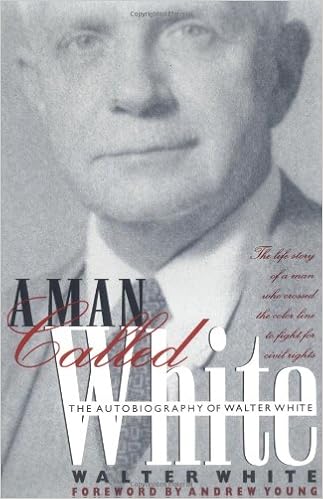
  • A Man Called White: The Autobiography of Walter White

    University of Georgia Press
    1994 (First published in 1948)
    392 pages
    5.5 x 8.5
    Paper ISBN: 978-0-8203-1698-7

    Walter White (1893-1955)

    Foreword by Andrew Young

    The life story of a man who crossed the color line to fight for civil rights

    First published in 1948, A Man Called White is the autobiography of the famous civil rights activist Walter White during his first thirty years of service to the National Association for the Advancement of Colored People. White joined the NAACP in 1918 and served as its executive secretary from 1931 until his death in 1955. His recollections tell not only of his personal life, but amount to an insider’s history of the association’s first decades.

    Although an African American, White was fair-skinned, blond-haired, and blue-eyed. His ability to pass as a white man allowed him—at great personal risk—to gather important information regarding lynchings, disfranchisement, and discrimination. Much of A Man Called White recounts his infiltration of the country’s white-racist power structure and the numerous legal battles fought by the NAACP that were aided by his daring efforts.

    Penetrating and detailed, this autobiography provides an important account of crucial events in the development of race relations before 1950—from the trial of the “Scottsboro Boys” to an investigation of the treatment of African American servicemen in World War II, from the struggle against the all-white primaries in the South to court decisions–at all levels—on equal education.

  • Flight: A Novel

    Louisiana State University Press
    April 1998 (Originally published in 1926)
    304 pages
    5.50 x 8.50 inches
    Paperback ISBN: 9780807122808

    Walter White (1893-1955)

    Published amid controversy in 1926, Flight focuses on the dilemma of Mimi Daquin, a light-complexioned African American woman who passes, for a time, as white. In the New Orleans of her birth, Mimi never encountered the hierarchies of skin color that existed elsewhere. But when her family moves to Atlanta, she embarks on a lifelong lesson about what it really means to belong to a people. From the Atlanta riot of 1906 to her shameful expulsion from black bourgeois society because of an out-of-wedlock pregnancy, to her working-class status in Philadelphia and Harlem, Mimi eventually decides to escape her miseries by passing for white in New York City. There, her success exceeds her expectations but even so cannot quell a recurrent yearning.

    Walter White (1893–1955), a blond-haired, blue-eyed African American, was a native of Atlanta and an adopted New Yorker. His other works are the novel Fire in the Flint and an autobiography, A Man Called White. He was a major figure in the NAACP for more than three decades.

  • Motivation to Control Prejudice Predicts Categorization of Multiracials

    Personality and Social Psychology Bulletin
    Volume 40, Number 5 (May 2014)
    pages 590-603
    DOI: 10.1177/0146167213520457

    Jacqueline M. Chen, Post-doctoral Scholar
    University of California, Davis

    Wesley G. Moons, Assistant Professor of Psychology
    University of California, Davis

    Sarah E. Gaither
    Department of Psychology
    Tufts University, Medford, Massachusetts

    David L. Hamilton, Research Professor of Social Psychology
    University of California, Santa Barbara

    Jeffrey W. Sherman, Professor of Psychology
    University of California, Davis

    Multiracial individuals often do not easily fit into existing racial categories. Perceivers may adopt a novel racial category to categorize multiracial targets, but their willingness to do so may depend on their motivations. We investigated whether perceivers’ levels of internal motivation to control prejudice (IMS) and external motivation to control prejudice (EMS) predicted their likelihood of categorizing Black–White multiracial faces as Multiracial. Across four studies, IMS positively predicted perceivers’ categorizations of multiracial faces as Multiracial. The association between IMS and Multiracial categorizations was strongest when faces were most racially ambiguous. Explicit prejudice, implicit prejudice, and interracial contact were ruled out as explanations for the relationship between IMS and Multiracial categorizations. EMS may be negatively associated with the use of the Multiracial category. Therefore, perceivers’ motivations to control prejudice have important implications for racial categorization processes.

    Read or purchase the article here.

  • The Trouble with Transcendence: Is Defying the Gender Binary the New Racial Passing?

    Nursing Clio: Because the Personal is Historical
    2014-01-21

    Mallory Nicole Davis
    University of Oregon

    In 2010, Thomas Araguz III, a Texas firefighter died on the job, leaving behind his two children and transgender wife, Nikki.[1] The couple was legally married because although the state of Texas only recognizes heterosexual marriages, the state will validate a transgender union if the trans partner’s identification documents dictate that s/he is the opposite legal sex of the spouse.[2] However, when Nikki sought survivor benefits after her husband’s unexpected death, Thomas’ family launched a case against Nikki, stating that Thomas did not know his wife was transgender. The suit argued that Nikki wrongfully deceived her husband, while lobbying for the nullification of their marriage and subsequently, Nikki’s request for spousal benefits. The case was complicated further by the prosecuting attorney’s interrogation of a deposition taken from Thomas in a separate court case—a battle over custody of his two sons with his ex-wife—in which he stated that he did not know that Nikki was transgender.[3] In response to the scrutinizing of her late husband’s statement, Nikki insisted that Thomas lied during his deposition and pretended to be unaware of her transgender status in order maintain custody of his two small children. Nikki stated, “At the time, Thomas and I thought it was in the best interest of our children to lie. They were the center of (our) lives”.[4] Whether Nikki neglected to disclose her trans identity to her husband or that the couple collectively decided to lie to the court during their custody case for the sake of their children, deception surrounding Nikki’s trans status is at the center of this legal case; and undoubtedly, her credibility will be diminished regardless of how the court decides…

    Passing is a term typically used to denote a person’s ability to move imperceptibly across racial lines, though the word is equally fitting to describe a trans* person’s ability to transgress the gender binary. Nikki’s perceived deceptions echoes the case of Alice and Leonard Rhinelander, an interracial couple who were married in 1924 who made national headlines because Alice, a light-skinned African-American woman, passed for white and married into the affluent Rhinelander family.[5] When negative press threatened to tarnish the Rhinelander family name, Leonard disappeared without warning and filed for an annulment, claiming that Alice misled him by presenting herself as a white woman. Ultimately, it was proved that Leonard had, in fact, known that Alice was African-American, and Alice counter-sued Leonard for abandonment. Although the Rhinelander family ended up offering Alice a monetary settlement upon her agreement to a divorce, the character attacks launched on Alice and her family, based upon her alleged racial deception were devastating. And like Nikki, Alice’s identity came under fire in a torrential court case only after the transcendent nature of her identity proved threatening to the family of her husband…

    Read the entire article here.

  • PHOTOS: 3rd Annual What Are You?

    Crossing Borders, Bridging Generations
    Brooklyn Historical Society
    Fall 2013

    Nayantara Sen, CBBG Project Associate

    All photos by Willie Davis for Brooklyn Historical Society, 2013

    Steven Riley, Founder of MixedRaceStudies.org gives a few remarks before introducing one of the panels. A participant in the packed the house in Brooklyn Historical Society’s newly renovated Great Hall asks a question.

    The 3rd Annual What Are You? event packed the house in Brooklyn Historical Society’s newly renovated Great Hall!

    This year’s discussion about mixed heritage had a thematic focus on art, media, and performance as avenues for engaging mixed-heritage identity and politics.

    Artist Chris Johnson explained the genesis of Question Bridge: Black Males: what would it be like to listen in like a fly on the wall to conversations Black men are having with their peers? What conversations across age, class, and experience are not happening that we wish would happen? What questions do Black men have for other Black men?

    Natasha Logan, a producer for Question Bridge: Black Males shared some incredible photographs from an exhibition she curated titled White Boys, highlighting the ways in which white male identity is neutralized or made invisible…

    …Many thanks to all of you who came and participated in conversations and shared your stories and questions with Crossing Borders, Bridging Generations! And special thanks to Steven Riley, Founder of MixedRaceStudies.org, and Kenda Danowski from SWIRL and founder of NAMSO (National Association for Mixed Student Organizations) for MC’ing!

    Read the entire article and view the photographs here.

  • “We Have Created Our Own Meaning for Hapa Identity”: The Mobilization of Self-Proclaimed Hapas within Institutions of Higher Education

    Amerasia Journal
    Volume 35, Number 2 (2009)
    pages 191-213

    Patricia E. Literte, Associate Professor of Sociology
    California State University, Fullerton

    This article examines Hapa student organizations on two university campuses—one public and one private. Drawing on qualitative data, this research interrogates the processes whereby young people who identify as Hapa come to: (1) recognize that race has importance in their lives, (2) rearticulate or reinterpret dominant racial thinking, and (3) translate their racial identities and experiences into organizations to negotiate the concrete and symbolic implications of race. This research also examines how institutions of higher education, in particular, student services that have a racial orientation (e.g., Asian Pacific American Student Services), are responding to Hapa organizations.

    He’s [Keanu Reeves] the face of globalization. Born in Beirut to an English mother and a father of Hawaiian and Chinese descent, he’s a citizen of the world.

    From Keanu Reeves, to Tiger Woods, to Barack Obama, multiracial people have increasingly received media attention, and as reflected in this description of Reeves, multiracial people are perceived as manifestations of the grand melting pot. Yet they can also be unsettling figures, symbolizing the breakdown of racial, cultural, and national boundaries which are central to the construction of identities.

    While society often fixates on public figures who are mixed race, the creation of multiracial identities is the story not just of individuals, but of a post-Civil Rights generation. While racially mixed people have always existed, a concurrent rise in interracial marriages and racial tolerance in recent decades has resulted in a population that increasingly seeks to assert multiracial identities. As a group, multiracial people tend to be disproportionately young and concentrated on the West Coast, particularly in California and Hawaii. According to data from the 2000 Census, 26.3 percent of the two or more races population is between the ages of 18 to 34 versus 23.7 percent for the total population. These age based discrepancies are larger with younger persons. 15.5 percent of the two or more races population is between 10 and 17, compared to 11.5 percent of the general population, and 25.2 percent of the two or more races population is under age ten, in contrast to 14.1 percent of the total population. The median age for the two or more races population is 23.4…

    Read or purchase the article here.

  • Beyond “Code-switching:” The Racial Capital of Black/White Biracial Americans

    University of Connecticut
    2013
    170 pages

    Chandra D. L. Waring

    A Dissertation Submitted in Partial Fulfillment of the Requirement for the Degree of Doctor of Philosophy

    Social science has examined the experiences of the burgeoning bi/multiracial population within the scope of three core areas: racial identity (Funderburg 1994; Kilson 2001; Rockquemore and Brunsma 2008; Renn 2004; Root 1996), social psychological well-being (Bracey et al. 2004; Campbell and Eggerling-Boek 2006; Cheng and Lively 2010; Binning et al. 2009) and family racial socialization (DaCosta 2007; Dalmage 2000; Samuels 2009; Socha and Diggs 1999; Twine 2010). In my dissertation, I shift the theoretical focus from identity and well-being to the conceptual development of how race—embedded with assumptions, understandings and histories—shapes bi/multiracial Americans’ everyday social interactions with white and black Americans. Through 60 in-depth, semi-structured, life story interviews, I found that the majority of my participants reported interacting differently during encounters with whites and blacks or when in predominately white settings versus predominately black settings as a means to establish racial in-group membership. In an effort to analyze these interactional patterns, I offer the concept of “racial capital” to call attention to the repertoire of racial resources (i.e. knowledge, experiences, meaning and language) that biracial Americans draw upon to negotiate racial boundaries in a highly racialized society. While past research on bi/multiracials has created conceptual frameworks for racial identity trends as well as social psychological development, these studies have not systematically considered how everyday interactions unfold, and how bi/multiracials draw upon a unique racialized “tool kit” (Swidler 1986) to work within and around racial boundaries. Furthermore, while racism scholars have discussed the negotiation of racial boundaries for other populations that do not neatly fit into racial categories, such as second generation South Asian Americans (Purkayastha 2005), these processes have not been systematically addressed in the bi/multiracial population. Through the narratives of my respondents, I fill this gap in the literature.

    TABLE OF CONTENTS

    • Chapter 1: Introduction: Why Study Biracials?
    • Chapter 2: Methodological Considerations
    • Chapter 3: Made in America: Interracial Sexuality and Bi/multiracial Children
    • Chapter 4: Race and Resemblance: Exploring Relationships in Multiracial Families
    • Chapter 5: “It’s Like We Have an ‘In’ Already:” The Racial Capital of Biracial Americans
    • Chapter 6: “I’m a Different Kind of Biracial:” Biracial Americans with Immigrant Parents Negotiate Race in the United States
    • Chapter 7: “I’m Exotic and That Intrigues Them:” Gender, Sexuality and the Racially Ambiguous Body
    • Chapter 8: Conclusions, Implications and Suggestions
    • Appendix: Interview Guide
    • References

    Read the entire dissertation here.