• Memoirs of Elleanor Eldridge

    West Virginia University Press
    December 2013
    160 pages
    Cloth ISBN: 978-1-935978-24-4
    Paperback ISBN: 978-1-935978-23-7
    ePub ISBN: 978-1-935978-25-1
    PDF ISBN: 978-1-938228-64-3

    Original Text by Frances Harriet Whipple (1805-1878) with Elleanor Eldridge (1794-1862)

    Edited by:

    Joycelyn K. Moody, Sue E. Denman Distinguished Chair in American Literature and Professor of English
    University of Texas, San Antonio
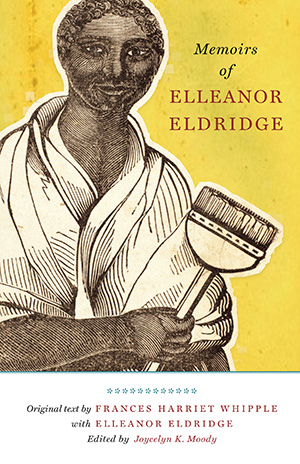
    Elleanor Eldridge, born of African and US indigenous descent in 1794, operated a lucrative domestic services business in nineteenth century Providence, Rhode Island. In defiance of her gender and racial background, she purchased land and built rental property from the wealth she gained as a business owner. In the 1830s, Eldridge was defrauded of her property by a white lender. In a series of common court cases as defendant and plaintiff, she managed to recover it through the Rhode Island judicial system. In order to raise funds to carry out this litigation, her memoir, which includes statements from employers endorsing her respectable character, was published in 1838. Frances Harriet Whipple, an aspiring white writer in Rhode Island, narrated and co-authored Eldridge’s story, expressing a proto-feminist outrage at the male “extortioners” who caused Eldridge’s loss and distress.

    With the rarity of Eldridge’s material achievements aside, Memoirs of Elleanor Eldridge forms an exceptional antebellum biography, chronicling Eldridge’s life from her birth. Because of Eldridge’s exceptional life as a freeborn woman of color entrepreneur, it constitutes a counter-narrative to slave narratives of early 19th-century New England, changing the literary landscape of conventional American Renaissance studies and interpretations of American Transcendentalism.

    With an introduction by Joycelyn K. Moody, this new edition contextualizes the extraordinary life of Elleanor Eldridge—from her acquisition of wealth and property to the publication of her biography and her legal struggles to regain stolen property. Because of her mixed-race identity, relative wealth, local and regional renown, and her efficacy in establishing a collective of white women patrons, this biography challenges typical African and indigenous women’s literary production of the early national period and resituates Elleanor Eldridge as an important cultural and historical figure of the nineteenth century.

    Read the original text from 1838 here.

  • De Blasio’s Daughter Reveals Substance Abuse

    The New York Times
    2013-12-24

    Javier C. Hernandez and Michael M. Grynbaum


    Chiara de Blasio, right, with her parents in September. Michael Appleton for The New York Times

    Days before her father’s inauguration, the 19-year-old daughter of Mayor-elect Bill de Blasio disclosed a history of drug and alcohol abuse that his campaign had taken pains to shield throughout a candidacy that relied heavily on the image of a happy and tight-knit family from Brooklyn.

    In a carefully crafted video distributed on Tuesday by her father’s staff, Chiara de Blasio spoke in candid terms about a battle with depression throughout her adolescence that led to drinking and drug use, habits that worsened when she was attending college in California last year.

    “It didn’t start out as like a huge thing for me, but then it became a really huge thing for me,” Ms. de Blasio said in the five-minute video, in which she sat alone on screen, accompanied by soft piano music…

    …Such is the celebrity of Mr. de Blasio’s children that Ms. de Blasio’s announcement on Tuesday was met with a statement from the director of the Office of National Drug Control Policy at the White House, who praised her “tremendous bravery in speaking out about her recovery.”…

    …Hank Sheinkopf, a political consultant, said the city had elected a family when it chose Mr. de Blasio in November, and that New Yorkers should expect his wife and children to continue to play a prominent role…

    Read the entire article here.

  • Surprising New Face in Arabic Music

    The New York Times
    2013-12-03

    Linsay Crouse

    Jennifer Grout Sings Umm Kulthum Hits on ‘Arabs Got Talent’

    The Arab world has an unlikely new star: an American who sings — but barely speaks — Arabic. Not only that, her genre is traditional Arab music.

    Plucking her oud, an Arabic version of the lute, and singing with the undulating emotion of Umm Kulthum, the Arab world’s legendary diva, the 23-year-old Jennifer Grout has become a sensation across the Middle East as a contestant on the reality show “Arabs Got Talent.”

    She will appear in the finals in Beirut, Lebanon, on Saturday, competing for viewer votes against an array of Arab performers, many of whom would be at home on a Western stage: comedians, hip-hop dancers and jugglers. The only performer of classical Arab music will be an American of European stock…

    … “So many times I’ve heard the comment ‘It’s “Arabs Got Talent” — go back to America,’ ” Ms. Grout said in a recent phone interview from Marrakesh, Morocco, where she lives. “It’s like I’m starting an invasion, when really I just love singing Arabic music and desperately wanted a chance to perform it for an audience that would appreciate it.”

    Her flair in doing so has also incited a wave of incredulity about her ethnicity: Ms. Grout, who is from Cambridge, Mass., describes her background as English, Scottish and Native American…

    Read the entire article here.

  • ‘A Dreadful Deceit’ argues against a ‘racial’ past

    The Los Angeles Times
    2013-12-20

    Robin D.G. Kelley, Distinguished Professor of History
    University of California, Los Angeles

    Jacqueline Jones in ‘A Dreadful Deceit’ aims to debunk the ‘myth of race’ and the ‘American creation story’ but for the most part is unconvincing in her argument.

    Jacqueline Jones, A Dreadful Deceit: The Myth of Race from the Colonial Era to Obama’s America (New York: Basic Books, 2013).

    Four years ago, Atty. Gen. Eric Holder called us a “nation of cowards” for refusing to confront our racial past. Jacqueline Jones’ “A Dreadful Deceit” dismisses the very idea that our past is “racial.”

    What Holder identifies as our national burden, Jones calls the “American creation story”: the narrative that slavery was born of racial prejudice and that the election of a black president marked a triumph over the long shadow of race. Her objective is to debunk the “myth of race,” to relieve Americans of the specious belief that “race is real and that race matters.”

    Jones is not the first. Franz Boas, W.E.B. DuBois and Ashley Montagu are among a veritable sea of scholars who have shown that “race” has no scientific basis. It is a socially created means of classifying and ranking humans based on any number of criteria. It is about power, not biology…

    …”A Dreadful Deceit’s” insistence that race is not a factor leads Jones to ignore racism’s role in creating economic inequality. Today’s workforce, she asserts, is “defined less by skin color and history than by shared powerlessness within a global economy.” But if truly “shared,” how do we explain the widening wealth gap between whites and blacks or that the world’s cheap apparel is made in the global South by a non-white, super-exploited labor force?

    Jones generally treats “race” (a means of classifying difference) as a proxy for “racism” (a hierarchical system of subjugation based on race). The point is not that race explains everything but that racism is built into the very structure of the economy. Race may be a myth, but racism survives…

    Read the entire review here.

  • Miscegenetic Melville: Race and Reconstruction in Clarel

    Zach Hutchins, Assistant Professor of English
    Colorado State University

    ELH
    Volume 80, Number 4, Winter 2013
    pages 1173-1203
    DOI: 10.1353/elh.2013.0039

    This essay investigates Herman Melville’s views on Reconstruction and racism in Clarel, the national epic published in the centennial year of 1876. In Clarel, Melville points toward miscegenation as the solution to problems of ethnic conflict festering since the Civil War, the key to rebuilding a nation torn apart by the economic exploitation and lingering racism of Reconstruction. Miscegenation is an ideal Melville pointed to somewhat naïvely in his earlier prose, but Clarel is Melville’s most sustained narrative commentary on race published after Benito Cereno and reflects a more sober assessment of racial realities and possibilities in the United States.

  • From Aesthetics to Allegory: Raphaël Confiant, the Creole Novel, and Interdisciplinary Translation

    Small Axe
    Volume 17, Number 3, November 2013 (No. 42)
    pages 89-99

    Justin Izzo, Assistant Professor of French Studies
    Brown University

    This essay examines the roles played by ethnographic writing and translation in Raphaël Confiant’s 1994 L’allée des soupirs. This novel fictionalizes the 1959 riots in Martinique while simultaneously creating characters who debate the relative merits of modes of expression capable of capturing the linguistic, cultural, and racial hybridity of créolité in literature. Confiant translates into fictional terms important precepts on Caribbean literary production set out in Eloge de la créolité, which Confiant wrote with Patrick Chamoiseau and Jean Bernabé. By transforming the aesthetic problems taken up in Eloge into a thoroughly creolized novel that deals with the hybridized messiness of everyday life, Confiant presents a text that ethnographically allegorizes its own conditions of production. This allegorization mobilizes a process the essay calls “interdisciplinary translation,” which relies on an ongoing process of conversion between ethnographic and literary modes of representation.

  • Race in a Bottle: The Story of BiDil and Racialized Medicine in a Post-Genomic Age by Jonathan Kahn (review)

    Bulletin of the History of Medicine
    Volume 87, Number 4, Winter 2013
    pages 708-709
    DOI: 10.1353/bhm.2013.0067

    Anne Pollock, Assistant Professor of Science, Technology and Culture
    Georgia Institute of Technology, Atlanta, Georgia

    Jonatha Kahn, Race in a Bottle: The Story of BiDil and Racialized Medicine in a Post-Genomic Age. New York: Columbia University Press, 2013. xi + 311 pp. Ill. (978-0-231-16298-2).

    When BiDil was approved by the U.S. Food and Drug Administration in 2005 for heart failure in black patients, it became the first ever drug to receive a racial indication. Race in a Bottle is likely to be the most in-depth book that will ever be written about BiDil’s controversial regulatory approval. Its author, Jonathan Kahn, has followed the case of BiDil’s approval at least as closely as anyone else, probably including those most directly involved (the clinicians, the pharmaceutical company, the FDA). Ever since he first heard about BiDil in 2002 (p. 4), Kahn has pursued the story doggedly. He became part of BiDil’s story through the articles he wrote about it, starting with a 2003 piece in Perspectives in Biology and Medicine, which debunked the statistic that blacks were twice as likely as whites to die of heart failure. These articles were read by regulators, among others, and in 2005 Kahn testified against BiDil’s race-specific indication at the FDA hearings on the drug (p. 94). Kahn notes that material in this book has previously been published in sixteen different journal articles and book chapters (pp. ix–x); Race in a Bottle is the definitive compilation of that body of work.

    Regulatory processes are at the center of Kahn’s account. According to Kahn, “Race enters biomedicine through many pathways. Foremost among these are federal initiatives that shape the production and use of racial categories in biomedical research” (p. 25). Kahn carefully traces the ways in which the terrain of BiDil was laid by mandates at the FDA and NIH to use OMB categories and, especially, by patent law. This regulatory focus is not inevitable as a way to approach how race enters biomedicine: we might start with lived experience in a structurally racist society, or with clinical encounters, or with social movements mobilized against health disparities, or elsewhere. But Kahn’s passion is for regulation, and this is where his expertise is on display.

    Race in a Bottle is at its most effective in debunking two things: BiDil’s racialized indication and racialized medicine as a path toward pharmacogenomics. As Kahn fastidiously shows, the vasodilating drug combination that would become BiDil (isosorbide dinitrate and hydralazine) was originally conceived of as a treatment for anyone with heart failure, not just blacks, and it was commercial imperatives—specifically circumventing the fact that the patent on the drug without the racial indication was about to expire—rather than persuasive scientific evidence that led the pharmaceutical company to seek approval for it as a drug for blacks. Kahn also persuasively debunks the notion that racialized medicine is a step toward pharmacogenomics. Although many BiDil proponents argued that race was a “crude surrogate” but nevertheless useful “in the meantime” until more was known about the genetics of drug response (p. 157), Kahn shows that even when there are genetic tests available to indicate drug response (as in warfarin, the “poster child for pharmacogenomics” [p. 165]), “far from withering away, race is persisting and even proliferating as genetic information increases” (p. 168).

    Race in a Bottle is less convincing as a window into “racialized medicine in a post-genomic age.” Situating BiDil in a “post-genomic age” is misleading. In Kahn’s own account, BiDil emerged from statistical signals in clinical trial data, not from genetic research. Related claims of racial differences in heart failure foregrounded pathophysiology, not genetics. BiDil’s FDA indication is for “self-identified black patients,” an explicitly social category rather than a genetic one. Yet the book opens by describing the White House ceremony on the occasion of the completion of the Human Genome Project (p. 1). This narrative choice is emblematic of a preoccupation with genetics in the account as a whole, and shows the intractable appeal of analyzing race in terms of genetics, even for those explicitly critiquing genetic understandings of race. Even if some (but not all) BiDil proponents simply slide the drug into a genetic frame, why should critique of BiDil do so?

    Finally, because of the explicitness of its racialization, BiDil has become an obvious icon of racialized medicine, but it is actually not clear that BiDil is…

  • Is Race a Fiction?

    Ideas with Paul Kennedy
    CBC Radio-Canada
    2013-12-04

    Paul Kennedy, Host

    Blood ties you to family, country and race. Should it? Watch a live panel discussion with Lawrence Hill, Priscila Uppal, Hayden King and Karina Vernon moderated by Ideas host Paul Kennedy.

    What happens to personal identity when race is removed as a marker of who you are? What happens when we use the term “culture” to replace the idea of race?” The panelists explore these questions and more.

    Panelists:

    • Lawrence Hill: Blood: The Stuff of Life is Lawrence Hill’s ninth book. His earlier works include the novels Some Great Thing and, and the memoir Black Berry, Sweet Juice: On Being Black and White in Canada.
    • Hayden King is an Anishinaabe writer, student, teacher, researcher at Ryerson University, McMaster University and Beausoleil First Nation.
    • Priscila Uppal is a poet, novelist, playwright and York University Professor in the Department of English.
    • Karina Vernon is an Assistant Professor at the University of Toronto and co-founder and editor of Commodore Books, the first black literary press in western Canada.

  • NYC Mayor-Elect’s Family Reflects Rise of Intermarriage

    Voice of America
    2013-12-17

    Carolyn Weaver

    In 1959, only four percent of Americans approved of interracial marriage. Today, 87 percent do, according to a Gallup poll. President Barack Obama was born to such a marriage, and census figures show that the fastest growing demographic under 18 is children of mixed race.

    When New York City’s new mayor-elect, Bill de Blasio, a white man married to an African American woman, takes office January 1 with his wife and their two children at his side, his family will mirror this new American landscape.

    It hardly could be more different from 1958, when people who married across racial lines were subject to arrest in 22 U.S. states. Mildred Jeter and Richard Loving wed that year in Washington, D.C. Mildred was African American and Richard was white. Six weeks after, when they returned to their home state of Virginia, police broke down the door of their house in the middle of the night…

    Read the entire article here.

  • Imagining Ourselves: What Does it Mean to be Part of the African Diaspora?

    Think Africa Press
    2013-11-21

    Jean-Philippe Dedieu, Research Fellow
    IRIS of the École des Hautes études en Sciences Sociales (EHESS)

    Tina Campt talks to Think Africa Press about black European subjectivities, the US’ dominance in diaspora studies, and how photographs tell us more than we might realise.

    Tina Campt, Director of the Africana Studies Program at Barnard College, Columbia University, has been examining gender, race and diasporic formation in black communities in Germany and Europe more broadly for the last decade.

    Her earliest works were insightful contributions to the growing scholarship on the overlooked history of African communities in imperial and post-colonial Europe. Her first book, Other Germans: Black Germans and the Politics of Race, Gender and Memory in the Third Reich, was an oral history acknowledging the participation of African minorities to the German history, from the Weimar Republic to the postwar period.

    More recently, Campt has deepened her intellectual reflection by exploring the crucial issue of visual representation. In Image Matters: Archive, Photography and the African Diaspora in Europe, published last year by Duke University Press, she traces the emergence of a black (European) subject by analysing a rich photographic documentation that intertwines her own family albums with snapshots of black German families and studio portraits of West Indian migrants in England.

    In an interview with Think Africa Press, Campt talked to the French scholar Jean-Philippe Dedieu about the intellectual discourses on diasporas across the Atlantic as well as the significance of photography for allowing black people to imagine themselves, freed from racial prejudice…

    …How did you end working on Afro-Germans?

    Serendipity. The first time I went to Germany, I went to Berlin to pass my language exams in graduate school. I was in Berlin before the wall fell, in ‘87, and it was an extraordinary experience because I had never been outside the United States and I had never experienced the particularly bizarre form of racism I encountered there. It was a concatenation of exoticism and ignorance that just did not fit with any of the forms of racism that I was familiar with as an African-American who grew up in Washington DC. When I went back a second time, I was studying in Bremen in a context with other African-Americans and Africans. That was incredibly revealing, and taught me more about how to understand some of the responses I was getting.

    Toward the end of my stay I happened, literally happened, to meet an Afro-German man on the street and had a conversation with him about being black and German, and there was something that distinguished his experience from mine because, as he described it, he had no point of reference. I remember him saying, “I am only German. I don’t have a history of slavery. I don’t have a history of a community that has fought racism or that has battled discrimination. I’m at the point where I am trying to gather that, to martial that as a set of resources that I can draw on to create this thing that I call Blackness in Germany, or Afro-German. I’m doing that in the absence of what you have – your history as an African-American.”…

    Read the entire interview here.