• Looking for Co-presenters for 2014 Critical Mixed Race Studies Conference (Chicago, November)

    2013-12-26

    Kim Potowski, Associate Professor of Linguistics
    University of Illinois, Chicago

    I would like to submit a panel for the 2014 Critical Mixed Race Studies Conference about language and the ways in which language (dialects, code-switching, etc.) reflects and enacts the identities of mixed “race” and mixed “ethnicity” individuals and groups.

    By “mixed ethnicity” I mean to include, for example, intra-Latino individuals (e.g. “MexiRicans”), intra-Asian individuals (e.g. “Chinese-Korean”), and other such combinations. Again, the focus of the panel is the ways in which such individuals use and are marked by their linguistic repertoires. Many MexiRicans, for example, speak a variety of Spanish that shows traits from both Mexican and Puerto Rican dialects.

    Ideally all presentations will incorporate some mixed race theory, but we can discuss this.

    If you know anyone who might like to be considered for this panel, please contact me, Kim Potowski at kimpotow@uic.edu. I would need to receive abstract proposals and author information (name, institution, areas of scholarly interest) by January 2, 2014.

    Thanks!

  • Four Simple Reasons Smart People Shouldn’t Believe in Races

    Psychology Today
    About Thinking: Questioning everything with a hopeful skeptic
    2013-12-23

    Guy P. Harrison

    Today is a good day to wake up and join the human species.

    Guess what I do almost every time race and racism are discussed in popular culture. I groan and turn away in discomfort. The curse of an anthropology education makes me painfully aware of how clueless politicians, writers, broadcasters, and virtually everyone else are on this topic. Whenever some celebrity utters the dreaded N-word or a person of one race does something horrible to a person of another race, the voices of authority take center stage and call for understanding, love and cooperation between races.

    Blah, blah, blah.

    Such reactions to race problems may feel nice and do some good but they are too shallow to be effective long-term. The problem is that they completely miss the core problem, which is race belief itself. Races are not naturally occurring subspecies of human beings. They are the artificial creations of our cultures. Therefore, attempting to solve the problem of racism by asking for tolerance between races is like turning up the air conditioner in a burning house because you don’t like the temperature. Overt racism and all other destructive but less obvious race problems are unlikely to ever go away no matter how much love and tolerance we pour on the fire. What is needed is a game-changer, an awakening to the reality of who we are as revealed by science.

    The critical problem with biological races is the claim that we are all inherently limited or empowered based on our birth into a unique genetic group that contains millions of other similar people. Many good people who champion racial equality and would not be considered racists carry this destructive belief in their heads. But it can’t be true because the groups themselves are unnatural, inconsistent and illogical. The biological race group called “black people”, for example, makes no sense because of the deep genetic diversity within it. Two randomly selected “black” people from Africa, the Caribbean or elsewhere are likely to be more distantly related to one another than any one of them is to a typical “white” European…

    1. The police lineup in your head. By far, the most common objection I hear to the rejection of biological races comes from what I call the “mental police lineup”. It’s easy to imagine a dark-skinned African, a light-skinned European, and a typical Japanese or Chinese person all standing side-by-side. The visible contrast is so great, I’m often told, that races must be real. There is an easy answer to this popular defense of the race concept, however…

    Read the entire article here.

  • Freedom’s Witness: The Civil War Correspondence of Henry McNeal Turner

    University of West Virginia Press
    March 2013
    288 pages
    Hardcover (Jacketed) ISBN: 978-1-935978-60-2
    Paperback ISBN: 978-1-935978-61-9
    ePub ISBN: 978-1-935978-62-6
    PDF ISBN: 978-1-935978-95-4

    Foreword by:

    Aaron Sheehan-Dean, Fred C. Frey Professor of Southern Studies
    Louisiana State University

    Edited by:

    Jean Lee Cole, Associate Professor of English
    Loyola University Maryland, Baltimore
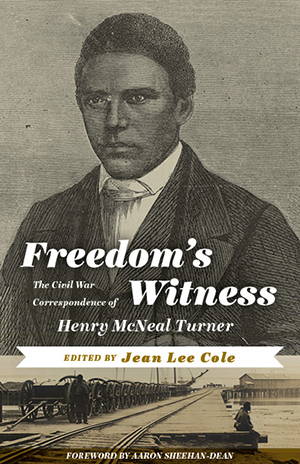
    In a series of columns published in the African American newspaper The Christian Recorder, the young, charismatic preacher Henry McNeal Turner described his experience of the Civil War, first from the perspective of a civilian observer in Washington, D.C., and later, as one of the Union army’s first black chaplains.

    In the halls of Congress, Turner witnessed the debates surrounding emancipation and black enlistment. As army chaplain, Turner dodged “grape” and cannon, comforted the sick and wounded, and settled disputes between white southerners and their former slaves. He was dismayed by the destruction left by Sherman’s army in the Carolinas, but buoyed by the bravery displayed by black soldiers in battle. After the war ended, he helped establish churches and schools for the freedmen, who previously had been prohibited from attending either.

    Throughout his columns, Turner evinces his firm belief in the absolute equality of blacks with whites, and insists on civil rights for all black citizens. In vivid, detailed prose, laced with a combination of trenchant commentary and self-deprecating humor, Turner established himself as more than an observer: he became a distinctive and authoritative voice for the black community, and a leader in the African Methodist Episcopal church. After Reconstruction failed, Turner became disillusioned with the American dream and became a vocal advocate of black emigration to Africa, prefiguring black nationalists such as Marcus Garvey and Malcolm X. Here, however, we see Turner’s youthful exuberance and optimism, and his open-eyed wonder at the momentous changes taking place in American society.

    Well-known in his day, Turner has been relegated to the fringes of African American history, in large part because neither his views nor the forms in which he expressed them were recognized by either the black or white elite. With an introduction by Jean Lee Cole and a foreword by Aaron Sheehan-Dean, Freedom’s Witness: The Civil War Correspondence of Henry McNeal Turner restores this important figure to the historical and literary record.

    Table of Contents

    • Editor’s Note
    • Foreword, Aaron Sheehan-Dean
    • Acknowledgments
    • Introduction: “I have seen war wonders”: The Civil War Correspondence of Henry McNeal Turner
    • Chapter 1. Emancipation and Enlistment (March 22, 1862–April 18, 1863)
    • Chapter 2. The Siege of Petersburg (June 25, 1864–December 17, 1864)
    • Chapter 3. Fort Fisher (Jan. 7, 1865–Feb. 18, 1865)
    • Chapter 4. Freeing Slaves, Meeting Sherman (Feb, 25, 1865–June 10, 1865)
    • Chapter 5. Roanoke Island (June 24, 1865–August 5, 1865)
    • About the Authors
  • Notes On A Theory Of Multi-Racial White Supremacist Patriarchy, aka MRWaSP

    it’s her factory: pop culture and philosophy from a critical-race feminist perspective.
    2013-11-29

    Robin James
    , Associate Professor of Philosophy & Women’s & Gender Studies
    University of North Carolina, Charlotte

    Multi-Racial White Supremacist Patriarchy, or MRWaSP, is my term for early 21st-century globalized Western race/gender/sexuality/capitalist hegemony. I put a lower-case “a” in the acronym to both make the acronym something pronounceable to English speakers, and to echo the older acronym WASP (White Anglo-Saxon Protestant). You say it like “Mr. Wasp”–emphasis on the “mister” shows that this is not just about white supremacy, it’s also about patriarchy.

    MRWaSP is an upgrade on WASP. As critical theorists of race have been arguing, white supremacy has retooled itself to work more efficiently in and for globalized, neoliberal hegemonies. Not only are exclusion and border-patrolling resource-intensive, they’re also not the most efficient ways of promoting nationalist, capitalist, patriarchal interests. As Jared Sexton argues, contemporary multiculturalism/multiracialism is a “protest less against the genocidal objectives of Anglo white supremacy than the inefficiency of unrestrained violence as the means of its accomplishment” (Amalgamation Schemes [: Antiblackness and the Critique of Multiracialism], 200). You can extend this argument to patriarchy and other institutionalized forms of identity-based oppression. It is more cost-effective to include some formerly excluded/abjected groups in racial/gender/sexual supremacy, because this inclusion further reinforces both the supremacy of the hyperelites and the precarity of the most unruly groups (those who pose the greatest threat to MRWaSP hegemony)…

    Read the entire article here.

  • The Widows

    NeWest Press
    April 1998
    256 pages
    Paperback ISBN: 978-1-896300-30-6

    Suzette Mayr

    Hannelore, Clotilde, and Frau Schnadelhuber are three old women tired of living in a world which does not allow old women to be seen or heard. Deciding to shake their fists at such a world, the three women plot to go over Niagara Falls in a bright orange space-age barrel. With the assistance of Cleopatra Maria, the 26-year-old genius granddaughter of Hannelore and grandniece of Clotilde, the four women steal the barrel from a travelling show and drive it across Canada determined to prove their worth to a world devoted to youth.

  • Moon Honey

    NeWest Press
    September 1995
    224 pages
    Paperback ISBN: 978-1-896300-00-9

    Suzette Mayr

    In this modern, magical tale, Carmen and Griffin, young and white, are goofy, head-over-heels in love. When Carmen turns into a black woman, Griffin thrills at a love turned exotic. But Carmen’s transformation means trouble for Griffin’s racist mother, already struggling with a new lover and a husband nicknamed God. The question is, can love be relied on to save the day?

    Moon Honey is an inventive, funny, sexy tale of love affairs and magical transformations.

  • “The Quiltings of Human Flesh”—Constructions of Racial Hybridity in Contemporary African-Canadian Literature

    University of Greifswald, Greifswald, Germany
    2010-05-02
    366 pages

    Heike Bast

    Dissertation to obtain the academic degree of Doctor of Philosophy, Division of the Humanities, University of Greifswald

    TABLE OF CONTENTS

    • ‘RACE’ MATTERS’: A PERSONAL NOTE ON BELONGING
    • 1. INTRODUCTION: ‘SOLE OR WHOLE’ – QUILTING THE RACIALIZED SUBJECT
    • 2. SIGNIFYING THE IN-BETWEEN: ‘RACE’, ‘RACIAL HYBRIDITY’ AND QUESTIONS OF BELONGING
      • 2.1. The Language of ‘Race’ – Notes on Terminology
      • 2.2. Identities in Flux: Discourses on ‘Race’ and Subjectivity
        • 2.2.1 ‘Race Theory’ – a Brief Historical Review
        • 2.2.2. “Identities Without Guarantees” and the Critique of Sameness: Contemporary Race Theory
      • 2.3. Uncertain Crossings: Racial Hybridity and Post-Colonial Belonging
    • 3. APPROACHING AFRICAN-CANADIAN BORDERLANDS
      • 3.1. The African-Canadian Experience: Unearthing the History of Miscegenation in Canada
      • 3.2. Canadian Multiculturalism and Cultural Violence: Mixed-Race Identities and the Intricacies of Belonging
      • 3.3. Living and Writing the In-Between: Tracing a Black Literary Tradition in Canada
      • 3.4. From ‘Tragic Mulatto’ to ‘Zebra Poetics’? – Racial Hybridity in African-Canadian literature
    • 4. EXPLORING AFRICAN-CANADIAN BORDERLANDS
      • 4.1. Borderlands Poetics in the Writings of Suzette Mayr
        • 4.1.1. Suzette Mayr’s Zebra Talk (1991)
        • 4.1.2. Metamorphoses and the Racialized Body: Suzette Mayr’s Moon Honey (1995)
        • 4.1.3. Canadian Hodgepodge in Suzette Mayr’s The Widows (1998)
      • 4.2. ‘Reverse Doublestuff’, or from Halfness to Wholeness: The Poetry of Mercedes Baines
      • 4.3. Polyvalent Blackness in African-Canadian Drama: Difference and Healing in Maxine Bailey’s and Sharon Lewis’s Sistahs (1994)
      • 4.4. ‘An Exile in the Land of My Birth’: Racial Mixture and National Belonging in the Autobiographical Writings of Camille Hernandez-Ramdwar
      • 4.5. Anti-Mulatto Rhetoric in Haitian and Haitian-Canadian History, Literature, and Culture
        • 4.5.1. Unmasking the Carnival: Max Dorsinville’s Erzulie Loves Shango (1998)
        • 4.5.2. Torment, Memory and Desire: Gérard Étienne’s La Pacotille (1991)
      • 4.6. ‘In Pursuit of Wholeness’: ‘Race’, Class and Black Masculinity in Kim Barry Brunhuber’s Kameleon Man (2003)
    • 5. ‘FROM SOLE TO WHOLE’ – AFRICAN-CANADIAN MIXED-RACE POETICS
    • 6. BIBLIOGRAPHY
    • APPENDIX I: BIO-BIBLIOGRAPHICAL NOTES ON AUTHORS
    • APPENDIX II: INTERVIEW WITH SUZETTE MAYR (JULY 25TH, 2009)
    • Danksagung

    Read the entire dissertation here.

  • Becoming Mexipino: Multiethnic Identities and Communities in San Diego [Floyd Review]

    The Journal of San Diego History
    Volume 59, Number 4 (Fall 2013)
    pages 291-292

    Carlton Floyd, Associate Professor of English
    University of San Diego

    Becoming Mexipino: Multiethnic Identities and Communities in San Diego. By Rudy P. Guevarra, Jr. New Brunswick, NJ: Rutgers University Press, 2012. Maps, photographs, tables, notes, and index. 256 pp. $25.95 paper.

    Becoming Mexipino: Multiethnic Identities and Communities in San Diego by Rudy P. Guevarra Jr. deftly explores his Filipino and Mexican familial history from its origins in Spanish colonialism to its current Mexipino configurations in San Diego. Addressing a subject that has received little extended critical attention, Guevarra argues that Spain’s sixteenth-century colonial enterprises brought Mexicans and Filipinos together in ways that facilitated their intimate interaction. First, they shared or, more aptly, endured enslavement and indentured servitude as well as the interest in surviving these perilous conditions. Second, Mexicans and Filipinos took on a common language and religion: Spanish and Catholicism. Third, they discovered themselves in possession of a similar sense of familial arrangements—in the notions of godparents and in the practice of coming-of-age ceremonies for young women, to cite two examples. These various conditions facilitated intimate interethnic relationships then, and foreshadowed similar intimate interactions centuries later, particularly in the western parts of the United States…

    Read the entire review here.

  • Science in support of racial mixture: Charles-Augustin Vandermonde’s Enlightenment program for improving the health and beauty of the human species

    Endeavor
    Available online 2013-12-25 (Corrected Proof)
    DOI: 10.1016/j.endeavour.2013.11.001

    Clara Pinto-Correia
    Instituto de Investigação Científica Bento da Rocha Cabral, Lisboa, Portugal
    Centro de Estudos de História e Filosofia das Ciências, Évora, Portugal

    João Lourenço Monteiro
    Departamento de Ciências Sociais Aplicadas
    Universidade Nova de Lisboa, Portugal

    In 1756, while he was regent of the Faculté de Médecine in Paris, Charles-Augustin Vandermonde published his Essai sur la Manière de Perfectionner l’Espèce Humaine. This treatise was situated within the French-led medical movement of meliorism, meant to increase public health by boosting the medical arrangement of marriages from all strata of society. What made Vandermonde different from his colleagues is that he was not just looking for a way to improve the health of society: he was also proposing a series of measures meant to increase the beauty of humankind. And, for the first time in the history of European medicine, he advocated mixed-race couplings as a means to obtain the best results. This latter development is so unexpected in the global setting of the Enlightenment that we could arguably hail Vandermonde as the founding father of what Michel Foucault later called ‘biopolitique’.

    Read or purchase the article here.

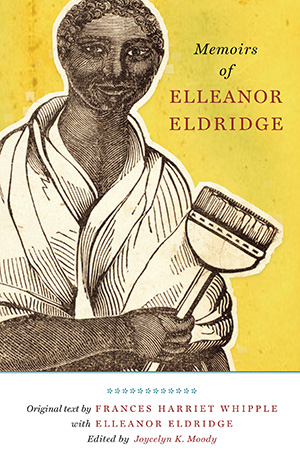
  • Memoirs of Elleanor Eldridge

    West Virginia University Press
    December 2013
    160 pages
    Cloth ISBN: 978-1-935978-24-4
    Paperback ISBN: 978-1-935978-23-7
    ePub ISBN: 978-1-935978-25-1
    PDF ISBN: 978-1-938228-64-3

    Original Text by Frances Harriet Whipple (1805-1878) with Elleanor Eldridge (1794-1862)

    Edited by:

    Joycelyn K. Moody, Sue E. Denman Distinguished Chair in American Literature and Professor of English
    University of Texas, San Antonio

    Elleanor Eldridge, born of African and US indigenous descent in 1794, operated a lucrative domestic services business in nineteenth century Providence, Rhode Island. In defiance of her gender and racial background, she purchased land and built rental property from the wealth she gained as a business owner. In the 1830s, Eldridge was defrauded of her property by a white lender. In a series of common court cases as defendant and plaintiff, she managed to recover it through the Rhode Island judicial system. In order to raise funds to carry out this litigation, her memoir, which includes statements from employers endorsing her respectable character, was published in 1838. Frances Harriet Whipple, an aspiring white writer in Rhode Island, narrated and co-authored Eldridge’s story, expressing a proto-feminist outrage at the male “extortioners” who caused Eldridge’s loss and distress.

    With the rarity of Eldridge’s material achievements aside, Memoirs of Elleanor Eldridge forms an exceptional antebellum biography, chronicling Eldridge’s life from her birth. Because of Eldridge’s exceptional life as a freeborn woman of color entrepreneur, it constitutes a counter-narrative to slave narratives of early 19th-century New England, changing the literary landscape of conventional American Renaissance studies and interpretations of American Transcendentalism.

    With an introduction by Joycelyn K. Moody, this new edition contextualizes the extraordinary life of Elleanor Eldridge—from her acquisition of wealth and property to the publication of her biography and her legal struggles to regain stolen property. Because of her mixed-race identity, relative wealth, local and regional renown, and her efficacy in establishing a collective of white women patrons, this biography challenges typical African and indigenous women’s literary production of the early national period and resituates Elleanor Eldridge as an important cultural and historical figure of the nineteenth century.

    Read the original text from 1838 here.