• Scientific Racism and the Emergence of the Homosexual Body

    Journal of the History of Sexuality
    Volume 5, Number 2 (October, 1994)
    pages 243-266

    Siobhan Somerville, Associate Professor
    University of Illinois, Urbana-Champaign

    One of the most important insights developed in the fields of lesbian and gay history and the history of sexuality has been the notion that homosexuality and, by extension, heterosexuality are relatively recent inventions in Western culture, rather than transhistorical or “natural” categories of human beings. As Michel Foucault and other historians of sexuality have argued, although sexual acts between two people of the same sex had been punishable through legal and religious sanctions well before the late nineteenth century, they did not necessarily define individuals as homosexual per se. Only recently, in the late nineteenth century, did a new understanding of sexuality emerge, in which sexual acts and desires became constitutive of identity. Homosexuality as the condition, and therefore identity, of particular bodies is thus a production of that historical moment.

    Medical literature, broadly defined to include the writings of physicians, sexologists, and psychiatrists, has been integral to this historical argument. Although medical discourse was by no means the only—nor necessarily the most powerful—site of the emergence of new sexual identities, it does nevertheless offer rich sources for at least partially understanding the complex development of these categories in the late nineteenth and early twentieth centuries. Medical and sexological literature not only became one of the few sites of explicit engagement with questions of sexuality during this period but also held substantial definitional power within a culture that sanctioned science to discover and tell the truth about bodies.

    As historians and theorists of sexuality have refined a notion of the late nineteenth-century “invention” of the homosexual, their discussions have drawn primarily upon theories and histories of gender. George Chauncey, in particular, has provided an invaluable discussion of the ways in which paradigms of sexuality shifted according to changing ideologies of gender during this period. He notes a gradual change in medical models of sexual deviance, from a notion of sexual inversion, understood as a reversal of one’s sex role, to a model of homosexuality, defined as deviant sexual object choice. These categories and their transformations, argues Chauncey, reflected concurrent shifts in the cultural organization of sex/gender roles and participated in prescribing acceptable behavior, especially within a context of white middle-class gender ideologies.

    While gender insubordination offers a powerful explanatory model for the “invention” of homosexuality, ideologies of gender also, of course, shaped and were shaped by dominant constructions of race. Indeed, although it has received little acknowledgment, it is striking that the “invention” of the homosexual occurred at roughly the same time that racial questions were being reformulated, particularly in the United States. This was the moment, for instance, of Plessy v. Ferguson the 1896 U.S. Supreme Court ruling that insisted that “black” and “white” races were “separate but equal.” Both a product of and a stimulus to a nationwide and brutal era of racial segregation, this ruling had profound and lasting effects in legitimating an apartheid structure that remained legally sanctioned for over half of the twentieth century. The Plessy case distilled in legal form many widespread contemporary fears about race and racial difference at the time. A deluge of “Jim Crow” and antimiscegenation laws, combined with unprecedented levels of racial violence, most visibly manifested in widespread lynching, reflected an aggressive attempt to classify and separate bodies as either “black” or “white.”

    Is it merely a historical coincidence that the classification of bodies as either “homosexual” or “heterosexual” emerged at the same time that the United States was aggressively policing the imaginary boundary between “black” and “white” bodies? Although some historians of sexuality have included brief acknowledgment of nineteenth-century discourses of racial difference, the particular relationship and potentially mutual effects of discourses of homosexuality and race remain unexplored. This silence around race may be due in part to the relative lack of explicit attention to race in medical and sexological literature of the period. These writers did not self-consciously interrogate race, nor were those whose gender insubordination and sexual transgression brought them under the medical gaze generally identified by race in these accounts. Yet the lack of explicit attention to race in these texts does not mean that it was irrelevant to sexologists’ endeavors. Given the upheavals surrounding racial definition during this period, it is reasonable to imagine that these texts were as embedded within contemporary racial ideologies as they were within ideologies of gender.

    Take, for instance, the words of Havelock Ellis, whose massive Studies in the Psychology of Sex was one of the most important texts of the late nineteenth-century medical and scientific discourse on sexuality. “I regard sex as the central problem of life,” began the general preface to the first volume. Justifying such unprecedented boldness toward the study of sex, Ellis explained, “And now that the problem of religion has practically been settled, and that the problem of labour has at least been placed on a practical foundation, the question of sex—with the racial questions that rest on it—stands before the coming generations as the chief problem for solution.” Despite Ellis’s oddly breezy dismissal of the problems of labor and religion, which were far from settled at the time, this passage points suggestively to a link between sexual and racial anxieties. Yet what exactly did Ellis mean by “racial questions”? More significantly, what was his sense of the relationship between racial questions and the question of “sex”? Although Ellis himself left these issues unresolved, his elliptical declaration nevertheless suggested that a discourse of race—however elusively—somehow hovered around or within the study of sexuality.

    In this article, I offer speculations on how late nineteenth- and early twentieth-century discourses of race and sexuality might be not merely juxtaposed, but brought together in ways that illuminate both. I suggest that the concurrent bifurcations of categories of race and sexuality were not only historically coincident but in fact structurally interdependent and perhaps mutually productive. My goal, however, is not to garner and display unequivocal evidence of the direct influence of racial categories on those who were developing scientific models of homosexuality. Nor am I interested in identifying individual writers and thinkers as racist or not. Rather, my focus here is on racial ideologies, the cultural assumptions and systems of representation about race through which individuals understood their relationships within the world. My emphasis lies in understanding the relationships between the medical/scientific discourse around sexuality and the dominant scientific discourse around race during this period, that is, scientific racism.

    My approach combines literary and historical methods of reading, particularly those that have been so crucial to lesbian and gay studies—the technique of reading to hear “the inexplicable presence of the thing not named,” of being attuned to the queer presences and implications in texts that do not otherwise name them. Without this collective project to see, hear, and confirm queer inflections where others would deny their existence, it is arguable that gay and lesbian studies itself, and particularly our knowledge and understanding of the histories, writing, and cultures of lesbians and gay men, would be impoverished, if not impossible. In a similar way, I propose to use the techniques of queer reading, but to modulate my analysis from a focus on sexuality and gender to one alert to racial resonances as well.

    My attention, then, is focused on the racial pressure points in exemplary texts from the late nineteenth-century discourse on sexuality, including those written by Ellis and other writers of the period who made explicit references to homosexuality. I suggest that the structures and methodologies that drove dominant ideologies of race also fueled the pursuit of scientific knowledge about the homosexual body: both sympathetic and hostile accounts of homosexuality were steeped in assumptions that had driven previous scientific studies of race. My aim is not to replace a focus on gender and sexuality with that of race but, rather, to understand how discourses of race and gender buttressed one another, often competing, often overlapping, in shaping emerging models of homosexuality.

    I suggest three broadly defined ways in which discourses of sexuality seem to have been particularly engaged, sometimes overtly, but largely implicitly, with the discourse of scientific racism. All of these models pathologized both the nonwhite body and the nonheterosexual body to greater or lesser extents. Although I discuss these models in separate sections here, they often coexisted, despite their contradictions. These models are speculative and are intended as a first step toward understanding the myriad and historically specific ways that racial and sexual discourses shaped each other at the moment that homosexuality entered scientific discourse…

    …The Mixed Body

    The emergence of evolutionary theory in the late nineteenth century foregrounded a view of continuity between the “savage” and “civilized” races, in contrast to earlier scientific thinking about race, which had focused on debates about the origins of different racial groups. Proponents of monogeny, on the one hand, argued that all races derived from a single origin. Those who argued for polygeny, on the other hand, argued that different races descended from separate biological and geographical sources, a view, not coincidentally, that supported segregationist impulses. With Darwin’s publication of Origin of the Species in 1859, the debate between polygeny and monogeny was replaced by evolutionary theory, which was appropriated as a powerful scientific model for understanding race. Its controversial innovation was its emphasis on the continuity between animals and human beings. Evolutionary theory held out the possibility that the physical, mental, and moral characteristics of human beings had evolved gradually over time from apelike ancestors. Although the idea of continuity depended logically on the blurring of boundaries within hierarchies, it did not necessarily invalidate the methods or assumptions of comparative anatomy. On the contrary, the notion of visible differences and racial hierarchies were deployed to corroborate Darwinian theory.

    The concept of continuity was harnessed to growing attention to miscegenation, or “amalgamation,” in social science writing in the first decades of the twentieth century. Edward Byron Reuter’s The Mulatto in the United States, for instance, pursued an exhaustive quantitative and comparative study of the mulatto population and its achievements in relation to those of “pure” white or African ancestry. Reuter traced the presence of a distinct group of mixed-race people back to early American history: “Their physical appearance, though markedly different from that of the pure blooded race, was sufficiently marked to set them off as a peculiar people.” Reuter, of course, was willing to admit the viability of “mulattoes” only within a framework that emphasized the separation of races. Far from using the notion of the biracial body to refute the belief in discrete markers of racial difference, Reuter perpetuated the notion by focusing on the distinctiveness of this “peculiar people.”

    Miscegenation was, of course, not only a question of race but also one of sex and sexuality. Ellis recognized this intersection implicitly, if not explicitly. His sense of the “racial questions” implicit in sex was surely informed by his involvement with eugenics, the movement in Britain, Europe, and the United States that, to greater or lesser degrees, advocated selective reproduction and “race hygiene.” In the United States, eugenics was both a political and scientific response to the growth of a population beginning to challenge the dominance of white political interests. The widespread scientific and social interest in eugenics was fueled by anxieties expressed through the popularized notion of (white) “race suicide.” This phrase, invoked most famously by Theodore Roosevelt, summed up nativist fears about a perceived decline in reproduction among white Americans. The new field of eugenics worked hand in hand with growing antimiscegenation sentiment and policy, provoked not only by attempts for political representation among African-Americans but also by the influx of large populations of immigrants. As Mark Haller has pointed out, “Racists and [immigration] restrictionists . . . found in eugenics the scientific reassurances they needed that heredity shaped man’s personality and that their assumptions rested on biological facts.” Ellis saw himself as an advocate for eugenics policies. As an active member of the British National Council for Public Morals, Ellis wrote several publications concerning eugenics, including The Problem of Race Regeneration, a pamphlet advocating “voluntary” sterilization of the unfit as a policy in the best interest of “the race.” In a letter to Francis Galton in 1907, Ellis wrote, “In the concluding volume of my Sex ‘Studies’ I shall do what I can to insinuate the eugenic attitude.”

    The beginnings of sexology, then, were related to and perhaps even dependent on a pervasive climate of eugenicist and antimiscegenation sentiment and legislation. Even at the level of nomenclature, anxieties about miscegenation shaped sexologists’ attempts to find an appropriate and scientific name for the newly visible object of their study Introduced in 1892 through the English translation of Krafft-Ebing’s Psychopathia Sexualis, the term “homosexuality” itself stimulated a great deal of uneasiness. In 1915, Ellis reported that “most investigators have been much puzzled in coming to a conclusion as to the best, most exact, and at the same time most colorless names [for same-sex desire].” Giving an account of the various names proposed, such as Ulrichs’s “Uranian” and Westphal’s “contrary sexual feeling,” Ellis admitted that “homosexuality” was the most widespread term used. Far from the ideal “colorless” term, however, “homosexuality” evoked Ellis’s distaste for its mixed origins: in a regretful aside, he noted that “it has, philologically, the awkward disadvantage of being a bastard term compounded of Greek and Latin elements” (p. 2). In the first edition of Sexual Inversion, Ellis had stated his alarm more directly: “‘Homosexual’ is a barbarously hybrid word.” A similar view was expressed by Edward Carpenter, an important socialist organizer in England and an outspoken advocate of homosexual and women’s emancipation at this time. Like Ellis, Carpenter winced at the connotations of illegitimacy in the word: “‘homosexual,’ generally used in scientific works, is of course a bastard word. ‘Homogenic’ has been suggested, as being from two roots, both Greek, i.e., ‘homos,’ same, and ‘genos,’ sex.” Carpenter’s suggestion, “homogenic,” of course, resonated both against and within the vocabularies of eugenics and miscegenation. Performing these etymological gyrations with almost comic literalism, Ellis and Carpenter expressed pervasive cultural sensitivities around questions of racial origins and purity. Concerned above with legitimacy, they attempted to remove and rewrite the mixed origins of “homosexuality.” Ironically, despite their suggestions for alternatives, the “bastard” term took hold among sexologists, thus yoking together, at least rhetorically, two kinds of mixed bodies—the racial “hybrid” and the invert.

    Although Ellis exhibited anxieties about biracial bodies, for others who sought to naturalize and recuperate homosexuality, the evolutionary emphasis on continuity offered potentially useful analogies. Xavier Mayne, for example, one of the earliest American advocates of homosexual rights, wrote, “Between whitest of men and the blackest negro stretches out a vast line of intermediary races as to their colours: brown, olive, red tawny, yellow.” He then invoked this model of race to envision a continuous spectrum of gender and sexuality: “Nature abhors the absolute, delights in the fractional. . . . Intersexes express the half-steps, the between-beings ” In this analogy, Mayne reversed dominant cultural hierarchies that privileged purity over mixture. Drawing upon irrefutable evidence of the “natural” existence of biracial people, Mayne posited a direct analogy to a similarly mixed body, the intersex, which he positioned as a necessary presence within the natural order.

    Despite Carpenter’s complaint about “bastard” terminology, he, like Mayne, also occasionally appropriated the scientific language of racial mixing in order to resist the association between homosexuality and degeneration. In The Intermediate Sex, he attempted to theorize homosexuality outside of the discourse of pathology or abnormality; he too suggested a continuum of genders, with “intermediate types” occupying a place between the poles of exclusively heterosexual male and female. In an appendix to The Intermediate Sex, Carpenter offered a series of quotations supporting his ideas, some of which drew upon racial analogies: “Anatomically and mentally we find all shades existing from the pure genus man to the pure genus woman. Thus there has been constituted what is well named by an illustrious exponent of the science ‘The Third Sex.’ … As we are continually meeting in cities women who are one-quarter, or one-eighth, or so on, male … so there are in the Inner Self similar half-breeds, all adapting themselves to circumstances with perfect ease.” Through notions of “shades” of gender and sexual “half-breeds,” Carpenter appropriated dominant scientific models of race to construct and embody what he called the intermediate sex. These racial paradigms, in addition to models of gender, offered a Carpenter a coherent vocabulary for understanding and expressing a new vision of sexual bodies…

    Read the entire article here.
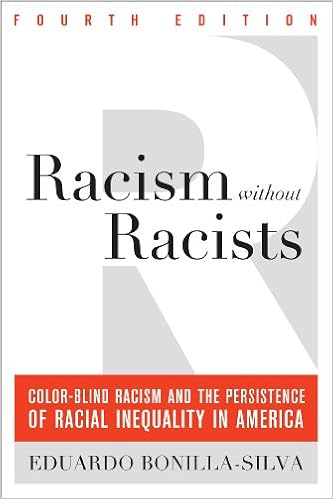
  • Racism without Racists: Color-Blind Racism and the Persistence of Racial Inequality in America (Fourth Edition)

    Rowman & Littlefield
    July 2013
    384 pages
    6 1/4 x 9 1/2
    Hardback ISBN: 978-1-4422-2054-6
    Paperback ISBN: 978-1-4422-2055-3
    eBook ISBN: 978-1-4422-2056-0

    Eduardo Bonilla-Silva, Professor of Sociology
    Duke University

    Eduardo Bonilla-Silva’s acclaimed Racism without Racists documents how beneath our contemporary conversation about race lies a full-blown arsenal of arguments, phrases, and stories that whites use to account for—and ultimately justify—racial inequalities. This provocative book explodes the belief that America is now a color-blind society.

    The fourth edition adds a chapter on what Bonilla-Silva calls “the new racism,” which provides the essential foundation to explore issues of race and ethnicity in more depth. This edition also updates Bonilla-Silva’s assessment of race in America after President Barack Obama’s re-election. Obama’s presidency, Bonilla-Silva argues, does not represent a sea change in race relations, but rather embodies disturbing racial trends of the past.

    In this fourth edition, Racism without Racists will continue to challenge readers and stimulate discussion about the state of race in America today.

    Features

    • An engaging read that provokes classroom discussion
    • Challenges the truth behind the assumption “I don’t see race”
    • A new chapter on what Bonilla-Silva calls “new racism” in America introduces students to key themes in studying race and ethnicity
    • Assesses the impact of Obama’s presidency and reelection on race relations in America

    Table of Contents

    • Acknowledgments
    • Preface to the Fourth Edition
    • 1. The Strange Enigma of Race in Contemporary America
    • 2. The New Racism: The U.S. Racial Structure Since the 1960s
    • 3. The Central Frames of Color-Blind Racism
    • 4. The Style of Color Blindness: How to Talk Nasty about Minorities without Sounding Racist
    • 5. “I Didn’t Get That Job Because of a Black Man”: Color-Blind Racism’s Racial Stories
    • 6. Peeking Inside the (White) House of Color Blindness: The Significance of Whites’ Segregation
    • 7. Are All Whites Refined Archie Bunkers? An Examination of White Racial Progressives
    • 8. Are Blacks Color Blind, Too?
    • 9. E Pluribus Unum, or the Same Old Perfume in a New Bottle? On the Future of Racial Stratification in the United States
    • 10. Race Matters in Obamerica: The Sweet (but Deadly) Enchantment of Color Blindness in Black Face
    • 11. “The (Color-Blind) Emperor Has No Clothes”: Exposing the Whiteness of Color Blindness
    • Bibliography
    • Index
    • About the Author
  • The Uniqueness of Dante de Blasio

    Gotham Gazette: The Place or New York Policy and Politics
    New York, New York
    2013-09-24

    Andy Beveridge, Professor of Sociology
    Queens College, City University of New York

    As New York took in the extent of the win by Bill de Blasio in the Democratic primary for mayor, the impact of a powerful television ad starring his son Dante seemed plain.

    The ad hit on de Blasio’s main campaign points of taxing the wealthy, ending a “stop-and-frisk era that unfairly targets people of color” and universal pre-K. But it was the messenger that made it a show-stopper: A mixed-race kid with an exuberant Afro speaking to the camera about how his dad was “the only Democrat with the guts to really break with the Bloomberg years.”

    De Blasio’s wife is a black woman, and both Dante and Chiara (his daughter) are mixed race. With his family and the ad featuring his son playing key roles in his campaign, de Blasio split the black vote almost evenly with former comptroller Bill Thompson, the only black candidate for mayor.

    Remember, in the primary between Hillary Clinton and Obama, who is mixed race, in 2008 Hillary Clinton did better among white and Hispanic voters than she did overall, and Barack Obama won the black vote by a very wide margin in an overall close race. In terms of who voted for whom, race mattered.

    As Joe Lenski, the man behind the exit polls, said in the Daily News, “I don’t know if I could ever remember a race where a black guy is (close to) losing the black vote, the woman is losing the woman vote, the Jewish guy is losing the Jewish vote. It’s quite impressive …. De Blasio did a good job of saying, ‘I’m one of you even though I’m not personally one of you.’ He was able to say, ‘my wife is African-American, my kids are multiracial.”

    How unique is Dante de Blasio, the 16-year-old superstar of the 2013 elections, who communicated this important message? Just how many New Yorkers are non-Hispanic males who would identify themselves as black and white? An analysis of 2010 Census data shows that very few young New Yorkers are black and white, and even fewer are non-Hispanic black and white. Furthermore, there are much lower proportions of such individuals in New York City in the country at large. These data are presented in the accompanying table, and some are summarized in the two charts below…

    Read the entire article here.

  • Geneticists and the Biology of Race Crossing

    Science Magazine
    Volume 182, Number 4114 (1973-11-23)
    pages 790-796
    DOI: 10.1126/science.182.4114.790

    William B. Provine, Andrew H. and James S. Tisch Distinguished University Professor
    Cornell University

    Geneticists changed their minds about the biological effects of race crossing

    Geneticists in England and the United States clearly reversed their published remarks on the effects of race crossing between 1930 and 1950. The reversal occurred in two steps. First came the change in the 1930’s from a condemnation of wide race crosses to an agnostic view. The second change, from the agnostic view to the belief that wide race crosses were at worst biologically harmless, took place during and shortly after World War II.

    The entire reversal occurred in the light of little new compelling data from studies of actual human race crosses. The lack of new data is unsurprising. Few geneticists wished to initiate experiments that took three human generations to complete. And controlled race crosses are hard to arrange, even with government grants. What might be more surprising was the willingness of geneticists to make such positive statements about race crossing when they had so little reliable genetic evidence.

    I interviewed or wrote to ten prominent geneticists who worked on human genetics between 1930 and 1950. Not one believed that new evidence on race crossing was the primary reason why geneticists changed their minds about the effects of race crossing. One plausible explanation, that the rise of “population thinking” (44) caused geneticists to change their minds, does not fit the evidence. Castle was no more of a “population” thinker than East, yet they differed radically in their conclusions about race crossing. What, then, did cause geneticists to change their minds?

    Most important was the revulsion of educated people in the United States and England to Nazi race doctrines and their use in justifying extermination of Jews. Few geneticists wanted to argue, as had the Nazis, that biology showed race crossing was harmful. Instead, having witnessed the horrible toll, geneticists naturally wanted to argue that biology showed race crossing was at worst harmless. No racist nation could misuse that conclusion. And geneticists did revise their biology to fit their feelings of revulsion.

    Geneticists’ ideas about the related question of hereditary mental differences between races is perhaps undergoing a similar development to that seen earlier in their ideas about race crossing. In 1951, judging from the response to the Unesco second statement on race and comments in genetics literature, most geneticists agreed with Muller that races probably differed in significant average mental traits. By 1969, when Arthur Jensen advocated this view in his controversial article (45), most geneticists who spoke publicly on the issue had adopted an agnostic position. Knowledge of hereditary racial differences in IQ had scarcely changed since 1951, but society had changed considerably in racial attitudes. It will be interesting to see if during the next several decades geneticists will argue, on the basis of little additional evidence, that hereditary mental differences between races do not exist.

    I am not condemning geneticists because social and political factors have influenced their scientific conclusions about race crossing and race differences. It is necessary and natural that changing social attitudes will influence areas of biology where little is known and the conclusions are possibly socially explosive. The real danger is not that biology changes with society, but that the public expects biology to provide the objective truth apart from social influences. Geneticists and the public should realize that the science of genetics is often closely intertwined with social attitudes and political considerations…

    Read or purchase the article here.

  • De Blasio Responds to Lhota’s Doomsday Ad With a Cheery One

    Politicker
    2013-10-17

    Colin Campbell

    Tale of Two Ads

    A day after Joe Lhota released an ad warning of apocalyptic results if rival Bill de Blasio is elected mayor–complete with photos of race riots and corpses–Mr. de Blasio is out with a new spot of his own.

    But Mr. de Blasio’s ad, narrated by his daughter Chiara, is almost saturated in sweetness.

    “From the start of this campaign, Bill de Blasio has offered a vision for New York that leaves no one behind. Now that my dad’s on the move. His opponents are on the attack,” says the older of the de Blasio kids, wearing her signature rose-adorned headband, as cheery music plays…

    Read the entire article here.

  • Fitting Into the Right Box: Multiracial America on the Rise

    Brown Political Review
    2013-10-18

    Meg Sullivan

    As swimmer Michael Phelps knows, one of the highest priorities of food corporations is maintaining their squeaky clean mainstream appeal. This usually involves companies giving wide berth to any manner of controversy, but Cheerios ignored this policy four months ago. In June, the cereal company released a 30 second television commercial that featured a mixed race married couple. The only detail of the ad that deviated from standard cereal advertisement conventions was black man and white woman actors playing the parents in the all-American family.

    Whether or not Cheerios predicted the commotion their commercial would cause, we don’t know. Regardless, the ad first met backlash–negative reactions drove YouTube to disable comments on the online video–but then an overwhelming show of support from Americans. The multiracial community applauded Cheerios for depicting a family on television that looked more like theirs.

    Aside from generating good publicity for Cheerios, the advertisement has drawn attention to the growing number of mixed race marriages and multiracial children in the United States. In 2010, 8.4 percent of all marriages were between individuals of a different race or ethnicity

    Read the entire article here.

  • Blow to multiple human species idea

    BBC News
    2013-10-17

    Melissa Hogenboom, Science Reporter

    The idea that there were several different human species walking the Earth two million years ago has been dealt a blow.

    Instead, scientists say early human fossils found in Africa and Eurasia may have been part of the same species.

    Writing in the journal Science, the team says that Homo habilis, Homo rudolfensis and Homo erectus are all part of a single evolving lineage that led to modern humans…

    Read the entire article here.

  • An Essentially American Narrative

    The New York Times
    2013-10-11

    Nelson George

    A Discussion of Steve McQueen’s Film ‘12 Years a Slave’

    Amid comic book epics, bromantic comedies and sequels of sequels, films about America’s tortured racial history have recently emerged as a surprisingly lucrative Hollywood staple. In the last two years, “The Help,” “Lincoln,””Django Unchained,””42” and “Lee Daniels’ The Butler” have performed well at the box office, gathering awards in some cases and drawing varying degrees of critical acclaim.

    The latest entry in this unlikely genre is “12 Years a Slave,” the director Steve McQueen’s adaptation of Solomon Northup’s 1853 memoir. A free black man living in Saratoga, N.Y., Northup (played by Chiwetel Ejiofor) was kidnapped in 1841 and sold into brutal servitude in the Deep South. During his ordeal, he labors at different plantations, including the one owned by the sadistic Edwin Epps (Michael Fassbender), who has a tortured sexual relationship with the slave Patsey (Lupita Nyong’o).

    Following a buzzed-about preview screening at the Telluride Film Festival and the audience award at the Toronto International Film Festival, “12 Years a Slave” arrives in theaters Friday amid much online chatter that it may be headed for Oscar nominations. But Mr. Ejiofor, who portrays Northup, and Mr. McQueen, known for the bracingly austere “Hunger” and “Shame,” both say that getting audiences to see an uncompromisingly violent and quietly meditative film about America’s “peculiar institution” is still a challenge even with the presence of a producer, Brad Pitt, in a small role.

    While the material was developed by Americans (including the screenwriter John Ridley) the director and most of the major cast members are British, a topic of concern among some early black commentators.

    On a sweltering afternoon in SoHo last month, the author and filmmaker Nelson George led a round-table discussion at the Crosby Street Hotel with Mr. Ejiofor and Mr. McQueen. Joining them to provide a wider historical and artistic context were the Columbia University professor Eric Foner, author of the Pulitzer Prize-winning “Fiery Trial: Abraham Lincoln and American Slavery,” among other books; and the artist Kara Walker, whose room-size tableaus of the Old South employing silhouettes have redefined how history and slavery are depicted in contemporary art and influenced many, including the “12 Years a Slave” production team. Current civil rights issues including the New York police practice of stop and frisk, recently declared unconstitutional; sexuality and slavery; Hollywood’s version of American history; and the themes of Obama-era cinema were among the topics of the sharp but polite dialogue. These are excerpts from the conversation…

    Q. I wanted to start with contemporary analogues. One thing that came to mind was stop and frisk, a way the New York City police could stop a black or Latino male. I thought of Solomon as a character who, for a lot of contemporary audiences, would be that young black person. [To Mr. McQueen and Mr. Ejiofor] When you were seeking a way into the slave story, was what happens now part of that?

    Steve McQueen Absolutely. History has a funny thing of repeating itself. Also, it’s the whole idea of once you’ve left the cinema, the story continues. Over a century and a half to the present day. I mean, you see the evidence of slavery as you walk down the street.

    What do you mean? 

    McQueen The prison population, mental illness, poverty, education. We could go on forever…

    …Servitude and Sexuality 

    There’s a lot of things to say about sex in the film, but one of the things that is going to leap out is Alfre Woodard’s character [Mistress Shaw, described in the book as the black wife of a white plantation owner]. 

    McQueen In the book, she doesn’t say anything. I had a conversation with John Ridley, and I said: “Look, we need a scene with this woman. I want her to have tea.” It was very simple. Give her a voice.

    Walker It’s not that it was that uncommon. That planter would be sort of the crazy one, the eccentric one, and she’s getting by.

    Ejiofor It was against the law to marry, but it did happen.

    Foner There were four million slaves in the U.S. in 1860 and several hundred thousand slave owners. It wasn’t just a homogeneous system. It had every kind of human variation you can imagine. There were black plantation owners in Louisiana, black slave owners

    …Solomon has a wife beforehand. In the film it seems as if he lived with Eliza [a fellow slave]. Then obviously [he has] some kind of relationship with Patsey, a friendship. But I wondered about Solomon’s own sexual expression. 

    Ejiofor  His sexuality felt slightly more of a tangent. I think the real story is where sex is in terms of power.

    Foner Remember, this book is one of the most remarkable first-person accounts of slavery. But it’s also a piece of propaganda. It’s written to persuade people that slavery needs to be abolished. He doesn’t say anything about sexual relations he may have had as a slave. There’s no place for such a discussion because of the purpose of the book.

    Walker But in “Incidents in the Life of a Slave Girl” [by Harriet Ann Jacobs] and other slave narratives written by women, that’s always kind of the subtext, because there are children that are produced, relationships that are formed or allegiances that are formed with white men in order to have freedom.

    Foner  Harriet Jacobs was condemned by many people for revealing this, even antislavery people.

    Walker Yes, but it’s always the subtext. Even “Uncle Tom’s Cabin.” It’s like, there’s little mulatto children, and that’s the evidence…

    Read the entire interview here.

  • Mary Seacole: The Charismatic Black Nurse Who Became a Heroine of the Crimea [new edition]

    Constable & Robinson
    2006-11-16
    288 pages
    Paperback ISBN: 9781845294977

    Jane Robinson

    The ‘Greatest Black Briton in History’ triumphed over the Crimea and Victorian England. She became an independent ‘doctress’ combining the herbal remedies of her African ancestry with sound surgical techniques. This biography of a Victorian celebrity, voted the greatest black Briton in history, brings Mary Seacole centre stage.

    The ‘Greatest Black Briton in History’ triumphed over the Crimea and Victorian England. ‘The Times’ called her a heroine, Florence Nightingale called her a brothel-keeping quack, and Queen Victoria’s nephew called her, simply, ‘Mammy’—Mary Seacole was one of the most eccentric and charismatic women of her era. Born at her mother’s hotel in Jamaica in 1805, she became an independent ‘doctress’ combining the herbal remedies of her African ancestry with sound surgical techniques.

    On the outbreak of the Crimean War, she arrived in London desperate to join Florence Nightingale at the Front, but the authorities refused to see her. Being black, nearly 50, rather stout, and gloriously loud in every way, she was obviously unsuitable. Undaunted, Mary travelled to Balaklava under her own steam to build the ‘British Hotel’, just behind the lines. It was an outrageous venture, and a huge success – she became known and loved by everyone from the rank and file to the royal family.

    For more than a century after her death this remarkable woman was all but forgotten. This, the first full-length biography of a Victorian celebrity recently voted the greatest black Briton in history, brings Mary Seacole centre stage at last.

  • About 15% of all new marriages in the United States in 2010 were between spouses of a different race or ethnicity from one another, more than double the share in 1980 (6.7%). Among all newlyweds in 2010, 9% of whites, 17% of blacks, 26% of Hispanics and 28% of Asians married out. Looking at all married couples in 2010, regardless of when they married, the share of intermarriages reached an all-time high of 8.4%. In 1980, that share was just 3.2%.

    Wendy Wang, “The Rise of Intermarriage: Rates, Characteristics Vary by Race and Gender,” Pew Research Center, (Washington, D.C., February 16, 2012), 1. http://www.pewsocialtrends.org/2012/02/16/the-rise-of-intermarriage/.