• United States of the United Races – Great Resource for Storytellers

    Mixed Roots Stories: Strengthening and celebrating diverse Mixed communities through the power of sharing stories
    2013-10-02

    Fanshen Cox DiGiovanni, Playwright, Producer, Actress, Educator

    Greg Carter, The United States of the United Races: A Utopian History of Racial Mixing (New York: New York University Press, 2013)

    When discovering the strongest submissions for the Mixed Roots Film & Literary Festival, one thing always stood out for me: the storyteller (filmmaker, author, performer) had a solid understanding of the historical context behind the story they were telling. Although many of the personal narratives were compelling, it was often clear when the creator of the work hadn’t delved into the historical reasons why they found themselves in a certain time and space. This often made the work feel lacking in some way.

    Enter Greg Carter’s United States of the United Races – an antidote to celebrations of the mixed experience that lack the important weight of context. The Introduction examines how President Obama – and many others – have capitalized on his being mixed, “he piggybacked onto positive notions about racially mixed people to improve his symbolic power.” Carter makes his goals for the book clear here: 1) to show that racial mixture has a long history of being touted as a way towards progress and 2) to question the notion that racial mixture automatically equals progress…

    Read the entire review here.
  • Marginalizing Métis histories through Treaty Territory Acknowledgment

    Big M Musings
    2013-10-03

    Chris Andersen, Research and Associate Professor of Native Studies
    University of Alberta

    In the last decade or so, it has become a fairly accepted practice in Indigenous Studies circles for scholars presenting on Indigenous issues to begin their talks with some form of acknowledgment of the Indigenous peoples upon whose territories they are presenting. In western Canada, home of several so-called “numbered treaties”, scholars often go further to more specifically acknowledge the treaty territory upon which they present: “I’d like to acknowledge our presence on Treaty 4 territory…” or even the historical names of the peoples on those territories. Scholars have also begun to acknowledge their presence on treaty territories in their book manuscripts and articles. Others – among them graduate students – have added treaty acknowledgments to the signature lines of their emails, some taking the time to find the proper Indigenous terms for the territory. In certain cases, universities have even begun to acknowledge this presence during their convocation ceremonies…

    …However, while many of us are aware of the historical treaty process, far fewer are aware of the options Métis were given to “surrender” their Aboriginal title. Certainly, it is possible to envision the Manitoba Act as a form of treaty, since it involved its own forms of negotiation between Métis representatives and Ottawa. Likewise, various historians have noted instances in which Métis individuals and families signed into treaty with their “First Nations” relatives….

    Read the entire article here.

  • Double the trouble, twice the joy for Japan’s hāfu

    The Japan Times
    2013-10-03

    Kaori Shoji, Special To The Japan Times

    Until about 10 years ago, the standard Japanese image of kids of mixed blood was that they were 1) gorgeous, 2) rich and 3) able to live in Japan with none of the kinks and hang out at Azabu clubs when they were 13. In high school, my girlfriends scorned their own Japanese heritage. The common reply to what we wanted to be when we graduated was “gaijin” (foreigner). Failing that, the next best option was to marry a gaijin and bear hāfu (mixed-race) kids, who would then automatically go on to have brilliant careers as newscasters or supermodels.

    Megumi Nishikura and Lara Perez Takagi’s documentary “Hafu” shows quite a different picture. “One of the reasons we made this film,” Nishikura tells The Japan Times, “is that the growing number of hāfu here are not celebrities or models. We wanted to put a hole in the stereotype of hāfu — to show that not everyone is Caucasian, well-to-do and beautiful. There are a lot of people who aren’t like that, who are struggling with the language, with life in Japan and with their own identities.”

    Both the filmmakers, who each have a background in documentaries, are mixed-race. Perez Takagi was born to a Japanese mother and Spanish father, and her childhood was divided by vacations spent in Japan at her grandmother’s house in Chiba and daily home life in Madrid

    Read the entire article here.

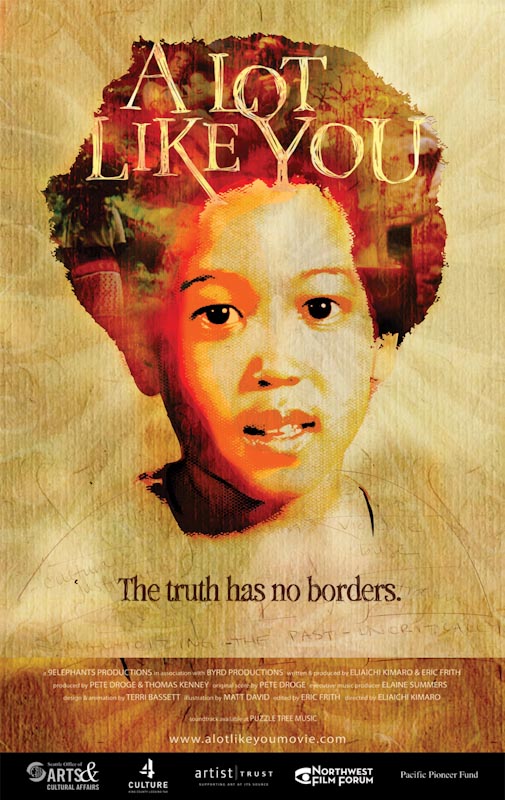
  • A Lot Like You

    DePaul University
    Center for Intercultural Programs
    LPC-Cortelyou Commons
    2324 N Fremont St.
    2013-10-15, 18:00-19:00 CDT (Local Time)

    Join documentary filmmaker Eliaichi Kimaro for a screening and discussion of scenes from A Lot Like Me, her own original autobiographical journey of self-discovery. Her film follows her experience as a mixed-race, first-generation American reconciling the culture she’s inherited with how she defines herself today.

    For more information, click here.

  • The Drock Story (Second Edition)

    Our Family Tree – Ancestors of Donald W.L. Roddy and Related Family Lines
    August 2005
    29 pages

    Donald W. L. Roddy (From Research by: Daryl Y. [Hooper] Holmes and Donald W. L. Roddy)

    1730 – Norwich, Connecticut:

    My great-great-great-great-great grandfather, Guy Drock, was probably born sometime between 1726 and 1742, most likely around 1730, give or take a few years. He may have been born in Norwich, or born elsewhere and brought to Norwich as a child. Guy officially became a Christian on 31 July, 1742, when he was baptized in the First Congregational Church in Norwich, New London County, in the Colony of Connecticut in New England. Nothing is said about his age in the baptismal Record, other than that he was a boy, so we don’t know if his was an infant baptism or a voluntary baptism sometime in his later childhood.

    As a boy, and young man, Guy worked for Captain Benajah Bushnell, who was a wealthy, influential land speculator, and one of the original settlers of what became Norwich in New London County in the Colony of Connecticut in New England. He got the title “Captain”, not from any association with seafaring, but because of his involvement with the local militia which conducted drills at least once a year, whether they needed it or not. Sometime around 1755, Sarah Powers, a young woman from Newport, on the Colony of Rhode Island, also started working for Benajah Bushnell. We do not know whether Sarah Powers was a voluntary employee of Bushnell or an indentured servant legally obligated to work for him for a specified period of time. In fact, we know very little about Sarah …. we do not even know for sure that she was born in Rhode Island, only that she had lived there prior to appearing in Norwich.

    While working for Bushnell, Sarah apparently fell in love with Guy, and probably married him sometime around 1757 or before. It is likely that she also had a child by Guy between 1757 and 1759, perhaps Simon. In June, 1759, Guy and Sarah probably stopped working for Benajah Bushnell, and set about trying to make a new life for themselves. The so called French and Indian War was raging at the time. Guy opened a small blacksmith shop in downtown Norwich. He may have learned his blacksmith’s skills while working for Bushnell, or perhaps he became self taught after he left Bushnell’s service. During the war, inflation ran rampant. After the war, of course, came an economic depression. Guy and Sarah must have been hard pressed indeed to keep body and soul together. Then, to make matters worse, the British parliament started passing the series of acts that eventually led to the Revolutionary War.

    Read the entire paper here.

  • The Counterfeit Family Tree of Vee Crawford-Wong

    Simon & Schuster Books for Young Readers
    July 2013
    368 pages
    Hardcover ISBN: 9781442412644
    eBook ISBN: 9781442412668

    L. Tam Holland

    A hysterically funny debut novel about discovering where you come from—even if you have to lie to get there.

    When Vee Crawford-Wong’s history teacher assigns an essay on his family history, Vee knows he’s in trouble. His parents—Chinese-born dad and Texas-bred Mom—are mysteriously and stubbornly close-lipped about his ancestors. So, he makes it all up and turns in the assignment. And then everything falls apart.

    After a fistfight, getting cut from the basketball team, offending his best friend, and watching his grades plummet, one thing becomes abundantly clear to Vee: No one understands him! If only he knew where he came from… So Vee does what anyone in his situation would do: He forges a letter from his grandparents in China, asking his father to bring their grandson to visit. Astonishingly, Vee’s father agrees. But in the land of his ancestors, Vee learns that the answers he seeks are closer to home then he could have ever imagined.

  • New mixed-race student group holds first meeting

    North by Northwestern
    2013-10-01

    Julia Clark-Riddell

    North by Northwestern is Northwestern University’s leading independent online publication, updated around the clock with stories about campus and culture.

    Wildcat Connection lists exactly 100 student groups in the “cultural” category, from the African Students Association to the Women in Leadership program, but, before this year, none had addressed the mixed-race community specifically.

    MIXED, formally known as the Mixed Race Student Coalition, held its first official meeting Tuesday night, beginning what co-presidents and founders Tori Marquez and Kalina Silverman hope will be a student group that can provide a safe space for mixed-race students on campus, as well as students interested in mixed-race culture.

    More than 40 students attended Tuesday’s meeting, where the seven executives of the group led introductions, icebreakers and small group discussions in a tucked away classroom of Seabury…

    …Medill professor Loren Ghiglione is writing a book about a cross-country trip he took with a couple of Medill students interviewing people about issues of race, sexual orientation and immigration. He was looking for signs of progress on these issues to add to his epilogue when he was saw that an organization like MIXED could be a good example…

    Read the entire article here.

  • Descendants of Norwich slave, owner meet

    Norwich Bulletin
    Norwich, Connecticut
    2012-03-29

    Adam Benson

    Norwich, Conn.—When descendants of Norwich slave Guy Drock and the man who owned him met  for the first time Thursday, they weren’t sure what would happen.

    Grant Hayter-Menzies’ fifth-generation great-grandfather, Capt. Benejah Bushnell, owned Drock for a decade in the mid-1700s in Norwich.

    Hayter-Menzies, of British Columbia; Daryl D’Angelo, of Amherst, N.H.; and her cousin, Donald Roddy, of Spokane, Wash. — all of them white — came to Karen Cook’s U.S. history class at Norwich Free Academy with a story they said had to be told.

    “I don’t have any of the cultural and social legacies of someone who grew up identified as an African-American, and I still had a moment of, ‘What does this guy want from me,’” D’Angelo said of meeting Hayter-Menzies.

    Hayter-Menzies was apprehensive, too…

    … Roddy, a retired airline pilot, said he stumbled across his Drock lineage several years ago, while doing genealogical research on his family.

    “I had no idea I had African ancestors until a few years ago,” Roddy said. “No one in my living family had a clue about that.”

    Hayter-Menzies said he’s forged a unique bond with D’Angelo and Roddy, and quickly felt a kinship with them once they finally met.

    “My first reaction was to reach out and hug you,” Hayter-Menzies told D’Angelo. “We feel like friends already.”…

    Read the entire article here.

  • [Kip] Fulbeck’s book accomplishes its goal of bringing awareness about Hapas to themselves and to the larger society. It creates a recognizable space for a particular group of mixed-race people that asserts itself against the traditional racial paradigm dominated by a logic of monoraciality, expands race beyond a black/white racial line, and sutures personal narrative back onto the visual images of mixed-race bodies. Although some elements of the book may work against the very multiplicity it seeks to convey, its most powerful impact is its promotion of a self-identification process through storytelling and narrative, which cannot be accomplished through the current racial language of identity, nor through bodily identification. By permitting the subjects not only to see themselves in the visual images of Hapaness but, more importantly, to speak for themselves and formulate their own sense of identity (whatever that may be), Fulbeck’s project resists simply (re)figuring Hapaness as a stabilized identity or giving into the community-forming demands of horizontal comradeship and hapagenization.

    Nicole Miyoshi Rabin, “Picturing the Mix: Visual and Linguistic Representations in Kip Fulbeck’s Part Asian, 100% Hapa,” Critical Studies in Media Communication, (Volume 29, Issue 5, 2012). http://dx.doi.org/10.1080/15295036.2012.691610.

  • “Slavery, Freedom and Reunion in a Colonial Connecticut Town” with Grant Hayter-Menzies, Daryl D’Angelo and Donald Roddy

    Research at the National Archives and Beyond
    BlogTalk Radio
    Thursday, 2013-10-03, 21:00 EDT, (Friday, 2013-10-04, 01:00Z)

    Bernice Bennett, Host

    In June 1759, Norwich, Connecticut businessman Benajah Bushnell sold Guy Drock, a slave of African ancestry, to Sarah Powers, the Caucasian woman Drock had possibly married. Ironically, this deed freed Drock from Bushnell’s control but not from slavery. In March 2012, descendants of Guy and Sarah Drock and of Benajah Bushnell came together in Norwich for the first time in over two centuries. Drock descendants Daryl D’Angelo and Donald Roddy—who when they began their research years earlier did not know they had African ancestry, and Bushnell descendant Grant Hayter-Menzies—who thought only his Southern ancestors were slave owners—met to try to understand a legacy they did not know they shared. In the town where their past began, they sought to explore the personal impact of their ancestors’ intertwined histories, how the past has shaped them, their research and their interactions with one another today, and the relatively unknown institution of slavery in early New England.

    • Grant Hayter-Menzies is an internationally published biographer and journalist .
    • Daryl D’Angelo is a wife and mother, photographer and writer, and lives in a small town [Amherst] in southern New Hampshire.
    • Donald Roddy is a 78 year old retired Airline Pilot.

    For more information, click here.