• Latina/o Healing Practices: Mestizo and Indigenous Perspectives

    Routledge
    2008-05-19
    360 pages
    Hardback ISBN: 978-0-415-95420-4

    Edited by:

    Brian McNeill, Professor and director of training for the Counseling Psychology Program
    Washington State University

    Joseph M. Cervantes, Professor in the Department of Counseling
    California State University, Fullerton

    This edited volume focuses on the role of traditional or indigenous healers, as well as the application of traditional healing practices in contemporary counseling and therapeutic modalities with Latina/o people. The book offers a broad coverage of important topics, such as traditional healer’s views of mental/psychological health and well-being, the use of traditional healing techniques in contemporary psychotherapy, and herbal remedies in psychiatric practice. It also discusses common factors across traditional healing methods and contemporary psychotherapies, the importance of spirituality in counseling and everyday life, the application of indigenous healing practices with Latina/o undergraduates, indigenous techniques in working with perpetrators of domestic violence, and religious healing systems and biomedical models. The book is an important reference for anyone working within the general field of mental health practice and those seeking to understand culturally relevant practice with Latina/o populations.

    Contents

    • An Appreciation of Dr. Michael W. Smith (1960-2006) Lorraine Garcia-Teague
    • Contributors
    • Introduction: Counselors and Curanderas/os—Parallels in the Healing Process Brian W. McNeill and Joseph M. Cervantes
    • Part One: Mestiza/o and Indigenous Perspectives
      • Chapter 1: What Is Indigenous About Being Indigenous? The Mestiza/o Experience Joseph M. Cervantes
      • Chapter 2: Latina/o Folk Saints and Marian Devotions: Popular Religiosity and Healing Fernando A. Ortiz and Kenneth G. Davis
      • Chapter 3: Santeria and the Healing Process in Cuba and the United States Brian W. McNeill, Eileen Esquivel, Arlene Carkasco, and Rosalilia Mendoza
    • Part Two: Indigenous and Mestiza/o Healing Practices
      • Chapter 4: The Use of Psychotropic Herbal and Natural Medicines in Latina/o and Mestiza/o Populations German Ascani and Michael W. Smith
      • Chapter 5: Brazil’s Ultimate Healing Resource: The Power of Spirit Sandra Nuñez
      • Chapter 6: La Limpia de San Lazaro as Individual and Collective Cleansing Rite Karen V. Holliday
      • Chapter 7: Resé un Ave María y Encendí una Velita: The Use of Spirituality and Religion as a Means of Coping with Educational Experiences for Latina/o College Students Jeanett Castellanos and Alberta M. Gloria
    • Part Three: Contemporary Aspects of Mestiza/o and Indigenous Healing Practices: Reclamation and Integration
      • Chapter 8: Los Espiritus Siguen Hablando: Chicana Spiritualities Lara Medina
      • Chapter 9: Religious Healing and Biomedicine in Comparative Context Karen V. Holliday
      • Chapter 10: Curanderismo: Religious and Spiritual Worldviews and Indigenous Healing Traditions Fernando A. Ortiz, Kenneth G. Davis, and Brian W. McNeill
    • Part Four: Epilogue
      • Epilogue: Summary and Future Research and Practice Agendas Joseph M. Cervantes and Brian W. McNeill
    • Index
  • In China, mixed marriages can be a labor of love

    The Christian Science Monitor
    2013-09-21

    Yepoka Yeebo, Contributor

    In one major Chinese city, marriages between Chinese and Africans are on the rise. In a country known for monoculture, it isn’t easy.

    GUANGZHOU, China

    The restaurant that Joey and Ugo Okonkwo own was packed on a recent Saturday night, with meal-time banter alternating between English, Cantonese Chinese, and Nigerian dialects among the mainly Nigerian patrons and the occasional Chinese girlfriend. In this bustling southern port city, it’s not an uncommon sight.

    Nor is the sight of marriages like Joey and Ugo’s. In Guangzhou, just next door to Hong Kong, a growing number of African traders and immigrants are marrying Chinese women, and mixed families like Joey and Ugo are grappling with questions about race and nationality, in a country that is often proud to be monocultural and is known for sometimes harsh xenophobia.

    Joey, who is native to Guangzhou, speaks English with a West African lilt, which she picked up from Ugo, who is from Anambra State in southeastern Nigeria. Joey, whose Chinese name is Li Jieyi, says people regularly look at her 2-year-old daughter Amanda and wonder about her origins.

    “Foreigners say she looks like me, Chinese say she looks like her father. I don’t know why,” Joey says as she bustles around the restaurant…

    Read the entire article here.

  • Lecture by Nayland Blake

    California College of the Arts
    Timken Lecture Hall, San Francisco Campus
    Graduate Studies Lectue Series
    2012-11-27, 19:00 PST

    Nayland Blake’s mixed-media work in sculpture and installation has been variously described as disturbing, provocative, elusive, tormented, sinister, hysterical, brutal, and tender. Often incorporating themes of masochism, it also manifests two other major threads: his biracial heritage and what he calls his pansexuality.

    Blake was included in the 1991 Whitney Biennial and the controversial Black Male: Representations of Masculinity in Contemporary American Art exhibition at the Whitney Museum of American Art in 1994. His work is in the collections of SFMOMA, the Whitney Museum, and the Walker Art Center in Minneapolis. He chairs the International Photography Center —Bard MFA program, and he lives and works in Brooklyn.

  • Faculty-Alumnus David Huffman’s “Out of Bounds” at SFAC Gallery a “SHIFT” Toward Dialogue About Race in America

    California College of the Arts
    Featured News
    2011-09-14

    Jim Norrena

    Alumnus David Huffman (MFA 1998), who is a recently tenured assistant professor in CCA’s undergraduate Painting/Drawing Program and Graduate Program in Fine Arts, is one of three featured artists in the current group exhibition SHIFT: Three Projects Constructing a New Dialogue About Race in America at the San Francisco Arts Commission Gallery (through December 10, 2011).

    Shifting Demographics, Shifting Races

    SHIFT is described as an exhibition that “pushes the public to think about our changing demographics and what role race plays in our post-millennial American circumstance.” Also featured are Bay Area artists Elizabeth Axtman [The Love Renegade #308: I Love You Keith Bardwell (Phase 1)] and Travis Somerville (Places I’ve Never Been), yet it is Huffman’s Out of Bounds, his first multimedia exhibition, that is positioned in the Main Gallery at 401 Van Ness Avenue.

    “Diversity can be viewed as a social activism of inclusion,” says Huffman, who is mixed race, “to include various groups of people who are normally rejected by prejudice, regardless of their capabilities. Out of Bounds includes works that examine various perspectives — some of which might normally be rejected because of their racial affiliation. I think that diversity is also about broadening the spectrum of possibilities from a variety of capable peoples and ideas.”…

    Read the entire article here.

  • The Essential Barack Obama

    Random House
    2008-03-10
    Abridged Compact Disc
    ISBN: 978-0-7393-7594-5

    Barack Obama, President of the United States

    A CD collection featuring the best-selling audiobooks, The Audacity of Hope and Dreams from My Father from Grammy® award-winning author, Barack Obama.

    The Audacity of Hope

    In July 2004, Barack Obama electrified the Democratic National Convention with an address that spoke to Americans across the political spectrum. One phrase in particular anchored itself in listeners’ minds, a reminder that for all the discord and struggle to be found in our history as a nation, we have always been guided by a dogged optimism in the future, or what Senator Obama called “the audacity of hope.”

    Now, in The Audacity of Hope, Senator Obama calls for a different brand of politics–a politics for those weary of bitter partisanship and alienated by the “endless clash of armies” we see in congress and on the campaign trail; a politics rooted in the faith, inclusiveness, and nobility of spirit at the heart of “our improbable experiment in democracy.” He explores those forces–from the fear of losing to the perpetual need to raise money to the power of the media–that can stifle even the best-intentioned politician. He also writes, with surprising intimacy and self-deprecating humor, about settling in as a senator, seeking to balance the demands of public service and family life, and his own deepening religious commitment.

    At the heart of this book is Senator Obama’s vision of how we can move beyond our divisions to tackle concrete problems. He examines the growing economic insecurity of American families, the racial and religious tensions within the body politic, and the transnational threats–from terrorism to pandemic–that gather beyond our shores. And he grapples with the role that faith plays in a democracy–where it is vital and where it must never intrude. Underlying his stories about family, friends, members of the Senate, even the president, is a vigorous search for connection: the foundation for a radically hopeful political consensus.

    A senator and a lawyer, a professor and a father, a Christian and a skeptic, and above all a student of history and human nature, Senator Obama has written a book of transforming power. Only by returning to the principles that gave birth to our Constitution, he says, can Americans repair a political process that is broken, and restore to working order a government that has fallen dangerously out of touch with millions of ordinary Americans. Those Americans are out there, he writes–“waiting for Republicans and Democrats to catch up with them.”

    Dreams from My Father

    In this lyrical, unsentimental, and compelling memoir, the son of a black African father and a white American mother searches for a workable meaning to his life as a black American. It begins in New York, where Barack Obama learns that his father—a figure he knows more as a myth than as a man—has been killed in a car accident. This sudden death inspires an emotional odyssey—first to a small town in Kansas, from which he retraces the migration of his mother’s family to Hawaii, and then to Kenya, where he meets the African side of his family, confronts the bitter truth of his father’s life, and at last reconciles his divided inheritance.

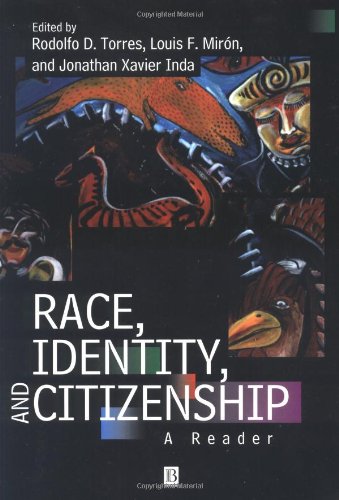
  • Race, Identity and Citizenship: A Reader

    Wiley-Blackwell
    June 1999
    454 pages
    Hardcover ISBN: 978-0-631-21021-4
    Paperback ISBN: 978-0-631-21022-1

    Edited by

    Rodolfo D. Torres, Professor of Planning, Policy & Design and Political Science
    University of California, Irvine

    Louis F. Mirón
    University of California, Irvine

    Jonathan Xavier Inda, Associate Professor of Latina/Latino Studies and Criticism and Interpretive Theory
    University of Illinois, Urbana-Champaign

    In recent years, race and ethnicity have been the focus of theoretical, political, and policy debates. This comprehensive and timely reader covers the range of topics that have been at the center of these debates including critical race theory, multiracial feminism, mixed race, whiteness, citizenship and globalization. Contributors include Angela Davis, Stuart Hall, Richard Delgado, Robert Miles, Michael Eric Dyson, Saskia Sassen, Étienne Balibar, Patricia Hill Collins, Renato Rosaldo, Stanley Aronowitz, and Collette Guillaumin.

    Table of Contents

    • List of Contributors
    • Acknowledgments/Copyright Information
    • Introduction
    • Part I: Mapping The Languages of Racism
      • 1. Does “Race” Matter? Transatlantic Perspectives on Racism after “Race Relations” Robert Miles and Rodolfo D. Torres
      • 2. “I Know it’s Not Nice, But. . . ” The Changing Face of “Race” Colette Guillaumin
      • 3. The Contours of Racialization: Structures, Representations and Resistance in the United States Stephen Small
      • 4. Marxism, Racism, and Ethnicity John Solomos and Les Back
      • 5. Postmodernism and the Politics of Racialized Identities Louis F. Mirón
    • Part II: Critical Multiracial Feminism
      • 6. Theorizing Difference from Multiracial Feminism Maxine Baca Zinn and Bonnie Thornton Dill
      • 7. Ethnicity, Gender Relations and Multiculturalism Nira Yuval-Davis
      • 8. What’s in a Name? Womanism, Black Feminism, and Beyond Patricia Hill Collins
    • Part III: Fashioning Mixed Race
      • 9. The Colorblind Multiracial Dilemma: Racial Categories Reconsidered john a. powell
      • 10. Multiracial Asians: Models of Ethnic Identity Maria P. P. Root
      • 11. Cipherspace: Latino Identity Past and Present J. Jorge Klor de Alva
    • Part IV: The Color(s) of Whiteness
      • 12. Establishing the Fact of Whiteness John Hartigan, Jr.
      • 13. Constructions of Whiteness in European and American Anti-Racism Alastair Bonnett
      • 14 The Labor of Whiteness, the Whiteness of Labor, and the Perils of Whitewishing Michael Eric Dyson
      • 15. The Trickster’s Play: Whiteness in the Subordination and Liberation Process Aida Hurtado
    • Part V: Cultural Citizenship, Multiculturalism, And The State
      • 16. Citizenship Richard Delgado
      • 17. Cultural Citizenship, Inequality, and Multiculturalism Renato Rosaldo
      • 18. Cultural Citizenship as Subject Making: Immigrants Negotiate Racial and Cultural Boundaries in the United States Aihwa Ong
    • Part VI: Locating Class
      • 19. The Site of Class Edna Bonacich
      • 20. Between Nationality and Class Stanley Aronowitz
      • 21. Class Racism Étienne Balibar
    • Part VII: Globalized Futures And Racialized Identities
      • 22. Multiculturalism and Flexibility: Some New Directions in Global Capitalism Richard P. Appelbaum
      • 23. Analytic Borderlands: Race, Gender and Representation in the New City Saskia Sassen
      • 24. Globalization, the Racial Divide, and a New Citizenship Michael C. Dawson
    • Part VIII: Critical Engagements
      • 25. Interview with Stuart Hall: Culture and Power Peter Osborne and Lynne Segal
      • 26. Angela Y. Davis: Reflections on Race, Class, and Gender in the USA Lisa Lowe
    • Index
  • Call for Papers – ‘Skin Tone, “Colourism” and “Passing”’

    University of Leeds
    School of Sociology and Social Policy
    Centre for Ethnicity and Racism Studies
    Leeds, West Yorkshire, England
    2013-09-11

    Peter Edwards

    The Race in the Americas (RITA) group, in partnership with the Centre for Ethnicity and Racism Studies (CERS), seeks abstract submissions on the theme of skin tone, ‘colourism’ and ‘passing’.

    The seminar will be held on Saturday 8 March 2014, at the University of Leeds.

    Submissions might include, but are not restricted to, research on the following topics:

    • ‘Colourism’ as a prejudice within racial groups with regard to skin tone;
    • The social implications of individuals passing as one race instead of another;
    • The impact of ‘passing’ on the politics of representation and governance;
    • The creation of space for a multi-ethnic identity: what is that space and does it exist? Are individuals forced to identify with one ethnicity over another?;
    • Racial identity as a performance through clothing, speech and patterns of consumption;
    • The proliferation of chemical products to lighten or darken skin tone and what this means for understandings of ‘race’;
    • Cultural systems of caste classification and translations of skin tone into political structures;
    • The role of skin tone in influencing confidence, and in determining social status within a power structure that privileges whiteness;

    For more information, click here.

  • Purchasing Whiteness in Colonial Latin America

    Not Even Past: “The past is never dead. It’s not even past.” —William Faulkner
    Department of History
    University of Texas at Austin
    2013-09-18

    Ann Twinam, Professor of History
    University of Texas, Austin

    The castas, or mixed race populations, suffered numerous forms of discrimination in colonial Latin America, but in practice pardos and mulatos could still achieve some social mobility.  A rare few, by the mid eighteenth century, were able to petition the Spanish crown through a process known as the gracias al sacar, to purchase whiteness…

    Read the entire article here.

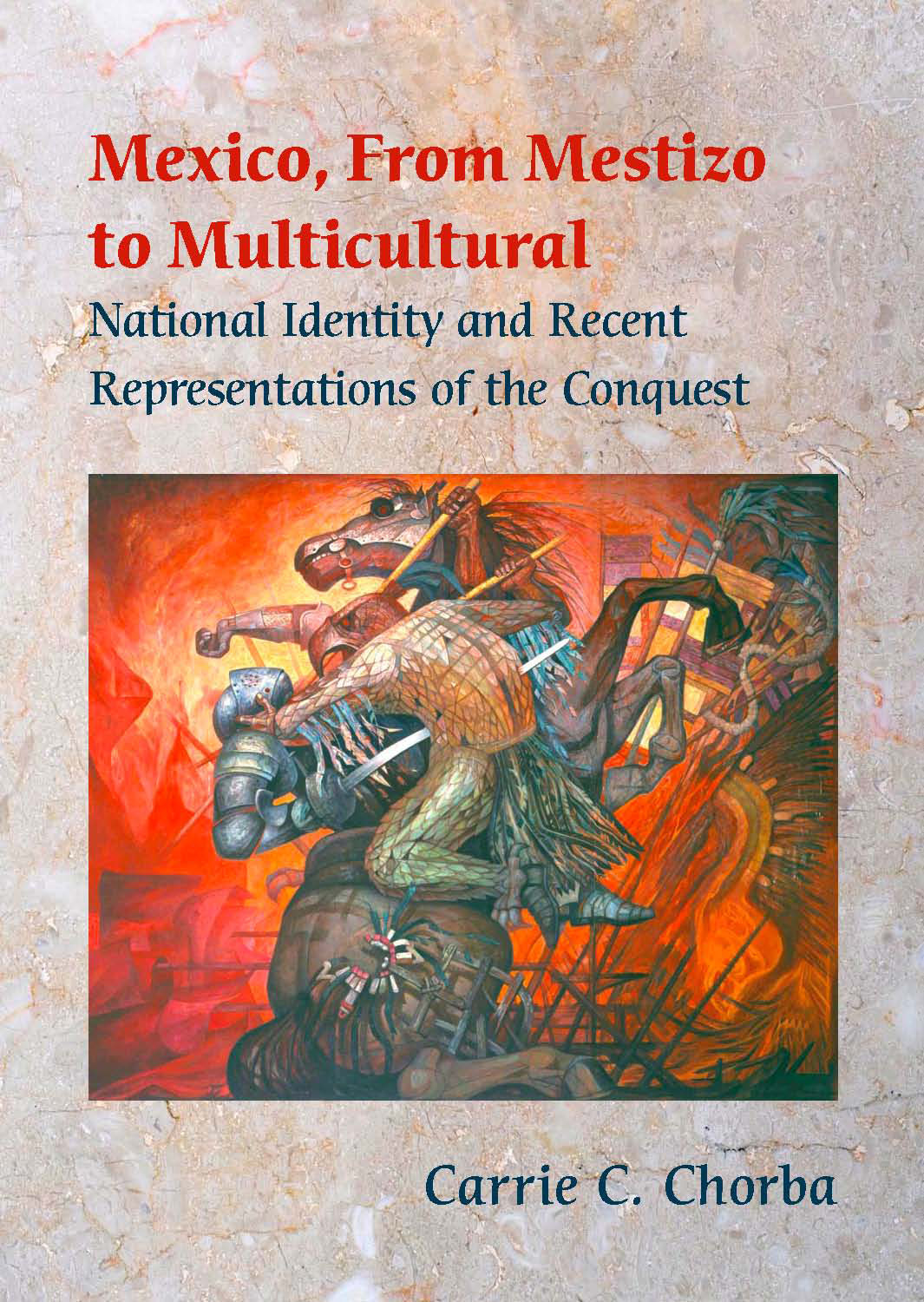
  • Mexico, From Mestizo to Multicultural

    Vanderbilt University Press
    2007-06-29
    254 pages
    7in x 10in
    60 Illustrations
    Paperback ISBN: 9780826515391
    Hardback ISBN: 9780826515384

    Carrie C. Chorba, Associate Professor of Spanish
    Claremont McKenna College, Claremont, California

    In Mexico, the confluence of the 1992 Quincentennial commemoration of Columbus’s voyages and the neo-liberal sexenio, or presidency, of Carlos Salinas de Gortari spurred artistic creations that capture the decade like no other source does. In the 1990s, Mexican artists produced an inordinate number of works that revise and rewrite the events of the sixteenth-century conquest and colonization. These works and their relationship to, indeed their mirroring of, the intellectual and cultural atmosphere in Mexico during the Salinas presidency are of paramount importance if we are to understand the subtle but deep shifts within Mexico’s national identity that took place at the end of the last century.

    Throughout the twentieth century, the post-revolutionary Mexican State had used mestizaje as a symbol of national unity and social integration. By the end of the millennium, however, Mexico had gone from a PRI-dominated, economically protectionist nation to a more democratic, economically globalizing one. More importantly, the homogenizing, mestizophile national identity that pervaded Mexico throughout the past century had given way to official admission of Mexico’s ethnic and linguistic diversity–or ‘pluriculture’ according to President Salinas’s 1992 constitutional revision.

    This book is the first interdisciplinary study of literary, cinematic, and graphic images of Mexican national identity in the 1980s and ’90s. Discussing, in depth, writings, films, and cartoons from a vast array of contemporary sources, Carrie C. Chorba creates a social history of this important shift.

  • Not Just Color: Whiteness, nation, and status in Latin America

    Hispanic American Historical Review
    Volume 93, Number 3 (August 2013)
    pages 411-449
    DOI: 10.1215/00182168-2210858

    Edward Telles, Professor of Sociology
    Princeton University

    René Flores
    Princeton University

    In this study we use statistical analysis of nationally representative surveys from the 2010 AmericasBarometer to examine how color, nationality, and several individual characteristics are related to white identification in 17 Latin American countries. Unlike the common treatment of racial identification as a fixed and self-evident determinant of social status or behavior, we treat it as a flexible social outcome. We find that though white identification is largely shaped by skin color, it is also shaped by national context, social status, and age.

    We discover that white identification is more common among persons of a brown skin color in Argentina, Uruguay, Chile, and Costa Rica than in the rest of Latin America, where such persons would generally identify as mestizo. This suggests that the whitening ideologies of these four countries have made whiteness a more capacious category. We find that younger Latin Americans are less likely to identify as white compared to their older conationals, suggesting a changing valorization of whiteness. Furthermore, college-educated persons are less likely to identify as white than their lower-educated counterparts, challenging ideas that “money whitens.” Findings for age and education may reflect a recent shift to multiculturalism. In addition, we find that white identification is predicted to change in response to the survey interviewer’s color, suggesting that choices about racial identification are relational.

    The work of historians has been critical to understanding our findings for the contemporary period, and we suggest ways that sociological work like ours might inform historical work on race and ethnicity.

    Read or purchase the article here. Read the entire original paper here.