• Blackness in Germany: Locating “Race” in Johannes Schaaf’s 1986 Film Adaptation of Michael Ende’s Fantasy Novel Momo

    Focus on German Studies
    Volume 19 (2012)
    pages 133-148

    Benjamin Nickl
    Georgetown University

    Michael Ende’s 1973 fantasy novel, Momo first became popular in West Germany. Decades later, the book remained successful in the unified Republic. Intended as a piece of alternative literature for children, the story advocates resistance to consumerism, capitalism, and the time bind, in which free market economies situate members of the working population. The novel’s protagonist is the titular character, a small girl named “Momo.” She fights her adversaries, the “Gray Agents,” who are sent by the “Timesaving Bank” to steal mankind’s unused time and use it to sustain their lives. What allows for Momo’s resistance to the time-thieves is her state of innocence, a natural purity which prevents the young heroine from falling prey to Western civilization’s dogma of capitalism.

    Ende’s original text, which is now in its 47th edition, never explicitly connects Momo as a symbol of pristine nature to non-white notions of race. However, the cinematic adaptation does exactly that. Cast in the role of Momo, then eleven-year-old Afro-German actress Radost Bokel was the visibly “exoticized” female lead. Her race set Bokel apart from her white cast members in the German-Italian production. Director Johannes Schaaf chose to define Momo in the context of a racial discourse to construct knowledge about otherness as ethnic difference. I read this as an exclusion of ethnic minorities in Germany, underscored by German film’s long tradition of nationalism based on ethnic affiliation.

    Schaaf’s adaptation perpetuates a racial bias, which occupies a large part of the country’s ethnic history. The film exemplifies the projection of identities on the black body and performative manifestations of (black) identity, which were authored by a white majority despite the actual presence of individuals who identify as black. In the 1960s and 1970s, for instance, “becoming black” was a widespread phenomenon in West Germany. In the wake of the nation’s politicized student movement in 1968 (“68’er Studentenbewegung”), a great part of the white population imagined “blackness” as a way to express (national-political) innocence and justified anger over being the victim of capitalist rule. White people appropriated racial features of the black body, which they believed was unrightfully oppressed by the establishment; hence they made claims to socio-cultural aspects of both Afro-German and Afro-American identity. Especially the German youth expressed their white afrophilia in terms of fierce socio-politic engagement and wide circulation of cultural products branded as “Afroblack”…

    Read the entire article here.

  • A Tale of Two Seminole Counties

    Indian Voices
    August 2013
    page 7

    Phil Fixico

    Some coincidences can’t be ignored, like February the 26th, in both Florida’s and Oklahoma’s Seminole Counties. What does this date and these counties have in common. Trayvon Martin was killed on February 26th, 2012, in Seminole County, Florida. He was born on Feb. 5th, 1995, not in Seminole County, but that, is where his young life would tragically be ended.

    My grandfather Pompey Bruner Fixico, on Feb. 14th, 1894, a hundred and one years before Trayvon’s birth, was born in Seminole County, Oklahoma. Eighty-seven years before Trayvon Martin’s death at the hands of an armed killer, who felt entitled to take Trayvon’s life, a similar scenario would end Pompey Bruner Fixico’s life on Feb. 26th, 1925, by someone else, who also didn’t hesitate. Pompey was a good deal older than Trayvon, he was 31 yrs. old and a WW1 Vet who had served his country in France during the War. He left a wife and four children, all younger than Trayvon’s 17 years, who by many, would be considered a child in a young man’s body. Pompey’s death took place, not far from the site of the “worst racial violence in American History”, “The Tulsa Race Riot”. The Riot had occurred 4 years earlier in 1921. Pompey Bruner’s (his father was Caesar Bruner) Draft Registration Card lists, his place of employment, in 1917, as the Brady Hotel, in Tulsa, Ok. It was owned by Mr. Tate Brady, the Grand Wizard of Oklahoma’s Ku Klux Klan, in that area. Grand Wizard Brady was reported to have had a hand in the, “Tulsa Race Riot”…

    Read the entire article here.

  • How my white mother shaped me into a black man

    Melissa Harris-Perry
    MSNBC
    2013-08-13

    Albert L. Butler, Radio Host
    900 AM WURD, Philadelphia

    I am an avid watcher of Melissa Harris-Perry, so I was not at all surprised–and was quite pleased–when host Melissa Harris-Perry tackled the subject of white mothers raising black boys in America in the wake of the George Zimmerman verdict. Prior to turning to her panel, the professor reminisced about her white mother offering a relevant (yet often overlooked) point that white mothers of black boys are confronted by the same realities as black mothers.

    As the segment continued, I found myself nodding in agreement as the panel of mothers discussed how important it was to talk about race, discrimination, and culture with their black children. I know firsthand how important this is; I am the black son of a white mother, and my mom made sure she addressed those issues in various ways from my early childhood to my early adulthood. Even now, as I stretch across the 40-year-old threshold, we still discuss all of it. Her choices, in very large measure, empowered me to be the strong, confident black man that I am today…

    Read the entire article here.

  • Alien Citizen, The Play

    World Premier at the Asylum Lab
    1078 Lillian Way
    Hollywood, California 90038
    Fridays & Saturdays @ 20:00 PDT (Local Time)
    Preview May 3, 2013, Opens May 4 – June 1

    Written and performed by Elizabeth Liang
    Directed by Sofie Calderon
    Associate Produced by Richard Lee, Karen Smith, and Wendy Belcher
    Co-produced by Leila Ciszewski
    Stage Managed by Michelle Hilyard
    House Managed by Charls Sedgwick Hall and Kate Huffman
    Lighting & Projection Design by Matt Richter
    Sound Design by Dennis Yen
    Graphic and Program Design by Gene Michael Barrera

    Presented by HapaLis Productions in association with Multiracial Americans of Southern California (MASC)

    Who are you when you’re from everywhere and nowhere? Alien Citizen is a funny and poignant one-woman show about growing up as a dual citizen of mixed heritage in Central America, North Africa, the Middle East, and New England.

    Elizabeth Liang, like President Obama, is a Third Culture Kid or a TCK. Third Culture Kids are the children of international business people, global educators, diplomats, missionaries, and the military — anyone whose family has relocated overseas because of a job placement. Liang weaves humorous stories about growing up as an Alien Citizen abroad with American commercial jingles providing her soundtrack through language confusion, first love, culture shock, Clark Gable, and sandstorms…

    Our protagonist deals with the decisions every global nomad has to make repeatedly: to adapt or to simply cope; to build a bridge or to just tolerate. From being a Guatemalan-American teen in North Africa to attending a women’s college in the USA, Alien Citizen reflects her experience that neither one was necessarily easier than the other. She realizes that girls across the world are growing into womanhood in environments that can be hostile to females (including the USA). How does a young girl cope as a border/culture/language/religion straddler in country after country that feels “other” to her when she is the “other?” Where is the line between respecting others and betraying yourself?

    Humor is a great survival mechanism! And friends make all the difference.

    TRAILER

    EXCERPT: On losing language

    EXCERPT: On (re)gaining language(s)

    For more information, click here.

  • Postwar responses to black occupation children represent a formative moment in the racial reconstruction of postfascist Germany. Military occupation between 1945 and 1949 produced some 94,000 occupation children. However, official and public attention fixed on a small subset, the so-called “farbige Mischlinge” or “colored mixed-bloods,” distinguished from the others by their black paternity. Although they constituted a small minority of postwar German births—numbering only about 3,000 in 1950 and nearly double that by 1955—West German federal and state officials, youth welfare workers, and the press invested the children with considerable symbolic significance.

    The years after 1945 were constituent for contemporary German racial understanding, and postwar debates regarding “miscegenation” and “Mischlingskinder” were central to the ideological transition from National Socialist to democratic approaches to race. The term “Mischling,” in fact, survived the Third Reich and persisted well into the 1960s in official, scholarly, media, and public usage in West Germany. But its content had changed. Rather than refer to the progeny of so-called mixed unions between Jewish and non-Jewish Germans as it had during the Third Reich, immediately after the war it came to connote the offspring of white German women and foreign men of color. Thus “Mischling” remained a racialized category of social analysis and social policy after 1945, as before. But the definition of which races had mixed, as well as the social significance of such mixing, had fundamentally altered.

    Rita Chin, Heide Fehrenbach, Geoff Eleym and Atina Grossmann, After the Nazi Racial State: Difference and Democracy in Germany and Europe, (Ann Arbor: University of Michigan Press, 2009). 31-32.

  • Schwarzsein, Weißsein, Deutschsein: Racial Narratives and Counter-discourses in German Film After 1950

    Duke University
    2012
    286 pages

    Michelle René Eley

    Dissertation submitted in partial fulfillment of the requirements for the degree of Doctor of Philosophy in the Carolina-Duke Program – German Studies in the Graduate School of Duke University

    This dissertation uses film to explore shifts in conceptions of race, cultural identity and national belonging in Germany from the 1950s West Germany to contemporary reunified Germany. Through the analysis of several German productions featuring Black characters in major narrative or symbolic roles, it identifies narrative and cinematic techniques used to thematize and problematize popular German conceptions of race and racism and to utilize race as a dynamic and flexible symbolic resource in defining specific identity borders. The dominant discourse around the concept of race and its far-reaching implications has long been impeded by the lack of a critical German vocabulary. This gap in mainstream German language is in large part a consequence of the immutable association between “race” (in German, Rasse) as a term, and the pro-Aryan, anti-Semitic dogma of National Socialist ideology. As Germany struggles to address racism as a specific problem in the process of its ongoing project to rehabilitate national identity in a post-colonial era indelibly marked by the Second World War, the films discussed in this work—Toxi (R.A. Stemmle, 1952), Gottes zweite Garnitur (P. Verhoeven, 1967), Angst essen Seele auf (R.W. Fassbinder, 1974), Die Ehe der Maria Braun (R.W. Fassbinder, 1979), Alles wird gut (Maccarone, 1998) and Tal der Ahnungslosen (Okpako, 2003)—provide evidence of attempts to create counter-discourses within the space of this language gap.

    Using approaches based primarily in critical race and film studies, the following work argues that these films’ depictions of racism and racial conflict are often both confined by and add new dimension to definitions of Blackness and of conceptions of race and racism in a German context. These attempts at redefinition reveal the ongoing difficulties Germany has faced when confronting the social and ideological structures that are the legacy of its colonialist and National Socialist history. More importantly, however, the films help us to retrace and recover Germany’s history of resistance to that legacy and expand the imaginative possibilities for using poetic politics and communities of coalition to affect social change.

    Read the entire thesis here.

  • Piesche Publishes Anthology on Audre Lorde

    Hamilton College, Clinton, New York
    College News
    2012-12-02

    In commemoration of the 20th anniversary of Audre Lorde’s death, Visiting Instructor of German & Russian Studies Peggy Piesche published a new anthology, Eurer Schweigen nützt euch nichts: Audre Lorde und die Schwarze Frauenbewegung in Deutschland (Your Silence Will Not Protect You:  Audre Lorde and the Black Women’s Movement in Germany). The book was launched with a discussion and reading on Nov. 21 in one of the main theaters in Berlin (Volksbühne)…

    Read the entire article here.

  • Still policing the crisis? Black and black and white mixed ‘race’ Seeking Interviewees]

    University of Leeds
    Leeds, West Yorkshire, England
    2013-08-12

    Lisa J. Long, Doctoral Researcher
    School of Sociology and Social Policy

    I am a Ph.D. Researcher at the University of Leeds. I am interested in understanding the experiences that black or black and white mixed ‘race’ people have had when they have found themselves in contact with the police, either as a victim of crime, when reporting a crime, as a crime suspect or in the course of routine policing enquiries e.g. stop and search. As part of my research I would like to interview black and black and white mixed ‘race’ people across all age groups (16+), both men and women with an opinion or view about policing based on personal experience.

    In order to be able to take part you will need to live in the West Yorkshire area and have had experience of policing within this area.

    If you would like more information about participating in the research please contact Lisa Long at ssljl@leeds.ac.uk.

  • Image Matters: Archive, Photography, and the African Diaspora in Europe

    Duke University Press
    2012
    256 pages
    118 photographs, 10 illustrations
    Paperback ISBN: 978-0-8223-5074-3
    Cloth ISBN: 978-0-8223-5056-9

    Tina M. Campt, Professor of Women’s, Gender and Sexuality Studies and Director of the Africana Studies Program
    Barnard College

    In Image Matters, Tina M. Campt traces the emergence of a black European subject by examining how specific black European communities used family photography to create forms of identification and community. At the heart of Campt’s study are two photographic archives, one composed primarily of snapshots of black German families taken between 1900 and 1945, and the other assembled from studio portraits of West Indian migrants to Birmingham, England, taken between 1948 and 1960. Campt shows how these photographs conveyed profound aspirations to forms of national and cultural belonging. In the process, she engages a host of contemporary issues, including the recoverability of non-stereotypical life stories of black people, especially in Europe, and their impact on our understanding of difference within diaspora; the relevance and theoretical approachability of domestic, vernacular photography; and the relationship between affect and photography. Campt places special emphasis on the tactile and sonic registers of family photographs, and she uses them to read the complexity of “race” in visual signs and to highlight the inseparability of gender and sexuality from any analysis of race and class. Image Matters is an extraordinary reflection on what vernacular photography enabled black Europeans to say about themselves and their communities.

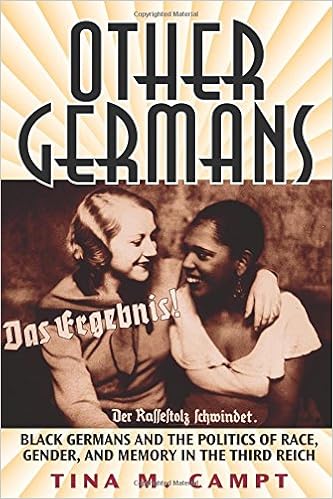
  • Other Germans: Black Germans and the Politics of Race, Gender, and Memory in the Third Reich

    University of Michigan Press
    2004
    296 pages
    6 x 9
    Paperback ISBN: 978-0-472-03138-2
    Ebook ISBN: 978-0-472-02160-4

    Tina M. Campt, Professor of Women’s, Gender and Sexuality Studies and Director of the Africana Studies Program
    Barnard College

    Tells the story, through analysis and oral history, of a nearly forgotten minority under Hitler’s regime

    It’s hard to imagine an issue or image more riveting than Black Germans during the Third Reich. Yet accounts of their lives are virtually nonexistent, despite the fact that they lived through a regime dedicated to racial purity.

    Tina M. Campt’s Other Germans tells the story of this largely forgotten group of individuals, with important distinctions from other accounts. Most strikingly, Campt centers her arguments on race, rather than anti-Semitism. She also provides an oral history as background for her study, interviewing two Black German subjects for her book.

    In the end the author comes face to face with an inevitable question: Is there a relationship between the history of Black Germans and those of other black communities?

    The answers to Campt’s questions make Other Germans essential reading in the emerging study of what it means to be black and German in the context of a society that looked at anyone with non-German blood as racially impure at best.

    Contents