• After the Nazi Racial State: Difference and Democracy in Germany and Europe

    University of Michigan Press
    2009
    272 pages
    6 x 9
    Paperback ISBN: 978-0-472-03344-7
    Ebook ISBN: 978-0-472-02578-7

    Rita Chin, Associate Professor of History
    University of Michigan

    Heide Fehrenbach, Presidential Research Professor
    Northern Illinois University

    Geoff Eley, Karl Pohrt Distinguished University Professor of Contemporary History
    University of Michigan

    Atina Grossmann, Professor of History
    Cooper Union, New York
    An investigation of the concept of “race” in post-Nazi Germany

    What happened to “race,” race thinking, and racial distinctions in Germany, and Europe more broadly, after the demise of the Nazi racial state? This book investigates the afterlife of “race” since 1945 and challenges the long-dominant assumption among historians that it disappeared from public discourse and policy-making with the defeat of the Third Reich and its genocidal European empire. Drawing on case studies of Afro-Germans, Jews, and Turks—arguably the three most important minority communities in postwar Germany—the authors detail continuities and change across the 1945 divide and offer the beginnings of a history of race and racialization after Hitler. A final chapter moves beyond the German context to consider the postwar engagement with “race” in France, Britain, Sweden, and the Netherlands, where waves of postwar, postcolonial, and labor migration troubled nativist notions of national and European identity.

    After the Nazi Racial State poses interpretative questions for the historical understanding of postwar societies and democratic transformation, both in Germany and throughout Europe. It elucidates key analytical categories, historicizes current discourse, and demonstrates how contemporary debates about immigration and integration—and about just how much “difference” a democracy can accommodate—are implicated in a longer history of “race.” This book explores why the concept of “race” became taboo as a tool for understanding German society after 1945. Most crucially, it suggests the social and epistemic consequences of this determined retreat from “race” for Germany and Europe as a whole.

    Contents

    • Preface
    • Introduction: What’s Race Got to Do With It? Postwar German History in Context / Rita Chin and Heide Fehrenhach
    • CHAPTER 1: Black Occupation Children and the Devolution of the Nazi Racial State / Heide Fehrenhach
    • CHAPTER 2: From Victims to “Homeless Foreigners”: Jewish Survivors in Postwar Germany / Atina Grossmann
    • CHAPTER 3: Guest Worker Migration and the Unexpected Return of Race / Rita Chin
    • CHAPTER 4: German Democracy and the Question of Difference, 1945 1995 / Rita Chin and Heide Fehrenhach
    • CHAPTER 5: The Trouble with “Race”: Migrancy, Cultural Difference, and the Remaking of Europe / Geoff Eley
    • Notes
    • Select Bibliography
    • Index
  • Euer Schweigen schützt Euch nicht: Audre Lorde und die Schwarze Frauenbewegung in Deutschland (Your silence will not protect you: Audre Lorde and the Black Women’s Movement in Germany)

    Orlanda-Verlag
    2012
    160 pages
    Paperback ISBN: 978-3936937-95-4
    (In German and English)

    Edited by:

    Peggy Piesche

    20er Todestag der Schwarzen, lesbischen Poetin und feministischen Autorin Audre Lorde

    “Euer Schweigen schützt Euch nicht” – Ein Aufruf zu Sprache und aktivem Handeln, der dringlicher nicht sein könnte. Wie viele der Appelle, Schriften und Aufrufe Audre Lordes war er prägend für die (internationale) Frauenbewegung und besonders für die Bewegung Schwarzer Frauen. Das rückhaltlose Ausloten von Sexismus, Rassismus, Homophobie und Klasse machen Audre Lorde auch zwanzig Jahre nach ihrem Tod zu einer der einflussreichsten Kämpferinnen für die Rechte Schwarzer Frauen. Der soziale Unterschied war für sie die treibende, kreative Kraft zu handeln und zu verändern. Ihre Essays, Gedichte, Vorträge und Erzählungen sind einschneidend und entschlossen, sie werfen einen schonungslosen Blick auf die Realität und transportieren dabei doch immer auch Hoffnung. Der vorliegende Band ist eine Sammlung von bereits erschienenen und bisher unveröffentlichten Texten Audre Lordes. Ergänzt werden diese durch Texte von Frauen, die gemeinsam mit der Autorin den Weg einer deutschen Schwarzen Frauenbewegung gingen und von Schwarzen Frauen der Nachfolgegenerationen aus Deutschland, die sich mit ihrem Erbe und den aktuellen Kämpfen auseinander setzen.

    20th Anniversary of the death of the Black, lesbian poet and feminist writer Audre Lorde

    “Your silence will not protect you” – A call to action and active language which could not be more urgent. How many of appeals, writings and views Audre Lorde he was formative for the (international) women’s movement, and particularly for the movement of Black women. The unreserved exploration of sexism, racism, homophobia, and class make Audre Lorde, even twenty years after her death, one of the most influential fighters for the rights of black women. The social difference was to act for them, the driving creative force and change it. Her essays, poems, speeches and narratives are incisive and determined, they throw an unsparing look at the reality, transporting always hope. The present volume is a collection of previously published and unpublished texts Audre Lorde. These are complemented by texts by women who went along with the author the way a German black women’s movement and the subsequent generations of black women from Germany who deal with their heritage and the current struggles apart.

  • Black and White Medicine

    PsycCRITIQUES
    Volume 58, Number 32 (August 2013)
    5 pages

    Alejandra Suarez, Professor of Psychology
    Antioch University, Seattle

    A review of Race in a Bottle: The Story of BiDil and Racialized Medicine in a Post-Genomic Age by Jonathan Kahn New York, NY: Columbia University Press, 2013. 311 pp. ISBN 978-0-231-16298-2 (hardcover); ISBN 978-0-231-53127-6 (e-book), hardcover.

    What is your race? (a) Mestizo, (b) Greek, (c) Creole, (d) Peninsular, (e) Mulatto, (f) Quadroon, (g) Octoroon, (h) Indian, (i) Chinese, (j) Japanese, (k) Moor, (l) Syrian, or (m) Nubian? In another time and place, these may have been the available choices. Obviously these categories are not anthropologically or scientifically based.

    Currently the United States uses the definition of racial categories as published by the Office of Management and Budget (1997) in its Revised Directive 15. Directive 15 stems from the civil rights movement; it aims to provide consistent data and a uniform language in order to increase fairness in society. All federally funded research with human participants is required to address issues of race, although the OMB explicitly states that its categories are not anthropologically or scientifically based.

    The current racial choices in the United States are (a) American Indian or Alaska Native, (b) Asian, (c) Black or African American, (d) Native Hawaiian or other PacificIslander, and (e) White. There are two categories for data on ethnicity: (a) Hispanic or Latino and (b) not Hispanic or Latino (Office of Management and Budget, 1997). Many people objected that it is difficult to fit into these categories, so in the 2000 census, one could also self-select multiple categories of race/ethnicity. Selecting one’s race is complicated: It is about identities; it is not about genetic differences.

    The human genome project, completed in June 2000, concluded that all human beings, regardless of race, have pretty much the same genes. In fact, the American Anthropological Association has asserted that race is “a worldview, a body of prejudgments that distorts our ideas about human differences and group behavior” and that “racial beliefs constitute myths about the diversity in the human species and about the abilities and behavior of people homogenized into ‘racial’ categories” (American Anthropological Association, 1998, para. 8, and cited in book under review, p. 40).

    Race is an ideology that changes according to time and place. However, at the same time that the human genome project has unequivocally demonstrated that race is a construct with no biological validity, the idea of race as a genetically based population variant is becoming more and more entrenched in biomedical research and practice. How is it possible?…

    Read the entire review here.

  • De Blasio Takes His Modern Family on the Campaign Trail

    The New York Times
    2013-08-07

    Michael Barbaro

    As his S.U.V. sped down the West Side Highway a few days ago, 30 minutes late to a campaign stop, Bill de Blasio, a Democratic mayoral candidate, proposed a simple solution: let his wife do the talking instead of him.

    “Is Chirlane there?” he asked an aide, as he began placing a call on his cellphone to his wife. “I already warned her she should be prepared to speak.”

    For the next five minutes, Mr. de Blasio, the public advocate, and his wife, Chirlane McCray, traded talking points while she prepared to address an angry crowd of hospital workers in Brooklyn.

    It was a small but telling glimpse into a candidacy that, to a remarkable degree, has thrust family into a starring role — in campaign literature and debate preparation sessions, at political rallies and at subway meet-and-greets…

    …In a city where white residents are becoming a minority of the voting population, the family-centric strategy has allowed Mr. de Blasio, who is Italian-American, to portray himself as a paragon of modern, middle-class, multicultural New York: Ms. McCray is black and the couple has two children, Dante and Chiara, 18…

    …In the most powerful moment of the new ad, Mr. de Blasio’s son takes aim at Mr. Bloomberg’s reliance on police stops and searches, which have had an outsize impact on young black men. Looking into the camera, Dante de Blasio promises that his father will be the “only one who will end an era of stop-and-frisk that unfairly targets people of color.”…

    Read the entire article here.

  • New Marker Unveiling this Saturday in Manteo!

    Chowan Discovery Group
    2013-08-07

    Marvin T. Jones, Executive Director

    For decades, [North Carolina] NC Highway markers in Manteo have honored English exploration, the Lost Colony and Confederate forts.  No reference to the local people has been acknowledged.  Well, this Saturday, the first town encountered by the English, in 1585, will get its own marker.  This NC Highway Historical Marker for the Roanoke Indian town of Dasemunkepuec will be unveiled.  (We call it “Dase”.)

  • Black German culture, history highlighted at Amherst-sponsored conference

    Amherst College News
    Amherst College
    Amherst, Massachusetts
    2013-08-16

    Peter Rooney, Director of Public Affairs

    As more African-Americans are realizing they have German roots, and as Germans expand the notion of what it means to be German, a new academic discipline dedicated to examining the Black German experience is having its third International Conference at Amherst College this week.

    Christian Rogowski, a professor of German at Amherst College, together with Sara Lennox of U Mass, helped organize this year’s conference of the Black German Heritage & Research Association Convention, which will be held from Thursday, August 8 to Saturday, August 10 and is free and open to the public.

    “The conference is unique,” Rogowski said, “because it brings together researchers who work on issues of ethnicity and racial diversity and the situation of blacks in Germany with people who themselves fall into that category, people with hyphenated identities such as Afro-German, African-American German or Black German.”

    One highlight of the conference is a screening of the film “Toxi”, recently released on DVD by the DEFA Library of the University of Massachusetts, Amherst.  The German movie from 1952 about an African-American girl who is born to a German mother after World War II, shows the impact that birth has on the girl, her family and the community that surrounds her. The film will be screened at 4 p.m. Friday in Stirn Auditorium, where Angelica Fenner of the University of Toronto will moderate a discussion about it…

    Read the entire article here.

  • “War Baby/Love Child~Capturing the Artistry of Mixed Identity

    Mixed Race Radio
    Blog Talk Radio
    2013-08-07, 16:00Z (12:00 EDT)

    Tiffany Rae Reid, Host

    Laura Kina, Associate Professor Art, Media and Design and Director Asian American Studies
    DePaul University

    Born in Riverside, California in 1973 to an Okinawan father from Hawai’i and a Spanish-Basque/Anglo mother, Laura Kina was raised in Poulsbo, WA, a small Norwegian town in the Pacific Northwest, and currently lives and works in a Jewish and South Asian neighborhood in Chicago, Illinois. She is a visual artist, curator, and author whose research is focused on Asian American and mixed race identities and history. Kina is a Vincent de Paul associate professor of Art, Media, & Design at DePaul University and the coeditor, along with Wei Ming Dariotis, of War Baby/Love Child: Mixed Race Asian American Art (University of Washington Press, 2013).

    Laura Kina is a cofounder of the DePaul biennial Critical Mixed Race Studies conference and cofounder and co-managing editor of the Journal of Critical Mixed Race Studies. She has exhibited her artwork across the U.S. and internationally including at the Chicago Cultural Center, India Habitat Centre, Nehuru Art Centre, Okinawa Prefectural Art Museum, the Rose Art Museum, and the Spertus Museum.

    Laura Kina and Wei Ming Dariotis have curated an exhibition “War Baby/Love Child: Mixed Race Asian American Art,” which features the work of 19 contemporary artists. It debuted at the DePaul University Art Museum in Chicago this past spring and will open up tomorrow night, April 8, 2013 at the Wing Luke Museum of the Asian Pacific American Experience in Seattle and will run through January 19, 2014.

    For more information, click here.

  • Fannie’s legacy: How a mixed-race couple settled early Lake Worth

    The Palm Beach Post
    West Palm Beach, Florida
    2013-08-06
    pages D4-D5

    Scott Eyman, Palm Beach Post Staff Writer

    They thrived until Jim Crow laws forced them from the town.

    Before there was Lake Worth, there was a town called Jewell.

    It wasn’t a big town — the initial population consisted of 13 people — but a town nonetheless, with those people mostly engaged in wrenching a living out of boggy soil, with a post office founded and manned by a black woman named Fannie James.

    There are no extant photos of Fannie, or, for I that matter, of her husband Samuel, even though Fannie lived until 1915. But their immeasurable importance is attested to by the comments of their peers m the Jewell community as well as in the historical record. Historian Ted Brownstein reconstructs both of these lives and the town they helped found In “Pioneers of
    Jewel
    ,” recently published to celebrate the centennial of Lake Worth.

    It’s a fascinating excavation of the past made possibly mainly by the profusion of on line databases that have become available in the last 20 years.

    The Post ran some articles about Fannie and Samuel in 1999, which is not that long ago,” says Brownstein. “At that time, It wasn’t known where they came from, whether they were black, Seminoles, or mulattos. There was nothing about their histories before they arrived at the Lake…

    …Sam and Fannie were lightskinned, which probably worked to their advantage Sam’s death certificate states that his mother was Irish, more proof the early history of America was a place of fairly open intermarriage, far more than was acknowledged at the time, far, far more than was allowed In the 20th century, when the Jim Crow laws came down…

    Sign-in to read the entire article here.

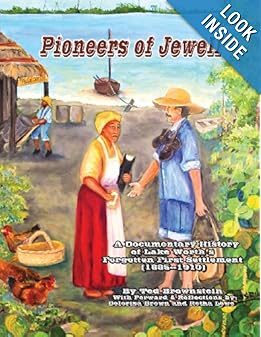
  • Pioneers of Jewell: A Documentary History of Lake Worth’s Forgotten First Settlement (1885 – 1910)

    Lake Worth Herald Publication
    2013
    254 pages
    Paperback ISBN-10: 098326094X; ISBN-13: 978-0983260943
    11 x 8.5 x 0.6 inches

    Ted Brownstein

    A documentary history of Jewell, Florida, a lost community of everglades pioneers founded in 1885 by Samuel and Fannie James, an African American couple, believed to be former slaves. Jewell eventually grew into the City of Lake Worth, its earliest history largely forgotten.

    Pioneers of Jewell rediscovers the world of Fannie and Samuel James in the context of their neighbors and the wider context of Race and Segregation in the aftermath of the American Civil War. For the first time, groundbreaking research reveals the flight of Fannie’s family from North Carolina to Ohio during the Civil War along the track of the Underground Railroad, and traces the Jameses’ trek back south through Tallahassee and Cocoa, Florida, before taking up a homestead on the western shore of Lake Worth. Once in South Florida, the Jameses overcame many of the hindrances of race in those troubled times, and became the nucleus of a vibrant, mostly white, farming community.

    Meet Dr. Harry Stites, a well-known physician who gave up a successful medical practice in Harrisburg, Pennsylvania to ‘rough it’ on the South Florida frontier. Meet Squire John C. Hoagland, the area’s first Justice of the Peace, who loved boating and spent much of his time sailing between Palm Beach and Jewell. Meet Michael Merkle, a hermit who lived an austere life in a lean-to west of Jewell, eating unseasoned fish and berries. Merkle, rumored to be a defrocked Catholic priest, was known to walk the pinewoods chanting in Latin when he thought no one was listening.

    Relying upon primary historical sources, Pioneers of Jewell reveals:

    • Bios of a dozen previously unknown Jewell pioneers.
    • The dispute that challenged the Jameses’ land holdings.
    • An in-depth look at the Jameses’ stunning financial success.
    • Investigation of the Jameses’ slave background.
    • The establishment of the Osborne Colored District.
    • Klu Klux Klan activity in Lake Worth during the 1920s.
    • The fate of Jewell and its pioneers.
  • BGHRA Convention 2013

    Black German Heritage & Research Association
    2013-05-15

    We are pleased to announce the Third Annual International Convention of the Black German Heritage & Research Association to be held August 8-11, 2013 at Amherst College, Amherst, Massachusetts.

    The conference will feature a keynote address by Maisha Eggers, Professor of Childhood and Diversity Studies at the University of Magdeburg, a screening of the 1952 film “Toxi” and presentations by guest artists Sharon Dodua Otoo and Sandrine Micossé-Aikins, editors of “The Little Book of Big Visions: How To Be an Artist and Revolutionize the World“.

    For more information, click here. View the conference schedule here.