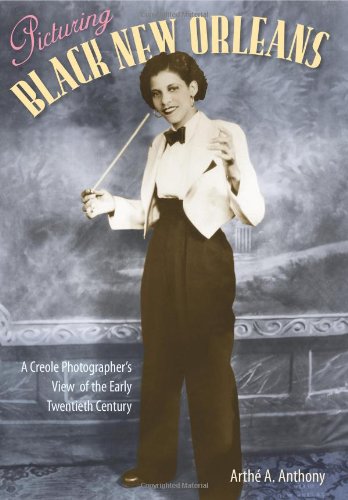
• Picturing Black New Orleans: A Creole Photographer’s View of the Early Twentieth Century

    University Press of Florida
    2012-09-02
    152 pages
    7×10
    Cloth ISBN 13: 978-0-8130-4187-2

    Arthé A. Anthony, Professor of American Studies, Emeritus
    Occidental College, Los Angeles, California

    Florestine Perrault Collins (1895-1988) lived a fascinating and singular life. She came from a Creole family that had known privileges before the Civil War, privileges that largely disappeared in the Jim Crow South. She learned photographic techniques while passing for white. She opened her first studio in her home, and later moved her business to New Orleans’s black business district. Fiercely independent, she ignored convention by moving out of her parents’ house before marriage and, later, by divorcing her first husband.

    Between 1920 and 1949, Collins documented African American life, capturing images of graduations, communions, and recitals, and allowing her subjects to help craft their images. She supported herself and her family throughout the Great Depression and in the process created an enduring pictorial record of her particular time and place. Collins left behind a visual legacy that taps into the social and cultural history of New Orleans and the South.

    It is this legacy that Arthé Anthony, Collins’s great-niece, explores in Picturing Black New Orleans. Anthony blends Collins’s story with those of the individuals she photographed, documenting the profound changes in the lives of Louisiana Creoles and African Americans. Balancing art, social theory, and history and drawing from family records, oral histories, and photographs rescued from New Orleans in the wake of Hurricane Katrina, Anthony gives us a rich look at the cultural landscape of New Orleans nearly a century ago.

  • New Latin American pope Jorge Mario Bergoglio not a person of color?

    New York Amsterdam News
    New York, New York
    2013-03-21

    Courtenay Brown, Special to the AmNews

    The installation of Jorge Mario Bergoglio as Pope Francis I on March 13 caused a stir of questions regarding his race. Yes, he was the first pope from Latin America, but should he be considered the first pope of color?

    By definition, a “person of color” is an all-encompassing, typically American term that categorizes non-whites, which include Asians, Indians, Native Americans, Blacks and Latinos.

    This classification may work in the U.S., but it does not function so well in Latin America. According to a study by the Yale-New Haven Teachers Institute, 31.4 percent of immigrants to Argentina came from Spain, while 44.9 percent came from Italy from 1857 to 1940. This helps quantify just how many immigrants came from these specific countries as opposed to other places in Europe.

    Pope Francis’ own parents were immigrants to Argentina. Since the children of two Italian citizens are legally regarded as Italian no matter where they are born, according to Italian legal tradition, Pope Francis is technically regarded as Italian.

    According to Argentina native Martin Pereyra, a law student at the University of Buenos Aires, many Argentines would not identify as people of color because of the great deal of European influence in the country. The country is often even nicknamed the “Paris of South America.”

    “I don’t think we have just one ‘color,’” Pereyra said. “But at the same time, we are considered Latinos.”…

    …So while prescribing to a single “race” is far from a universal concept for the Latino community, Raúl Hinojosa-Ojeda, professor in the Chávez Department of Chicano/a Studies at the University of Central Los Angeles (UCLA), believes that Bergoglio should be considered Latino and thus a person of color—despite the pope’s Italian roots. According to Hinojosa-Ojeda, using lineage to determine who is Latino would “eliminate a large part of Latin America and a lot of Latinos,” he told LA Weekly last week.

    “More important is the experience, not the genetic background,” he continued…

    Read the entire article here.

  • Mixed race in a world not yet post-racial

    The Seattle Times
    2013-03-20

    Jerry Large, Staff Columnist

    Populations of humans have always been mixing genes, but we still have trouble with the concept.

    Two recent books by University of Washington professors address what mixed means in America, particularly examining the period between the Census Bureau’s decision in the late 1990s to allow people, beginning in 2000, to choose more than one race, and the election of Barack Obama in 2008. Both books say something about how mixed race as a category is sometimes used to further marginalize African Americans.

    Troubling the Family: The Promise of Personhood and the Rise of Multiracialism,” by Habiba Ibrahim, an assistant professor of English, is written largely for an academic audience.

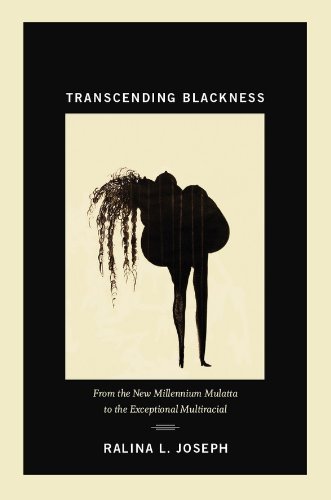
    Transcending Blackness: From the New Millennium Mulatta to the Exceptional Multiracial,” is written by Ralina Joseph, associate professor in the Department of Communications.

    Both are important works, but today I’m going to focus on Joseph’s book, which is also scholarly, but written with the general reader in mind.

    We’re not post-racial yet, Joseph told me when we talked over coffee this week, and more mixing isn’t getting us there, because we haven’t shaken old ways of categorizing people. The combination of black and white, weighted with centuries of racism, raises the most issues.

    Joseph noted the census change was most notably championed by Susan Graham, a white mother who wanted her son to be able to mark down multiracial, and, Joseph said, “had her young son testify before Congress, so that he did not have to identify as black.”…

    …But seeing multiracial as a separate category, a way of transcending blackness, is not a step forward, and it isn’t racially neutral, Joseph said. It is, instead, a new use of old concepts, an affirmation that blackness is something to escape.

    Embracing all parts of a mixed heritage is a more positive act than migrating to a new category. Joseph calls herself a mixed-race African American. “One can’t think about one’s own identity choices without thinking about power realities.”…

    The African-American community has long been multiracial, ranging from milky skin and green eyes to deep chocolate, but to be counted as white still requires “purity.” It’s a protected status…

    Read the entire article here.

  • Troubling the Family: The Promise of Personhood and the Rise of Multiracialism

    University of Minnesota Press
    October 2012
    256 pages
    5 1/2 x 8 1/2
    Paper ISBN: 978-0-8166-7918-8
    Cloth ISBN: 978-0-8166-7917-1

    Habiba Ibrahim, Associate Professor of English
    University of Washington

    Troubling the Family argues that the emergence of multiracialism during the 1990s was determined by underlying and unacknowledged gender norms. Opening with a germinal moment for multiracialism—the seemingly massive and instantaneous popular appearance of Tiger Woods in 1997—Habiba Ibrahim examines how the shifting status of racial hero for both black and multiracial communities makes sense only by means of an account of masculinity.

    Ibrahim looks across historical events and memoirs (beginning with the Loving v. Virginia case in 1967 when miscegenation laws were struck down) to reveal that gender was the starting point of an analytics that made categorical multiracialism, and multiracial politics, possible. Producing a genealogy of multiracialism’s gendered basis allows Ibrahim to focus on a range of stakeholders whose interests often ran against the grain of what the multiracial movement of the 1990s often privileged—the sanctity of the heteronormative family, the labor of child rearing, and more precise forms of racial tabulation—all of which, when taken together, could form the basis for creating so-called neutral personhood.

    Ibrahim concludes with a consideration of Barack Obama as a representation of the resurrection of the assurance that multiracialism extended into the 2000s: a version of personhood with no memory of its own gendered legacy, and with no self-account of how it became so masculine that it can at once fill the position of political leader and the promise of the end of politics.

    Contents

    • Introduction: The Rising Son of Multiracialism
    • 1. Multiracial Timelines: A Genealogy of Personhood
    • 2. Legitimizing the Deviant Family: Loving vs. Virginia and the Moynihan Report
    • 3. The Whiteness of Maternal Memoirs: Politicizing the Multiracial Child
    • 4. Ambivalent Outcomes: Blackness and the Return of Racial Passing
    • Conclusion: Dreams of the Father and Potentials Lost
    • Acknowledgments
    • Notes
    • Index
  • Transcending Blackness: From the New Millennium Mulatta to the Exceptional Multiracial

    Duke University Press
    November 2012
    256 pages
    20 photographs
    Cloth ISBN: 978-0-8223-5277-8
    Paperback ISBN: 978-0-8223-5292-1

    Ralina L. Joseph, Associate Professor of Communication
    University of Washington

    Representations of multiracial Americans, especially those with one black and one white parent, appear everywhere in contemporary culture, from reality shows to presidential politics. Some depict multiracial individuals as being mired in painful confusion; others equate them with progress, as the embodiment of a postracial utopia. In Transcending Blackness, Ralina L. Joseph critiques both depictions as being rooted in—and still defined by—the racist notion that Blackness is a deficit that must be overcome.

    Analyzing emblematic representations of multiracial figures in popular culture—Jennifer Beals’s character in the The L Word; the protagonist in Danny Senza’s novel, Caucasia; the title character in the independent film, Mixing Nia; and contestants in a controversial episode of the reality show, America’s Next Top Model, who had to “switch ethnicities” for a photo shoot—Joseph identifies the persistance of two widespread stereotypes about mixed-race African Americans: “new millennium mulattas” and “exceptional multiracials.” The former inscribes the multiracial African American as a tragic figure whose Blackness predestines them for misfortune; the latter rewards mixed-race African Americans with success for erasing their Blackness. Addressing questions of authenticity, sexuality, and privilege, Transcending Blackness refutes that idea that in American society, race no longer matters.

    Table of Contents

    • Preface. From Biracial to Multiracial to Mixed-Race to Critical Mixed-Race Studies
    • Introduction. Reading Mixed-Race African American Representations in the New Millennium
    • Part I: The New Millennium Mulatta
      • 1. The Bad Race Girl: Jennifer Beals on The L Word, the Race Card, and the Punishment of Mixed-Race Blackness
      • 2. The Sad Race Girl: Passing and the New Millennium Mulatta in Danzy Senna’s Caucasia
    • Part II: The Exceptional Multiracial
      • 3. Transitioning to the Exceptional Multiracial: Escaping Tragedy through Black Transcendence in Mixing Nia
      • 4. Recursive Racial Transformation: Selling the Exceptional Multiracial on America’s Next Top Model
    • Conclusion. Racist Jokes and the Exceptional Multiracial, or Why Transcending Blackness Is a Terrible Proposition
    • Notes
    • Bibliography
    • Index
  • The Chowan Discovery Group: Documenting the Mixed-Race History of North Carolina’s “Winton Triangle”

    Renegade South: Histories of Unconventional Southerners
    2013-03-20

    Vikki Bynum, Distinguished Emeritus Professor of History
    Texas State University, San Marcos

    Here’s another region of the South with a fascinating history of mixed-race ancestry. I discovered the Chowan Discovery Group after Steven Riley, creator and moderator of MixedRaceStudies.org, introduced me via email to the Group’s Executive Director, Marvin T. Jones. The “Winton Triangle,” located in Hertford County, North Carolina, encompasses the three towns of Winton, Cofield, and Ahoskie. Here, people maintain a distinctive identity rooted in Native American, European, and African ancestry.

    According to Marvin Jones, the Triangle traces its origins to before the 1584 arrival of the English to the Outer Banks of North Carolina, where Chowanoke (Choanoac) Indian settlements were prominent along the Chowan River. After the English invasion, diseases (to which Native Americans lacked immunity) and territorial disputes decimated and disrupted the Chowanoke settlements of present-day Hertford County…

    Read the entire article here.

  • BlackAtlas and Laura Izibor in Dublin, Ireland

    BlackAtlas
    American Airlines
    2012-09-28

    Laura Izibor, Singer/Songwriter

    Singer/Songwriter Laura Izibor explores multicultural Dublin, Ireland through her eyes.  Featured are Temple Bar area, the pubs, the Guinness factory, the Grand Canal, the Royal Canal and a statue of Phil Lynott (the only African-Irish statue in Ireland).

  • Danzy Senna

    The Southeast Review
    2010-05-01

    The Southeast Review is published by Florida State University’s Creative Writing Program.

    Interviewed by Janeen Price

    Danzy Senna is the author of two novels, a memoir, numerous essays and works of short fiction. Her debut novel, Caucasia, a coming-of-age story, was named the Los Angeles Times Best Book of the Year. It also won the Book-of-the-Month Club’s Stephen Crane Award for First Fiction and the American Library Association’s Alex Award. Her latest book, Where Did You Sleep Last Night?: A Personal History, is a memoir of her journey to solve the enigma of her father’s family history.

    Q: Where Did You Sleep Last Night? is your first memoir. What compelled you to write and publish this personal narrative?

    A: I was intrigued by this mystery of my father’s mother, a black woman from the South who was educated and ambitious in her youth down South, then gave it all up and became the modest, retiring woman we knew in Boston. There were so many gaps in her story—so much mystery surrounding her. The book began as an investigation into her, and I didn’t think of it as a memoir. But as it progressed, I realized that my relationship to my father—the contradictions in it, the pain and also the love there—was central to the story. So the personal material sort of snuck up on me as I tried to find and tell this other, more historically distant tale. I still consider myself first and foremost a fiction writer…

    …Q: You are biracial, the protagonists of your two novels are biracial, and issues of racial identity loom large in all three of your books. How has your exploration of racial identity evolved from one book to the next?

    A: That’s a good question, but not one I feel I can really answer. I think my readers could answer that better than I could. But it does lead me to another related thought. Readers have at times over the years asked me, “Are you ever going to write about people who aren’t mixed?” I always feel there is an implicit criticism in the question—as if maybe I should be writing about a white man, or a Chinese woman, to prove my universality. But I never hear white writers being asked, “Are you ever going to write about characters that aren’t white?” And I don’t even hear the question being thrown at black writers who write about black life and black characters. It has made me wonder if the question has more to do with a discomfort with my racial ambiguity. I think people are comfortable with black people writing about black people (and maybe uncomfortable with black people not writing about black people). And I think people assume the universality of white characters, especially if they are male. But they can’t quite wrap their finger around what they see me as. Maybe they see me as white, because that’s what my features read, and can’t really understand why race and blackness would persist as a theme in my work.

    So for me I’ve had to really ignore all those questions about subject matter and race, etc., because I think it doesn’t really have to do with my work, the real issues I’m writing about, which I hope are about more than racial identity. Racial identity is there, of course, but to me other questions loom larger. Did Raymond Carver write about white people? Yes, in a way, but in another way, no, that wasn’t his subject. I write books set in multiracial worlds, and from the perspective of multiracial characters. Maybe I won’t always write from that perspective, but I see nothing limiting about it. In writing, the universal is found in the specific. And I have learned that you really have to just write about your obsessions and from a place of truth, and ignore the rest…

    Read the entire interview here.
  • How the Africans Became Black

    The Atlantic
    2012-12-13

    Wayétu Moore

    A Liberian-American reflects on the experiences of Africans who have moved to the United States, a growing community that accounts for 3 percent of the U.S.’s foreign-born population.

    After leaving my nine-to-five job, I was led to a New York Immigration Coalition job posting. While waiting in the coalition’s lobby for an interview, a copy of a popular TIME Magazine cover caught my eye. “WE ARE AMERICANS,” the cover read. The photo on the cover featured faces of various brown and yellow immigrants, eager and hopeful, representing both the spirit of America’s revolutionary history and its inevitable future. I was remembering my own family’s immigration when I stopped to wonder: Where are the Africans?

    U.S. immigration debates are overwhelmingly centered on immigrants from Latin America. Proportionately, Mexicans and central Americans far outnumber other immigrant groups in the United States. According to a Migration Policy Institute study, since 1970, “a period during which the overall U.S. immigration population increased four-fold, the Mexican and central American population increased by a factor of 20.” In a subsequent study on black immigration, the same organization reported that black African immigrants account for 3 percent of the total U.S. foreign-born population.

    Like their Latin American counterparts, African immigrants keep a low profile in an effort to avoid humiliation, deportation, and loss of work. Many of them, whether accidentally or otherwise, wind up blending in with African-American culture. But however closely they may identify with black America, they, too, are immigrants…

    …In order to stand out from blacks economically, Irish immigrants had to monopolize their low-wage jobs and keep free Northern blacks from joining unions during the labor movement. And in order to disassociate socially, they had to consent to active participation in the oppression of the black race, embracing whiteness and the system that disenfranchised and justified an ungovernable hatred toward African-Americans.

    Ignatiev includes an 1843 letter from Daniel O’Connell: “Over the broad Atlantic I pour forth my voice, saying, come out of such land, you Irishmen; or, if you remain, and dare countenance the system of slavery that is supported there, we will recognize you as Irishmen no longer.”

    The color of their skin saved them, but has also nearly obliterated a once vibrant cultural identity so that today I know no Irishmen. I have friends of Irish descent, former coworkers who mentioned the occasional Irish grandfather or associates who gesture toward familiarity of the lost heritage over empty pints on St. Patrick’s Day — but the Irishmen are now white, and the Irishmen are now gone…

    Read the entire article here.

  • Creating a “Latino” Race

    The Society Pages: Social Science That Matters
    2013-03-13

    Wendy D. Roth, Associate Professor of Sociology
    University of British Columbia
    (Author of Race Migrations: Latinos and the Cultural Transformation of Race)

    Editors’ Note: The author prefers to capitalize Black and White along with other socially constructed racial categories.

    For much of American history, race has been a dichotomous, Black-White affair where the “one-drop rule” dictated that people with any amount of racial mixture were defined legally and socially as Black. In recent generations, however, with the rise of intermarriage and the entrance of new immigrants from all over the world, American racial categories and conceptions have become much more complicated and contested. Latinos provide a particularly revealing case of the new complexities of race in America.

    Persons of Hispanic ancestry have long had mixed racial identities and classifications. The history of Latin America is characterized by the mixing of European colonizers, native Indigenous groups, and Africans brought over as slaves. As a result, the diverse Latino group includes people who look White, Black, and many mixtures in between. In the mid-20th century, it was assumed that as they Americanized, Latinos who looked European would join the White race, while those with visible African ancestry would join the Black race, and others might be seen as Native American. For fifty years, the Census has supported this vision by informing us that Latinos could be classified as White, Black, or “other,” but not as a race themselves. “Hispanic” remained an ethnic, not a racial, category.

    To answer this question, I studied Dominicans and Puerto Ricans, two groups whose members span the traditional Black/White color line. I interviewed sixty Dominican and Puerto Rican migrants in New York City, and another sixty Dominicans and Puerto Ricans who have never migrated out of their countries of origin. We spoke about how they understand and classify their own and other people’s races, their perception of races in the mainland United States and their home country, what race means to them, and the migrants’ integration experiences. Their interviews revealed that most identify with a new, unified racial category that challenges not only the traditional Black-White dichotomy but also the relationship between race and ethnicity in American society. In other words, the experiences of these groups help us to better understand how immigrants’ views of collective identity and the relationship between color and culture are reshaping contemporary American racial classifications…

    Read the entire article here.