• Asked to Declare His Race, Obama Checks ‘Black’

    The New York Times
    2010-04-02

    Sam Roberts

    Peter Baker

    It is official: Barack Obama is the nation’s first black president.

    A White House spokesman confirmed that Mr. Obama, the son of a black father from Kenya and a white mother from Kansas, checked African-American on the 2010 census questionnaire…

    …Mr. Obama could have checked white, checked both black and white, or checked the last category on the form, “some other race,” which he would then have been asked to identify in writing…

    Read the entire article here.

  • A Unique Slant of Light: The Bicentennial History of Art in Louisiana

    University Press of Mississippi
    2012-09-20
    450 pages
    9 1/2 x 11 7/8 inches,
    400+ color illustrations, foreword, introduction, bibliography, index of artists
    Cloth ISBN: 978-1-61703-690-3
     
    Edited By:

    Michael Sartisky, President
    Louisiana Endowment for the Humanities

    J. Richard Gruber, Director Emeritus
    Ogden Museum of Southern Art

    Associate Editor:

    John R. Kemp, Former Deputy Director
    Louisiana Endowment for the Humanities

    A lushly illustrated celebration of two centuries of creative work from Louisiana

    A Unique Slant of Light: The Bicentennial History of Art in Louisiana is a handsome, unprecedented, commemorative hardcover edition limited to approximately 3,000 copies. This large-format volume encompasses 450 color pages featuring approximately 275 artists and photographers. For art collectors and enthusiasts, for followers of Louisiana history, and for keepers of Louisiana pride, this dazzling book is testimony to the state’s vibrant artistic culture.

    Coeditors are Michael Sartisky, PhD, president of the Louisiana Endowment for the Humanities, and J. Richard Gruber, PhD, director emeritus of the Ogden Museum of Southern Art; John R. Kemp, former deputy director of the LEH, is serving as associate editor. Written by scholars from around the country, the entries include all genres (painting, sculpture, photography, folk art, decorative art, furniture) and periods, from colonial to contemporary. Private collections and major archives such as the Ogden Museum of Southern Art, the Louisiana State Museum, the Historic New Orleans Collection, and the Louisiana State University Museum of Art, among others, contribute a comprehensive library of images.

    Every entry in the book will be linked to fully articulated entries on each artist and genre in KnowLA: The Digital Encyclopedia of Louisiana History and Culture,which also will have the capacity to include a much more extensive image gallery for each artist and genre.

    View A Unique Slant of Light in digital format here.

  • Black and Blue: The Origins and Consequences of Medical Racism

    University of California Press
    April 2012
    304 pages
    Paperback ISBN: 9780520274013
    Hardcover ISBN: 9780520248908

    John Hoberman

    Black & Blue is the first systematic description of how American doctors think about racial differences and how this kind of thinking affects the treatment of their black patients. The standard studies of medical racism examine past medical abuses of black people and do not address the racially motivated thinking and behaviors of physicians practicing medicine today.

    Black & Blue penetrates the physician’s private sphere where racial fantasies and misinformation distort diagnoses and treatments. Doctors have always absorbed the racial stereotypes and folkloric beliefs about racial differences that permeate the general population. Within the world of medicine this racial folklore has infiltrated all of the medical sub-disciplines, from cardiology to gynecology to psychiatry. Doctors have thus imposed white or black racial identities upon every organ system of the human body, along with racial interpretations of black children, the black elderly, the black athlete, black musicality, black pain thresholds, and other aspects of black minds and bodies. The American medical establishment does not readily absorb either historical or current information about medical racism. For this reason, racial enlightenment will not reach medical schools until the current race-aversive curricula include new historical and sociological perspectives.

    Contents

    • Acknowledgments
    • 1. THE NATURE OF MEDICAL RACISM: THE ORIGINS AND CONSEQUENCES OF MEDICAL RACISM
      • Introduction
      • “Avoidance and Evasion”
      • Judging How Physicians Behave
      • Judging Physician Conduct: Privacy and the “Halo Effect”
      • The Oral Tradition
      • Physicians Share the Racial Attitudes of Their Fellow Citizens
      • The Medical Liberals
    • 2. BLACK PATIENTS AND WHITE DOCTORS
      • The African American Health Calamity: The Silence
      • Medical Vulnerability and Racial Defamation
      • How Do (White) Physicians Think about Race?
      • Evidence or Medical Racism
      • Resistance to the Critique of Racial Bias in Medicine
      • Medical Liberalism and the Medical Literature
      • The Physician’s Private Sphere
      • Playing Anthropologist
      • From Racial Folklore to Racial Medicine
    • 3. MEDICAL CONSEQUENCES OF RACIALIZING THE HUMAN ORGANISM
      • Racial Interpretations of Human Types and Traits
        • Introduction
        • Racial Interpretations of Black Infants and Children
        • Racial Interpretations of the Black Elderly
        • Racial Interpretations of the Black Athlete
        • Racial Interpretations of Black Musical Aptitude
        • Racial Interpretations of Losing Consciousness
        • Racial Interpretations of the Nervous System
        • Racial Interpretations of Pain Sensitivity
        • Racial Interpretations of Heart Disease
      • Racial Interpretations of Human Organs and Disorders
        • Racial Interpretations of the Eyes
        • Racial Interpretations of Black Skin
        • Racial Interpretations of Human Teeth
        • Racial Interpretations of “While” and “Black” Disorders
        • Black “Hardiness”
        • Physical Hardiness
        • Emotional Hardiness
        • Conclusion: How Human Organ Systems Acquire Racial Identities
      • Racial Folklore in Medical Specialties
        • A Century of Racial Pharmacology: From Racial Folklore to Racial Genetics
        • The Role of Racial Folklore in Obstetrics and Gynecology during the Twentieth Century
    • 4. MEDICAL APARTHEID, INTERNAL COLONIALISM, AND THE TASK OF AMERICAN PSYCHIATRY
      • Introduction
      • “Africanizing” the Black Image
      • American Psychiatry as Racial Medicine
      • The Racial Primitive in American Psychiatry
      • The Task of Black Psychiatry
      • Colonial Medical Status
    • 5. A MEDICAL SCHOOL SYLLABUS ON RACE
      • Introduction
      • The Doctor-Patient Relationship
      • The Problem Patient
      • Medical Authors’ Aversion to Race
      • Race and Medical Education: The Search for “Cultural Competence”
      • Two Official Versions of “Cultural Competence”
      • Physicians’ Beliefs about Racial Differences: A (Belated) Study
      • A Medical Curriculum on Race
      • Practical Advice for Physicians
      • Social Class, Misdiagnoses, and Therapeutic Fatalism
      • “Cultural Competence” as Knowledge of Stereotype Systems
      • Raceless Humanism: “Medical Humanities” and the Evasion of Difference
      • Medical Curriculum Change Is Possible: The Case of Abortion Training
    • Notes
    • Index
  • Mixed-Race Chic

    The Chronicle Review
    The Chronicle of Higher Education
    2009-05-19

    Rainier Spencer, Associate Vice Provost for Academic Affairs
    University of Nevada, Las Vegas

    Popular wisdom suggests that we are in the midst of a transformation in the way race is constructed in the United States. Indeed, so strong and so inevitable is this shift said to be that longstanding racial dynamics are purportedly being dismantled and reconstructed even as you read these words.

    According to this view, individuals of mixed race, particularly first-generation multiracial people, are confounding the American racial template with their ambiguous phenotypes and purported ability to serve as living bridges between races. This perspective is reflected in television and magazine advertising and coverage and in books both academic and nonacademic. As long as a decade ago, the sociologist Kathleen Odell Korgen wrote in From Black to Biracial: Transforming Racial Identity Among Americans (Praeger, 1998) that “today mixed-race Americans challenge the very foundation of our racial structure.”

    From his well-received speech on race, in which he positioned himself as having a direct understanding of both black and white anger, to his reference to himself as a “mutt,” Barack Obama and his historic election have significantly boosted this view. Many Americans hail his background as portending our postracial future. We hear that self-styled multiracial young adults accept their mixed identity far more than did their pre-civil-rights-era predecessors; but precisely what they are actually assenting to and what it means may be little more than a fad.

    People who see us accepting a new multiracial identity have long argued that it is destructive of race: that recognition and acceptance of multiracialism will bring about the demise of the American racial model. The American Multiracial Identity Movement thereby suggests that multiracial identity possesses an insurgent character, a militant stance against the idea of recognizing race in the United States.

    Regardless of their contemporary popularity, such claims are without merit. Indeed, they are self-contradictory. If one holds that multiracial identity is a real and valid identity, then it can be sensible only as a biological racial identity. If words are to mean anything, and they should, it quite obviously cannot be that a multiracial identity is somehow not a biological racial identity. Rather, multiracial identity merely falls in place to join other, already existing racial categories…

    …As Catherine R. Squires, a professor of journalism, writes in Dispatches From the Color Line: The Press and Multiracial America (State University of New York Press, 2007), multiracialism is fundamentally ambiguous: “This ambiguity is about exoticism and intrigue, providing opportunities for consumers to fantasize and speculate about the Other with no expectations of critical consideration of power and racial categories.” Squires makes an important point, for it is crucial to be able to separate racial ambiguity that might be utilized to work consciously against racial hierarchies from racial ambiguity that is simply a form of self-interested celebration that ends up reinforcing those racial hierarchies…

    Read the entire article here.

  • The very definition of a “mixed-race” society is fraught with difficulty, and this is one of the problems of acknowledgement, even in Liverpool. All the current terms are inadequate: The term “half-caste” has long been discredited, but even newer terms; “mixed-race” and “dual heritage” have their own problems. “Dual heritage” suggests a child living with the supposed ‘dilemma’ of each parent having a different culture or background. This may not be the case in many Liverpool children with both European and African genes, as any intermarriage may have taken place generations ago. Thus, a child who appears to have 50/50 genes may not have one black and one white parent, but could be the product of a community which became a distinct multi-racial community literally centuries ago, just as Mexicans and many Central and South Americans have now evolved from being considered half Native American (or ‘Indian’, as they were wrongly called) and half Spanish to distinct ethnic identities…

    Dr. Ray Costello. “The Liverpool-Born Black Community,” Diverse Magazine. 2009.

  • At school I was called a half-caste. Today I’m proud: As census reveals over a million Britons were born to inter-racial relationships, one woman’s moving story

    The Daily Mail
    2012-12-11

    Tanith Carey

    Whenever the moment comes when I have to choose the box on the Census that asks me to describe my national identity, my hand hovers over which one to tick.

    With my fair hair, pale skin and green eyes, I certainly look like I should be picking the category that says ‘White/British’.

    But by putting my mark in that square, I would not be doing justice to all that I am.

    Like more than one million people in Britain, according to data from the 2011 Census released yesterday, I am a member of the fastest-growing population group in this country: those born to parents in inter-racial relationships.

    Jubilation over the successes this summer of Olympic athletes such as Jessica Ennis —  the daughter of a Jamaican father and a white British mother — has shown how far we have come in embracing such a large mixed-raced population.

    When talking race, people are very quick to talk about the negatives — discrimination and the difficulties of integration, to name but two.

    But let’s not forget how tolerant Britain is as a nation, and how inclusive we have become in the space of just a few decades.

    As the granddaughter of an Indian entrepreneur who was at the forefront of this transformation, I can testify to just how far we have.

    When I was a child growing up in the Seventies, it was not uncommon to be called a ‘half-caste’.

    Sometimes the phrase was used to try to pigeon-hole me when I was asked about my slightly more exotic origins.  At the time, the term ‘half-caste’ implied that because you were the sum of two halves, you amounted to nothing much.

    It was used as the worst of all insults…

    Read the entire article here.

  • From Colour-Blindness to Recognition? Political Paths to New Identity Practices in Brazil and France

    Prepared for presentation at the conference:
    Le multiculturalisme a-t-il un avenir?
    Paris 1-Panthéon Sorbonne University
    2010-02-26 through 2010-02-27
    25 pages

    Karen Bird, Associate Professor of Political Science
    McMaster University, Canada

    Jessica Franklin
    Department of Political Science
    McMaster University, Canada

    For decades, both France and Brazil officially denied the existence of race and, by extension, racism. France, with its republican and universalist normative framework, insisted on a political project of assimilative integration and non-differentiation among citizens in the public sphere. Race and ethnicity, in this regard, were not merely suspect but politically and normatively illegitimate categories. Despite the significant role of colonialization and immigration in modern French social history, the theme of ethnic and racial relations would remain taboo in both political discourse and social science research until the late-1990s. Brazil, on the other hand, constructed itself as a nation representing the idea of a “racial democracy.” In a progressive fashion since the abolition of slavery, racial mixing and harmonious racial relations became a central pillar of Brazilian democracy. They were held to be so amply developed as to provide no room for racial discrimination. Despite these official paradigms of colour-blindness, both France and Brazil have taken significant steps in recent years towards recognizing ethnic difference and combating structures of racist discrimination. This paper examines the emergence of the theme of race and ethnicity in public discourse and public policies in France and Brazil, looking at similarities and differences in the political pathways of transformation across the two countries.

    Read the entire paper here.

  • In Brazil, a mix of racial openness and exclusion

    Nordonia Hills News-Leader
    Kent, Ohio
    2013-03-14

    Jenny Barchfield
    Associated Press

    RIO DE JANEIRO (AP) — Many Brazilians cast their country as racial democracy where people of different groups long have intermarried, resulting in a large mixed-race population. But you need only turn on the TV, open the newspaper or stroll down the street to see clear evidence of segregation.
     
    In Brazil, whites are at the top of the social pyramid, dominating professions of wealth, prestige and power. Dark-skinned people are at the bottom of the heap, left to clean up after others and take care of their children and the elderly.
     
    The 2010 census marked the first time in which black and mixed-race people officially outnumbered whites, weighing in at just over 50 percent, compared with 47 percent for whites. Researchers suggest that Brazil actually may have been a majority-nonwhite country for some time, with the latest statistics reflecting a decreased social stigma that makes it easier for nonwhites to report their actual race.
     
    It is a mix of anomalies in Brazil that offers lessons to a United States now in transition to a “majority-minority” nation: how racial integration in social life does not always translate to economic equality, and how centuries of racial mixing are no guaranteed route to a colorblind society…

    …Nubia de Lima, a 29-year-old black producer for Globo television network, said she experiences racism on a daily basis, in the reactions and comments of strangers who are constantly taking her for a maid, a nanny or a cook, despite her flair for fashion and pricey wardrobe.
     
    “People aren’t used to seeing black people in positions of power,” she said. “It doesn’t exist. They see you are black and naturally assume that you live in a favela (hillside slum) and you work as a housekeeper.”…

    Read the entire article here.

  • Brazilian Population ‘Color’ Self-Descriptors

    Source: National Survey by Household Sample (PNAD).  Extracted from: Lilia Moritz Schwarcz, “Not black, not white: just the opposite. Culture, race and national identity in Brazil,” Centre for Brazilian Studies, Working Paper Number CBS-47-03, (2003): 5.

    # Portuguese Translation Gender
    1. Acastanhada somewhat chestnut-coloured F
    2. Agalegada somewhat like a Galician F
    3. Alva snowy white F
    4. Alva escura dark snowy white F
    5. Alvarenta* (not in dictionary; poss. dialect) snowy white F
    6. Alvarinta* snowy white F
    7. Alva rosada pinkish white F
    8. Alvinha snowy white F dimin
    9. Amarela Yellow F
    10. Amarelada Yellowish F
    11. Amarela-queimada Burnt yellow F
    12. Amarelosa Yellowy F
    13. Amorenada somewhat dark-skinned F
    14. Avermelhada Reddish F
    15. Azul Blue
    16. Azul-marinho Sea blue
    17. Baiano From Bahia M
    18. Bem branca Very white F
    19. Bem clara Very pale F
    20. Bem morena Very dark-skinned F
    21. Branca White F
    22. Branca-avermelhada White going on for red F
    23. Branca-melada Honey-coloured white F
    24. Branca-morena White but dark-skinned F
    25. Branca-pálida Pale white F
    26. Branca-queimada Burnt white F
    27. Branca-sardenta Freckled white F
    28. Branca-suja Off-white F
    29. Branquiça* Whitish F
    30. Branquinha Very white F dimin
    31. Bronze Bronze-coloured
    32. Bronzeada Sun-tanned F
    33. Bugrezinha-escura Dark-skinned India F dimin + derogatory
    34. Burro-quando-foge Disappearing donkey (i.e. nondescript) humorous
    35. Cabocla Copper-coloured ( refers to civilized Indians) F
    36. Cabo-verde from Cabo Verde
    37. Café Coffee-coloured
    38. Café-com-leite Café au lait
    39. Canela Cinnamon
    40. Canelada somewhat like cinnamon F
    41. Cardão colour of the cardoon, or thistle (blue-violet)
    42. Castanha Chestnut F
    43. Castanha-clara Light chestnut F
    44. Castanha-escura Dark chestnut F
    45. Chocolate Chocolate-coloured
    46. Clara Light-coloured, pale F
    47. Clarinha Light-coloured, pale F dimin
    48. Cobre Copper-coloured
    49. Corada With a high colour F
    50. Cor-de-café Coffee-coloured
    51. Cor-de-canela Cinnamon-coloured
    52. Cor-de-cuia Gourd-coloured
    53. Cor-de-leite Milk-coloured (i.e. milk-white)
    54. Cor-de-ouro Gold-coloured (i.e. golden)
    55. Cor-de-rosa Pink
    56. Cor-firme Steady-coloured
    57. Crioula Creole F
    58. Encerada Polished F
    59. Enxofrada Pallid F
    60. Esbranquecimento Whitening
    61. Escura Dark F
    62. Escurinha Very dark F dimin
    63. Fogoió Having fiery-colored hair
    64. Galega Galician or Portuguese F
    65. Galegada Somewhat like a Galician or Portuguese F
    66. Jambo Light-skinned (the colour of a type of apple)
    67. Laranja Orange
    68. Lilás Lilac
    69. Loira Blonde F
    70. Loira-clara Light blonde F
    71. Loura Blonde F
    72. Lourinha Petite blonde F dimin
    73. Malaia* Malaysian woman F
    74. Marinheira Sailor-woman F
    75. Marrom Brown
    76. Meio-amarela Half-yellow F
    77. Meio-branca Half-white F
    78. Meio-morena Half dark-skinned F
    79. Meio-preta Half-black F
    80. Melada Honey-coloured F
    81. Mestiça Half-caste/mestiza F
    82. Miscigenação Miscegenation
    83. Mista Mixed F
    84. Morena Dark-skinned, brunette F
    85. Morena-bem-chegada Very nearly morena F
    86. Morena-bronzeada Sunburnt morena F
    87. Morena-canelada Somewhat cinnamon-coloured morena F
    88. Morena-castanha Chestnut-coloured morena F
    89. Morena-clara Light-skinned morena F
    90. Morena-cor-de-canela Cinnamon-coloured morena F
    91. Morena-jambo Light-skinned morena F
    92. Morenada Somewhat morena F
    93. Morena-escura Dark morena F
    94. Morena-fechada Dark morena F
    95. Morenão Dark-complexioned man M aug
    96. Morena-parda Dark morena F
    97. Morena-roxa Purplish morena F
    98. Morena-ruiva Red-headed morena F
    99. Morena-trigueira Swarthy, dusky morena F
    100. Moreninha Petite morena F dimin
    101. Mulata Mulatto girl F
    102. Mulatinha Little mulatto girl F dimin
    103. Negra Negress F
    104. Negrota Young negress F
    105. Pálida Pale F
    106. Paraíba From Paraíba
    107. Parda Brown F
    108. Parda-clara Light brown F
    109. Parda-morena Brown morena F
    110. Parda-preta Black-brown F
    111. Polaca Polish woman F
    112. Pouco-clara Not very light F
    113. Pouco-morena Not very dark-complexioned F
    114. Pretinha Black – either young, or small F
    115. Puxa-para-branco Somewhat towards white F
    116. Quase-negra Almost negro F
    117. Queimada Sunburnt F
    118. Queimada-de-praia Beach sunburnt F
    119. Queimada-de-sol Sunburnt F
    120. Regular Regular, normal
    121. Retinta Deep-dyed, very dark F
    122. Rosa Rose-coloured (or the rose itself) F
    123. Rosada Rosy F
    124. Rosa-queimada Sunburnt-rosy F
    125. Roxa Purple F
    126. Ruiva Redhead F
    127. Russo Russian M
    128. Sapecada Singed F
    129. Sarará Yellow-haired negro
    130. Saraúba* (poss. dialect) Untranslatable
    131. Tostada Toasted F
    132. Trigo Wheat
    133. Trigueira Brunette F
    134. Turva Murky F
    135. Verde Green
    136. Vermelha Red F
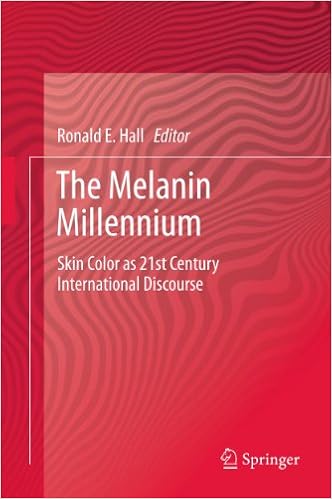
  • The Melanin Millennium: Skin Color as 21st Century International Discourse

    Springer
    2013
    348 pages
    32 illustrations
    Hardcover ISBN 978-94-007-4607-7
    eBook ISBN: 978-94-007-4608-4
    DOI: 10.1007/978-94-007-4608-4

    Edited by:

    Ronald E. Hall, Professor of Social Work
    Michigan State University

    • Addresses the issue of skin color in a worldwide context
    • Discusses the introduction of new forms of visual media and their effect on skin color discrimination
    • Touches up on the issue of skin bleaching and the Bleaching Syndrome

    In the aftermath of the 60s “Black is Beautiful” movement and publication of The Color Complex almost thirty years later the issue of skin color has mushroomed onto the world stage of social science. Such visibility has inspired publication of the Melanin Millennium for insuring that the discourse on skin color meet the highest standards of accuracy and objective investigation.

    This volume addresses the issue of skin color in a worldwide context. A virtual visit to countries that have witnessed a huge rise in the use of skin whitening products and facial feature surgeries aiming for a more Caucasian-like appearance will be taken into account. The book also addresses the question of whether using the laws has helped to redress injustices of skin color discrimination, or only further promoted recognition of its divisiveness among people of color and Whites.

    The Melanin Millennium has to do with now and the future. In the 20th century science including eugenics was given to and dominated by discussions of race category. Heretofore there remain social scientists and other relative to the issue of skin color loyal to race discourse. However in their interpretation and analysis of social phenomena the world has moved on. Thus while race dominated the 20th century the 21st century will emerge as a global community dominated by skin color and making it the melanin millennium.

    Contents

    • Preface
    • Chapter 1. The Bleaching Syndrome: Western Civilization vis-à-vis Inferiorized People of Color; Ronald E. Hall
    • Chapter 2. The Historical and Cultural Influences of Skin Bleaching in Tanzania;  Kelly M. Lewis, Solette Harris, Christina Champ, Willbrord Kalala, Will Jones, Kecia L. Ellick, Justie Huff and Sinead Younge
    • Chapter 3. Pathophysiology and Psychopathology of Skin Bleaching and Implicationa of Skin Colour in Africa; A. A. Olowu and O. Ogunlade
    • Chapter 4. An Introduction to Japanese Society’s Attitudes Toward Race and Skin Color; Arudou Debito
    • Chapter 5. The Inconvenient Truth of India, Caste, and Color Discrimination; Varsha Ayyar and Lalit Khandare
    • Chapter 6. Indigeneity on Guahan: Skin Color as a Measure of Decolonization; LisaLinda Natividad
    • Chapter 7. A Table of Two Cultures; Eneid Routté-Gómez
    • Chapter 8. Where are you From?; Stéphanie Cassilde
    • Chapter 9. Social Work Futures: Reflections from the UK on the Demise of Anti-racist Social Work and Emerging Issues in a “Post-Race’” Era; Mekada J. Graham
    • Chapter 10. Shades of Conciousness: From Jamaica to the UK; William Henry
    • Chapter 11. Fanon Revisited: Race Gender and Colniality vis-à-vis Skin Color; Linda Lane and Hauwa Mahdi
    • Chapter 12. Pigment Disorders and Pigment Manipulations; Henk E. Menke
    • Chapter 13. Skin Color and Blood Quantum: Getting the Red Out; Deb Bakken and Karen Branden
    • Chapter 14. The Impact of Skin Color on Mental and Behavorial Health in African American and Latina Adolescent Girls: A Review of the Literature; Alfiee M. Breland-Noble
    • Chapter 15. Characteristics of Color Discrimination Charges Filed with the EEOC; Joni Hersch
    • Chapter 16. The Consequences of Colorism; Margaret Hunter
    • Chapter 17. Navigating the Color Complex: How Multiracial Individuals Narrate the Elements of Appearance and Dynamics of Color in Twenty-first Century America; Sara McDonough and David L. Brunsma
    • Chapter 18. The Fade-Out of Shirley, a Once-Ultimate Norm: Colour Balance, Image Technologies, and Cognitive Equity; Lorna Roth
    • Chapter 19. What Color is Red? Exploring the implications of Phenotype for Native Americans; Hilary N. Weaver
    • Chapter 20. From Fair & Lovely to Banho de Lua: Skin Whitening and its Implications in the Multi-ethnic and Multicolored Surinamese Society; Jack Menke
    • Chapter 21. Affirmative Action and Racial Identityin Brazil: A Study of the First Quota Graduates at the State University of Rio de Janneiro: Vânia Penha-Lopes
    • Index