• While contemporary academic discourse acknowledges the existence of multiple identities, and it is possible to talk about having identities that are both/and rather than either/or (Collins 1990) for a child with one black and one white parent, this is usually restricted to a choice of being both mixed race and black. You can never claim whiteness. Whiteness is sustained and preserved through a myth of purity, exclusivity and restricted access. The addition of a ‘mixed-race’ category on the census does nothing to challenge the racial hierarchy and this is one of the reasons I reject it. Similarly, a decision for me to identify exclusively as black fails to disrupt the status quo and so for me is also problematic. It is the fluid and multidimensional models for identity that are reminiscent of a time before we had been conditioned into a belief in rigid racial classification which are so interesting and potentially offer such scope to the ‘mixed’ person—and indeed all people.

    Emma Dabiri, “Why I see myself as a daughter of the Diaspora rather than mixed-race,” Black Girl Dancing at Lughnasa (March 12, 2013). http://thediasporadiva.tumblr.com/post/45223779733/why-i-see-myself-as-a-daughter-of-the-diaspora-rather.

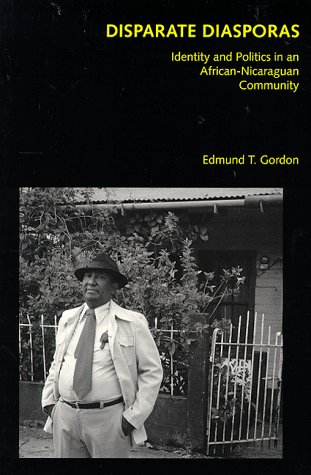
  • Disparate Diasporas: Identity and Politics in an African-Nicaraguan Community

    University of Texas Press
    August 1998
    320 pages
    ISBN-10: 0292728190; ISBN-13: 978-0292728196

    Edmund Gordon, Associate Professor of Anthropology
    University of Texas, Austin

    This book is out of print.

    Based on a decade the author spent among the African-Caribbean “Creole” people on Nicaragua’s southern Caribbean coast, Disparate Diasporas is a study of identity formation and politics in that community. Edmund Gordon lived in Bluefields, Nicaragua, during most of the 1980s, a turbulent period during which he participated in the community’s search for solutions to problems ranging from a crumbling economic base to the mutual mistrust and animosity between most Creole people and the Sandinista revolutionary government.

    Disparate Diasporas is not a conventional ethnography. Rather than being just an observer, Gordon actively participated in the life of the community, intent on contributing to its political processes. A basic premise of his book is that engagement and activity can enhance ethnographic insights and sharpen theoretical understanding.

    Disparate Diasporas shows how a particular “Black” community can evolve distinct types of diasporic consciousness, and, depending on the historical moment, how different types of memories, consciousness, and politics come to predominate. The author uses the Gramscian notion of “common sense” to understand the Creole community’s history of shifting politics and ideologies, focusing on the period of the 1970s and 1980s. His work explains the inability of the Sandinistas to come to terms with the racial and cultural challenge to the Nicaraguan nation posed by the Creole community.

  • IU Libraries Film Archive a treasure chest of educational, rare films

    inside IU Bloomington
    Weekly news for faculty and staff from the Indiana University Bloomington campus
    2013-03-07

    Lynn Schoch, Office of the Vice President for International Affairs

    Many of a certain age—particularly those who were in elementary school in the ’50s and ’60s—will remember 16 mm films produced by the U.S. government, Encyclopedia Britannica, Inc., McGraw-Hill or National Educational Television.

    They often provided the only glimpses of other worlds that U.S. school children had the opportunity to see.

    By the 1970s, videotape and documentaries with large budgets and prime-time aspirations, like Kenneth Clark’s “Civilisation,” began to replace the older formats.

    From about 1940, IU’s Audio-Visual Center (then part of the Extension Division and later, Instructional Support Services) was the depository for U.S. government films. In time, it became the state’s most active lender of educational films to schools, museums, clubs, community centers, and churches in the state.

    As the move to videotape made 16 mm films “obsolete,” the center became a repository for what other institutions and organizations no longer wanted.

    In 2006 what was then a collection of 34,000 reels formed the core of the IU Libraries Film Archive. IU Libraries has supported the transition from lending library to historical archive with a dedicated film achivist in the Herman B. Wells Library, support for resources to digitize the collections and an off-site storage environment designed to minimize deterioration.

    “We have the largest educational film collection in any university library,” said Rachael Stoeltje, film archivist with the IU Libraries Film Archive.

    There are films available nowhere else in the world, and rarities such as 30 titles from the 1950s CBS series “You Are There” and the world’s most complete collection of Encyclopedia Britannica films…

    Darlene Sadlier, director of the Portuguese Program and a professor in the Department of Spanish and Portuguese, a program within the College of Arts and Sciences, has been using educational films from the collection for many years in her classes in Latin American cinema and culture.

    “One film that is helpful in a discussion of the history of race relations in Brazil, for instance, is ‘Brazil: The Vanishing Negro,’” she said. The film is a 30-minute film produced for public television in the 1960s, showing Afro-Brazilian religious ceremonies and the daily lives of Brazil’s black population.

    “It was an informative resource when it was first produced, but it was also polemical because it discussed the benefits of racial mixing, or rather whitening, of the Brazilian African population, to the detriment of its heritage,” Sadlier said. “In recent years, Brazil has recognized its African heritage with affirmative action laws and a holiday dedicated to national race consciousness. With this film, we can look back and consider how far the country has moved to acknowledge its long-held myth of ‘racial democracy.’”

    Sadlier has published extensively on the histories, languages and cultures of Brazil. Her latest book deals with the Good Neighbor policy adopted by the U.S. government during World War II to cultivate stronger alliances with countries in the Western Hemisphere…

    Read the entire article here.
  • Passing and the Problematic of Multiracial Pride (or, Why One Mixed Girl Still Answers to Black)

    by Danzy Senna

    Chapter in: Black Cultural Traffic: Crossroads in Global Performance and Popular Culture
    University of Michigan Press
    2005
    416 pages
    Cloth ISBN: 978-0-472-09840-8
    Paper ISBN: 978-0-472-06840-1
    Ebook ISBN: 978-0-472-02545-9

    Edited By:

    Harry J. Elam, Jr., Olive H. Palmer Professor in Humanities and Professor of Drama
    Stanford University

    Kennell Jackson (1941-2005), Associate Professor of History
    Stanford University

    I have never had the comfort zone of a given racial identity. My mother is a Bostonian white woman of WASP heritage. My father is a Louisiana black man of mixed African and Mexican heritage. Unlike people who are automatically classified as black or white, I have always been up for debate. I am forever having to explain to people why it is that I look so white for a black girl, why it is that my features don’t reveal my heritage. It’s not something I should have to explain, but in America, at least, people are obsessed with this dissonance between my face and my race. White Americans in particular have a difficult time understanding why somebody of my background would choose blackness. With Tiger Woods proclaiming himself a Cablinasian, multiracial activists demanding new categories, and Newsweek declaring it hip to be mixed, it strikes most people as odd that I would call myself a black girl.

    But my racial identity developed when I was growing up in Boston in the 1970s, where there were only two choices for me: black and white. For my sister, a year older than me, with curly hair and more African features, there weren’t even these choices. There was only black. And my parents, smitten with the black power politics of the time, taught my siblings and me, in no uncertain terms, that we were all black. They saw this identity as armor against the racism beyond our front door. They also knew that my sister didn’t have a choice, and to define us differently would be damaging to us as a family unit. The tact that the world saw each of us as different (my sister as light-skinned black, my brother as Puerto Rican, and me as Italian) raised complications, but didn’t change the fact that we were all one tribe…

    Read the entire chapter here. (pages 83-87)

  • “Interracial” Sex and Racial Democracy in Brazil: Twin Concepts?

    American Anthropologist
    Volume 101, Issue 3 (September 1999)
    pages 563–578
    DOI: 10.1525/aa.1999.101.3.563

    Donna Goldstein, Associate Professor of Anthropology
    University of Colorado, Boulder

    Racial democracy is maintained in Brazil through both scholarly and popular discourses that consider “interracial” sex as proof of Brazil’s lack of a racial problem. In this article, I scrutinize the discourse that asks, “How can we be racist when so many of us are mixed?” I argue that racial discourses are embedded in everyday interactions, but are often codified or masked. “Race” is especially pertinent to sexuality, yet the two have hardly been analyzed together. In fact, it is not the belief in a racial democracy that is at the heart of Brazilian racial hegemony, but rather the belief that Brazil is a color-blind erotic democracy. Using my ethnographic data, I illustrate that “race” is embodied in everyday valuations of sexual attractiveness that are gendered, racialized, and class-oriented in ways that commodity black female bodies and white male economic, racial, and class privilege.

    Read the entire article here.

  • Mixed Race Across the Pacific

    University of Southern California
    Freshman Seminars
    Spring 2013

    Duncan Williams, Associate Professor of Religion

    In an era when a mixed-race President of the United States proudly proclaims himself as the first Pacific President of America, how might we rethink the study of race in a global, rather than merely a regional, perspective? With the recent changes to the U.S. Census that allows for multiple racial identifications, how might race and race relations be recast when multiplicity, hybridity, and creolization marks everyone from Obama’s half-American/half-Indonesian half-sister to the so-called black golfer Tiger Woods, who is actually primarily Asian?

    This course investigates how shifting the paradigm of race studies to the Asia Pacific Americas (Transpacific) experience of race disrupts and reorients the traditionally binary, black/white or white/colored Transatlantic model of race studies in the United States that emerged from a focus on the Transatlantic slave trade. By examining the legacies of Western and Japanese empires in Korea, Taiwan, Southeast Asia, and the Pacific Islands and the legacies of disaporic communities in North and South Americas we will reframe the lens through which we approach race studies. Our second focus is to look at miscegenation, creolization, and how mixed race disrupts simplistic racial category formations. We will study comparative anti-miscegenation laws across transnational boundaries and the role of the offspring of mixed race unions that emerged through migrations, trade flows, and the impact of wars.

    Duncan Williams is the chair of the School of Religion and director of the USC Center for Japanese Religions and Culture and the founder of the Hapa Japan Project (a database of mixed-race Japanese people from 1500s to the present) and the Mugen Project (the world’s first online bibliographical database on Buddhism).

  • James Douglas: Father of British Columbia

    Dundurn Press
    October 2009
    240 pages
    5.5 in x 8.5 in
    Paperback ISBN: 978-1-55488-409-4
    eBook ISBN: 978-1-77070-564-7

    Julia H. Ferguson

    James Douglas’s story is one of high adventure in pre-Confederation Canada. It weaves through the heart of Canadian and Pacific Northwest history when British Columbia was a wild land, Vancouver didn’t exist, and Victoria was a muddy village. Part black and illegitimate, Douglas was born in British Guiana (now Guyana) in 1803 to a Scottish plantation owner and a mixed-race woman. After schooling in Scotland, the fifteen-year-old Douglas sailed to Canada in 1819 to join the fur trade. With roads non-existent, he travelled thousands of miles each year, using the rivers and lakes as his highways. He paddled canoes, drove dogsleds, and snowshoed to his destinations. Douglas became a hard-nosed fur trader, married a part-Cree wife, and nearly provoked a war between Britain and the United States over the San Juan Islands on the West Coast. When he was in his prime, he established Victoria and secured the western region of British North America from the Russian Empire and the expansionist Americans. Eventually, Douglas became the controversial governor of the Colonies of Vancouver Island and British Columbia and oversaw the frenzied Fraser and Cariboo gold rushes.

  • Love in black and white

    Princeton Alumni Weekly
    2009-04-22

    Lawrence Otis Graham ’83

    Martha Sandweiss examines racial passing in America

    Clarence King, a celebrated explorer, geologist, and surveyor in 19th-century America, chose to set that identity aside — and live as a working-class black man during a time of harsh racial segregation in the United States. He did it for love.

    King moved back and forth between two sides of the color line: as the very public white, Newport-born, Yale-educated cartographer and researcher of the American West, and at other times as the strangely private man pretending to be a black Pullman train porter and itinerant steelworker (using the alias “James Todd”) who married an African-American woman. Martha Sandweiss, who joined Princeton’s history department this semester, explores King’s double life in her book Passing Strange: A Gilded Age Tale of Love and Deception Across the Color Line, published by Penguin Press in February. 

    “While racial passing was surely attempted by some light-skinned blacks who wanted to escape the economic disadvantages tied to black life at the time,” explains Sandweiss, “it was virtually unheard-of for whites to voluntarily choose to face social and economic discrimination and live as black people.” But after falling in love with a black nursemaid, Ada Copeland, in 1888, that is what Clarence King did for 13 years. His wife and their five children had no idea that he was, in fact, white, and that he was the famous Clarence King, until he confessed it on his deathbed in 1901…

    Read the entire article here.

  • Woman finds out famous relative was black

    The Toronto Star
    2011-02-23

    Megan Ogilvie, Health Reporter

    Growing up in Georgetown, Catherine Slaney knew her great-grandfather had an important and interesting past.

    She knew he was a respected doctor and a surgeon in the American Civil War. She knew he was a friend of Abraham Lincoln and had received a gift — the shawl Lincoln wore to his first inauguration — from his widow after the president was killed. She knew he was a coroner in Kent County, Ont., and that he was involved in politics.

    But Slaney did not know Dr. Anderson Ruffin Abbott was black…

    …The uncle — Slaney’s mother’s brother — knew Abbott was black. His youngest sister, however, had no idea previous generations of her family had passed as white. Or that some family members still kept the secret.

    “The family my mother and father knew was white-haired and pale-skinned,” Slaney says. “The question of race just never came up.”

    Slaney says finding out Abbott was black cast a new importance on the pieces of history she did know about him. Abbott wasn’t just a doctor — he was the first black Canadian to be a licensed physician. He wasn’t just a coroner — he was the first the first black Canadian to hold the office…

    ..Slaney turned her research and personal experience into a book, Family Secrets: Crossing the Colour Line, which was published in 2000. She also completed a PhD at the University of Toronto, focusing on racial identity and the practice of passing.

    By exploring her past, and finding her black heritage, Slaney says her outlook on the world has expanded…

    Read the entire article here.

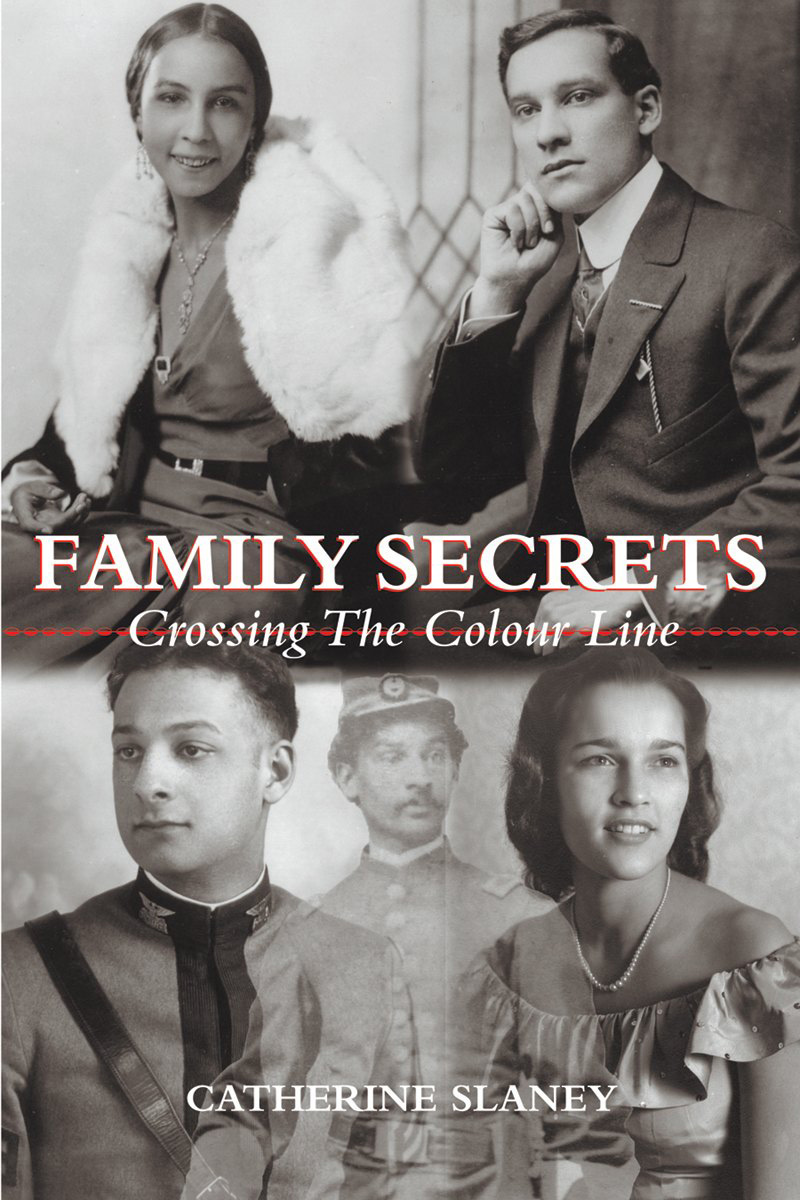
  • Family Secrets: Crossing the Colour Line

    Dundurn Publishing
    February 2003
    264 pages
    6 x 9 in
    Paperback ISBN: 978-1-89621-982-0
    eBook (PDF) ISBN: 978-1-55488-161-1
    eBook (EPUB) ISBN: 978-1-45971-478-6

    Catherine Slaney

    Foreword by:

    Daniel G. Hill, III (1923-2003)

    Catherine Slaney grew into womanhood unaware of her celebrated Black ancestors. An unanticipated meeting was to change her life. Her great-grandfather was Dr. Anderson Abbott, the first Canadian-born Black to graduate from medical school in Toronto in 1861. In Family Secrets Catherine Slaney narrates her journey along the trail of her family tree, back through the era of slavery and the plight of fugitive slaves, the Civil War, the Elgin settlement near Chatham, Ontario, and the Chicago years. Why did some of her family identify with the Black Community while others did not? What role did “passing” play? Personal anecdotes and excerpts from archival Abbott family papers enliven the historical context of this compelling account of a family dealing with an unknown past. A welcome addition to African-Canadian history, this moving and uplifting story demonstrates that understanding one’s identity requires first the embracing of the past.

    Why did some of her family identify with the Black Community while others did not? What role did “passing” play? Personal anecdotes and excerpts from archival Abbott family papers enliven the historical context of this compelling account of a family dealing with an unknown past. A welcome addition to African-Canadian history, this moving and uplifting story demonstrates that understanding one’s identity requires first the embracing of the past.