• The Multiracial Category Movement originated in the 1980s when parents of biracial children began to challenge identification criteria on school data forms. By the 1990s, multiracial category advocates had shifted most of their energy to a campaign to secure the addition of a multiracial category on decennial census forms for the year 2000. Their efforts were ultimately unsuccessful. The debate concerning racial categories, however, extends well beyond census classifications.

    Although it is difficult to reduce such a controversial and complex topic to a few words, multiracial category proponents appear to believe that the category will: (1) challenge the use of racial categorization by forcing society to acknowledge that race is too fluid to monitor in an increasingly diverse society; (2) promote racial harmony by identifying a group that is capable of bridging the gap between Blacks and Whites; and (3) allow mixed-race persons to self-identify and to acknowledge all aspects of their racial heritages. Although one can understand the appeal of and the potential merit to these claims, proponents fail to engage sufficiently the complex history and present reality of colorism.

    The first argument—that a multiracial category will eliminate racial classification altogether and move society beyond racial divisions—is debatable. The adoption of a multiracial category is equally likely to contribute to the proliferation of racial categories rather than to their elimination. Even assuming, arguendo, that a multiracial category will cause society to recognize that race is too fluid to monitor, this claim assumes that along with racial classifications, discrimination will also disappear. But, one event need not follow the other. The fact that racial labels may no longer be handy does not mean that discrimination will disappear. Rather, the virus of discrimination may simply mutate or find another host. Because skin color has been used historically as a basis for subordination in this country, skin color may provide an alternative site. That is, in the future, skin color differences may increasingly perform the role played by racial categories today. In this new social context, multiracial individuals and other persons of color will still be subject to discrimination on the basis of skin color to the extent that their skin is too dark or too light.

    The second argument—that a multiracial category will produce an identifiable class of people who will facilitate interracial communications between Blacks and Whites—sounds like a modern-day appeal for a buffer class (a class distinguishable by its lighter skin tone). In the United States, however, buffer classes have not historically acted as catalysts for interracial harmony. Rather, they have served to increase the status of those in the middle (the buffer class) without fundamentally challenging the status quo for those on the top and bottom.1 In Brazil and Latin American countries where buffer classes have existed historically, the same dynamic has occurred. Thus, while tending to improve the lot of some, buffer categories fail to challenge existing racial and color hierarchies. In future discussions, proponents of a multiracial category must come forth with evidence that history will not repeat itself in the current context. In short, they must explain how a multiracial category will avoid simply reinforcing the existing racial and color hierarchy.

    The third argument—that a multiracial category will allow mixed-race persons to self-identify and to acknowledge the totality of their racial heritages—is intuitively appealing. It seems that a goal of multiracial category proponents is to challenge the continued application of the one-drop rule (e.g., the notion that a person is Black if she has a trace of blackness in her physical appearance or in her ancestry). Again, this goal seems fair, neutral, and perhaps even laudable. However, as I explain below, an unintended consequence or negative externality of this objective must be considered: mixed-racial heritage and skin color may operate to elevate the status of lighter-skinned multiracial individuals, while doing nothing to alleviate the subordination of those who are darker or to change the idea that Black is undesirable.

    Trina Jones, “Shades of Brown: The Law of Skin Color,” Duke Law Journal, Volume 49, Number 6 (April 2000): 1521-1525.

  • Notorious in the Neighborhood: Sex and Families across the Color Line in Virginia, 1787-1861

    University of North Carolina Press
    March 2003
    360 pages
    6.125 x 9.25, 1 genealogical chart, 4 maps, notes, bibl., index
    Paper ISBN  978-0-8078-5440-2

    Joshua D. Rothman, Associate Professor of History
    University of Alabama, Tuscaloosa

    Winner of the 2004 Outstanding Book Award, Organization for the Study of Communication, Language, and Gender.

    Laws and cultural norms militated against interracial sex in Virginia before the Civil War, and yet it was ubiquitous in cities, towns, and plantation communities throughout the state. In Notorious in the Neighborhood, Joshua Rothman examines the full spectrum of interracial sexual relationships under slavery—from Thomas Jefferson, Sally Hemings, and the intertwined interracial families of Monticello and Charlottesville to commercial sex in Richmond, the routinized sexual exploitation of enslaved women, and adultery across the color line. He explores the complex considerations of legal and judicial authorities who handled cases involving illicit sex and describes how the customary toleration of sex across the color line both supported and undermined racism and slavery in the early national and antebellum South.

    White Virginians allowed for an astonishing degree of flexibility and fluidity within a seemingly rigid system of race and interracial relations, Rothman argues, and the relationship between law and custom regarding racial intermixture was always shifting. As a consequence, even as whites never questioned their own racial supremacy, the meaning and significance of racial boundaries, racial hierarchy, and ultimately of race itself always stood on unstable ground—a reality that whites understood and about which they demonstrated increasing anxiety as the nation’s sectional crisis intensified.

  • ‘We have a race problem in England’

    The Voice
    London, England
    2013-03-06

    Hazelann Williams

    Arinze Kene says he does not do politics. But for anyone who has seen one of Kene’s plays, it may sound like an unusual statement because the prolific playwright has written many plays about the state of society, ranging from life on a housing estate to African perceptions on Christianity. Yet, Kene says his plays are not political, they are humanistic.

    “I’m not a political person, my plays always cover issues that people may say are political, but I’m tackling issues from the human perspective, from where it affects people personally. I can’t shun politics because I live on planet Earth but when I can I try to avoid it, because I don’t understand it. It gets me worked up and gets me stressed out and stress is the enemy,” confessed the 25-year-old.

    In his latest play, God’s Property, Kene takes the audience back in time to the restless streets of Deptford, south London in the early 1980s, as estranged mixed race brothers Chima (Kinsley Ben-Adir) and Onochie (Ash Hunter) are unexpectedly reunited.

    Not only covering the spiraling youth unemployment, inner city riots and economic downturn of the Eighties, the writer also is exploring the very divisive issue of race and where mixed race people stand in society. And although the Little Baby Jesus author tried to stay away from the political aspect of race he had to admit that, like 30 years ago, the UK still has a racial problem…

    …“I know that some mixed raced people feel black, some feel mixed race and I thought I would explore that. It is still relevant, I don’t think discussing race is overdone, if you looked at the amount of time Great Expectations has been done and re-done, I don’t get bored of a good story and I don’t think this issue has been explored anywhere near enough as most. I think I am tapping into something that has not been explored enough,” said Kene…

    Read the entire article here.

  • Canada Is Still Racist: And No Think Piece Can Change That

    Vice Canada: The Definitive Guide to Enlightening Information
    2013-03-05

    Anupa Mistry

    When I was younger and more naïve and shielded by my parents, Canadian multiculturalism felt real and true. I grew up in Brampton, Ont., a restlessly expanding suburb of Toronto that teems with immigrants. In 1992, the city – or, at least, my grade two classroom – was a case study in the celebratory, preservation-minded policy of Trudeau’s multiculturalism: My pale blonde friend Zeyn was from Turkey and Afia and all her cousins were Pakistani. Ebony and Roxanne had parents from Jamaica, Seth The Pervert was a Newfie, and Natasha, whose surprise birthday party I ruined because I cannot keep those kinds of secrets, constantly had relatives visiting from Guyana.

    There was never a need to question where I fit in, and that same school year when some sniveling, store brand whiteboy called me a ‘Paki’ I went home and told my parents and cried because I knew from TV that that was what I was supposed to do. In reality, while I still remember exactly how the light filled the air in that bustling elementary school hallway, I was left largely unfazed by first contact with overt racism. Even my eight-year-old mind could grasp that dude was either scared, stupid or, at the very least, outnumbered. In that multiethnic microcosm his bad attitude was undesirable, and I was the normal one. He had nothing to take. There might not be a better place to grow up brown or black than Brampton.

    Then, I enrolled in a performing arts high school north of the city only to transfer after two years because it was too white. Race as it actually functions, as a tool of human insidiousness and despotism, became real beyond my imagined utopia. As a millennial citizen of the Western world I move with an according sense of privilege: whatever you got, I’ma have that too. It’s my birthright, regardless of the colour of my skin or where my grandparents are from. Until it’s not. In hindsight my problem with that school was an inability to articulate feeling exposed and significantly different and, for the first time in my life, outnumbered. I’d taken diversity for granted; my normal was not so much…

    …Two recent high profile pieces by Canadian writers are willfully naïve about the psychic reality of this country’s demographics…

    …Fear is kind of the subtext for “Mixie Me,” a personal essay about being mixed race by Nick Hune-Brown in Toronto Life, with the attendant claim that the city is set to be the world’s first post-racial metropolis. Mixed race people are a more common sight on the streets of Toronto now, more than ever, and there’s comfort to be taken in that kind of visibility, he writes. Anxieties about interracial unions have given way to curiosity. Sexy, ethnically ambiguous mixies are what makes Toronto desirable next to taco restaurants and condos and a trap music party every night of the week. The beige and the beautiful will blur the lines that constitute xenophobia, or at least confuse us into submission.

    Glib eugenics aside, there is a lot of merit to visibility. It’s why I was able to easily dismiss that second grade bully. But I’m skeptical that birthing a Yoruba-Guinea-Indian child, though a political act, will dissolve the structures that preserve xenophobia unless, maybe, that hot multiracial baby grows up to marry a Weston

    Read the entire article here.

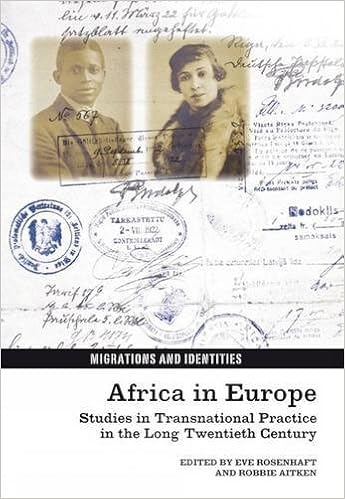
  • Africa in Europe: Studies in Transnational Practice in the Long Twentieth Century

    Liverpool University Press
    January 2013
    304 pages
    Illustrations: 8 colour plates, 12 black and white illustrations
    234 x 156 mm
    Hardback ISBN: 9781846318474

    Edited by:

    Eve Rosenhaft, Professor of German Historical Studies
    University of Liverpool, United Kingdom

    Robbie Aitken, Senior Lecturer in History
    Sheffield Hallam University, United Kingdom

    This volume explores the lives and activities of people of African descent in Europe between the 1880s and the beginning of the twenty-first century. It goes beyond the still-dominant Anglo-American or transatlantic focus of diaspora studies to examine the experiences of black and white Africans, Afro-Caribbeans and African Americans who settled or travelled in Germany, France, Portugal, Italy and the Soviet Union, as well as in Britain. At the same time, while studies of Africans in Europe have tended to focus on the relationship between colonial (or former colonial) subjects and their respective metropolitan nation states, the essays in this volume widen the lens to consider the skills, practices and negotiations called for by other kinds of border-crossing: The subjects of these essays include people moving between European states and state jurisdictions or from the former colony of one state to another place in Europe, African-born colonial settlers returning to the metropolis, migrants conversing across ethnic and cultural boundaries among ‘Africans’, and visitors for whom the face-to-face encounter with European society involves working across the ‘colour line’ and testing the limits of solidarity. Case studies of family life, community-building and politics and cultural production, drawing on original research, illuminate the transformative impact of those journeys and encounters and the forms of ‘transnational practice’ that they have generated. The contributors include specialist scholars in social history, art history, anthropology, cultural studies and literature, as well as a novelist and a filmmaker who reflect on their own experiences of these complex histories and the challenges of narrating them.

    Contents

    • Acknowledgements
    • List of Illustrations
    • List of Abbreviations
    • List of Contributors
    • 1. Introduction / Eve Rosenhaft and Robbie Aitken
    • I. Enacting Identity: Individuals, Families and Communities
      • 2. Prince Dido of Didotown and ‘Human Zoos’ in Wilhelmine Germany: Strategies for Self-Representation under the Othering Gaze / Albert Gouaffo
      • 3. Schwarze Schmach and métissages contemporains: The Politics and Poetics of Mixed Marriage in a Refugee Family / Eve Rosenhaft
      • 4. ‘Among them Complicit’? Life and Politics in France’s Black Communities, 1919–1939 / Jennifer Anne Boittin
      • 5. ‘In this Metropolis of the World We Must Have a Building Worthy of Our Great People’: Race, Empire and Hospitality in Imperial London, 1931–1948 / Daniel Whittall
    • II. Authenticity and Influence: Contexts for Black Cultural Production
      • 6. Féral Benga’s Body / James Smalls
      • 7. ‘Like Another Planet to the Darker Americans’: Black Cultural Work in 1930s Moscow / S. Ani Mukherji
      • 8. ‘Coulibaly’ Cosmopolitanism in Moscow: Mamadou Somé Coulibaly and the Surikov Academy Paintings, 1960s–1970s / Paul R. Davis
      • 9. Afro-Italian Literature: From Productive Collaborations to Individual Affirmations / Christopher Hogarth
    • III. Post-colonial Belonging
      • 10. Of Homecomings and Homesickness: The Question of White Angolans in Post-Colonial Portugal / Cecilie Øien
      • 11. Blackness over Europe: Meditations on Culture and Belonging / Donald Martin Carter
    • IV. Narratives/Histories
      • 12. Middle Passage Blackness and its Diasporic Discontents: The Case for a Post-War Epistemology / Michelle M. Wright
      • 13. Black and German: Filming Black History and Experience / John Sealey
      • 14. Excavating Diaspora: An Interview Discussing Elleke Boehmer’s Novel Nile Baby / John Masterson with Elleke Boehmer
      • 15. Afterword / Susan Dabney Pennybacker
    • Bibliography
    • Index
  • 2013-03-06

    My name is Nina Robinson, a third year photography student at Glamorgan University. To form part of the research for my dissertation about mixed-race identity, I am looking for British mixed-race girls aged 16-25 to fill in my questionnaire. It’s a good way to express your opinions and feelings, be part of a project and help out a student!

    Please email me at njrobinson@hotmail.co.uk if you are interested.

  • Laylah Ali: The Greenheads Series

    Weisman Art Museum
    University of Minnesota
    333 East River Road
    Minneapolis, Minnesota 55455
    (612) 625-9494
    2013-02-16 through 2013-05-12

    Laylah Ali, Associate Professor of Art
    Williams College, Williamstown, Massachusetts

    Join us for a talk with Laylah Ali on March 7, 2013.

    WAM is pleased to present Laylah Ali: The Greenheads Series. This is the first time the Greenheads series, created between 1996 and 2005, is being shown as a comprehensive body of work. Forty-three of the exquisitely rendered gouache paintings—from a total of more than eighty—have been gathered from collections here and abroad to chronicle the series’ development.

    The figures inhabiting Ali’s works—the Greenheads—are enigmatic, round-headed beings of indeterminate sex and race who inhabit a regimented, dystopian world where odd and menacing, though sometimes strangely humorous, encounters prevail.

    This exhibition will allow viewers to examine the evolution of Ali’s series. While the early paintings frequently focus on physically aggressive exchanges between groups of figures, these interactions are later replaced by individuals—alone or in small groups—who witness the prelude to, or aftermath of, a charged encounter. As the series continues, more and more of the figures’ anatomy is pruned away, as if the artist is examining how much can be taken out—such as arms, feet, skin color—while still communicating thought, emotion, and social status.

    This exhibition was organized by the Williams College Museum of Art, Williamstown, Massachusetts. It is co-sponsored by the University of Minnesota Department of Art…

    For more information, click here.

  • 60 Ways of Looking at a Black Woman

    The New York Times
    2005-01-23

    Edward Lewine

    Ellen Gallagher dabbed a swirl of gray watercolor onto the delicate pencil drawing she had just sketched of a furry hamster. Late December sunlight radiated through the windows at Two Palms Press, the SoHo printmaking studio where she has spent the last 18 months preparing a work comprising 60 collage prints. Titled “DeLuxe,” it is the subject of its own show at the Whitney Museum, opening this week.

    Weeks remained until “DeLuxe” had to be delivered, and the mood in the lower Broadway loft was intense. One artist glued toy eyeballs onto a collage; another placed wig shapes made of plasticine clay onto a different collage; while a master printer was in a darkroom reproducing pages from black magazines like Ebony, Sepia and Our World that dated from the 1930’s through the 1970’s.

    Reserved in manner, with a sonorous voice and a girlish laugh, Ms. Gallagher seemed relaxed despite her looming deadline and pleased to see the first copy of “DeLuxe” nearing completion. (The set of 60 collages will be printed 20 times in a numbered edition.)

    “I love this moment,” she said. “It is sort of delicious. You have come through the agonizing part, when you are trying to articulate what you want to say but can’t. You have made your ideas visible.”

    Until recently, Ms. Gallagher, 39, had charted a quiet if successful course as an artist, mostly as a painter whose work plays with ideas about race. In the past year, however, her career has gained momentum. Major institutions including the Museum of Modern Art have bought paintings; and the technical virtuosity of “DeLuxe,” the subject of her first solo show in a New York museum, is generating buzz…

    …Many curators praise Ms. Gallagher for her ability to discuss race without being pompous and for the way she balances ideas with technique. “She’s masterful at creating tension between form and content,” said Elizabeth Smith, the chief curator of the Museum of Contemporary Art Chicago, which bought a Gallagher painting last year.

    Not all agree. Ms. Gallagher has been faulted for what some critics see as a certain facile quality. Writing in The New York Times about Ms. Gallagher’s winter 2004 show at the Gagosian Gallery, Ken Johnson called her paintings and collages “visually catchy” but “too obvious.”

    Ms. Gallagher said she draws such criticism because her material makes people uncomfortable. “Somehow in America black artists aren’t allowed to use banal images of blackness,” she said. “On the other hand, the idea of something black and inscrutable is also very disturbing.”

    …Ms. Gallagher was raised in Providence, R.I. Her mother was white, her father black. Her father, a professional boxer, was rarely around, she said, and died in 1998.

    Growing up, Ms. Gallagher said, she learned to navigate the worlds of her mother’s blue-collar, Irish family, her father’s family of recent immigrants from the Cape Verde Islands and the homes of her friends, many of them African Americans…

    Read the entire article here.

  • “Double Natural”

    Yale University
    Department of African American Studies
    81 Wall St., Gordon Parks Room 201
    2013-01-24, 11:45-13:15 EST (Local Time)

    Ellen Gallagher, Hayden Visiting Artist
    Yale University Art Gallery

    Ellen Gallagher breaks the boundaries of traditional art by using materials and found images in unexpected ways. Her work often looks at how African Americans have been represented and stereotyped. She also explores her own identity and experience as an American woman of African and Irish descent. In DeLuxe (2004-2005), Gallagher experimented with printmaking by using materials including Plasticine and glitter to transform old advertisements for beauty products targeted at African Americans into a work of art.

    Co-sponsored by the Yale University Art Gallery and the Dept. of African American Studies.

  • MFA Thesis Choreographies

    Davis Life Magazine
    Davis, California
    2013-02-28

    UC Davis Department of Theatre and Dance is proud to present MFA Thesis Choreographies: “Ligilo” by Jarrell Iu-Hui Chua, in collaboration with Bobby August Jr., travels through the worlds of memories, dreams and present realities to investigate touch and its effects on relationships; “Transmutation” by Christine Germain, in collaboration with Andrea del Moral and Deirdre Morris, examines questions of personal identity and shifts in identity. MFA Thesis Choreographies opens at Mondavi Center’s Vanderhoef Studio Theatre on Thursday, Feb. 21 and runs through Sunday, March 3.

    The title of Jarrell Iu-Hui Chua’s work “Ligilo” means “link” in Esperanto, a language that represents the choreographer’s ethnic sensitivities. She and collaborator Bobby August Jr. are both “hapa,” a term that Chua lovingly uses to describe their half-Asian heritage. Their hapa experiences of prejudice growing up in America are a core element in the choreography as is personal trauma from which Chua is recovering.

    Emanating from these painful themes, “Ligilo” portrays anger and violence as two performers, Chua and August Jr., physically connect and disconnect. Most emphatically, the piece explores the positive dimensions of human touch in erotic love, humor, tenderness and other aspects of humanity and healing. The spiritual touch of bathing a loved one conveys hope and tranquility. This is both the heart of “Ligilo” and the basis of its foreign title as Esperanto (literally meaning “one who hopes”) was intended to foster peace among peoples of differing cultures…

    Read the entire article here.